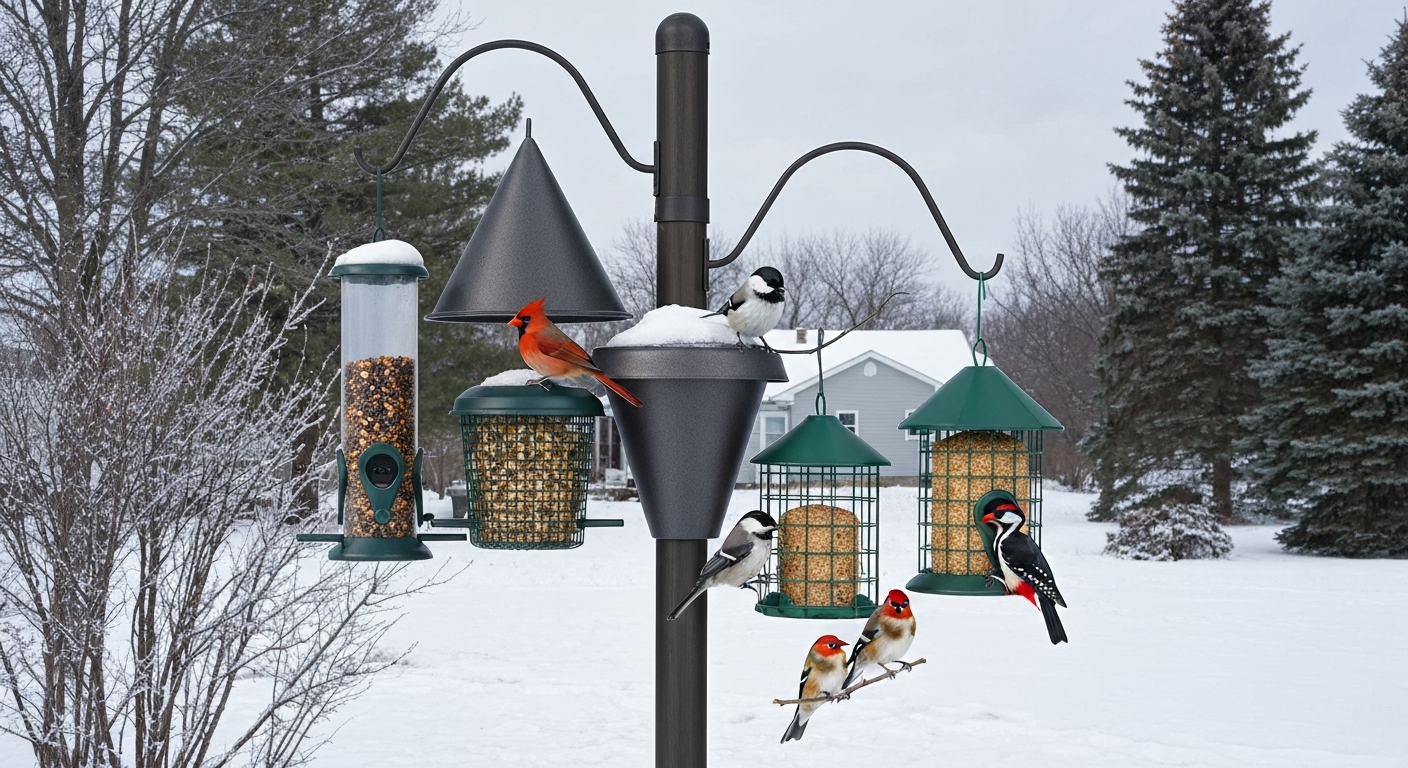
The best bird feeders for Michigan backyards are ones built to handle genuine winters. That means freeze-thaw-resistant materials, roofs or vents that shed ice and wet snow, and anti-pest designs that hold up against the squirrels and grackles that come with Midwestern territory. For most Michigan yards, the winning combination is a tube feeder loaded with black-oil sunflower, a hopper feeder for cardinals and jays, a suet cage for woodpeckers and nuthatches, and a nyjer sock or mesh tube for goldfinches, all pole-mounted with a baffle, kept at least 7 to 10 feet from any squirrel launch point.
Best Bird Feeders for Michigan: Top Picks & Buying Guide

Marcus Holloway
26 Jul 2026
Why Michigan demands more from a bird feeder
Michigan is not a mild state for backyard gear. Detroit averages a January mean around 25 to 26°F with regular freeze-thaw swings, while Marquette in the Upper Peninsula can see 120 to 150 inches of snowfall a year with temperatures that make cheap plastic crack before February. Ice storms, heavy wet snow loading on roofs and ports, and prolonged cold spells that drain the energy reserves of small birds like Black-capped Chickadees all push you toward better-quality feeders faster than any marketing pitch will. A feeder that works fine in the Carolinas may split at the seams after one Michigan winter.
There are also Michigan-specific rules to know. Because of chronic wasting disease (CWD) concerns and deer baiting regulations, Michigan Audubon and the MDNR advise against ground-level feeding and recommend cleaning up spilled seed daily. Platform and tray feeders placed low to the ground can attract deer, which creates both a regulatory and disease-risk problem. The practical fix is to keep feeders tube-style or hopper-style, mount them at least 5 feet above typical snow depth (more in the U.P.), and use caged designs where possible.
Michigan's bird diversity also rewards putting out multiple feeder types. Cardinals, Blue Jays, and Rose-breasted Grosbeaks want big perches and generous ports. Goldfinches and Common Redpolls need small nyjer ports. Downy, Hairy, and Red-bellied Woodpeckers come reliably to suet. House Finches and American Tree Sparrows work tube feeders happily. Trying to serve all those birds with a single multi-purpose feeder is how you end up with grackles eating everything and the birds you actually want skipping the yard. A short look at common Michigan feeder birds helps clarify the setup before you spend anything. For a quick species reference, see a list of common Michigan bird feeder birds to match feeder types with the species you're trying to attract.
Top picks at a glance
| Feeder Type | Top Pick | Best For (Michigan Species) | Standout Feature |
|---|---|---|---|
| Tube (sunflower) | Brome Squirrel Buster Plus | Chickadees, nuthatches, finches, house finches | Weight-activated port closing; vented base; chew-proof ports |
| Tube (nyjer/thistle) | Droll Yankees Onyx Clever-Clean Finch | American Goldfinch, Pine Siskin, Common Redpoll | Removable base for fast cleaning; UV-stable polycarbonate |
| Hopper/House | Perky-Pet Panorama or similar large-capacity hopper | Cardinals, Blue Jays, Rose-breasted Grosbeaks, Dark-eyed Juncos | Large capacity; covered seed reservoir; wide perch ledge |
| Suet | Stokes Select Double Suet Feeder (caged) | Downy/Hairy/Red-bellied Woodpecker, White-breasted Nuthatch, Chickadee | Holds two cakes; inverted feeding option deters starlings |
| Platform/Tray | Aspects Quick-Clean Tray or pole-mounted covered tray | Cardinals, jays, doves, juncos (wide variety) | Screened floor drains seed; dome cover reduces snow loading |
| Thistle/Finch mesh | Brome Finch Feeder or Nyjer mesh sock | Goldfinches, siskins, redpolls | Clinging mesh; no perch needed; lightweight and portable |
| Hummingbird (nectar) | First Nature 32 oz or Aspects HummZinger HighView | Ruby-throated Hummingbird (May–Sept) | Wide mouth for easy cleaning; ant moat; UV-stable red plastic |
| Oriole | Aspects 367 Oriole Feeder or Birdola Oriole Cake | Baltimore Oriole (May–Sept) | Orange color; dual jelly + nectar + fruit ports |
| Smart/Camera | Bird Buddy or Birdfy Feeder Cam | All common species with AI ID logging | AI species ID; app notifications; solar charging option |
| Woodpecker specialty | Kettle Moraine log feeder or peanut butter suet tube | Pileated, Red-bellied, Hairy/Downy Woodpecker | Natural wood or metal tube; holds suet plugs or peanut butter |
What actually matters when you're comparing feeders
Product descriptions are written to sell feeders, not to prepare you for a Michigan February. Here are the criteria worth weighing seriously, ranked roughly by how much they affect real-world satisfaction.
Material durability and freeze-thaw resistance
Metal components (stainless steel, powder-coated steel, zinc-coated wire) consistently outperform standard plastics in Michigan winters. UV-stabilized polycarbonate is the best plastic option for tubes because it resists both UV degradation and cold-weather cracking. Avoid thin acrylic or standard ABS plastic on any external component. Metal-lined feeding ports are non-negotiable on any feeder you expect to last more than one season around squirrels.
Weather resistance: snow, ice, and moisture
Sloped or domed roofs shed snow before it packs over ports. Built-in vents near the base let moisture escape so seed doesn't clump and mold. Any feeder with a flat or slightly sloped roof that funnels water into the seed reservoir will give you frozen, moldy seed within days of the first wet snowfall. This is one of the most common complaints in user reviews and one of the easiest problems to screen for before you buy.
Seed capacity and refill convenience
Larger capacity sounds better until you realize that a feeder holding 5 pounds of seed in a slow-traffic yard means that seed sits for two weeks in wet cold conditions. Match capacity to your expected bird traffic. For high-traffic tube feeders, 1.5 to 2 pounds of black-oil sunflower is a reasonable starting point. Twist-release or removable base designs (like the Droll Yankees Clever-Clean series) cut fill time significantly compared to feeders that require unscrewing a fixed base.
Anti-squirrel and anti-grackle effectiveness
Weight-activated port closing (Brome Squirrel Buster series) is the most reliable passive mechanism for excluding squirrels without electricity or batteries. The tension is adjustable on some models so you can dial out grackles and starlings as well as squirrels. Outer cages work well for suet and peanut feeders, and they exclude large birds when the mesh is sized correctly. Spinning perch mechanisms (Droll Yankees Yankee Flipper) are entertaining and effective but require batteries and occasional motor maintenance. No mechanism survives bad placement: if a squirrel can launch from a fence or branch within 7 to 10 feet, it will eventually breach most feeders. Testing and large-scale user reviews summarized in 6 Best Squirrel-Proof Bird Feeders (BirdWatchingHQ) show that baffles plus 7–10 ft clearance are essential because no feeder is truly squirrel‑proof if placement allows launches.
Ease of cleaning
Cornell Lab and Audubon both recommend cleaning feeders every one to two weeks in winter, and more frequently during wet periods. That schedule is only realistic if cleaning the feeder takes under five minutes. Feeders that require you to unscrew multiple components, squeeze a brush into a narrow tube, or fight a stuck base will get cleaned less often, which means disease risk goes up. Prioritize removable bases, wide tube openings, and dishwasher-safe trays.
Mounting compatibility
Most quality feeders come with a hanging loop and fit a standard shepherd's hook, but check whether the feeder accepts a pole mount adapter if you're planning a dedicated feeding station. Feeders with top-heavy designs or low-quality hanging hardware can swing and dump seed in Michigan wind, which is both wasteful and an invitation for ground-feeding deer.
How to choose the right feeder for your yard
Before picking any specific model, three questions help narrow the field: How big is your yard? Which birds do you most want to attract? And what's your realistic budget for both the feeder and ongoing seed costs?
Yard size and placement options
A small urban or suburban yard with a single deck post can support two or three feeders on a multi-arm shepherd's hook system: one tube feeder, one suet cage, and one small nyjer feeder covers most Michigan winter species. Larger yards with mature trees can support dedicated pole stations positioned 7 to 10 feet from any tree trunk or fence, which is the critical squirrel-proofing clearance. If deer are a documented issue in your neighborhood, raise everything to at least 5 feet above your deepest typical snowpack and keep the ground below clear of fallen seed.
Target species and feeder type mapping
If your goal is cardinals and grosbeaks, lead with a hopper feeder stocked with black-oil sunflower or safflower, and add a platform tray mounted at shoulder height for the widest variety. For finches (goldfinches are year-round residents in Michigan, redpolls visit in irruption winters), a nyjer mesh tube or finch sock is the most efficient option. Woodpeckers and nuthatches respond reliably to suet, especially during the deep cold of January and February when their energy demands peak. Hummingbirds and Baltimore Orioles are migrants, arriving in May and departing by September, so nectar and oriole feeders are seasonal investments.
Budget guidance
A solid functional Michigan setup, one quality tube feeder, one suet cage, one baffle, and a shepherd's hook pole, runs about $60 to $120 depending on brands. Adding a smart camera feeder pushes that to $150 to $250 or more with subscription costs. Cheap feeders under $15 are rarely worth replacing every one to two years; investing $30 to $50 per feeder in quality polycarbonate or metal construction pays off in longevity. Seed costs matter more long-term: black-oil sunflower is the most cost-effective general attractant, and buying 25 to 40 pound bags cuts per-pound cost significantly versus smaller bags.
Best feeders by type for Michigan: overview
Michigan backyards benefit most from running multiple feeder types simultaneously. Each type attracts a different feeding guild, and the combination is what produces a genuinely active yard rather than a feeder that draws only house sparrows. Here's how the main types perform in Michigan conditions and which species actually use them.
| Feeder Type | Primary Michigan Species | Season | Michigan-Specific Consideration |
|---|---|---|---|
| Tube (sunflower) | Chickadees, nuthatches, finches, titmice | Year-round | Choose vented base and metal ports; UV-stable tube |
| Tube (nyjer) | Goldfinch, Pine Siskin, Common Redpoll | Year-round (redpolls: winter irruptions) | Small ports prevent waste; sock feeders freeze less than hard tubes |
| Hopper/House | Cardinals, Blue Jays, Grosbeaks, Juncos | Year-round | Covered reservoir critical in heavy snow; wide perch ledge preferred |
| Platform/Tray | Cardinals, doves, jays, sparrows, juncos | Year-round (careful in deer zones) | Screened floor required; add dome cover for winter; clean frequently |
| Suet cage | Woodpeckers, nuthatches, chickadees | Year-round (critical in winter) | No-melt suet in summer; caged models deter starlings |
| Thistle/Finch mesh | Goldfinch, siskins, redpolls | Year-round to winter | Lightweight; can freeze to pole in ice storms — check weekly |
| Hummingbird nectar | Ruby-throated Hummingbird | May–September | Bring in by first frost; freeze risk ends season abruptly |
| Oriole | Baltimore Oriole | May–September | Put out by May 1 before males pass through; orange color signals |
| Woodpecker log/plug | All woodpecker species, nuthatches | Year-round | Natural wood holds heat better; use suet plugs not loose suet in winter |
| Smart/Camera | All species | Year-round | Battery drain in cold; ensure strong Wi-Fi at feeder location |
Tube feeders: the Michigan workhorse
Tube feeders are the most versatile option for Michigan yards. They keep seed dry, limit access to one bird per port at a time (which slows grackle raids), and work year-round for the species that most Michigan birders most want to attract: Black-capped Chickadees, White-breasted Nuthatches, House Finches, and American Goldfinches. The key design question is sunflower ports versus nyjer ports, these are not interchangeable, and a feeder with large ports filled with nyjer will just dump seed onto the ground.
What to look for in a Michigan-ready tube feeder
- UV-stabilized polycarbonate or metal tube body (resists cold cracking and gnawing)
- Metal-lined ports (prevent squirrel chewing at openings)
- Vented base or drainage holes (prevent moisture pooling and seed molding)
- Removable base or twist-off bottom for easy cleaning (target: under 5 minutes)
- Sloped or domed top to shed snow before it packs over the fill hole
- Weight-activated port closing mechanism for squirrel and large-bird exclusion (Brome Squirrel Buster Plus is the benchmark)
Pros and cons in Michigan conditions
The advantages of tube feeders in Michigan are real: they hold seed off the ground (important for CWD/deer reasons), they limit simultaneous access to reduce bully-bird dominance, and they work with the widest range of pole and hanging hardware. The disadvantages are mostly maintenance-related. A tube feeder with a fixed base and narrow diameter is genuinely difficult to scrub clean, and in winter you want to be cleaning every one to two weeks. Narrow tubes also let seed clump and freeze at the base in ice storms, blocking the lowest ports. If you've had that problem, a feeder with a wider tube diameter and a dedicated venting channel solves it.
Top tube feeder picks for Michigan
The Brome Squirrel Buster Plus is the most consistently recommended squirrel-proof tube feeder in recent tests. Its weight-activated shroud drops to close ports when a squirrel (or grackle, at adjusted tension) lands, and the entire feeder disassembles by hand for cleaning without tools. The polycarbonate tube is UV-stabilized and the ports are metal-lined. For finches specifically, the Droll Yankees Onyx Clever-Clean Finch Feeder earns its reputation from a single feature: the base twists off completely for cleaning in about 30 seconds. In a Michigan winter with repeated wet-snow events, that matters. For budget-conscious setups, the Aspects 153 Quick-Clean Small Tube Feeder is a durable polycarbonate option with a removable base that significantly undercuts the Brome on price while still handling freeze-thaw reasonably well.
Michigan species using tube feeders
- Black-capped Chickadee (year-round resident; high winter energy demand — needs black-oil sunflower or suet proximity)
- White-breasted Nuthatch (year-round; prefers sunflower and peanut hearts)
- American Goldfinch (year-round resident; nyjer/thistle tube or mesh)
- House Finch (year-round; black-oil sunflower)
- Pine Siskin (irregular winter visitor; nyjer)
- Common Redpoll (irruptive winter visitor; nyjer and small sunflower chips)
- Tufted Titmouse (southern Lower Peninsula; black-oil sunflower)
Hopper and gravity feeders: capacity and cold-weather performance
Hopper feeders are the cardinal feeders. That's not the only thing they do, but if your goal includes Northern Cardinals, and in Michigan that's most people's goal, a hopper feeder with a wide perch ledge and a gravity-fed seed reservoir is the right tool. Blue Jays, Rose-breasted Grosbeaks (spring and fall migrants), Dark-eyed Juncos, and White-throated Sparrows all use hoppers regularly. The tradeoff is that the same wide perch and generous port that cardinals love also works perfectly for Common Grackles, European Starlings, and Brown-headed Cowbirds.
Capacity versus spoilage in Michigan winters
A large hopper feeder can hold 3 to 5 pounds of seed, which sounds convenient but creates a real spoilage risk. In a wet Michigan winter, seed sitting in an inadequately covered reservoir can clump, mold, or freeze into a solid block within a few days of a storm. The best Michigan-ready hopper designs have a fully covered or lidded seed chamber that keeps direct precipitation off the seed, drainage or ventilation at the base of the reservoir, and a roof with significant overhang. Feeders with a clear acrylic panel showing seed level are useful for monitoring without disturbing birds, but check that the acrylic is thick enough not to crack in hard freezes.
Freeze-resistance tips for hopper feeders
- Use dry, fresh black-oil sunflower seed (not mixes with fillers that absorb moisture faster)
- Add safflower seed as a partial substitute — it's slightly harder for moisture to penetrate and grackles avoid it more reliably than sunflower
- Shake or stir the seed reservoir every couple of days during ice-storm periods to break up clumps before they freeze solid
- If the feeder roof accumulates ice, gently clear it so the weight doesn't stress mounting hardware
- In the Upper Peninsula, consider reducing fill volume in the deepest winter months to ensure full turnover every 3 to 4 days
Best hopper feeder picks for Michigan
For a general-purpose Michigan hopper, look for a cedar or metal-roofed design with a covered seed chamber and wide perch ledge. Cedar weathers well in Michigan but needs occasional sealing. Metal roofs and hardware are more durable long-term. The Perky-Pet Panorama and similar gravity-fed models with a central-fill design and full-perimeter tray work well for cardinals because the birds can approach from any direction. For anti-grackle adjustment, look for a hopper with adjustable perch sensitivity or the option to add a weight-sensitive closing mechanism. Some birders pair a standard hopper with safflower seed rather than sunflower as the primary grackle deterrent, since many grackle populations are reliably disinterested in safflower.
Michigan species using hopper feeders
- Northern Cardinal (year-round; primary hopper user — prefers black-oil sunflower, safflower, or peanut hearts)
- Blue Jay (year-round; prefers peanuts and sunflower; benefits from large perch ledge)
- Rose-breasted Grosbeak (spring/fall migrant; black-oil sunflower)
- Dark-eyed Junco (winter resident; millet or sunflower from tray/ground below hopper)
- White-throated and White-crowned Sparrow (fall/winter migrants; seeds dropped below)
- Common Grackle (spring–fall; use safflower or caged design to discourage)
Platform and tray feeders: high variety, higher maintenance
Platform feeders attract the widest variety of Michigan birds, full stop. If you want to see the most species in the least time, a screened-floor tray or platform feeder loaded with a mixed seed or black-oil sunflower will deliver. The problem is that everything you want to attract also attracts everything you don't: grackles, starlings, house sparrows, and in rural or semi-rural Michigan yards, deer and occasionally raccoons. The design and placement choices you make with platform feeders matter more than with any other type.
Open-feeding trade-offs
An uncovered platform feeder in a Michigan winter will have ice-encrusted seed within hours of a freezing rain event. A dome-covered tray dramatically extends the usable window between refills and keeps seed from becoming a frozen mass. Screened or mesh floors are important for drainage and disease control, seed sitting on a solid flat surface stays wet, molds fast, and can harbor pathogens that affect House Finches in particular (Mycoplasmal conjunctivitis is a real concern at high-density feeders). Clean covered trays with a screened floor every 5 to 7 days during active winter feeding.
Anti-waste strategies for Michigan platform feeders
Seed waste from platform feeders falls to the ground, which attracts deer and also just makes a mess. A few practical adjustments help. First, offer only seed the birds at your feeder actually consume: if you see large amounts of millet left over, switch to straight black-oil sunflower on the tray. Second, use a tray with raised edge lips to slow wind scatter. Third, add a seed catcher tray below a hopper or tube feeder if you want to capture dropped seed without putting a ground feeder in play. The Aspects Quick-Clean series and similar trays with push-out screened floors make weekly cleaning genuinely fast.
Winter modifications for snow and ice
- Add a dome or roof cover (12 to 15 inch diameter minimum) to deflect snow and ice from the seed surface
- Brush accumulated snow off the tray after major storms — birds will return within minutes
- Mount the tray on a smooth metal pole with a baffle rather than hanging it, to reduce swing and improve stability in wind
- In the Upper Peninsula or northern Lower Michigan, consider reducing seed quantity per fill to ensure turnover in 2 to 3 days rather than letting it sit through multiple freeze cycles
- Avoid suet or peanut butter directly on open platform trays in warm spells — these go rancid quickly in direct sun and are difficult to clean from porous wood surfaces
Michigan species using platform feeders
Platform feeders are where you'll see the most activity during fall and spring migration windows, when White-throated Sparrows, Fox Sparrows, and Eastern Towhees move through and forage on open surfaces. Year-round users include cardinals, Blue Jays, Dark-eyed Juncos, and Mourning Doves. In grackle-heavy suburban yards, a platform feeder can become almost unusable from April through July without active management, safflower seed and limiting fill to morning quantities that birds consume before peak grackle activity times can help.
Suet, specialty, and seasonal feeders for Michigan
Suet feeders: the woodpecker magnet
If you want Downy, Hairy, and Red-bellied Woodpeckers, the three most common year-round Michigan woodpecker species, suet is your most reliable tool. A basic wire suet cage costs under $10 and works, but a caged outer-cage design (cage within cage) excludes starlings more reliably by forcing birds to cling and reach rather than stand and feed. Inverted suet feeders (where the suet is accessed from below) take this further: clinging species like woodpeckers and nuthatches access them easily, while starlings and grackles that need to stand on top are mostly excluded. For winter, use standard suet cakes; switch to no-melt or dough-style suet once temperatures consistently exceed 70°F to prevent the fat from going soft and rancid.
Nyjer and finch feeders
American Goldfinches are year-round residents in Michigan and are one of the most satisfying birds to attract in bulk. A nyjer (thistle) mesh sock or small-port tube feeder can hold 6 to 12 goldfinches simultaneously and draws reliably from late summer through winter. Common Redpolls, irruptive visitors from the boreal north that show up in Michigan in variable numbers depending on seed crop failures up north, also use nyjer feeders. Pine Siskins appear irregularly. The practical consideration in Michigan is that nyjer seed goes stale faster than sunflower seed, so smaller fills with more frequent refills are preferable to large-capacity finch feeders that sit through a slow week.
Hummingbird feeders
Ruby-throated Hummingbirds arrive in Michigan typically in early to mid-May and depart by mid-September, with some stragglers into early October. The feeder design matters less than the maintenance discipline: nectar spoils in 2 to 3 days in warm weather and should be replaced on that schedule, or faster in direct sun. A wide-mouth feeder that fits a bottle brush is easier to clean thoroughly than a decorative feeder with narrow reservoirs. The First Nature 32 oz and Aspects HummZinger HighView both earn consistent recommendations for clean design and easy maintenance. Use 4:1 water to white sugar ratio, no red dye needed, and no honey or artificial sweeteners.
Oriole feeders
Baltimore Orioles are one of Michigan's showiest migrants and they arrive hungry from their Central American wintering grounds. Put an oriole feeder out by May 1 before the first males pass through. Effective oriole feeders offer grape jelly (the single most reliable attractant), orange halves, and optionally nectar. The Aspects 367 and similar feeders with dedicated jelly cups, fruit spikes, and a nectar reservoir cover all three bases. Oriole visitation drops off as the season progresses and local fruits ripen, so most Michigan birders use oriole feeders actively from May through July.
Woodpecker specialty feeders
Beyond suet, Pileated Woodpeckers (present across much of Michigan, especially in areas with mature forest) are attracted to large suet log feeders or peanut butter suet tubes. A log feeder with 1.5-inch diameter holes drilled for suet plugs mimics natural foraging on dead wood and tends to hold up better than wire cages in very cold conditions. Red-headed Woodpeckers, less common than the other species, will also use suet but are more likely to visit if you have large nut-bearing trees nearby.
Smart and camera feeders: honest assessment for Michigan yards
Smart bird feeders with built-in cameras and AI species identification (Bird Buddy, Birdfy, Netvue Birdfy, and similar models) are genuinely useful tools for logging yard species and sharing sightings, but they come with real limitations that matter more in Michigan than in milder climates. The Smart Bird Feeders, comparative review (AboutBirdFeeders) documents common failure modes, placement defeating anti‑squirrel designs, plastic cracking in freeze–thaw cycles, large‑capacity spoilage risks, and smart‑feeder Wi‑Fi/connectivity and subscription limitations Smart Bird Feeders — comparative review (AboutBirdFeeders).
What smart feeders do well
- Photo and video capture of feeder visits with automatic species ID for common birds
- App-based notifications when specific species visit
- Passive species logging without sitting at a window
- Solar charging options (Birdfy solar model) that reduce battery management in outdoor settings
- Community sharing features for eBird-adjacent records of yard species
Where smart feeders fall short in Michigan
- Battery drain accelerates significantly in sustained cold below 20°F — a common Michigan winter condition
- AI accuracy drops on juvenile birds, uncommon species, and similar-looking species pairs (female House Finch vs. female Purple Finch, for example)
- Reliable operation requires consistent Wi-Fi signal at the feeder location, which can be challenging at distances over 30 to 40 feet from a router
- Full video history and cloud storage often require paid subscriptions ($30 to $60/year depending on platform)
- Motion-trigger systems can miss brief visits and occasionally false-trigger on blowing vegetation or snow
The honest verdict: a smart feeder is a good addition to an already-functional yard setup, not a replacement for quality feeders and thoughtful placement. If you're new to Michigan backyard birding, spend your initial budget on a solid tube feeder, suet cage, and baffle. Add a smart feeder once you know which species you're seeing and want to document them more systematically.
Mounting, placement, and predator-proofing
The single most common reason a squirrel-proof feeder fails is placement. No weight-activated mechanism helps if a squirrel can leap directly from a fence post, deck railing, or tree branch onto the feeder. The required clearances are not suggestions: 7 to 10 feet of horizontal distance from any potential launch point, and at least 5 feet of height above the ground or typical snow depth. In the Upper Peninsula, where snow depth can exceed 3 to 4 feet in heavy winters, that means mounting feeders 8 to 9 feet off the ground.
The pole-and-baffle system
A smooth metal pole (Erva, Squirrel Stopper, or similar dedicated feeder pole systems) combined with a wide wrap-around or torpedo-style baffle is the most reliable overall mounting strategy. The baffle should be at least 12 to 15 inches in diameter, installed at least 4 feet above the ground (and above snow level), and positioned on a smooth section of pole with no hardware below it that a squirrel could use as a grip. Coons and deer have different enough tactics that a pole baffle designed for squirrels may not stop a determined raccoon, adding a Wobble-free or dedicated raccoon baffle higher on the pole addresses this.
Window feeders and collision prevention
Window-mounted feeders are popular in small yards, apartments, and situations where a yard pole isn't feasible. The window-strike risk with these feeders is real, but the American Bird Conservancy's guidance provides a practical answer: place feeders either within 3 feet of a window (so any collision happens at low speed and doesn't injure the bird) or beyond 30 feet away (so birds have enough distance to see and avoid the glass). Mid-range placement, say, 10 to 20 feet from a window, is actually the most dangerous scenario. Window clings, screens, or break-up film on the glass near feeders further reduce strike risk.
Cover proximity
Birds need nearby escape cover to feel safe at feeders. Place feeders 5 to 15 feet from dense shrubs, brush piles, or conifers where birds can retreat from hawks. The trick is to keep this cover distance in the 5 to 15 foot range: close enough for birds to dash to safety, but not so close that squirrels can use the shrub branches as a launch ramp. Native shrubs like American Hazelnut, serviceberry, or dense spruces serve double duty as cover and natural food sources for Michigan birds.
Solving Michigan's most common backyard feeder problems
Squirrel access
Start with placement: 7 to 10 feet from any launch point, 5+ feet off the ground or snow surface, on a smooth metal pole with a wide baffle. Add a weight-activated feeder (Brome Squirrel Buster series) as your first line of defense. If squirrels are still breaching, audit your placement first before blaming the feeder, most breakthrough reports from user reviews trace back to a fence post or tree branch that was closer than the owner realized.
Grackle and starling invasions
Common Grackles arrive in Michigan in March and can dominate feeders through June. The most effective combination: switch hopper and tray feeders to safflower seed (grackles largely ignore it, cardinals and chickadees eat it readily), use caged tube feeders for sunflower that physically exclude large-bodied birds, and use inverted suet feeders that require clinging from below. Adjusting the weight-tension on Brome feeders to a heavier setting also excludes grackles. No single method is perfect, but the safflower-plus-caged-feeder combination dramatically reduces grackle pressure for most Michigan yards.
Seed waste and ground mess
Ground mess under feeders attracts deer in Michigan, which triggers the CWD-related concerns around baiting regulations. Use a seed catcher tray on the pole below the feeder to catch hulls and dropped seed. Offer no-waste seed blends (hulled sunflower hearts, peanut hearts, nyjer) that produce no shell debris. Clean up fallen seed from the ground after storms and at least once a week during active feeding season.
Window strikes
Place feeders within 3 feet of or beyond 30 feet from windows. Apply window collision-deterrent film, ABC BirdTape vertical stripes, or external screens on large window panes near feeders. Moving a feeder from 15 feet to within 3 feet of a window is counterintuitive but dramatically reduces fatal collision speed.
Winter and seasonal feeding tips
Black-capped Chickadees, Michigan's most reliable winter feeder bird, have measurably high energy demands during sustained cold. Peer-reviewed research on winter feeder use documents that small resident species may need dozens of high-energy seeds per day to meet daily energy budgets during cold snaps, which is the science behind the recommendation to prioritize black-oil sunflower and suet over cheap millet-heavy mixes in Michigan winters. Birds know the difference: a feeder stocked with quality food in a bad weather window will be emptied significantly faster than the same feeder with a filler-heavy mix.
For seasonal timing, have hummingbird and oriole feeders cleaned and filled by May 1 to catch early migrants. Pull hummingbird feeders in by mid-October (the last stragglers have typically left Michigan by then) and switch full attention to high-energy winter foods. Suet is essential from November through March. A heated birdbath is one of the most impactful additions you can make to a Michigan winter setup, liquid water in hard freezes attracts birds that won't visit seed feeders at all.
Cleaning schedule for Michigan winters
| Feeder Type | Cleaning Interval (Winter) | Key Issue to Watch |
|---|---|---|
| Tube (sunflower) | Every 1–2 weeks | Seed clumping at base ports in ice storms |
| Tube (nyjer) | Every 1–2 weeks | Nyjer goes stale faster than sunflower — watch for bird disinterest |
| Hopper | Every 1–2 weeks | Seed caking in covered reservoir during wet-freeze cycles |
| Platform/Tray | Every 5–7 days | Molding seed on mesh floor; disease risk highest here |
| Suet cage | Monthly (or when empty and before refill) | Rancid fat in warm spells; cage wire can accumulate debris |
| Hummingbird nectar | Every 2–3 days in warm weather (seasonal) | Nectar ferments rapidly; not a winter feeder in Michigan |
| Smart camera feeder | With regular cleaning cycle; check battery | Ice can block lens or motion sensor |
Your Michigan feeder buying checklist
Use this checklist before finalizing any feeder purchase for a Michigan yard. It covers the issues that come up most often in real-world winter use and in the peer-reviewed and hands-on test data behind the recommendations above.
- Is the tube or body material UV-stabilized polycarbonate or metal? Avoid thin standard acrylic or ABS plastic for exterior components.
- Do the feeding ports have metal lining? Unlined plastic ports won't survive a season of squirrel attention.
- Does the feeder have drainage or ventilation at the base to prevent seed from pooling and molding?
- Can you fully disassemble and clean it in under 5 minutes? If not, you won't clean it as often as needed.
- Is the roof sloped or domed with enough overhang to shed Michigan snow loads?
- Does it have an anti-squirrel mechanism appropriate to your yard (weight-activated, caged, or pole-baffled)?
- Is the seed type matched to the feeder's port size? (Nyjer through small ports; sunflower through large ports; suet in cages.)
- Does your planned mounting location maintain 7–10 ft horizontal and 5+ ft vertical clearance from squirrel launch points?
- Is the feeder type matched to your target species? (Tube for chickadees/finches; hopper for cardinals/jays; suet cage for woodpeckers.)
- If buying a smart feeder, is there reliable Wi-Fi at the planned location and have you accounted for cold-weather battery drain?
Michigan rewards backyard birders who set up thoughtfully. The state's mix of resident species, irruptive winter visitors, and reliable spring migrants means a well-maintained feeding station sees significant variety across twelve months. The birds visiting Michigan yards overlap meaningfully with those in neighboring states, many of the same species and challenges appear in Illinois and Missouri setups, but the intensity of Michigan winters, the deer-related CWD considerations, and the U. For guidance tailored to warmer winters and local species, see our guide to the best bird feeders for Missouri. For broader regional options and models that perform across Midwestern climates, see our guide to the best bird feeders for the Midwest. For recommendations tailored to Illinois conditions, see our guide to the best bird feeders for Illinois. P.'s lake-effect snow conditions make Michigan-specific choices worth taking seriously. Get the mounting and material basics right first, then optimize for specific species from there.
FAQ
What types of feeders work best for Michigan backyards and which species do they attract?
Use a mix: tube feeders (small‑port for nyjer/thistle attract goldfinches; larger‑port tube or sunflower tubes for chickadees and titmice), hopper/house feeders for cardinals, grosbeaks and jays, platform/tray feeders for ground‑feeding species but expect more pests, suet feeders for woodpeckers and nuthatches, thistle/finch feeders for goldfinches/siskins, nectar/hummingbird feeders for hummingbirds (bright red ports, clean sugar solution) and specialized oriole feeders. Multiple types and foods maximize species diversity across Michigan’s seasons.
Which specific feeders are recommended for Michigan conditions (durability, anti‑squirrel, winter performance)?
Look for metal or UV‑stabilized polycarbonate construction, metal‑lined ports, removable bases for cleaning, and weight‑activated or caged squirrel/large‑bird deterrents. Examples commonly recommended in tests: Brome Squirrel Buster (weight‑closing tube) for sunflower/ mixed seed, Droll Yankees Onyx/Clever‑Clean series for easy cleaning and durability, motorized Yankee Flipper for active squirrel removal, and sturdy suet cages with metal frames for woodpeckers. Choose larger capacity, vented models in wetter/freeze–thaw prone areas to reduce icing and spoilage.
How should I choose feeders based on target species (cardinals, chickadees, nuthatches, finches, woodpeckers, hummingbirds, jays, grosbeaks, grackles, starlings)?
Match feeder type and food: - Cardinals/grosbeaks/jays: hopper or platform feeders, black‑oil sunflower, safflower, peanuts. - Chickadees/nuthatches: small‑to‑medium tube feeders, suet, sunflower chips. - Finches (goldfinch/siskin): nyjer/thistle feeders with narrow ports. - Woodpeckers: suet cages, peanut feeders. - Hummingbirds: nectar feeders (fresh 4:1 water:sugar solution), sheltered placement. - Grackles/starlings: avoid open platforms; use caged sunflower feeders or safflower to discourage them. Adjust port sizes and cage mesh to exclude large bills when needed.
What real‑world testing criteria should I consider when comparing feeders?
Compare material durability (metal/UV‑stabilized plastic vs cheap plastic), weather resistance (roof design, vents, freeze/thaw tolerance), seed capacity and refill interval, anti‑squirrel/grackle effectiveness (weight‑activated perches, cages, motorized spinners), ease and time to clean (removable bases/twist releases), and measurable breach rates under challenge. These axes predict long‑term performance in Michigan’s varied climate.
How do I predator‑proof and properly mount feeders in a Michigan yard?
Use smooth metal poles with a wide baffle (12–15 in dome or cylindrical) at least 4 ft above base, mount feeders 7–10 ft horizontally from trees, fences or launch points and ~5+ ft above expected snow depth to block mammal access, and keep some nearby cover (5–15 ft) so birds can escape predators. Avoid platform feeders at ground level where deer or concentrated ground traffic is a concern (also relevant for Michigan deer/CWD guidance). Window and rail mounts should follow collision guidance (see next FAQ).
How do I reduce window strikes while keeping feeders near windows for viewing?
Follow the 3‑ft/30‑ft rule: place feeders either within about 3 ft of the window (so birds cannot build up speed) or at least 30+ ft away. Use visible window markers, keep feeders and perches close to glass if you want viewing, and avoid placing feeders where birds will fly across large open expanses between cover and feeder.