For most backyard bird feeders, the sweet spot is between 5 and 6 feet off the ground. That height keeps food visible to the birds you want, puts the feeder out of easy reach for cats and most ground predators, and still lands below the threshold where squirrels reliably launch from tree branches. But that's the general rule. The real answer depends on your feeder type, the species you're targeting, how close you are to trees and shrubs, and whether you're running a camera or AI-powered feeder that needs the right angle to actually capture what's visiting.
Best Height for Bird Feeders: Exact Ranges by Feeder Type
Marcus Holloway
5 May 2026
Best height ranges by feeder type (quick reference)
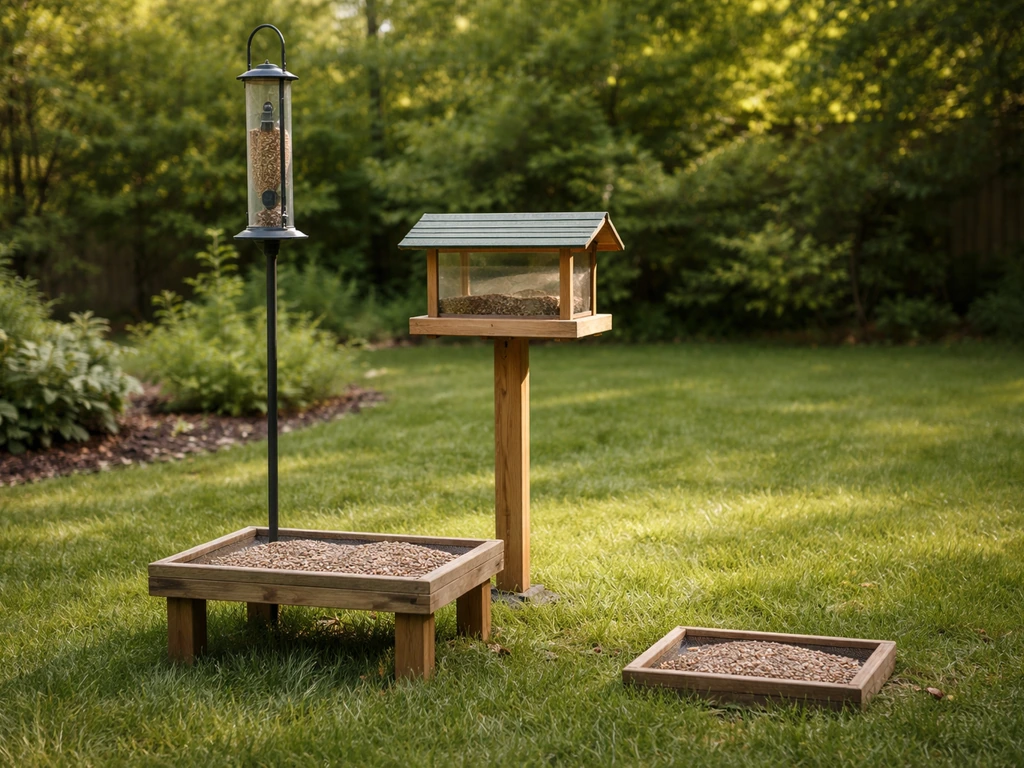
Different feeders attract different birds with different habits. A hummingbird feeder and a ground-level platform serve completely different visitors, so there's no single universal height. Here's what works in practice.
| Feeder Type | Recommended Height | Notes |
|---|---|---|
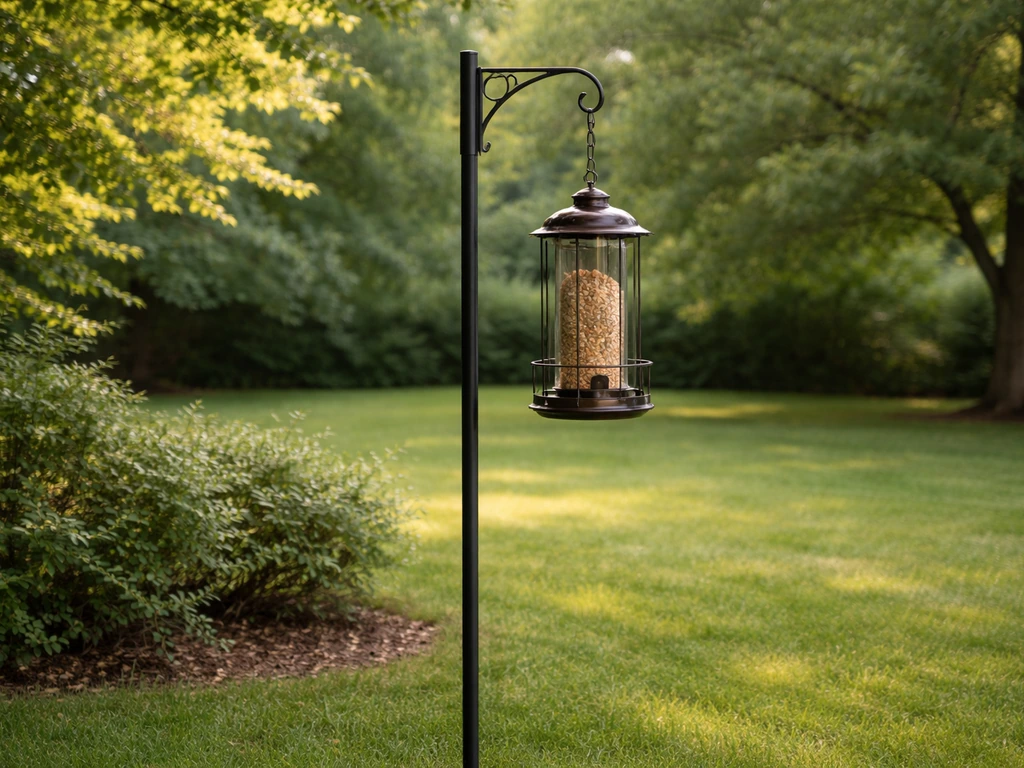
| Tube feeder (pole-mounted) | 5–6 ft | Baffle mounted at 4–5 ft; keeps bottom of feeder above squirrel jump height from ground |
| Hopper / house feeder | 5–6 ft | Same pole rules apply; heavier feeder benefits from a sturdy post |
| Platform / tray feeder | 2–4 ft (elevated) or ground level | Ground-feeding birds like juncos, doves, sparrows prefer 0–2 ft; cardinals and jays use 3–4 ft platforms |
| Suet cage | 5–7 ft on a tree or post | Woodpeckers are comfortable higher up; avoid placing too low where cats can ambush clinging birds |
| Finch / nyjer sock or tube | 5–6 ft | Goldfinches will feed up to 7–8 ft; higher placement can reduce house sparrow competition |
| Hummingbird feeder | 4–6 ft | Eye level or just above makes refilling easy and viewing rewarding; avoid full shade which slows traffic |
| Smart / AI camera feeder (e.g., Bird Buddy) | 4–6 ft | Camera lens must face the perch correctly; Bird Buddy instructs mounting so the camera module sits at the bottom of the feeder, aimed outward at bird eye level |
A note on smart feeders: if you're running a Bird Buddy, Bird Buddy Pro, or any feeder with a built-in camera, height matters for image quality as much as for bird access. Bird Buddy's own guidance specifies that the camera module should sit at the bottom of the feeder housing, positioned to look out toward where the bird perches. Too high and you get top-down shots of bird backs. Too low and you're fighting ground glare and motion blur from grass or mulch movement. The 4–6 ft range gives you clean, face-level shots that the AI can actually identify reliably.
Matching height to the birds you actually want
Birds have strong preferences for feeding height based on where they naturally forage in the wild. Ground foragers like white-throated sparrows, dark-eyed juncos, mourning doves, and towhees feel most comfortable at or below 2 feet. If you want them, a low platform tray or a simple scatter of seed on flat ground works better than anything mounted high on a pole. They'll visit elevated feeders reluctantly, if at all.
Cardinals, blue jays, and chickadees are mid-level foragers. They're comfortable anywhere from 4 to 8 feet and will readily use a hopper or platform feeder on a 5-foot pole. Chickadees are especially adaptable and will zip up to a tube feeder at almost any height, but they prefer having a nearby shrub to duck into between visits. Cardinals specifically seem to favor feeders positioned at the edge of open space with shrubs or trees within 10 feet for cover retreat.
Woodpeckers naturally feed on tree trunks, so a suet cage mounted against a post or tree between 5 and 7 feet mimics that vertical foraging posture. Mounting suet too low (under 4 feet) invites cats, and too high (above 8 feet) makes refilling a pain and gives starlings an easy overhead drop-in. Goldfinches and pine siskins will use nyjer feeders from about 4 feet up to 8 feet, and placing them slightly higher than your other feeders genuinely does reduce house sparrow competition in my experience.
Hummingbirds are a special case. They're not bothered by height the way ground birds are, but they do care about visibility and ease of approach from above. Mounting a hummingbird feeder at 4–6 feet, in a relatively open spot with some red flowers or a red ribbon nearby as a visual cue, tends to attract first-time visitors faster. Once they know it's there, they'll find it even if you move it a foot or two.
Poles, hooks, stands, and how far from trees or cover
How you mount the feeder matters as much as the height itself. A hook screwed into a tree branch at 5 feet doesn't give you the same predator protection as a freestanding pole with a baffle at the same height. The mounting method determines what animals can access the feeder, not just the birds.
Freestanding poles
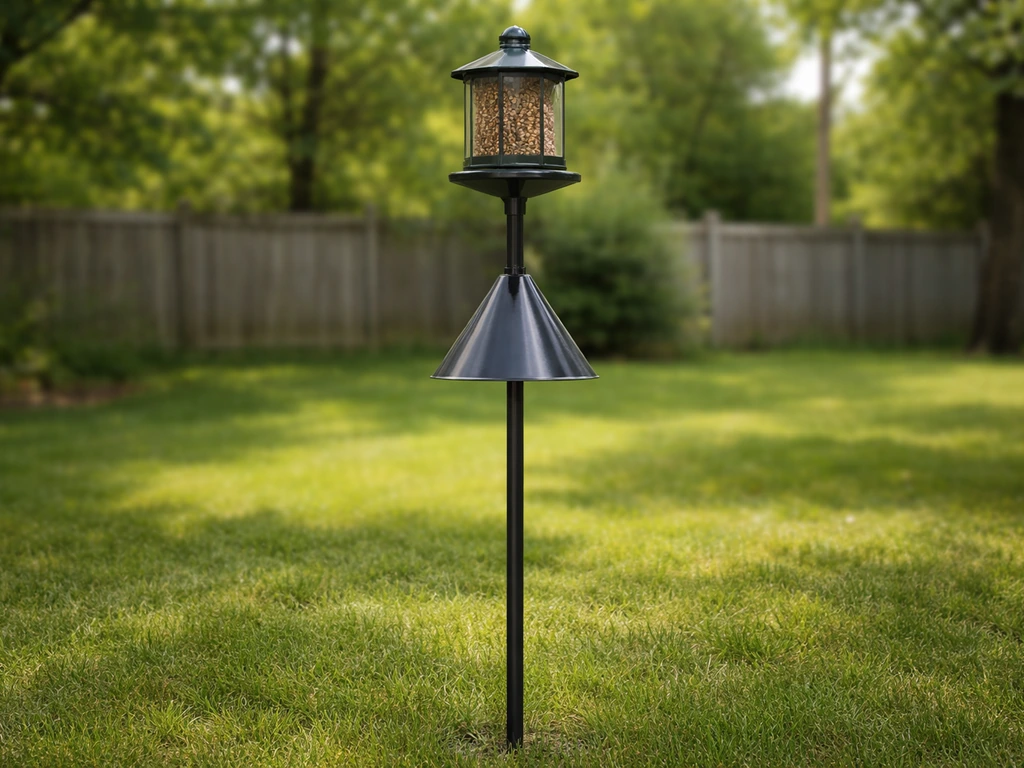
A dedicated feeder pole with a squirrel baffle is the most versatile and predator-resistant setup. Audubon recommends positioning the baffle between 4 and 5 feet off the ground, which means the pole itself typically needs to be about 7–8 feet tall total to give you a feeder height in the 5–6 foot zone. The pole should be placed at least 8 to 10 feet away from anything a squirrel can use as a launch pad: trees, fences, deck rails, large shrubs, the side of your house, other feeder poles. Perky-Pet's guidance adds that setting the pole about 1 foot into the ground while keeping the feeder bottom at 4 feet works well for lighter setups, though for heavier hopper feeders you want at least 18 inches of depth in the soil.
Hanging from trees or hooks on structures
If you're hanging from a tree branch, Perky-Pet recommends keeping the feeder at least 4 feet from the ground and at least 12 feet horizontally from the trunk or the branch you're hanging from. That 12-foot lateral distance is the hard part: most backyard trees don't have branches that extend that far over open space, which is why a freestanding pole usually beats tree-hanging for squirrel control. If you use a hook on a deck post or eave, you're essentially giving every squirrel in the neighborhood a staircase. I've tried it. They figure it out within a day.
Distance from shrubs and cover
Birds need nearby cover to feel safe landing and departing. The general rule is to position feeders 8–15 feet from the nearest shrub, brush pile, or low tree. Close enough that a chickadee can dart to safety in under a second, but far enough that a cat hiding in the shrubs can't spring and catch a bird at the feeder. Placing a feeder right next to a dense evergreen shrub looks natural but is a cat and Cooper's hawk ambush setup. The gap matters.
How height affects squirrels, cats, raccoons, and grackles
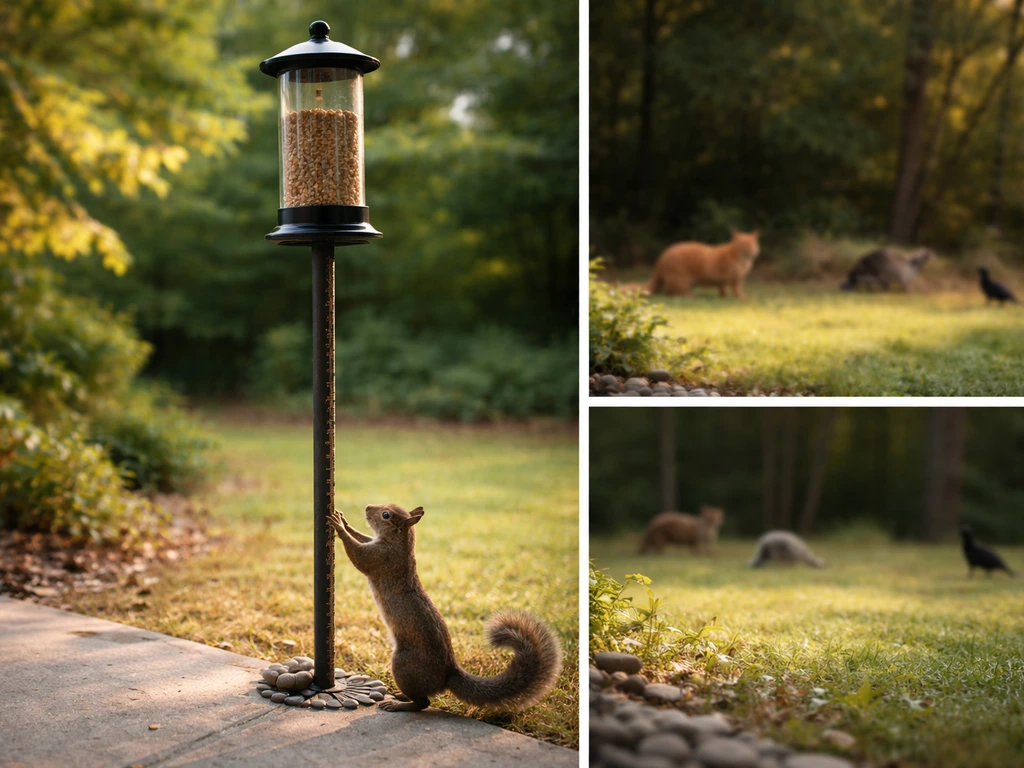
Squirrels can jump roughly 4 feet straight up from the ground and leap horizontally up to 8–10 feet from a stationary surface. Those two numbers should drive every height and placement decision you make. A baffle at 4–5 feet stops the vertical jump. The 8–10 foot horizontal clearance from any solid object handles the lateral leap. Both conditions need to be met simultaneously, or squirrels will find the angle. Wild Birds Unlimited recommends that full 8-foot horizontal buffer from decks, shrubs, trees, or other feeder systems to make a pole setup reliably squirrel-resistant.
Cats are a different problem. They don't jump as high as squirrels but they're patient ambush predators. A feeder at 4 feet on a thin pole without a baffle is accessible to a determined cat. A baffle at 4–5 feet also solves the cat problem, since smooth baffles are impossible for cats to grip. Raccoons are bolder and stronger: they can reach up to about 4 feet and will attempt to climb poles. A wide cone-style baffle (at least 17 inches in diameter) mounted at 4–5 feet is the practical solution for all three animals at once.
Grackles and starlings are a height-independent problem in the sense that they'll visit feeders at any height. What changes with height is which feeder types they can use. Grackles prefer platform and hopper feeders where they can stand and eat comfortably. When you’re figuring out the best position for a bird feeder, don’t forget that height changes what feeder types grackles can use. Hanging tube feeders with small perches, especially with a cage or mesh sleeve around them, force smaller birds to cling while excluding grackles by size. Raising a nyjer feeder slightly higher (6–8 feet) doesn't stop grackles but does reduce how comfortable they feel. The good news, as All About Birds notes, is that grackle and blackbird influxes are usually seasonal: they show up in waves, dominate for a few weeks, and then move on. blank" rel="noopener noreferrer">All About Birds notes that grackle and blackbird influxes are usually seasonal, showing up in waves and then moving on. Adjusting feeder height and type during those windows (temporarily switching to tube feeders and removing platform feeders) gets you through it.
Adjusting for your specific yard conditions
A perfect height on paper can still fail in a real backyard. Wind, shade patterns, visibility from indoors, and feeder swing all affect whether a setup actually works.
Wind and feeder swing
Feeders hung from hooks or chains swing in wind, which spills seed, discourages landing birds, and can knock suet cakes loose. If your yard is exposed, a pole-mounted feeder (which doesn't swing) is more stable than a hanging setup. If you have to hang, use a short leader (6–10 inches of chain rather than 18–24 inches) to reduce the pendulum effect. Feeders over 6 feet high tend to catch more wind and swing more aggressively.
Shade and sun exposure
Hummingbird feeders in full sun all day ferment nectar faster, so partial shade is better for them. Seed feeders in full shade don't attract as many birds, because birds need to see the feeder and feel safe scanning for predators while feeding. Morning sun, afternoon shade is a good compromise. Avoid placing feeders directly under dripping tree branches or where leaves fall into the seed port, which accelerates mold.
Visibility from indoors and camera angles
If you're placing a feeder to watch or photograph, height directly affects your viewing angle. For most people, choosing the best height for a bird feeder also means thinking about how you will photograph the birds when they arrive height directly affects. A feeder at 5 feet viewed through a window at sitting eye level (about 3.5–4 feet when seated) gives you a slightly upward angle that produces good bird photos. If you are aiming for the best bird feeder for photography, focus on clean sightlines, face-level angles, and a setup that lets birds approach confidently without visual clutter. This also matters for AI and camera feeders: Ring's motion detection and Bird's Eye Zones are calibrated to the actual mounting height you set in the app, and if the feeder height doesn't match what's configured, motion detection zones shift and you miss captures. Set the height in the app to match reality, not the other way around. For a Bird Buddy Pro with pole or wall mount options, choosing a height of 4–5 feet on a pole in an open spot gives the camera module clean sightlines without foreground obstruction.
Step-by-step placement plan you can use today
- Pick your mounting method first. Decide between a freestanding pole with baffle, a tree hang, or a wall/deck hook. If squirrels are a known issue in your yard, commit to the freestanding pole with a baffle before anything else.
- Find open ground at least 8–10 feet from the nearest tree, fence, deck rail, or dense shrub. Measure it. Eyeballing this is how most squirrel-proofing attempts fail.
- Set your pole depth and feeder height. Drive the pole so the baffle sits between 4 and 5 feet from the ground. The feeder itself should end up 5–6 feet off the ground, depending on feeder size.
- Check cover distance. Make sure there's a shrub, small tree, or brush pile within 10–15 feet of the feeder for bird safety retreats, but not within 8 feet for squirrel-launch clearance.
- Choose your seed and feeder type for your target birds. Black-oil sunflower seed in a tube or hopper covers the widest range. Add a separate nyjer sock for finches and a suet cage for woodpeckers if you have room.
- If using a camera or AI feeder, mount at 4–5 feet, confirm the camera module faces the perch directly, and set the height in the app to match your actual installation height.
- Add a squirrel baffle even if you don't think you need one. You'll thank yourself within a week.
Fine-tuning after the first week
Give the feeder 3–5 days before drawing conclusions. Birds in an unfamiliar yard can take a few days to notice a new food source. Watch from a window at different times: early morning (6–9 AM) tends to be peak activity for most songbirds. If nothing has visited after 5–7 days, try moving the feeder 5–10 feet closer to the nearest shrub cover. Sometimes that reduction in open-space anxiety is all it takes. If you're seeing lots of ground activity under the feeder but few birds on it, lower the feeder 12–18 inches and consider adding a low platform tray to capture the spillage and serve ground foragers simultaneously.
If squirrels are still getting through after you've set up a baffle, walk around the setup and look for anything within 8–10 feet that you missed: a low fence board, a garden stake, an overgrown shrub. Squirrels are testing every angle, and they only need one. Move the pole or trim the launch point.
Common mistakes and how to fix them
Feeder too high or too low
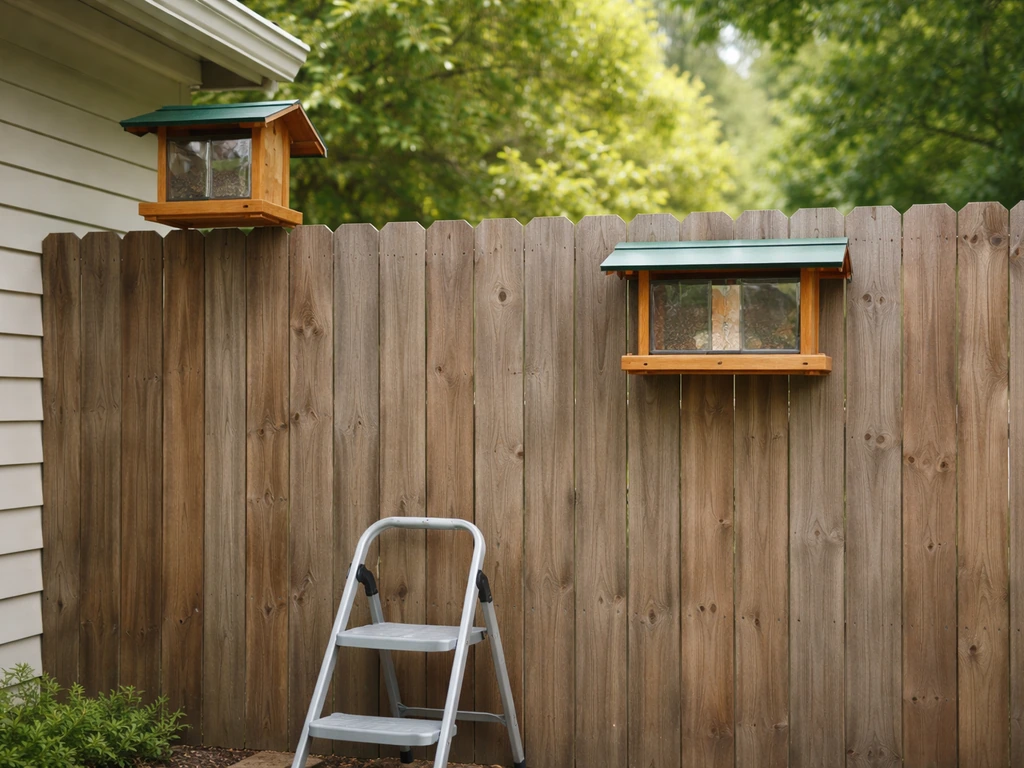
Mounting a feeder at 8–10 feet to "keep it away from squirrels" is one of the most common mistakes I see. It doesn't actually stop squirrels (who leap from above, not just from the ground), and it makes the feeder nearly invisible to ground-level birds and hard for you to refill or clean. Stick to the 5–6 foot range for most feeders and solve the squirrel problem with a baffle and clearance distance, not height.
Too few birds visiting
If birds aren't coming, the most common causes are: too far from cover, wrong seed type, a new feeder smell that hasn't weathered yet, or a hawk that's been hunting nearby and spooked the local population. Don't move the feeder more than once every 4–5 days or you'll restart the discovery clock each time. Rub a little peanut butter on the perch of a new feeder to get early visitors, then let word spread naturally.
Grackle and starling takeovers
If grackles or starlings are dominating your feeders, the fix is feeder design rather than height. Switch to tube feeders with short or no perches, use a cage or mesh surround, and temporarily remove any platform or hopper feeders that let large birds stand and dominate. Grackles in particular struggle with clinging feeders. As mentioned earlier, these influxes are usually seasonal and short-lived, so a 2–3 week adjustment in feeder style usually gets you through the peak period without permanently giving up the species you want.
Camera and AI feeder placement errors
Smart feeders get misplaced more often than traditional ones because people treat them like regular feeders and ignore the camera requirements. Mounting a Bird Buddy against a wall with a dark background gives the AI nothing to work with, and placing it in direct afternoon sun washes out the image sensor. The same height principles apply (4–6 feet), but you also need an open background, reasonable lighting, and a clear path for birds to approach the perch from the front rather than landing on top or from behind. If you're also thinking about ideal positioning for a feeder with a camera, the considerations around direction, backdrop, and distance from windows overlap significantly with height choices and deserve their own thought. If you want the best place to put a bird feeder with a camera, focus on a clear, face-level view of the perch and enough space for birds to approach from the front.
Ignoring the ground below the feeder
Seed spillage creates a ground-level feeding station whether you plan for it or not. Rats, mice, and deer will find it. Either use a no-waste seed mix (hulled sunflower, shelled peanuts) that doesn't leave husks, add a catch tray below the feeder, or rake and remove spilled seed every few days. This matters more than feeder height for keeping rodents out of the equation.
FAQ
What is the best height for bird feeders if I have both squirrels and cats?
Aim for the same core range (about 5 to 6 feet for most feeders) but make predator resistance the priority: use a smooth baffle positioned around 4 to 5 feet, and ensure the feeder pole has clearances of at least 8 to 10 feet from launch points like trees, fences, rails, or shrubs. Height alone usually fails against smart climbers, but a baffle plus clearance is the combination that works.
Should I set the feeder lower than 5 feet if birds are feeding but look nervous?
Try a small adjustment, about 12 to 18 inches lower, only if the feeder is already close to cover. Nervousness usually means the feeder is too exposed, so moving it 5 to 10 feet closer to the nearest shrub or brush pile often helps more than chasing a lower height. Also confirm there is safe landing cover (not a dense evergreen that creates an ambush lane).
If I use a shepherd hook or chain to hang my feeder, what height should I choose to avoid swinging?
Use the same height guidance (about 4 to 6 feet for many feeders), but choose a shorter hanging length so it does not swing as much. If you must hang, keep the chain/leader shorter (around 6 to 10 inches of chain rather than 18 to 24 inches). Swinging increases seed scatter, knocks suet loose, and makes birds less confident.
Do ground-foraging birds still come if the feeder is mounted at 5 to 6 feet?
Some may, but many ground specialists prefer at or below about 2 feet. If you want reliably consistent visits from ground foragers, add a low platform or scatter seed at ground level rather than relocating everything upward. You can keep your main feeder at 5 to 6 feet and run a second low feeding station.
What is the best height for a suet feeder if woodpeckers are my main target?
For woodpecker-style foraging, mount suet between about 5 and 7 feet on a post or against a tree so it mimics vertical trunk feeding. Avoid going under 4 feet to reduce cat access, and avoid above about 8 feet because it increases refill hassle and gives overhead competitors a cleaner approach.
I placed the feeder in the recommended range, but grackles dominate. Does changing height help?
Changing height helps only a little. Grackles can use a wide range, so the better lever is feeder design: switch to tube feeders with short or no perches, use a mesh sleeve or cage to limit clinging access, and temporarily remove platform or hopper feeders that let larger birds stand and crowd. If the influx is seasonal, this style change for a couple of weeks is often enough.
How do I set the height for a camera or AI feeder if the app asks for a height input?
Set the height in the app to match the actual mounting height, not the other way around. If the configuration is off, the motion detection zones can shift and you get fewer correct captures. For camera feeders, the effective target is still usually the 4 to 6 foot zone for face-level views, but also make sure birds approach the perch from the front with a lighter, open background.
Where should the feeder be in relation to shrubs if I want birds to feel safe, but still want predator control?
Place the feeder roughly 8 to 15 feet from the nearest shrub, brush pile, or low tree. Too close (right next to dense cover) can turn it into an ambush zone for cats and some hawks, while too far means birds linger on the edges. If you see many ground visits but fewer on the feeder, that can also signal the feeder is too exposed or too high for the specific species.
What is a common mistake people make with feeder height to stop squirrels?
Mounting the feeder at 8 to 10 feet thinking it is “out of reach” usually backfires. Squirrels can leap from above, not just climb from the ground, and higher placement also makes the feeder harder for you to clean and refill. Use the proper baffle height (around 4 to 5 feet) and maintain 8 to 10 feet of horizontal clearance from any launch surfaces instead.
If birds stopped coming after I adjusted height, how long should I wait before changing again?
Give it 3 to 5 days before judging. Birds often need a discovery period in a new setup, so moving the feeder repeatedly resets that learning curve. If you need a change, try one adjustment at a time (for example, 5 to 10 feet closer to cover, or lowering by 12 to 18 inches), then wait again.
Is there a different “best height” for hummingbird feeders?
Hummingbirds care less about height than ground birds, but they do care about visibility and approach. Around 4 to 6 feet in a relatively open spot can attract first-time visitors faster. Once established, minor repositioning (like moving a foot or two) typically still works, as long as there is a clear visual cue such as nearby red flowers or a red ribbon.
I get spillage under the feeder. Does feeder height affect rodent problems?
Spillage is the main driver of rodent activity, so height matters less than what falls below. Use a no-waste seed mix or add a catch tray, and rake or remove spilled seed every few days. Rodents and deer often arrive quickly at a seed “station,” regardless of whether the feeder is set at 5 feet or 6 feet.