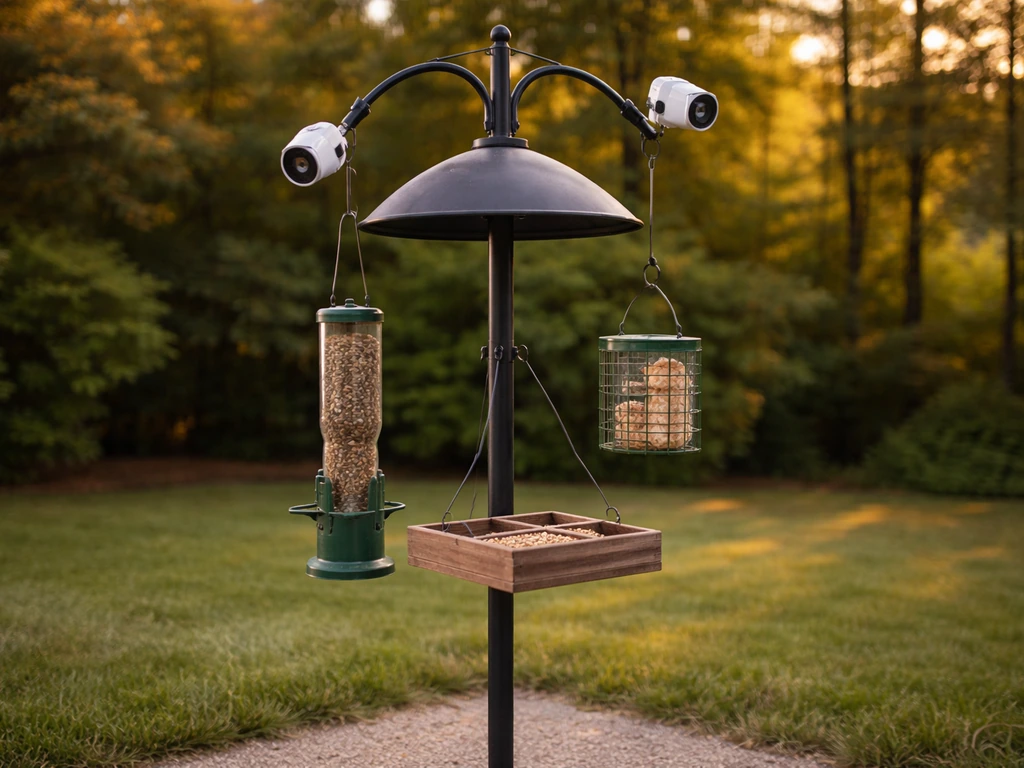
For most backyards, the best heavy duty bird feeding station is a powder-coated steel pole system with a weighted or threaded base, a squirrel baffle mounted at least 4 feet up the pole, and two to four individual feeders hanging from arms rated for year-round outdoor use. The setup needs to handle wind, rain, squirrels, raccoons, and aggressive birds like grackles without rusting out, tipping over, or dumping seed onto the ground every time something lands on it. If you buy cheap here, you replace it in one season. Spend more upfront on a steel frame with a solid base and the right feeder combos, and you are set for years.
Best Heavy Duty Bird Feeding Station With Base Buying Guide
Marcus Holloway
11 May 2026
What a heavy duty feeding station actually needs to include
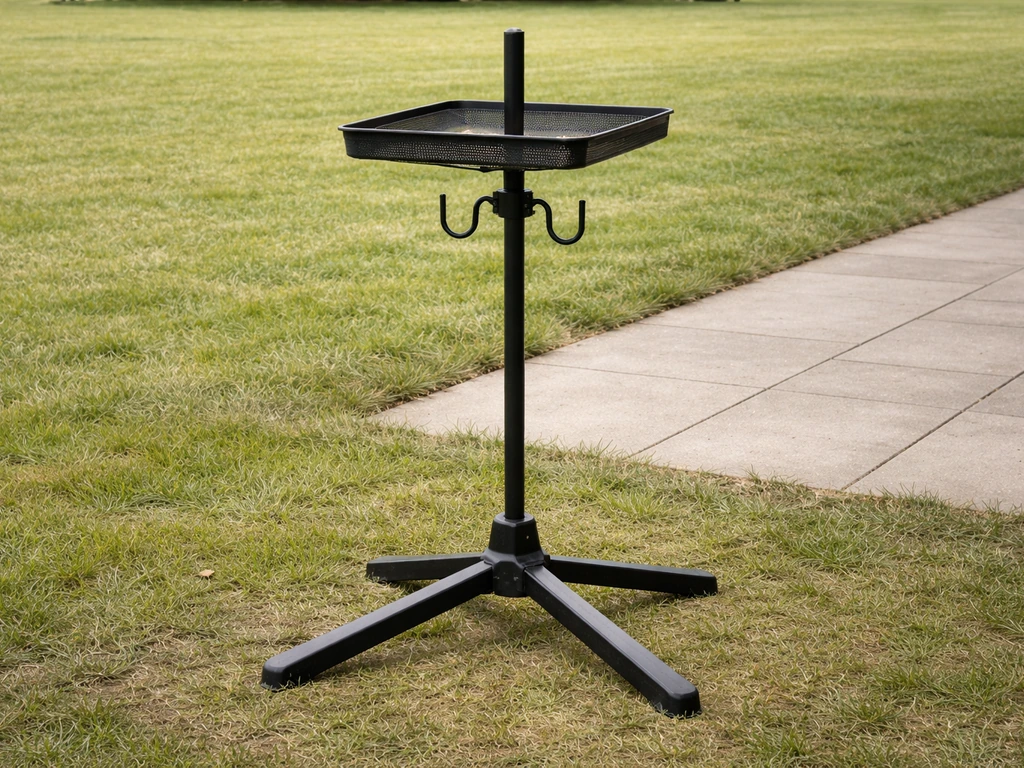
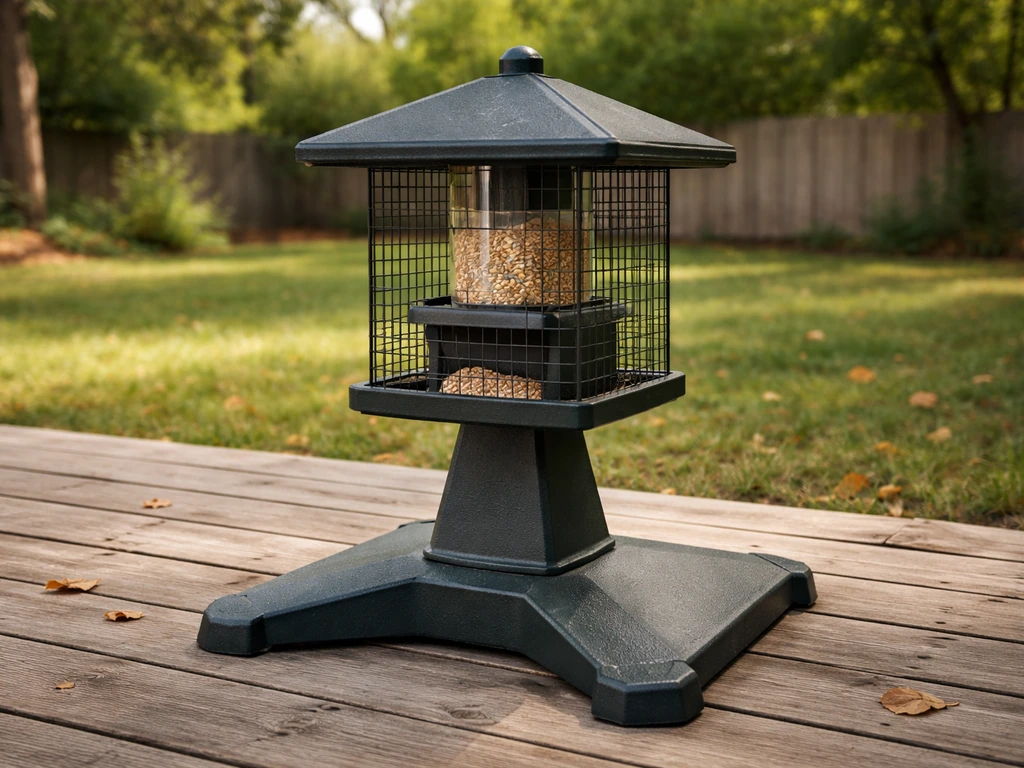
A true heavy duty feeding station is not just a pole with some plastic hooks. The base or stand matters as much as anything else. For free-standing stations, look for a wide-footprint metal base plate or a ground-spike anchor at least 12 to 18 inches deep. Some stations use a screw-in auger spike that threads into soil rather than just pushing in, which makes a huge difference on windy days or when a squirrel decides to launch itself at the whole assembly. If your station wobbles in a light breeze, it is not heavy duty, it is just tall.
Beyond the base, a proper heavy duty station should include these core elements: a powder-coated or galvanized steel main pole of at least 1 inch diameter, adjustable arm hooks rated to hold feeders in the 3 to 5 pound range when full, a dedicated squirrel baffle (either a wrap-around cone or cylindrical cage style mounted mid-pole), and drainage holes or a tray design that keeps standing water from pooling under feeders. Some premium stations include a detachable seed tray at the bottom to catch dropped seed, which cuts ground mess dramatically and lets you offer a second seed type without adding another pole.
- Powder-coated or galvanized steel pole, minimum 1-inch diameter
- Screw-in auger spike or wide anchor base plate for ground stability
- Multiple adjustable arms or hooks, each rated for 3 to 5 lbs when loaded
- Integrated or compatible squirrel baffle (cone or cylindrical) at 4+ feet height
- Seed catch tray with drainage to reduce ground mess
- Corrosion-resistant hardware throughout (stainless or coated fasteners)
Key specs to compare before you buy
Materials and build quality
Steel wins over aluminum and plastic every time for the main structure. Powder-coated steel resists rust, handles UV degradation much better than raw finishes, and does not flex or crack in cold weather the way cheaper materials do. For the feeders themselves hanging on the station, UV-stabilized polycarbonate tubes (as used by Droll Yankees in their tube feeders) are the right call because standard acrylic cracks after a couple of winters. Avoid feeders with thin plastic port rings, cheap welded wire, or unsealed wood components if you want them to last more than one or two seasons.
Weather resistance
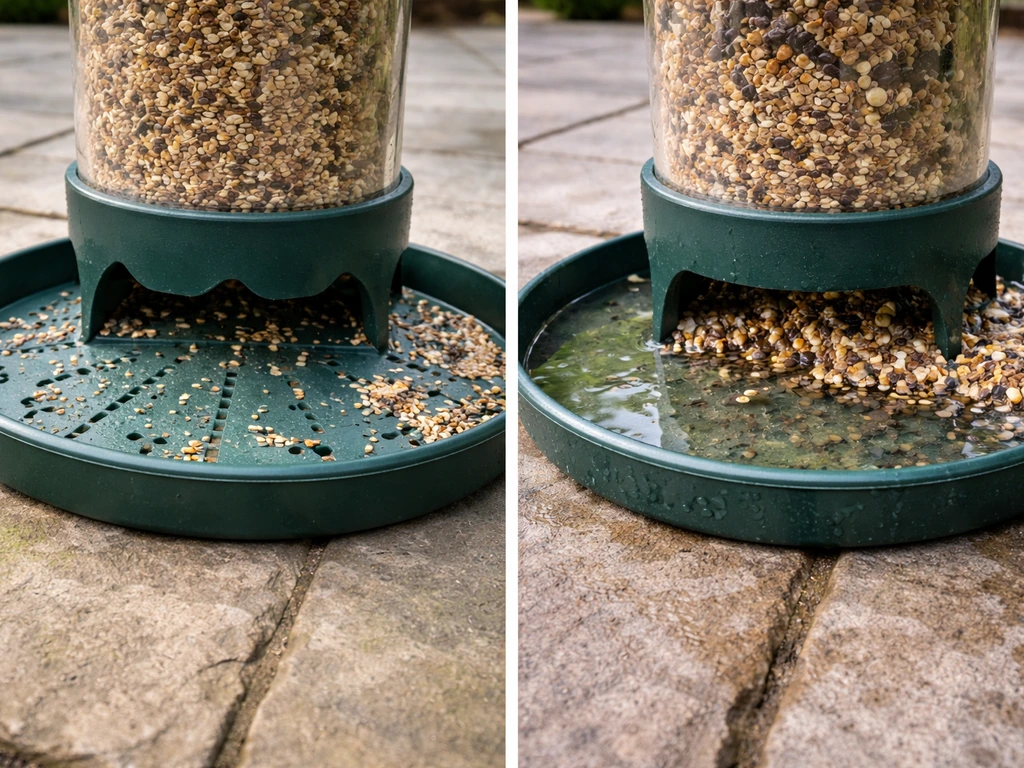
Look specifically for drainage in every horizontal surface. Water that sits in a seed tray or hopper bottom grows mold fast, and wet seed clumps, blocks ports, and can kill birds. Brome's Squirrel Buster line handles this well with a patented Seed Tube Ventilation System that lets humidity and warm air escape through vents at the top of the tube, which is exactly the kind of engineering detail that separates a good feeder from a maintenance headache. For the station frame, check that arm attachment points are welded or bolted rather than just friction-fit, because those connections corrode and loosen after one wet season.
Capacity
Capacity is mostly about how often you want to refill. A single tube feeder holds 1 to 2 cups of seed. A large hopper or a wide-mouth tube can hold 4 to 6 cups. If you get serious bird traffic or you travel and cannot refill every two days, go with high-capacity feeders on each arm. Keep in mind that larger capacity only makes sense if the feeder also seals well enough to keep rain out. A big open tray feeder in a rainy climate just gives you a bigger pile of soggy waste.
| Feature | Budget Station (under $60) | Mid-Range Station ($60-$120) | Heavy Duty Station ($120+) |
|---|---|---|---|
| Pole material | Thin steel or aluminum | Coated steel | Powder-coated/galvanized thick steel |
| Base/anchor | Push-in spike or plastic base | Metal spike, moderate depth | Auger spike or wide anchor plate, 12-18 in deep |
| Arm rating | Light duty, 1-2 lbs | Moderate, 2-3 lbs | Heavy duty, 3-5 lbs per arm |
| Squirrel baffle included | Rarely | Sometimes | Usually included or compatible |
| Weather sealing | Minimal | Basic drainage | Vented tubes, drainage trays, sealed hardware |
| Expected lifespan | 1-2 seasons | 2-4 seasons | 5+ seasons with maintenance |
Stopping squirrels, raccoons, and grackles for real
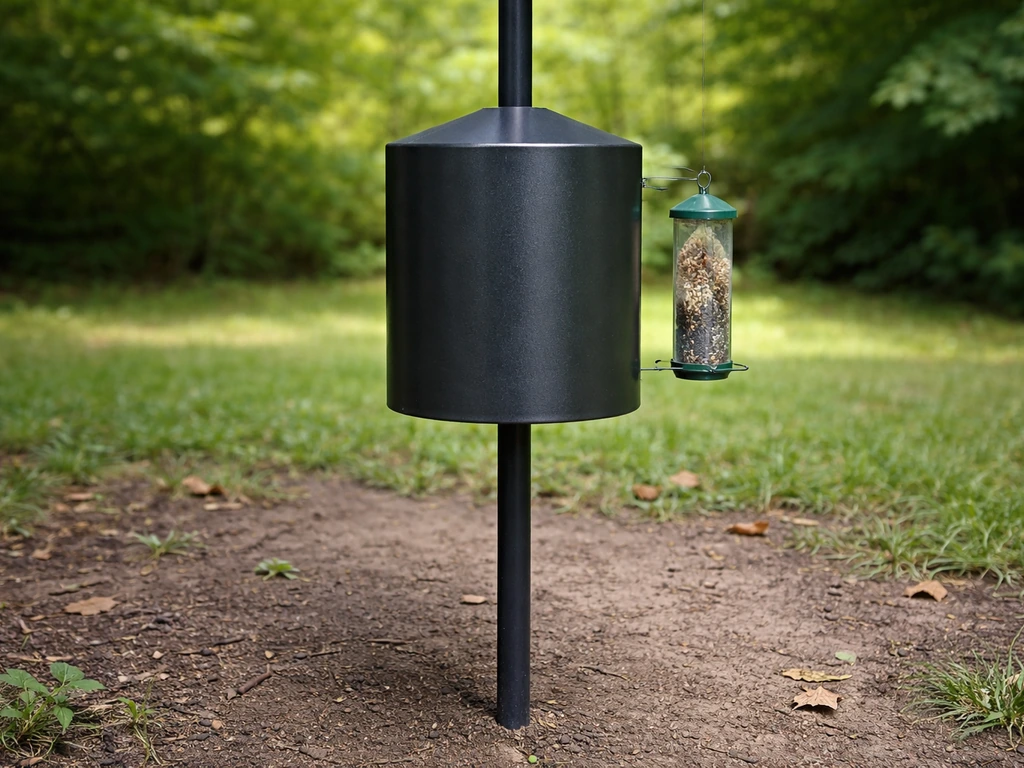
Squirrel-proofing a feeding station is a two-part job: placement and physical barriers. On placement, Erva's installation guidance is clear: position your station 8 to 10 feet away from any railing, roof edge, fence top, or tree branch. Squirrels are good jumpers but not that good. If your station is closer than that to a launch point, no baffle in the world will fully stop them because they never need the pole at all. Get that clearance right first, then add your hardware.
For the pole itself, a cylindrical raccoon/squirrel baffle mounted at 4 to 4. 5 feet high is the most reliable physical deterrent. The wrap-around cone style from Erva works well too, especially on narrower poles. The key is mounting height: too low and a raccoon can reach over it from the ground, too high and a climbing squirrel just bypasses the baffle entirely before it can deploy.
Some setups combine a mid-pole baffle with weight-activated feeders like the Brome Squirrel Solution 150, which closes its seed ports under squirrel weight but stays open for birds. Brome Squirrel Solution 150 uses a weight-triggered mechanism that closes seed ports when squirrels step on the perch, allowing access to heavier birds only when the ports are open weight-activated feeders like the Brome Squirrel Solution 150.
That combination is genuinely hard to beat.
Grackles are a different problem. They are not deterred by baffles, and they can empty a feeder in minutes when they flock. The most practical fixes are using feeders with shorter or upward-angled perches that grackles find awkward, switching to safflower seed (which grackles generally avoid but cardinals love), and using caged tube feeders with spacing sized for smaller songbirds. A caged feeder with 1.5-inch wire spacing lets chickadees, nuthatches, and finches in while physically blocking larger birds. For a station setup, mixing one caged tube feeder with one standard feeder gives you coverage without completely locking out everything.
Mounting, stability, and where to put it in your yard
Free-standing vs pole-mounted
Free-standing stations with a ground base are the most flexible option. You can move them seasonally, adjust their distance from structures, and add or remove feeders without drilling into anything. The trade-off is stability: a free-standing base in loose or sandy soil, or in a yard with strong prevailing winds, needs a heavier footprint or an auger spike to stay put. Pole-mounted systems anchored directly into the ground via an auger spike are significantly more stable but harder to reposition. For most suburban yards with moderate foot traffic and squirrel pressure, a ground-auger free-standing system threads the needle well.
Placement for viewing and safety
Put your station somewhere you will actually see it from a window or seating area. That sounds obvious but a lot of people install stations in the most "logical" spot for the birds and then never enjoy watching them. Aim for 10 to 15 feet from a window: close enough to see bird detail, far enough that window strikes are less likely. If you go closer than 3 feet, birds do not build up flying speed and window strikes drop significantly too, but then you lose the viewing experience. The 10 to 15 foot range with window decals or screens is the practical sweet spot.
Shade matters for seed freshness. Direct afternoon sun in summer heats up plastic feeders and spoils seed faster, and millet and sunflower both go rancid in heat. A spot with morning sun and afternoon shade (or dappled light from a tree at least 10 feet away) is ideal. It keeps birds comfortable at the feeder and extends the life of the seed between refills.
Choosing the right feeder styles for your station
The real strength of a multi-arm feeding station is mixing feeder types so you attract more species and reduce competition at any single feeding point. Here is how I approach the arms on a four-arm station.
| Feeder Type | Best Seed | Bird Attraction | Squirrel Resistance | Notes |
|---|---|---|---|---|
| Tube feeder (6-port) | Sunflower chips, nyjer | Chickadees, finches, nuthatches | Moderate (add baffle) | Good capacity, easy to clean |
| Hopper feeder | Black oil sunflower, mixed | Cardinals, jays, sparrows | Low without cage | High capacity, needs drainage |
| Caged tube feeder | Sunflower chips, nyjer | Small songbirds only | High (physical barrier) | Blocks grackles and squirrels |
| Suet cage | Suet cakes | Woodpeckers, nuthatches | Moderate | Swap to upside-down style to exclude starlings |
| Platform/tray feeder | Millet, peanut pieces | Doves, sparrows, ground birds | Low | Add drainage holes; scatter feed thinly |
For a heavy duty station that sees high traffic, I would put a large caged tube on one arm, a hopper on a second arm, a suet cage on a third, and either a nyjer sock or a small tube feeder on the fourth. That combination pulls in the widest variety without letting any one bully species take over the whole station. If grackle pressure is extreme in your yard, swap the hopper for a second caged tube and switch both to safflower.
Single-port vs multi-port tube feeders
Multi-port tube feeders (six ports or more) let several birds feed simultaneously, which cuts down on the chasing and territorial behavior that makes bird watching frustrating. Single or dual-port feeders tend to attract more dominant individuals who chase others off. On a station where you have multiple separate feeders running, you get some of that distributed feeding effect anyway, but within each feeder, more ports generally means more peaceful activity.
Matching your station setup to the birds in your yard
Not every station setup works for every species. If you are specifically targeting cardinals, a hopper feeder with a wide tray and black oil sunflower or safflower is your best bet on the station. Cardinals do not like tube feeders much, they prefer a platform they can perch on comfortably. Woodpeckers go straight for suet or peanut pieces in a cage or hopper. Goldfinches want nyjer in a fine-port tube or a dedicated nyjer sock hung from an arm. House finches and purple finches will use almost any tube feeder. Chickadees and nuthatches will take sunflower from tubes or hoppers and they are happy on most standard feeder styles.
| Target Species | Best Feeder Style on Station | Best Seed | Special Notes |
|---|---|---|---|
| Northern Cardinal | Hopper or platform tray | Safflower, black oil sunflower | Needs wide perch; avoid narrow tube feeders |
| American Goldfinch | Nyjer tube or sock | Nyjer (thistle) | Use fine ports; standard ports waste nyjer |
| Black-capped Chickadee | Tube (any), hopper | Sunflower chips, peanut pieces | Very adaptable; one of the first visitors |
| Downy/Hairy Woodpecker | Suet cage or peanut feeder | Suet, peanut pieces | Upside-down suet cage excludes starlings |
| White-breasted Nuthatch | Tube, suet cage | Sunflower chips, suet | Often feeds head-down; comfortable on any orientation |
| House Sparrow/Grackle | Any open feeder | Millet, mixed | Pests on mixed-seed trays; use safflower or caged feeders to discourage |
If you are setting up a station to attract a wide range rather than targeting one or two species, black oil sunflower seed in a tube or hopper is the single best all-around option. It pulls in more species than any other seed type and produces less waste than mixed seed blends with filler millet that most birds kick out anyway.
Setup, first-week maintenance, and common troubleshooting
Getting the station up right
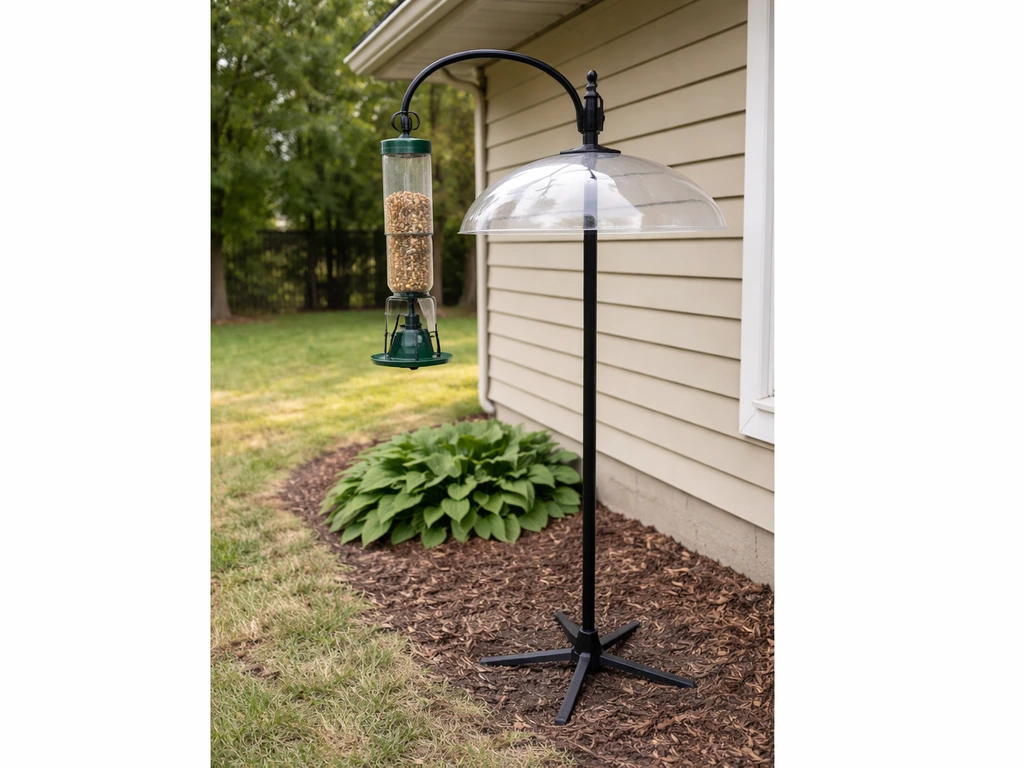
Before you fill a single feeder, spend five minutes confirming placement: at least 8 to 10 feet from any tree, fence, or roof that could serve as a squirrel launch point, and the station itself should be on level ground so nothing leans. Thread your auger spike in slowly if you hit rocks or roots. Forcing it strips the threads. Once the pole is in, hang only one or two feeders the first few days. Birds need time to discover a new station. Overwhelming it with six feeders immediately often means none of them get found quickly, and you end up with stale seed in several feeders at once.
The first week routine
- Day 1-2: Install station and baffle. Hang one tube feeder with black oil sunflower. Do not fill other arms yet.
- Day 3-4: Check seed level and look for activity. If no birds have found it, scatter a small amount of seed on the ground below the station to draw attention.
- Day 5-6: Once birds are visiting the first feeder regularly, add a second feeder type (suet cage or hopper).
- Day 7: Check baffle mounting height, tighten any arm connections, clear dropped seed from the base, and rinse out the seed tray if one is present.
- Ongoing: Refill before feeders run completely empty. Completely empty feeders mean birds stop checking and may not return for several days.
Cleaning and maintenance that actually matters
Every feeder on the station needs a scrub at least once a month, more often in humid weather or if you see any dark clumping in the seed. Use a long feeder brush to reach inside tube feeders, and a 10 percent bleach solution rinse followed by a complete air dry before refilling. Wet seed in any feeder can carry Salmonella and aspergillosis, both of which kill birds and are entirely preventable with basic hygiene. The Yankee Blocker's care instructions specifically call out manual access to ports and tube areas with a feeder brush, which is the right approach for any tube-style feeder.
Common first-week problems and fixes
- No birds after 5+ days: Move the station closer to existing shrubs or tree cover; birds prefer feeding near escape cover. Also check that the seed is fresh, stale seed has no smell and birds notice.
- Squirrels still getting in: Remeasure your clearance from jump points and confirm baffle height is 4 to 4.5 feet off the ground. If a squirrel is climbing past a baffle, the baffle is mounted too high.
- Seed going wet and clumping: Add drainage holes to trays if not present. Switch to shell-free sunflower chips which absorb less moisture than whole seed.
- Feeders spinning or tangling in wind: Tighten arm locking screws. Add a small S-hook with a locking clip between the arm and feeder to reduce rotation.
- One feeder ignored while others are busy: Try a different seed type, or move the arm to a slightly different position. Sometimes a sight-line difference of a foot changes how birds perceive a feeder's accessibility.
- Raccoon damage: Note that most manufacturer warranties (including Yankee products) do not cover raccoon or bear damage. Physical deterrents like a wide cylindrical baffle and bringing feeders inside at night are the only reliable fixes.
How this compares to a standard bird feeder station
If you have been researching standard bird feeder stations or quality bird feeding stations, you will notice that the jump to heavy duty is mostly about materials and build redundancy rather than a completely different product category. Standard stations often use thinner steel tubing, lighter-duty arms, and push-in ground stakes that work fine in normal conditions.
Heavy duty versions use thicker steel, deeper anchor systems, and hardware that holds up under the added stress of wildlife pressure, high bird traffic, and multi-season outdoor exposure. If you have a sheltered yard with light squirrel activity and mild weather, a well-built standard station may serve you fine. If you have had a station tip over, rust out, or get destroyed by wildlife within a year or two, moving up to heavy duty construction pays for itself quickly.
The bottom line: buy the heaviest base and thickest pole you can justify for your budget, pair it with a mid-pole baffle and at least one caged or weight-activated feeder, place it 8 to 10 feet clear of any launch points, and fill it with black oil sunflower to start. That combination beats almost every problem most backyard birders run into, and it gives you a foundation you can build on with additional feeders and species-specific setups over time.
FAQ
Can I use a heavy duty feeding station on a patio or deck where I cannot install an auger spike?
If you cannot anchor into soil, choose a station with a very wide, weighted base plate and pre-drilled bolt pattern, then set it on a solid surface (paver pad or level concrete) so it cannot rock. Avoid “universal” hardware that requires loose weights, because wildlife hits create leverage that loosens lighter bases over time.
How do I decide the right baffle height for my yard’s squirrels and raccoons?
A baffle that is mounted mid-pole is still useful, but it must be tall enough for the specific animals you have. Start by measuring the access height squirrels or raccoons use in your yard (fence top, planter, low branches). Then mount the baffle so it is above the highest realistic jump point, not just an average height.
What base and hardware choices matter most in high-wind or freeze-thaw climates?
For storm-prone areas, prioritize an anchor that threads into the ground (screw-in auger) over push-in stakes, because push-in stakes shift when saturated. Also check arm welds or bolted joints are fully sealed or coated, since water intrusion at connections is what usually causes wobble after repeated rain.
Should I add all feeders at once when installing a new heavy duty station?
Yes, but do it gradually. Add only one or two feeders for the first few days, then expand. If you start with many feeders, birds often cannot find them fast enough, and the unused feeders collect wet seed and mold before you ever refill.
What should I do if I live in a humid climate and seed keeps getting clumpy?
Do not rely on drainage alone. In humid areas, use feeders with fully enclosed seed paths, keep horizontal surfaces minimal, and wipe visible residue weekly. If you see dark clumping or wet streaks around ports, switch to more frequent top-offs with smaller refills rather than waiting for emptiness.
How can I reduce seed being emptied fast by grackles or other bully birds?
Use the seed type to manage heavy feeder loss, not just cleanup. For yards with dominant grackles or larger bullies, switch to seeds they avoid (like safflower) and use shorter perches or caged/tube designs with smaller wire spacing to reduce access to the main ports.
Why do I see a lot of waste under the station, even after choosing a drainage tray?
If birds are wasting seed through cracking or kicking, reduce the opening size and increase port control. Tube feeders and caged tube feeders usually cut waste more effectively than wide platform hoppers, and seed blends with millet often produce more rejected pieces than black oil sunflower.
What can I do if my station attracts big birds but smaller songbirds do not get enough access?
Aggressive birds like grackles can still intimidate smaller species. Consider spacing and feeder choice: use at least one multi-port or caged feeder to spread out access, and place the “easy landing” feeders higher or with less convenient perches so dominant birds have fewer advantages.
How often should I clean a heavy duty station if I notice mold risk but the feeders do not look dirty yet?
Scrub frequency depends on moisture and foot traffic, not just time. If you see any dark spots, damp odors, or seed bridging in ports, clean immediately and shorten the refill interval. In rainy seasons, a mid-week brush-out is often better than waiting for the next monthly deep clean.
If tube feeders work for most birds, which species might not use them?
Not always. Tube feeders are convenient, but some species (notably cardinals) often prefer a platform-style hopper or wide tray with comfortable perching. If you are targeting a specific bird, match the feeder architecture first, then adjust seed type.
What special steps help a heavy duty station last through winter?
Winter changes the equation. Use seed types that stay viable, keep ports free of ice by using feeders designed for ventilation, and inspect the baffle and arm joints after freeze-thaw cycles for looseness or coating cracks before spring wildlife ramps up again.
If I want lots of species, what is the best order to expand feeder types over time?
Start with a single high-performing “all-around” feeder like a black oil sunflower tube or hopper, then add one specialty feeder at a time (suet cage, nyjer sock/tube, or a caged tube sized for smaller birds). This makes it easier to identify which setup attracts which species and reduces the chance of leaving multiple feeders stale for weeks.
Next Article
Best Bird Feeder Station: Top Picks, Features, and Setup
Best bird feeder station picks with predator control, bird-type options, setup tips, and smart camera choices.