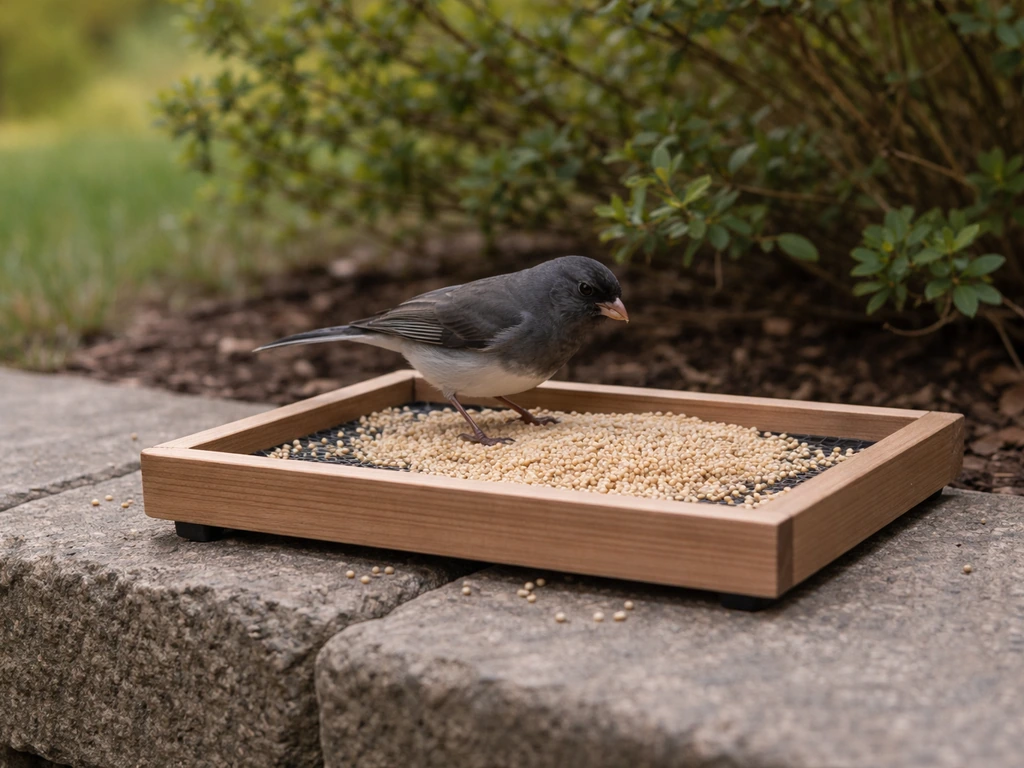
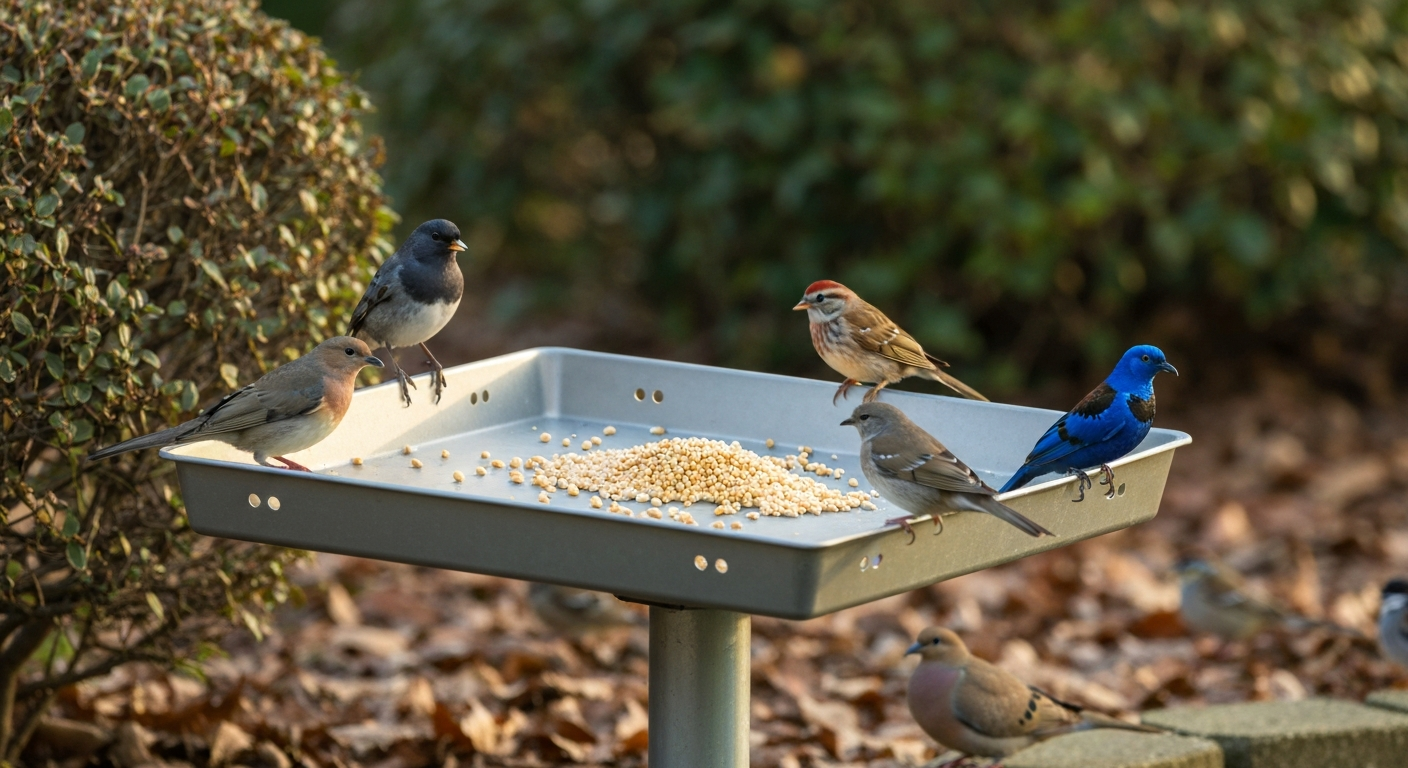
For white millet, a low platform tray or open ground feeder is almost always the right choice. Millet seeds are roughly 2 mm wide, and they fall through most standard hardware cloth or tube feeder ports without a solid catch tray. The birds that love millet most, dark-eyed juncos, song sparrows, towhees, mourning doves, and indigo buntings, are ground or low-platform foragers by instinct, and they will ignore a narrow tube feeder hanging at eye level while happily cleaning up a tray feeder set within a foot or two of the ground.
Best Bird Feeder for White Millet: Top Picks & Buying Guide

Marcus Holloway
22 Jul 2026
Quick Recommendations by Goal
| Your Goal | Best Feeder Type | Key Feature to Prioritize |
|---|---|---|
| Attract juncos and ground-feeders | Low platform tray or ground-scatter tray | Solid or near-solid floor, low mounting height (6–12 inches off ground) |
| Attract indigo bunting | Open platform or low hopper with tray | Perching rail, small seed ports or open tray, low placement near shrub cover |
| Mixed small-seed yard (sparrows, doves, towhees) | Larger platform tray or hopper + tray combo | Capacity of 2–3 lbs, drainage holes, weather roof or dome |
| Pest-prone yard (squirrels, grackles, starlings) | Weight-activated caged feeder or baffled pole platform | Cage opening <1.5 inches, weight-sensitive perch, full metal construction |
Which Birds Eat White Millet and Why It Changes Your Feeder Choice
White proso millet (Panicum miliaceum) is one of the most reliably attractive seeds you can put out for native backyard birds, but it only works well when it is presented at the right height and in the right feeder style. Most of the species that actively prefer it evolved to forage at or near the ground, picking through leaf litter and low vegetation. That behavior is the single biggest driver of which feeders actually perform in the field.
Dark-Eyed Juncos
Juncos are almost strictly ground foragers. They scratch and peck, and they rarely hover or cling to a tall tube feeder. In my yard, I have watched dozens of juncos completely ignore a hanging hopper filled with millet mix, only to crowd a low tray feeder mounted about eight inches off the ground just a few feet away. Cornell Lab data backs this up: juncos are described as primarily foraging on the ground, with low platform feeders listed as the functional equivalent. If juncos are your main target, a ground-level or very low platform tray with a solid floor is the correct tool. For specific product recommendations and setup tips, see our guide to the best bird feeder for juncos. The feeder type for juncos is closely linked to best setups for native sparrows and towhees, all of which share this low-foraging behavior.
Indigo Buntings
Indigo buntings are a bit more flexible. They will take millet from the ground but also use low perches and platform edges to access seed. Their small bill is well suited to millet-sized kernels, and they tend to visit briefly and at lower densities than sparrows or juncos. An open platform feeder placed near dense shrub cover, ideally five to eight feet off the ground rather than at ankle level, works well for buntings because they prefer a quick visual scan before landing. For specific product recommendations, see our guide to the best bird feeder for indigo bunting. A low hopper feeder with a generous tray works too. Indigo buntings overlap in feeder preference with other small buntings that visit during migration, so setting up for one often draws the others.
How Grosbeaks Differ
Grosbeaks are worth a specific note here because they sometimes show up in the same yard as millet-eating species, but they are not primarily millet birds. Rose-breasted and black-headed grosbeaks prefer sunflower seeds and do most of their feeder visiting at mid- to high-height platforms or hopper feeders. If grosbeaks are also a goal in your yard, a taller platform hopper that can hold both sunflower and millet mixes, with larger perch rails to accommodate their bigger body, is a better investment than a low millet-only tray. Mixing grosbeaks and juncos on the same feeder often ends with the larger birds dominating and smaller species backing off.
Mourning Doves, Song Sparrows, and Towhees
Mourning doves are heavy millet consumers. Field studies and wildlife energy data suggest doves can consume tens of grams of seed per day, far outpacing the 2–4 grams a small sparrow eats. If doves are regular visitors, plan on refilling more often and using a feeder with at least a 2–3 lb capacity. Doves feed almost exclusively on seeds and will happily crowd a wide, open tray. Song sparrows and towhees share the same low-platform preference as juncos but are slightly more tolerant of elevated trays up to about two feet off the ground.
Feeder Types That Actually Work for White Millet
Platform and Ground Tray Feeders
Platform feeders are the most consistently effective option for white millet. They present seed openly, at low height, with no port or tube that seeds need to flow through. A good platform tray has a solid or near-solid floor (more on mesh sizing below), a roof or dome to limit rain contact, and drainage holes sized small enough that millet does not escape but large enough to let water run off. Attracting Backyard Birds: Bird Feeder Selection (UF/IFAS Extension) recommends using a solid or very fine‑mesh floor (or ground placement) to prevent millet seeds (~2 mm) from falling through Attracting Backyard Birds: Bird Feeder Selection (UF/IFAS Extension) recommends using a solid or very fine‑mesh floor (or ground placement) to prevent millet seeds (~2 mm) from falling through.. The main drawback is exposure: open trays collect rain, debris, and droppings faster than covered feeders, which means more frequent cleaning. For ground scatter, simply placing a tray or shallow dish directly on the ground is the purest form of this setup and the most junco-friendly option I have tested.
Hopper Feeders with a Tray
A hopper feeder that dispenses seed into a wide, accessible tray at the base is a good all-rounder for millet. The hopper keeps a reserve of seed dry and protected, and as birds feed from the tray, gravity pulls more seed down. This setup works well for mixed seed yards where you want both millet-preferring species and larger birds like cardinals or doves sharing the same station. The catch is that hopper feeders typically hang or mount at a height more convenient for humans to fill, usually three to five feet off the ground, which is accessible for most species but slightly suboptimal for strict ground foragers like juncos. I usually run a separate low tray alongside a hopper when juncos are active.
Mesh and Screen Tray Feeders
Mesh-bottomed tray feeders offer better drainage than solid trays and can extend seed freshness in wet climates, but the mesh opening size is critical for millet. Standard hardware cloth with 1/4-inch (6.35 mm) openings will let virtually every millet kernel fall straight through. You need mesh with openings smaller than the seed width, which is approximately 1.7–2.0 mm. That means you are looking at very fine screen material, closer to window-screen or insect-screen grade, which does not drain as aggressively. In practice, I have found that a solid tray with a few small drainage holes in the corners outperforms fine mesh for millet because it actually retains seeds and cleans up easily.
Tube Feeders with Tray Attachments or Ports
Narrow tube feeders, especially nyjer or thistle-style feeders with tiny ports, do not work well for white millet. Millet kernels are roughly 2–3 mm long and 1.7–2.3 mm wide, which is considerably larger and rounder than nyjer seed. Millet either jams in fine ports or streams out too freely. If you already own a tube feeder, adding a wide catch tray at the base converts it into something more useful for millet-feeding species, since spilled seed collects in the tray where ground foragers can access it. A tube feeder with enlarged ports (about 8–10 mm diameter) and a generous attached tray can work as a compromise, but it is not my first recommendation for a millet-focused setup.
Mesh, Screen, and Port Sizing for White Millet
Getting the mesh or port size right is probably the most overlooked part of buying a millet feeder. White proso millet kernels measure roughly 2.0–3.0 mm in length and 1.7–2.3 mm in width based on published agronomic data. For a feeder floor or screen to retain millet, the openings must be smaller than the narrowest seed dimension, so smaller than approximately 1.6–1.7 mm. Here is how that maps to practical feeder hardware:
| Mesh/Opening Type | Opening Size | Retains Millet? | Best Use |
|---|---|---|---|
| 1/4-inch hardware cloth | 6.35 mm | No — seeds fall through | Not suitable for millet floors |
| 1/8-inch hardware cloth | 3.175 mm | No — seeds fall through | Too large for millet retention |
| Window screen / insect screen | approx. 1.2–1.5 mm | Yes, marginally | Drainage tray liner; drains slowly |
| Solid tray with drainage holes | Holes <1.5 mm diameter | Yes | Best all-around millet tray floor |
| Tube feeder port (standard) | 8–12 mm diameter | N/A (port, not floor) | Works for millet flow if paired with tray |
| Tube feeder port (nyjer/finch style) | 3–5 mm diameter | N/A | Too narrow for millet; will jam or block |
To measure an existing feeder's mesh or port opening, use a digital caliper or even a standard ruler with millimeter markings. Measure the open span of one mesh cell (not the wire diameter) or the inner diameter of a port hole. For port-based feeders, a port of about 8 mm (roughly 5/16 inch) is a reasonable minimum for millet to flow freely while still discouraging larger, less desirable seeds from washing out. If grosbeaks are also a target species, enlarging ports to 10–12 mm accommodates their slightly more forceful feeding style, but at that size you should expect more seed spillage and increased access for nuisance birds.
Seed Capacity and How Often You Will Need to Refill
Most backyard feeders sold for small seeds hold between 1 and 5 lbs (about 450 g to 2.3 kg) of seed. For a purely millet-focused feeder with small passerines (juncos, sparrows, small buntings), a reasonable consumption estimate is about 2–4 grams per bird per day. A 1 lb (454 g) fill of pure millet could theoretically supply around 25 small birds for a full day, or a single bird for several months, but in reality, seed also spoils, gets flicked out by foraging birds, and gets wet. The practical refill interval for a small 1 lb platform feeder with active small bird traffic is typically every 2–4 days in moderate weather.
Mourning doves change the math significantly. A single dove can consume 20–30 grams of seed per day, and doves often visit in groups. If your setup regularly draws four or five doves, a 1 lb feeder may need daily refills. In that scenario, a larger platform with a 3–5 lb capacity is a smarter investment, both for convenience and for reducing how often you disturb the feeding area. In hot, humid climates, err toward smaller fills more frequently rather than large fills less often, because uneaten millet molds quickly in standing moisture. I have found that millet sitting in a wet open tray can go moldy in 36–48 hours in summer heat. A feeder with a roof or dome cover dramatically reduces this problem.
| Feeder Capacity | Estimated Refill Interval (Small Passerines) | Estimated Refill Interval (Doves + Passerines) | Climate Notes |
|---|---|---|---|
| 1 lb (454 g) | 2–4 days | Daily or every other day | Reduce fill size in summer/humid climates |
| 2 lbs (907 g) | 4–7 days | 2–3 days | Add roof; clean before refilling in wet weather |
| 3–5 lbs (1.4–2.3 kg) | 7–14 days | 3–5 days | Only practical with roof and drainage; risk of spoilage without both |
Materials and Weatherproofing: What to Look For
Millet feeders spend their time at low heights, closer to ground moisture, splash-back, and animal contact than hanging tube feeders. Material quality matters more here than people expect. My top material recommendations, in order of durability, are stainless steel, powder-coated steel, UV-stabilized recycled plastic, and cedar or rot-resistant hardwood. Untreated pine and non-UV-stabilized injection-molded plastic are the materials I have seen fail fastest, usually within a season or two in outdoor conditions.
- Stainless steel: best corrosion resistance, handles constant moisture exposure without rusting, resists squirrel chewing, and cleans easily with mild bleach solution. Higher cost but longer lifespan.
- Powder-coated steel: good balance of cost and durability; look for at least two coats and UV-cured finish. Inspect annually for chips — exposed bare metal will rust, especially at drainage holes.
- UV-stabilized polycarbonate or ABS plastic: retains structural integrity for 3–5+ years in direct sun; clear panels let you see seed levels. Avoid cheap translucent plastics that yellow and crack in one season.
- Cedar and rot-resistant hardwood: aesthetically appealing and reasonably durable when properly finished; require annual sealing with a bird-safe oil or sealant. Avoid pressure-treated wood (chemical residues) near seed.
- Drainage design: the single most important weatherproofing detail. A tray with no drainage, or drainage holes too small to pass water quickly, will collect standing water and ruin seed within hours of rain. Look for multiple drainage holes of at least 4–6 mm diameter in the corners of the tray floor, paired with a roof that overhangs the tray edge by at least 2 inches.
Pest and Nuisance-Bird Solutions
Squirrel-Proofing Hardware
Squirrels and millet are a particular combination of frustrations because low platform feeders, the best feeders for millet, are also the easiest feeders for squirrels to reach. I have tried most of the common solutions and the ones that actually work come down to a few proven mechanisms. Pole-mounted baffles (conical, at least 17 inches in diameter) placed 4–5 feet up the pole stop most squirrels from climbing, provided the pole is positioned at least 4–6 feet horizontally from any jump-off point (tree, fence, deck rail, or structure). That clearance is non-negotiable, squirrels can jump further than most people expect.
Weight-activated feeders use a perch mechanism that closes seed access when the weight exceeds a threshold (typically set above about 2–3 oz, which excludes most squirrels but allows songbirds). These work well for hopper feeders but are harder to implement on open trays. For a low platform tray that cannot be weight-gated, a cage surround with openings of about 1.5 inches (38 mm) allows juncos and sparrows to enter while blocking most squirrels. Stainless steel or powder-coated steel cage construction is essential, squirrels chew through plastic cage material in a season.
Anti-Grackle and Starling Tactics
Grackles and European starlings are real problems at millet feeders because they arrive in large numbers and can empty a tray in minutes. Port sizing is your first line of defense: cage surrounds with openings of 1.25–1.5 inches (32–38 mm) will pass most juncos and sparrows but physically exclude common grackles and starlings, which have larger body depths. Selective placement also helps, placing a platform feeder under dense shrub cover or close to a brush pile makes grackles (which prefer open feeding areas with clear sight lines) less comfortable, while juncos and native sparrows are perfectly at ease foraging in covered spots.
For open trays where a cage is not practical, weight-activated perch mechanisms on adjacent hopper feeders and selective feeding schedules (offering millet in early morning before large flock arrivals) are partial solutions, though not perfect ones. I have also had good results simply moving the feeder to a more sheltered, lower-profile location after a grackle invasion, large birds tend to dominate feeding stations they can see from a distance.
Predator-Proof Mounting and Hardware
Low-mounted and ground feeders attract the attention of cats, raccoons, and hawks, as well as squirrels. For pole-mounted platform feeders, the combination of a smooth metal pole (avoid wood poles, which raccoons climb easily), a conical pole baffle at least 17 inches wide placed 4–5 feet up, and a minimum 4–6 foot clearance from any climbable structure is the most reliable physical deterrent. Anti-climb pole sleeves (smooth PVC pipe around a steel pole) add an extra barrier for raccoons.
For ground trays, the honest reality is that you are trading some predator security for maximum junco and dove access. Placing a ground tray within a cylinder of wire fencing (roughly 18 inches tall, 2-foot diameter, with 1.5-inch openings) lets small birds in and out while slowing down cats and larger predators. Position ground feeders at least 10 feet from dense shrubs that could conceal a stalking cat, but within about 6–10 feet of lower shrub cover that birds can retreat to quickly. That balance of open approach with nearby escape cover is what works in practice.
Placement and Installation Options
For millet feeders specifically, height and proximity to cover matter more than they do for sunflower or nyjer setups. The general target height for juncos, towhees, and sparrows is ground level to about 24 inches. Indigo buntings and mixed groups of small buntings can tolerate feeders up to about five feet, especially with a perching edge. Mourning doves strongly prefer the lowest option available.
- Pole-mounted platform tray: set the tray at 6–18 inches above ground for maximum junco and sparrow appeal; use a smooth steel pole with a conical baffle; keep at least 4 feet of horizontal clearance from cover that squirrels could use as a launch point.
- Hanging tray with dome: hang 3–5 feet off the ground near a shrub; dome above protects from rain and provides some raptor deterrence; most effective for buntings and mixed sparrows when placed near but not inside dense vegetation.
- Ground scatter tray: a shallow dish or tray placed directly on the ground or on a flat paver; highest appeal for juncos, doves, and towhees; least predator-secure; move it close to cover each evening if cats are a known issue in your yard.
- Distance from windows: place any feeder either within 3 feet of a window (too close for dangerous bird strike velocity) or more than 30 feet away; mid-range distances of 5–25 feet produce the most window-strike risk.
- Multi-feeder grouping: running a low millet tray alongside a hopper feeder for sunflower allows you to serve species with different preferences simultaneously without each feeder competing for the same birds.
Smart Feeders, Camera Compatibility, and AI-Enabled Options
Camera-equipped and AI-enabled feeders have improved quickly, and some models now offer species identification, visitor logs, and remote seed-level monitoring. Most of these products are designed around tube or hopper feeders aimed at chickadees, finches, and cardinals, not the low platform format that works best for millet. That said, you can add an external camera to almost any platform feeder. A wide-angle wildlife camera mounted on a nearby stake or attached to a baffle pole, aimed at the tray, gives you solid visitor documentation without requiring a specific smart-feeder product.
AI-identification feeders from brands like Bird Buddy are primarily designed for perch-style feeders and work best when birds land at a fixed, well-lit point in the camera frame. Low platform feeders present a wider, more chaotic foraging scene that AI identification handles less reliably. If species identification is important to you and you want to monitor a millet tray, a dedicated trail camera with a time-lapse mode aimed at the tray tends to produce more reliable footage than trying to adapt a smart perch-feeder to a ground setup. Power and data needs for camera-equipped setups range from battery-powered trail cams (swap batteries every 4–8 weeks) to wired or solar-assisted smart feeders for near-structure installations.
Cleaning, Drainage, and Keeping Millet Fresh
Millet molds faster than sunflower seed because it has a higher surface-area-to-volume ratio and sits in a layer rather than a concentrated pile. In warm, humid weather, I clean my millet trays every 3–4 days, more often than I clean my other feeders. The cleaning process is simple: dump remaining seed, scrub the tray with a stiff brush and a 9:1 water-to-bleach solution, rinse thoroughly, and let it dry completely before refilling. Do not rush the drying step; a damp tray refilled immediately just accelerates the next mold cycle.
- Cleaning schedule: every 3–4 days in summer and humid climates; every 7–10 days in dry winter conditions.
- Sanitizer: a 9:1 water-to-bleach solution (about 1.5 tablespoons of bleach per quart of water) kills mold and bacteria; rinse twice and air dry fully.
- Drainage: at least two to four drainage holes of 4–6 mm in each corner of the tray; do not cover holes with seed guard mesh smaller than 2 mm or drainage will clog.
- Mold prevention: a roof or dome that overhangs the tray edge by 2 inches or more is the single most effective structural feature for extending seed life; UV sunlight on an uncovered tray also accelerates seed rancidity.
- Seed rotation: in summer, fill trays with no more than 1–2 days worth of seed to limit waste from spoilage; larger fills in dry, cold winter weather are fine.
- Wet seed: if millet clumps or smells sour, discard it entirely before it causes bird illness; do not try to dry and reuse clumped wet millet.
Feature-by-Feature Buying Checklist
Use this checklist before purchasing. Must-have features apply to almost every millet feeder situation; optional features depend on your specific yard setup and target species.
| Feature | Must-Have or Optional | Notes |
|---|---|---|
| Solid or near-solid tray floor | Must-have | Standard mesh hardware cloth is too large; millet falls through openings >1.6 mm |
| Drainage holes in tray corners (4–6 mm) | Must-have | Critical for preventing standing water and mold |
| Weather roof or dome cover | Must-have for humid/rainy climates | Extends seed life significantly; choose 2-inch overhang minimum |
| Full metal construction or UV-stabilized plastic | Must-have for longevity | Wood requires annual maintenance; avoid untreated pine |
| Low mounting height (6–24 inches for juncos/doves) | Must-have if targeting ground-foragers | Indigo buntings and grosbeaks tolerate higher placement |
| Perching rail or edge | Must-have for buntings, optional for sparrows | Wider tray edge serves as natural perch for platform-foraging species |
| Cage surround (1.25–1.5 inch openings) | Optional but recommended in pest-prone yards | Blocks grackles, starlings, and most squirrels; passes small sparrows and juncos |
| Pole baffle (conical, 17+ inches diameter) | Must-have if pole-mounted and squirrels present | Place 4–5 feet up pole; maintain 4–6 foot clearance from launch points |
| Weight-activated perch mechanism | Optional; better for adjacent hopper feeders | Not easily adapted to open trays |
| Camera mount point or smart-feeder integration | Optional | External trail cam often more practical than smart-feeder for low platform setups |
| Capacity 1–3 lbs for small yards; 3–5 lbs for high-traffic dove yards | Depends on visitation | Match capacity to consumption; avoid large fills in summer |
Real-World Testing Notes and Common Pitfalls
After testing several platform and tray feeders over multiple seasons, the failure patterns are fairly predictable. The most common one is drainage clogging: a thin layer of wet, compressed millet sits over drainage holes and prevents water from escaping, creating a soggy seed mat that molds within a day. The fix is simple, clean more frequently and keep fill levels thin enough that seed does not compress over the holes. Drilling the existing holes slightly larger (to about 5–6 mm) on a feeder with undersized factory drainage also helps.
Seed spill is the second common complaint, especially on open trays with no lip or with a lip shorter than about 1/2 inch. Birds, especially doves and towhees, scratch actively and fling seed off the edges. A tray lip of at least 3/4 inch retains far more seed. On feeders where I cannot change the lip height, I set the tray on a large flat stone or secondary dish to catch spillage, which also attracts juncos foraging at the base.
Pest adaptation is the third issue. Squirrels that have worked out a path to a feeder once will retry it repeatedly. I have seen squirrels figure out baffled poles after about two weeks of trying different approaches, usually by using an adjacent plant or fence I had not accounted for. Do a full perimeter scan for jump-off points within 8 feet of the feeder pole in all directions before considering the setup done. The 4–6 foot clearance recommendation is a minimum, not a guarantee.
Finally, wear points to inspect: hinge pins and closure latches on hopper feeders corrode first; tray floor where it meets the side walls is where water pools and rot starts on wood feeders; powder-coat chips at drilled holes are the earliest corrosion points on steel feeders. A quick 10-minute annual inspection and touch-up with matching outdoor paint buys several extra seasons from a mid-priced feeder.
What to Buy for Your Specific Setup
Here is how to match feeder type and specs to the most common backyard scenarios, based on everything above.
- Primarily juncos, sparrows, and towhees in a temperate yard: buy a low powder-coated steel or stainless platform tray, 12–18 inches wide, solid floor with 4 mm drainage holes, mounted 6–12 inches above ground on a smooth pole with a conical baffle. Fill with 1 lb of white millet every 2–3 days. Add a dome cover if rain is frequent.
- Indigo buntings as the main target: use an open platform feeder or shallow hopper with a tray, mounted at 3–5 feet near a shrubby hedgerow or dense low vegetation. Look for a perching rail at least 1/2 inch wide around the tray edge. UV-stabilized polycarbonate or cedar with a sealed finish works well at this height.
- Mixed yard with doves, sparrows, and towhees: scale up to a 3 lb capacity platform tray or hopper-plus-tray combination; a weather roof is essential to reduce spoilage from high dove traffic and frequent seed disturbance. Plan for near-daily refills in summer if dove numbers are high.
- Pest-prone yard with squirrels and grackles: invest in a cage-surrounded platform feeder with 1.25–1.5 inch cage openings, full stainless or powder-coated steel construction, pole-mounted with a conical baffle at 4–5 feet and 4–6 feet of horizontal clearance from any jump-off structure. Place the feeder near low cover rather than in the open to discourage grackle flocks.
- Beginner or low-maintenance setup: a simple wide cedar tray feeder or recycled plastic platform with drainage holes, placed directly on the ground near a fence line or brush pile, refilled with 1/2 lb of millet every other day, cleaned weekly. This is the lowest barrier setup and will draw juncos, sparrows, and doves reliably with minimal investment.
The throughline across all of these setups is the same: keep it low, keep it draining, use millet on a solid or near-solid surface, and maintain it more often than you think you need to. White millet is one of the most reliably attractive seeds you can offer native birds, and the birds will find it quickly once the right feeder is in place. The feeder hardware itself is rarely the limiting factor, placement, cleanliness, and pest management are where most backyard setups succeed or fail.
FAQ
Which backyard species prefer white (proso) millet and how does their feeding behavior affect feeder choice?
White proso millet is a top attractant for ground- and low-platform feeders: dark‑eyed juncos, many native sparrows (song sparrow, etc.), spotted/eastern towhees, mourning doves, and indigo buntings commonly take millet. These species are primarily ground or low‑perch feeders, so open trays/low platforms or hopper feeders that deliver seed onto a tray work far better than narrow tube feeders. Grosbeaks and some larger seed specialists differ: grosbeaks favor larger seeds and use strong perches and larger‑port feeders, so millet is less effective for them.
What feeder types best present white millet?
Best: open platform/low tray feeders (solid floor), ground scatter near cover, and hopper feeders that dispense onto a shallow tray. Acceptable: tube or tray hybrids with a solid catch tray. Poor choices: narrow thistle/nyjer style tube feeders and tubes with large drainage openings because millet either falls through or clogs ports.
What mesh or port opening sizes are appropriate for storing and presenting millet?
Millet kernels average ~2–3 mm in length and ~1.7–2.3 mm width. To retain individual grains on raised surfaces use a solid tray or a fine screen with openings substantially smaller than the seed—target <1.6 mm (≈1/16") if you use mesh. Standard hardware cloth (1/4" or 1/8") is too large and will allow seed loss. For ports/perches designed for small passerines, use small perch sizes and avoid large circular ports that admit larger birds or let seed spill.
How should tray depth, floor material, and drainage be designed for millet feeders?
Use a shallow tray (10–25 mm / ~0.4–1.0" deep) so small birds can pick seeds easily but seeds don't pool. The floor should be solid or a fine insect/mesh screen (<1.6 mm openings) to prevent seed loss. Include multiple small drainage holes (not large slots) so water drains quickly; slope the tray slightly toward exits if possible. Avoid deep, narrow wells that trap wet seed and rot.
What feeder capacity should I choose for millet depending on bird mix and refilling frequency?
Common feeder capacities range 0.5–5 lb. For planning: 1 lb (≈454 g) of millet equals roughly 100 small‑passerine bird‑days (small birds consuming a few grams/day), but mourning doves can consume many times more seed/day, so where doves are regular expect to refill more often or choose larger capacity (2–5 lb). Match capacity to local bird pressure and refill convenience—e.g., heavy dove use: 3–5 lb hopper or frequent ground scatter; light passerine use: 0.5–1 lb platform or tray.
Which materials and finishes are best for millet feeders?
Durable outdoor choices: stainless steel and powder‑coated metal resist corrosion and chewing; UV‑stabilized plastics are acceptable but cheaper plastics and untreated wood degrade faster and can harbor mold. Metal trays and stainless mesh are easiest to clean and deter squirrels/rodents. Avoid thin, brittle plastics in high‑sun areas and unsealed wood where moisture and mold accumulate.
Next Article
Best Bird Feeder for Juncos: Buying Guide and Setup
Find the best bird feeder for juncos with seed and tray setup tips, weather protection, cleaning, and squirrel-proofing.