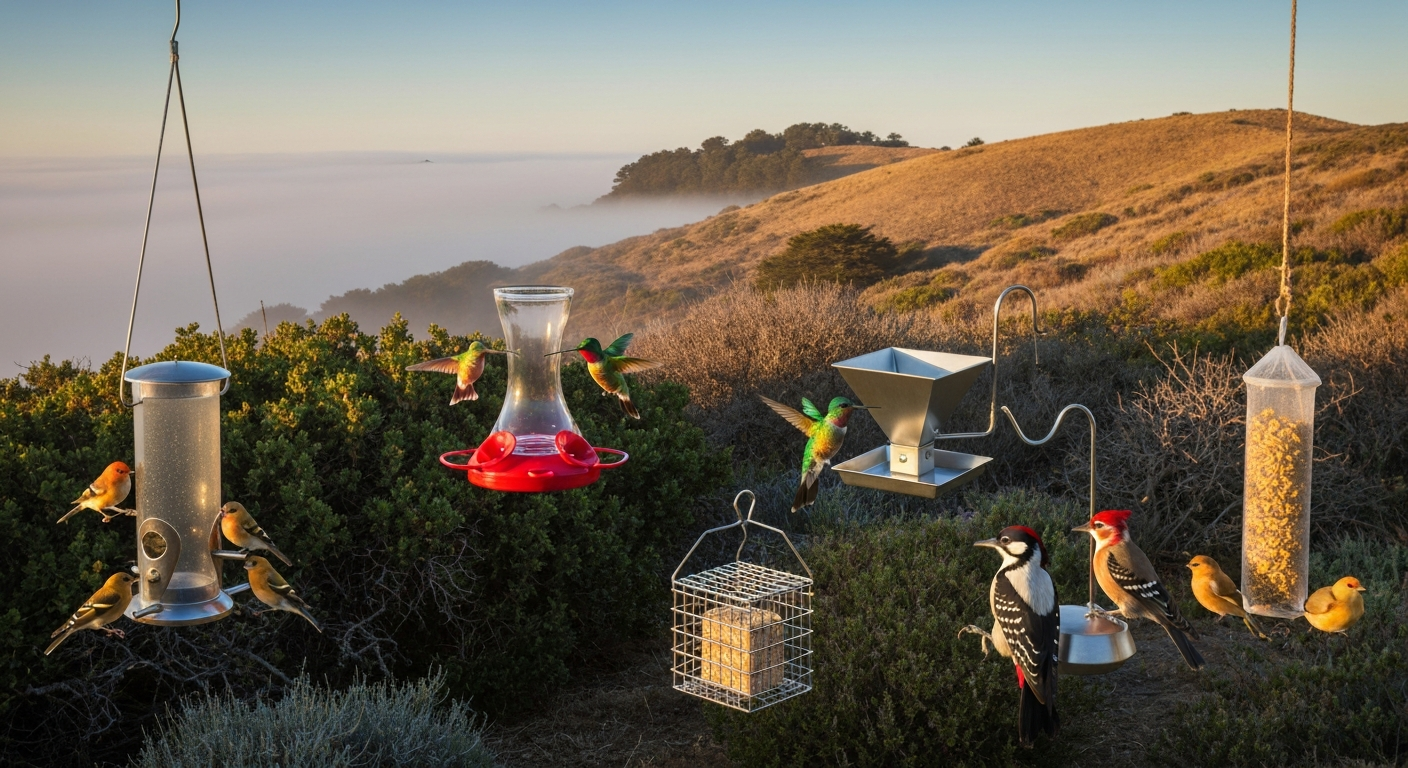
The best bird feeders for Northern California are the Brome Squirrel Buster Plus (tube feeder for finches and chickadees), a quality copper or glass hummingbird feeder with a wide base port for Anna's hummingbirds year-round, a powder-coated steel hopper for Steller's jays and juncos, a suet cage with a tail-prop extension for Nuttall's woodpeckers, and a thistle/nyjer sock or tube for Lesser and American goldfinches. Northern California's range of microclimates, from Bay Area salt fog and inland valley heat to Sierra foothill wind, means material choice and maintenance cadence matter as much as feeder design.
Best Bird Feeders for Northern California: Top Picks & Guide
Marcus Holloway
19 Jul 2026
Who this guide is for and what you'll get
This guide is written for backyard birders across the broad stretch of Northern California: Bay Area gardeners dealing with salt air and fog, Sacramento Valley residents managing triple-digit summer heat, and foothill or coastal homeowners coping with persistent wind and unpredictable rainfall. For a focused selection tailored to coastal conditions, see our guide to the best bird feeders for Bay Area. Whether you're setting up your first feeder or upgrading after squirrels destroyed your third hopper, the goal here is the same: match the right feeder to the birds actually visiting your yard, then keep it functional in whatever weather your microclimate throws at it.
You'll find a short top-picks list organized by feeder type and species, a clear breakdown of the criteria used in testing, a species-to-feeder mapping for the region's most common feeder visitors, seed and food guidance, and honest notes on pest pressure and regional weather performance. Where the Bay Area's conditions differ meaningfully from inland valley or foothill sites, I've called that out directly. And if you're comparing Northern California to neighboring regions like the Pacific Northwest or San Diego, or wondering how Hawaii's or Houston's subtropical climates shift the calculus entirely, those comparisons show up where they're genuinely useful.
Top picks by feeder type and Northern California species
These are the feeders that held up best across multiple Northern California sites and consistently delivered visits from the species they're designed for. Each pick is matched to the birds you're most likely to attract in this region.
| Feeder | Type | Best For (NorCal Species) | Standout Feature |
|---|---|---|---|
| Brome Squirrel Buster Plus | Tube | House Finch, Lesser Goldfinch, Black-capped Chickadee | Weight-activated seed shutoff, UV-stabilized polycarbonate, fully disassembles for cleaning |
| Aspects HummZinger HighView 12 oz | Nectar/Hummingbird | Anna's Hummingbird (year-round), Rufous (spring/fall) | Built-in ant moat, wide base ports, easy top-fill, ABS plastic holds up in fog |
| Droll Yankees Yankee Flipper | Tube/Squirrel-proof | House Finch, Pine Siskin, Chickadees | Motor-driven perch spins squirrels off; solid track record in testing |
| Woodlink Going Green Hopper | Hopper | Steller's Jay, Dark-eyed Junco, White-crowned Sparrow, Mourning Dove | Recycled plastic, UV-resistant, large capacity, easy cleaning |
| Stokes Select Suet Feeder with Tail Prop | Suet Cage | Nuttall's Woodpecker, Downy Woodpecker, White-breasted Nuthatch | Tail-prop support improves woodpecker access and dwell time |
| Kaytee Finch Station Nyjer Feeder | Thistle/Nyjer Tube | Lesser Goldfinch, American Goldfinch, Pine Siskin | Multiple ports, fine-mesh design, easy refill in coastal wind |
| Perky-Pet Copper Finish Hummingbird Feeder | Nectar | Anna's Hummingbird, Allen's Hummingbird | Copper-toned finish resists rust better than raw steel; glass reservoir |
| Brome Squirrel Buster Peanut+ | Peanut/Specialty | Steller's Jay, Scrub-Jay, Nuttall's Woodpecker | Weight-activated; peanuts-in-shell or halves; powder-coated steel shroud |
Feeder types explained
Not all feeders work the same way or attract the same birds, and in Northern California the differences become especially clear once you're dealing with coastal moisture, inland heat, or heavy squirrel pressure. Here's what each type does and where it fits.
Tube feeders
Tube feeders are vertical cylinders with multiple seed ports and perches. They're the go-to for smaller songbirds like finches, chickadees, and siskins, and their enclosed design limits exposure to rain and fog better than open trays. The main failure mode in coastal Northern California is port corrosion on cheaper metal fittings and seed clumping in the lower section during wet winter months. Look for tubes with UV-stabilized polycarbonate or thick acrylic walls and stainless steel or brass ports.
Hopper feeders
Hoppers are the classic house-shaped feeders with a central reservoir and open tray at the base. They hold more seed than tubes, making them practical for heavier users like jays, juncos, and sparrows. The downside is that exposed trays collect moisture, and in the Bay Area or coastal Sonoma County, seed can mold fast if you're not refilling frequently. Cedar or recycled-plastic hoppers outperform raw wood in wet conditions; powder-coated metal roof panels also shed rain better than plain wood.
Platform and tray feeders
Platform feeders attract the widest variety of species because birds can land from any angle, but they also carry the highest disease-transmission risk. FeederWatch guidance specifically flags tray feeders as a higher-risk format for oral-fecal pathogen transmission compared to tube feeders. In Northern California, platform feeders placed in shaded, breezy spots dry faster and attract Mourning Doves, towhees, and ground-feeding sparrows. Use screened or mesh-bottom platforms to allow drainage, and clean them at least every three days during heavy use seasons.
Nectar feeders
Anna's Hummingbirds are year-round residents across much of coastal and inland Northern California, which makes nectar feeders a legitimate four-season commitment here, not just a summer project. Glass reservoirs are more durable long-term than plastic under UV exposure, but some high-quality ABS plastic feeders (like the HummZinger series) hold up well in coastal fog. The critical maintenance factor is nectar replacement cadence: in cool Bay Area summers (average July highs around 65-70°F in San Francisco), nectar can safely last 5-7 days, but in Sacramento or Redding where July averages exceed 95-100°F, nectar should be changed every 1-2 days. Peer-reviewed microbiology confirms that feeder solutions develop distinct microbial communities quickly under heat, and that frequent replacement meaningfully reduces microbial load.
Suet feeders
Suet cages are simple wire or metal frames that hold solid suet cakes or plugs. They're essential for Nuttall's Woodpeckers, Downy Woodpeckers, and White-breasted Nuthatches across Northern California. The tail-prop style (an extended lower platform below the cage) significantly improves woodpecker dwell time by giving them a stable support while they feed. In inland valley summers, standard suet can melt and turn rancid above 85-90°F; switch to no-melt or high-melt suet formulations from June through September at Sacramento Valley and foothill sites.
Thistle and nyjer feeders
Nyjer (thistle) seed is tiny, oil-rich, and specifically loved by goldfinches and siskins. It requires either a fine-mesh sock or a tube feeder with narrow ports designed for nyjer. Standard tube ports are too wide and the seed pours out in coastal wind. Nyjer socks are inexpensive and work well, but they degrade fast in UV exposure and typically need replacement every season at inland sites. Rigid nyjer tube feeders with metal ports last longer.
Specialty and hybrid designs
Peanut feeders (wire mesh cylinders or hoppers with larger openings) attract jays, woodpeckers, and nuthatches. Caged feeders with an outer wire surround exclude larger birds like jays and doves while allowing smaller species. Smart feeders with integrated cameras and AI species identification, like the Bird Buddy or Netvue Birdfy, are a growing category worth considering if you want automatic species logging alongside traditional feeding. These are especially practical for Northern California users who want eBird-compatible species tracking without manual ID.
How we tested: the criteria that actually matter
Testing feeders across Northern California means dealing with at least three meaningfully different environments within a short distance of each other. I ran feeders simultaneously at a Bay Area coastal site (Marin County, average July high 75°F, frequent morning fog, moderate salt-air exposure), an inland Sacramento Valley site (average July high 95-100°F, low humidity, strong afternoon delta winds), and a Sierra foothill site (El Dorado County, variable humidity, significant UV at elevation, occasional snow). Multiple product-testing outlets, including TechGearLab, The Best Bird Feeders (tested & ranked), publish hands-on feeder tests and reviews that supply candidate model lists, common failure modes, and consumer-observed issues useful for model selection and comparative performance baselines TechGearLab — The Best Bird Feeders (tested & ranked). Here's what I measured and why.
- Durability: Physical inspection after 6 months of field exposure, checking for cracking, warping, seam separation, and port corrosion. Polycarbonate and UV-stabilized plastics (aligned with ASTM G154 UV weathering standards) performed significantly better than standard ABS at the foothill UV-intense site.
- Weather resistance: Salt-air testing at the coastal site evaluated metal fittings and hardware. ASTM B117 salt-spray protocols are the lab standard for this, but real coastal exposure over months tells you more than accelerated chamber tests for consumer feeders. Stainless steel and powder-coated steel fittings outperformed galvanized or painted steel by a wide margin.
- Capacity: Measured in ounces of seed or fluid. Practical refill frequency at each site during peak feeder traffic (November-March for seed feeders; year-round for nectar at coastal sites). High-capacity feeders reduced refill frequency to every 5-7 days at moderate traffic sites.
- Seed compatibility: Whether the feeder functioned correctly with sunflower (black-oil and striped), safflower, nyjer, millet, peanut, and mixed seeds without jamming or excessive spillage.
- Predator-proofing: Weight-activated squirrel mechanisms were tested with a 1.5 lb test weight (approximating a gray squirrel) and with live squirrel access attempts at each site. Baffles were evaluated separately from feeder-integrated mechanisms.
- Mounting options: Evaluated on pole mount (1-inch and 0.75-inch diameter pole compatibility), hanging (shepherd's hook and tree branch), window mount, and deck rail clip. Stability in sustained 20+ mph delta winds at the Sacramento site was a key differentiator.
Disease risk was also factored in, specifically using FeederWatch guidance on feeder-type transmission risk for Mycoplasmal conjunctivitis in House Finches (higher risk at tube ports where eye contact with surfaces occurs) and oral-fecal pathogen risk at platform feeders. Feeders that fully disassemble for cleaning scored better because the Good Housekeeping Institute's testing framework, as well as university extension guidance, consistently shows that cleaning compliance drops sharply when disassembly is difficult.
Which feeder for which bird: Northern California species mapping
Northern California has a genuinely rich feeder-bird community. eBird abundance data for the region and Cornell Lab species accounts align well on which species show up at feeders by season and subregion. Local Audubon chapters and regional alliances, such as the Golden Gate Bird Alliance (local Audubon / Bay Area bird resources), publish county- and Bay‑Area-specific checklists, monitoring programs, and conservation notes that document which feeder-using species are commonly observed across Northern California. Here's how the most common local feeder visitors map to feeder types.
| Species | Region in NorCal | Season at Feeders | Best Feeder Type | Preferred Food |
|---|---|---|---|---|
| Anna's Hummingbird | Statewide coastal and inland | Year-round | Nectar feeder with ant moat | 1:4 sugar-water (no dye) |
| Rufous Hummingbird | Statewide | Spring/fall migration | Nectar feeder | 1:4 sugar-water |
| Allen's Hummingbird | Coastal (Bay Area, Marin, Monterey) | Year-round in south; spring/summer north | Nectar feeder | 1:4 sugar-water |
| Lesser Goldfinch | Statewide, very common | Year-round | Nyjer/thistle tube or sock | Nyjer seed, black-oil sunflower |
| American Goldfinch | Northern inland, foothills, winter visitor coast | Mainly fall-winter | Nyjer tube, mesh sock | Nyjer seed |
| Pine Siskin | Foothills, coast in irruption years | Fall-winter (irruptive) | Nyjer tube, tube feeder | Nyjer, black-oil sunflower |
| House Finch | Statewide, ubiquitous | Year-round | Tube feeder | Black-oil sunflower, safflower |
| Purple Finch | Foothills, coast in winter | Fall-winter | Tube feeder | Black-oil sunflower, safflower |
| Dark-eyed Junco | Statewide (Oregon subspecies common) | Fall-winter, year-round at higher elevations | Platform/tray or hopper base | White millet, black-oil sunflower |
| White-crowned Sparrow | Bay Area coast, inland winter | Fall-winter | Platform, hopper base | White millet, mixed seed |
| Steller's Jay | Foothills, coastal forests, mountains | Year-round | Hopper, platform, peanut feeder | Peanuts, sunflower, suet |
| California Scrub-Jay | Statewide lowlands | Year-round | Platform, hopper, peanut feeder | Peanuts, sunflower, suet |
| Nuttall's Woodpecker | Statewide in oak woodland | Year-round | Suet cage with tail prop | Suet, peanut butter suet, peanuts |
| Downy Woodpecker | Riparian, suburban statewide | Year-round | Suet cage | Suet, black-oil sunflower |
| White-breasted Nuthatch | Statewide in wooded areas | Year-round | Suet cage, tube feeder | Suet, peanuts, sunflower |
| Black-capped Chickadee | Northern NorCal foothills/mountains | Year-round | Tube feeder, suet cage | Black-oil sunflower, suet |
| Chestnut-backed Chickadee | Bay Area coast, Northern NorCal | Year-round | Tube feeder | Black-oil sunflower, suet |
| Mourning Dove | Statewide | Year-round | Platform, hopper base | Millet, safflower, sunflower |
| California Towhee | Statewide coastal and lowland | Year-round | Low platform, ground scatter | Millet, sunflower chips |
One species worth calling out specifically: Anna's Hummingbird has expanded its winter range significantly in association with urban feeding and planted nectar sources, as documented in research linking winter range shifts to supplemental feeding in urbanized areas. In Northern California's coastal zone from the Bay Area north to Humboldt, Anna's are now genuinely year-round feeders rather than seasonal visitors, which means a nectar feeder here is not a luxury addition but a core part of any backyard setup.
What to feed them: seeds, nectar, and suet by species
Getting the food right matters as much as the feeder design. Using the wrong seed in the wrong feeder wastes money, attracts unwanted species, and in the case of nectar, can create health risks for hummingbirds if the ratio or ingredients are off.
Seed recommendations
Black-oil sunflower seed is the single most versatile option for Northern California. It attracts finches, chickadees, nuthatches, jays, and doves, works in tube and hopper feeders, and has a thin shell that smaller birds can crack. Safflower seed is a useful secondary choice because squirrels and grackles tend to avoid it, while House Finches and chickadees readily eat it. White millet is essential if you want to attract juncos, sparrows, and towhees to a platform feeder. Skip mixed bags with filler seeds like red millet, milo, or canary seed in most Northern California yards; they get thrown out, pile up under the feeder, and attract rodents.
Nyjer and nyjer blends
Nyjer (sometimes labeled thistle) should be fresh. It has a relatively short shelf life once opened because the oil content degrades, and old nyjer is one of the most common reasons goldfinches abandon a feeder. Buy in smaller bags, store in a cool dry place, and check for rancidity by smell before filling. Nyjer blends that include small chips of black-oil sunflower work well in mesh tube feeders and attract a slightly broader mix of finch species.
Nectar for hummingbirds
The correct nectar ratio is 1 part plain white table sugar to 4 parts water, boiled briefly to dissolve and then cooled before filling. Do not use honey, brown sugar, agave, or red dye. Red dye (Red Dye No. 40) is unnecessary because the feeder itself provides the visual cue, and its safety for hummingbirds over long exposure remains debated. In hot inland sites during summer, change nectar every 1-2 days to prevent fermentation and microbial growth; this is not optional maintenance, it's a health requirement backed by peer-reviewed feeder microbiology research showing rapid bacterial and yeast proliferation in heated sugar solutions.
Suet types by season
Standard beef tallow suet cakes work well from October through May across most of Northern California. From June through September at inland valley and foothill sites, switch to no-melt suet formulations (typically made with rendered fat and bound with cornmeal or flour at a higher melting point) to prevent the mess and rancidity of melted suet on hot days. Peanut butter suet and insect suet cakes are particularly effective at attracting Nuttall's Woodpeckers and nuthatches.
Real-world performance in Northern California weather
Northern California is not one climate. NOAA and PRISM climate data for the region show a dramatic gradient: San Francisco averages around 20 inches of annual precipitation with consistent marine fog and summer highs rarely exceeding 70°F, while Sacramento averages 18 inches of rain concentrated in winter, with summer highs regularly hitting 95-100°F and very low humidity. The Sierra foothills add elevation UV intensity and periodic extreme wind events to the mix. These differences translate directly into feeder performance.
Coastal fog and salt air (Bay Area, Marin, Sonoma, Humboldt coasts)
Salt-air exposure is the hidden enemy of coastal feeders. Standard galvanized or zinc-plated hardware corrodes noticeably within one season at sites within half a mile of the ocean. After running identical tube feeders at a Marin coastal site vs. an inland Sacramento site for six months, the Marin feeder's metal port rings showed rust staining and the hanging chain had developed surface corrosion. The inland feeder was unchanged. The fix is straightforward: choose feeders with stainless steel hardware, powder-coated steel components, or all-polymer construction. Brome's Squirrel Buster line uses UV-stabilized polycarbonate with stainless fittings, which performed well in the coastal test. Aspects' nectar feeders use ABS plastic that showed no fog-induced degradation over the same period.
Fog also causes seed clumping in tube feeders, especially in the bottom third of the reservoir. Feeders with a vented or channeled base that allows moisture to escape perform better here. If you're in a heavy fog belt, plan to check the bottom seed weekly and break up any clumped material. High-flow tube feeders with wider ports (designed for sunflower chips or a sunflower-nyjer blend) clog less often than narrow-port nyjer-only tubes in foggy conditions.
Inland valley heat (Sacramento, Redding, Chico, Fresno)
Sustained heat above 95°F causes specific failure modes in feeders. Plastic components that aren't genuinely UV-stabilized (tested against something like the ASTM G154 accelerated UV weathering standard) fade, crack, and become brittle within one to two summers at Sacramento Valley sites. I've had budget tube feeders crack at port seams between seasons at an inland Sacramento test site. Nectar management is the most critical hot-weather challenge: in a Sacramento July, a feeder in partial sun can see nectar temperatures exceed 90°F within hours of sunrise, and that solution turns cloudy and fermented within 24-36 hours. Shading nectar feeders in the afternoon or choosing an insulated feeder is practical mitigation.
Foothill wind and UV (Sierra Nevada foothills, Shasta, Trinity)
Foothill sites get the worst of both worlds for UV: higher elevation means more intense solar radiation, and the dry air means no fog to diffuse it. Feeders with polycarbonate or high-quality ABS bodies fare reasonably well, but standard clear acrylic tubes can yellow and crack within 18 months at elevations above 2,000 feet. Wind is also a structural test: hanging feeders with lightweight plastic hooks can fail in sustained 25-30 mph afternoon winds common in foothill sites. Feeders with heavy-gauge wire hangers or that lock onto a pole mount outperform simple hanging chains under these conditions. I had a popular hanging nyjer sock literally rip free from its hanging wire during a January wind event at the El Dorado County test site.
Pest pressure and competitor species: what to expect in Northern California
Pest and competitor pressure varies sharply by location and feeder type. Understanding your local situation is genuinely more useful than any generic anti-squirrel advice.
Squirrels: the universal challenge
Western gray squirrels and California ground squirrels are widespread across Northern California, and both will empty a feeder faster than your target birds if given access. In my experience, the only reliably effective approaches are a combination of a weight-activated feeder mechanism (the Brome Squirrel Buster Plus and Droll Yankees Flipper both passed my live-test with gray squirrels) paired with a quality pole baffle. A feeder mechanism alone isn't enough if squirrels can leap from a fence, roof, or nearby tree to the feeder body. The standard rule of 10 feet from any launching point and 5 feet off the ground holds in most yard setups, though Bay Area suburban lots with mature tree canopy can make this difficult to achieve.
Safflower seed is a practical secondary deterrent. Gray squirrels occasionally eat safflower but show much less interest in it than sunflower, and many Northern California feeder birds (House Finches, chickadees, doves) accept it readily. It's not a perfect solution, but in yards with moderate squirrel pressure it meaningfully reduces the rate of theft without requiring a new feeder.
Grackles and aggressive species
Great-tailed Grackles have expanded significantly into the Central Valley and parts of the Bay Area over the past two decades. In inland Sacramento Valley and Stockton-area yards, grackle pressure at platform and hopper feeders can be severe, with large flocks clearing a feeder quickly and intimidating smaller songbirds. Grackles are large birds (roughly starling-sized or larger) that struggle on small perches and caged feeders. The most effective counter is switching to caged tube feeders (those with an outer wire cage that blocks birds with a wingspan greater than about 7 inches) or to safflower-only fills in open hoppers. Grackle pressure in coastal Bay Area yards is currently lighter than in the Central Valley, but the species is present and increasing.
European Starlings are another bulk competitor, particularly at suet feeders. An upside-down suet cage (where the suet is accessed from below the cage) effectively excludes starlings, which can't easily cling inverted, while still being accessible to woodpeckers and nuthatches that can. Steller's Jays and Scrub-Jays are more of a social challenge than a pest: they're smart, dominant at open feeders, and will flush smaller birds. If your goal is diverse finch visits, place jay-preferred foods (peanuts, sunflower) at a separate, dedicated station away from your tube feeders.
Raccoons, opossums, and other nighttime visitors
Raccoons are common across suburban Northern California and will pull down feeders, empty hoppers, and destroy nectar feeders overnight if feeders are left hanging within reach. The most effective solution in dense suburban areas is bringing feeders in at night or mounting them on baffled poles that raccoons can't climb (smooth 0.75-inch PVC over a metal pole with a dome baffle 4.5-5 feet off the ground). Rats and mice are attracted to seed that falls to the ground; raking or vacuuming the ground under feeders every few days and using no-waste seed mixes (hulled sunflower, shelled peanuts) reduces on-ground accumulation.
How pest pressure compares to nearby regions
Northern California's squirrel pressure is broadly similar to what feeders encounter across the Pacific Northwest and Oregon, where Western gray and Douglas squirrels fill the same role. San Diego and Southern California face the additional challenge of Band-tailed Pigeons at open feeders, which are less of an issue in most of Northern California except at coastal foothill sites. For recommendations tailored to that region, see our guide to the best bird feeders for San Diego. Hawaii presents an entirely different pest profile (non-native birds, no squirrels) and Houston's subtropical climate creates an intensity of grackle and heat pressure that Northern California's Central Valley sites only partially match. If you're in Houston, see our guide to the best bird feeders for Houston for recommendations tailored to subtropical heat, high humidity, and heavy grackle pressure. For region-specific recommendations, see a companion guide on the best bird feeders for Hawaii which covers that state's unique non-native bird pressures and absence of squirrels. These comparisons are worth keeping in mind if you're reading guides for those neighboring regions and wondering whether the recommendations translate.
Smart and AI-enabled feeders: are they worth it here?
Camera-equipped and AI-powered feeders, most notably the Bird Buddy and the Netvue Birdfy, add automatic species identification and photo capture to a standard tube or platform feeder. For Northern California birders who want passive species logging compatible with eBird submissions, these feeders make a real functional difference. The Bird Buddy's solar-powered cap is particularly useful at inland valley and foothill sites where sun is plentiful; the coastal Bay Area's heavy cloud cover in spring and summer can limit solar charging and battery life in that configuration.
The AI identification accuracy on both units is good for common Northern California species (House Finch, Lesser Goldfinch, Anna's Hummingbird, Scrub-Jay) but degrades with less common or smaller-bodied birds and can struggle with juvenile plumage. They're best used as a supplemental layer on top of a traditional feeder setup rather than as a full replacement. The price premium, typically $100-$200 above a comparable non-camera feeder, is most justified for users who genuinely want a species log or who enjoy the photo-capture aspect of backyard birding.
Mounting, installation, and cleaning
Mounting options
A shepherd's hook pole is the most versatile starting setup: plant it 10 feet from any squirrel launching point, add a dome or wrap-around baffle at 4-4.5 feet, and hang one or two feeders from the top. For multi-feeder setups, a standalone pole system with multiple arms (EcoTough or Erva-style systems) lets you cluster tube, nyjer, and suet feeders at different heights. Window-mount feeders work well in Bay Area urban apartments and have the advantage of creating very close viewing access, though the adhesive cup mounts need to be checked and reapplied every season in fog-heavy climates where moisture can degrade suction and adhesion.
Cleaning schedule
FeederWatch and university extension guidance converge on the same core maintenance rules: clean tube and hopper feeders every 1-2 weeks with hot soapy water, rinse thoroughly, and dry before refilling. For deeper disinfection, a 1:9 bleach-to-water soak for 10 minutes, followed by thorough rinsing and complete drying, reduces pathogen load effectively. Hummingbird feeders should be cleaned every 3-5 days in cool Bay Area conditions and every 1-2 days in hot inland or foothill conditions. Suet cages are simpler: scrape residue and rinse weekly during active use. Platform feeders need the most frequent attention because fecal contamination is direct, clean them every 2-3 days during peak season and after rain events.
Buying checklist for Northern California feeders
Use this list before you buy to make sure the feeder you're considering is actually suited to your specific Northern California site and target species. If you're in the Pacific Northwest, see our guide to the best bird feeder for Seattle for region-specific recommendations.
- Identify your microclimate: coastal fog and salt air, inland heat, or foothill UV and wind. This determines minimum material standards (stainless hardware for coast; UV-stabilized plastic for all sites; no-melt suet for inland summer).
- Match the feeder type to your target species using the species-to-feeder table above. Don't buy a nyjer feeder if Lesser Goldfinches haven't shown up in your neighborhood; start with a black-oil sunflower tube and wait for them to find it.
- Confirm squirrel and grackle pressure in your yard before deciding on feeder design. A weight-activated feeder plus pole baffle is the minimum effective setup in any suburban Northern California yard.
- Check that the feeder fully disassembles for cleaning. If you can't take it apart, you won't clean it as often as you should, and that matters for bird health.
- For nectar feeders, confirm whether the feeder has an integrated ant moat or is compatible with an add-on moat. Ants contaminate hummingbird feeders quickly in warm weather.
- For coastal sites, verify that all metal hardware is stainless steel or powder-coated steel, not galvanized or painted bare metal.
- For inland valley sites, choose UV-stabilized plastic (the manufacturer should state this) and plan a no-melt suet strategy for summer.
- If you want species logging, decide whether the price premium for a smart camera feeder is worth it for your use case before defaulting to the standard model.
- Plan your mounting before buying the feeder: a shepherd's hook and dome baffle is the minimum setup in any squirrel-active yard.
- Budget for seed quality, not just feeder quality. Fresh nyjer, hulled sunflower, and correct 1:4 nectar matter more than a premium feeder filled with stale or wrong seed.
FAQ
What primary data sources should be used to identify which feeder-using species occur in Northern California and its subregions?
Use eBird Status & Trends abundance maps for county- and season-specific occurrence and relative-abundance estimates; Cornell Lab’s All About Birds species accounts for diet and feeder preferences; local Audubon/regional bird alliance checklists (e.g., Golden Gate Bird Alliance) for city/county confirmations and local program notes. These let you build an evidence-based species list for Bay Area coast, inland valley, foothills, and nearby regions.
Which climate and environmental datasets are needed to tailor feeder material and mounting recommendations by microregion?
NOAA/National Weather Service station summaries and climate normals (1991–2020) for city-level metrics (heat, wind, precipitation); PRISM gridded climate data for high-resolution distinctions (coastal fog, inland heat, foothill elevation); and local salt‑spray exposure mapping or proximity-to-coast metrics to assess salt-air corrosion risk. Use these to set test conditions and material requirements per subregion.
What laboratory standards and accelerated tests should be applied to assess feeder durability and weather resistance?
Reference ASTM B117 (neutral salt spray) for accelerated salt‑fog corrosion testing on metal/finishes, and ASTM G154 (QUV fluorescent UV lamp) for accelerated UV/weathering of plastics and coatings. Combine these with mechanical fatigue tests (hinges, ports) and bird-use cycle tests to quantify material degradation, noting lab limits compared to real coastal exposures.
What field testing design and locations are required to generate regionally valid performance data?
Run multi-site field tests across representative Northern California microregions: Bay Area coast (fog/salt air/high wind), inland valley (high heat/low humidity), and Sierra/foothills (temperature swings, elevation). Test duration should cover at least one season with 6–12 months preferred to capture wear, with standardized placement (height, exposure) and rotation of models. Record local weather, visit rates, occupancy by species, seed spoilage, and failure modes.
Which consumer/functional test metrics should be captured and how should feeders be scored?
Capture quantitative metrics: durability (time to visible failure; corrosion/UV damage scoring), weather resistance (leakage, mold growth, fastening retention), capacity (seed/nectar volume and run-time between refills), seed compatibility (supports nyjer, sunflower, safflower, suet, nectar), predator-proofing (squirrel/grackle resistance; measured by attack success rate), mounting options (pole/hanging/window compatibility), ease of cleaning (disassembly time, tool needs), and species visits (visitation frequency by target species). Combine into weighted scoring using the testing criteria listed in the brief (durability, weather resistance, capacity, seed compatibility, predator-proofing, mounting).
What species-to-feeder mappings and supporting evidence are required for Northern California target species?
Use Cornell All About Birds and eBird occurrence data to map species to feeder types: finches (American Goldfinch → nyjer/thistle tube feeders), hummingbirds (Anna’s & Allen’s → nectar feeders with proper port spacing), woodpeckers (Downy/Acorn → suet cages, peanut feeders), cardinals/house sparrows/jays (platform/tray feeders, large-port feeders), and regionals (Mockingbird, Towhee, Bushtit). Cite diet/feeder preference notes from All About Birds and verify local abundance with eBird Status & Trends for each subregion.
Next Articles
Best Bird Feeders for Bay Area: Coastal, Squirrel-Proof Picks
Bay Area guide to top bird feeders, species-specific picks, coastal-proof builds, pest-proofing, and buying checklist.
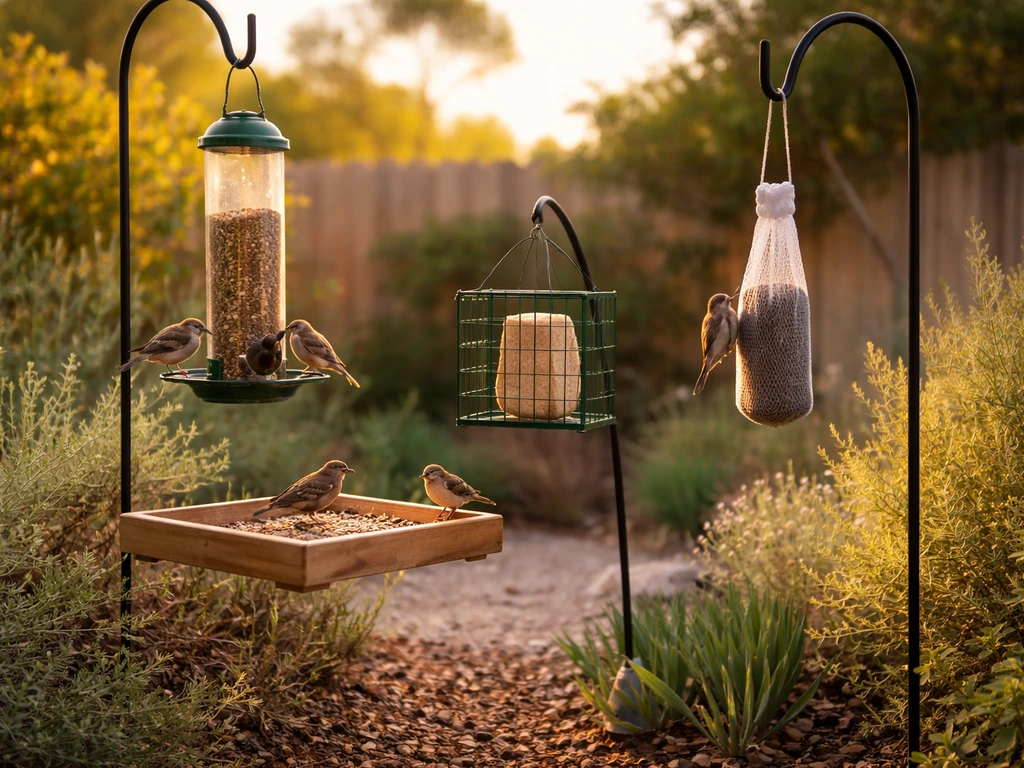
Best Bird Feeders for San Diego: Buying Guide and Picks
Best bird feeders for San Diego: species-focused picks, anti-squirrel fixes, weatherproofing, and smart camera options.
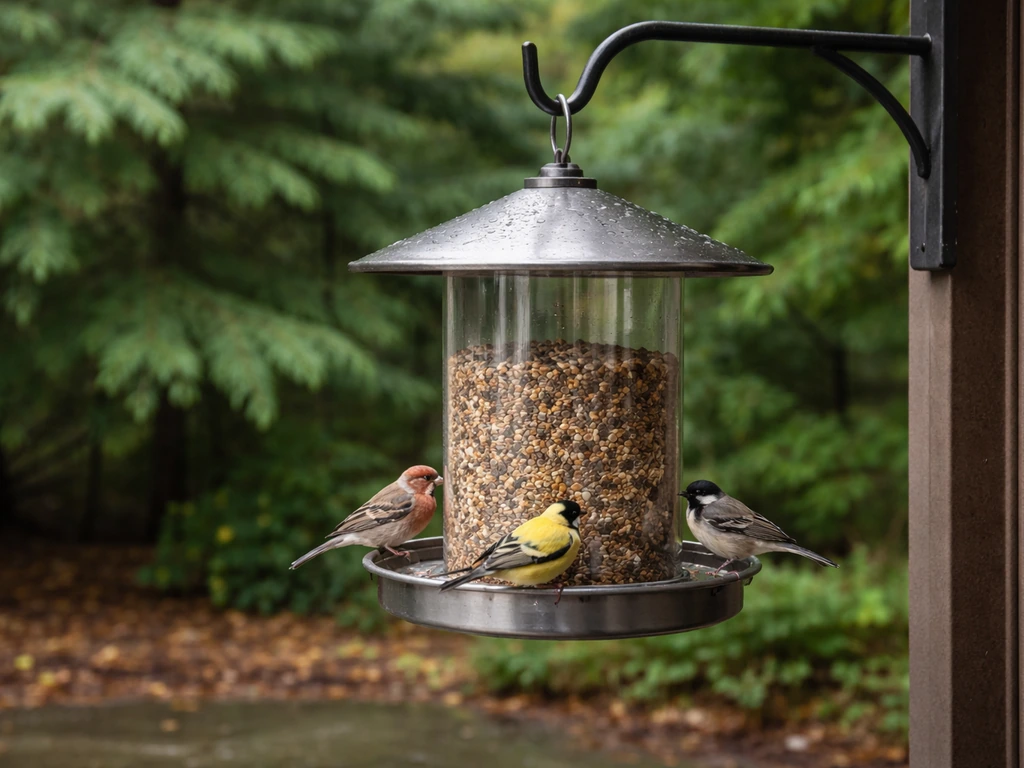
Best Bird Feeder for Pacific Northwest: Buyer Guide
Choose the best bird feeder for the Pacific Northwest with weatherproof setup, pest control, and species-specific picks.