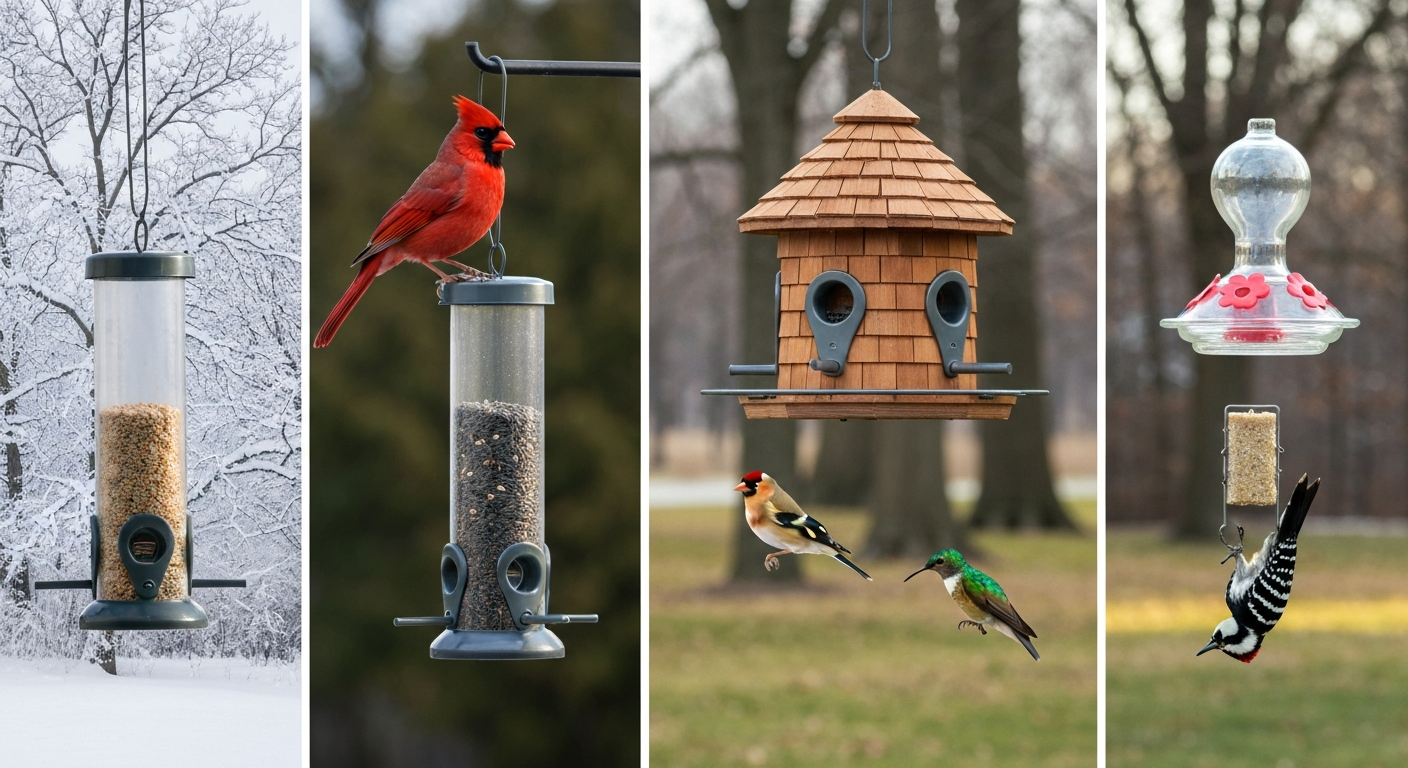
Illinois is genuinely one of the better states in the Midwest for backyard birding. You get year-round regulars like Northern Cardinals and Black-capped Chickadees, a strong wave of Ruby-throated Hummingbirds every summer, wintering Dark-eyed Juncos, and the full chaos of spring and fall migration funneling right through the state along the Mississippi Flyway. The best bird feeders for Illinois are ones that can handle -15°F wind chills and ice storms in January just as well as they handle July humidity, keep squirrels and grackles at bay, and actually attract the specific species you want to see. After testing feeders across multiple Illinois seasons, the clearest recommendations by type are: a weight-sensitive tube feeder for general use, a caged suet cage for woodpeckers, a dedicated nyjer sock or fine-port thistle feeder for goldfinches, a wide platform or hopper for cardinals and doves, a nectar feeder with ant moat for hummingbirds, and a smart camera feeder if you want AI-assisted species ID. The sections below break all of that down in detail.
Best Bird Feeders for Illinois: Top Picks & Buying Guide
Why Illinois deserves its own feeder guide
Generic feeder guides written for a national audience tend to gloss over regional conditions that actually matter. Illinois sits in USDA Hardiness Zones 5a through 6b depending on where you are in the state, with Chicago metro winters averaging lows around 14°F in January and southern Illinois running noticeably milder. NOAA's 1991-2020 climate normals show Illinois averages 25 to 38 inches of annual snowfall in the north and less than 10 in the south. Freeze-thaw cycles are constant from November through March, and that repeated expansion and contraction is what destroys cheap plastic seed ports, warps wooden roofs, and cracks poorly formulated acrylic tubes faster than any single cold snap. On top of that, Illinois has a specific pest pressure problem: Common Grackles and European Starlings are abundant and aggressive at feeders, and squirrels are everywhere from Chicago suburbs to rural downstate yards. A feeder that works beautifully in Arizona or Florida may be structurally inadequate and functionally useless here within a single winter. The species mix also skews toward woodland-edge birds, including species that neighboring states like Michigan and Missouri share, so some of these recommendations translate directly across the broader Midwest region.
How to choose the right feeder for your Illinois yard
Before buying anything, answer five questions honestly: What birds do you actually want to attract? How large is your yard and how much activity can you manage? Where will the feeder physically go? Do you have squirrels, grackles, or raccoons? And what is your realistic budget for both the feeder and the ongoing seed cost? These five factors will eliminate most wrong choices before you spend a dollar.
Target species
Species dictate feeder style more than anything else. Cardinals prefer wide, stable perches or open platforms and will not squeeze into narrow tube ports the way House Finches do. Goldfinches almost exclusively use thistle/nyjer feeders with fine ports. Woodpeckers need vertical suet cages or clinging feeders. Hummingbirds require nectar feeders with red accents. If you just want maximum variety, a hopper or platform feeder filled with a black-oil sunflower seed mix covers the most ground.
Yard size and placement
University of Illinois Extension recommends positioning feeders either within 3 feet of a window (to prevent dangerous collision speeds) or more than 30 feet away. Nearby shrubs or brush piles give birds safe escape cover, but the feeder itself should be in the open so you can spot approaching predators and so cats cannot stalk from adjacent vegetation. For squirrel management, a pole-mounted feeder with a baffle needs at least 10 feet of clearance from any launch point: trees, fences, deck rails, or overhanging branches. That is harder than it sounds in a mature suburban Illinois yard, so also factor in weight-sensitive shutoff designs.
Pest pressure and budget
Penn State Extension is blunt on this point: there is no truly squirrel-proof feeder. Weight-sensitive feeders that shut off ports when something heavier than a songbird lands are the most effective deterrent tested in repeated trials, but they cost more upfront. Caged feeders physically block larger animals but also exclude larger desirable birds. Budget-wise, a solid beginner setup for an Illinois yard (one tube feeder, one suet cage, one thistle feeder, a baffle, and a pole) runs roughly $80 to $150 before seed. Smart camera feeders add another $100 to $250. Going cheap on the feeder itself rarely saves money once you account for seed waste from cracked ports, weather damage, or a squirrel that learned to dismantle the tray.
Top picks by feeder type
Best tube feeder
For a general-purpose tube feeder in an Illinois yard, look for UV-stabilized polycarbonate or borosilicate glass tubes (not standard acrylic), metal-reinforced ports, and a powder-coated or stainless steel frame. The Brome Squirrel Buster Plus is the benchmark here: it uses a weight-sensitive mechanism that closes seed ports when a squirrel (or a grackle, which is heavy enough to trigger it) lands on the cage, and the entire unit disassembles into a dishwasher-safe form for weekly cleaning. It holds about 5.1 quarts of black-oil sunflower seed, which is enough capacity for a busy Illinois yard without seeds sitting long enough to mold. The perch ring design accommodates clinging birds like nuthatches and chickadees without giving grackles a stable foothold. It is expensive at around $60 to $80, but after one winter of watching cheaper tube feeders crack at the seam, the cost is easy to justify.
Best hopper feeder
Hopper feeders are the Illinois workhorses for cardinals, House Finches, and mixed flocks. A cedar or powder-coated metal hopper with a wide tray, drainage holes in the base, and a roof with at least a 2-inch overhang handles Illinois rain and snow load reasonably well. The Perky-Pet Squirrel-Be-Gone II and the Woodlink Going Green hopper (made from recycled plastic) both perform well in cold weather. The Going Green version is particularly good at resisting freeze-thaw cracking because it flexes slightly rather than becoming brittle. Look for hoppers with removable trays so you can clean out wet seed before it ferments, which is a genuine problem during Illinois spring rains.
Best platform feeder
Platform feeders attract the widest variety of birds including Mourning Doves, cardinals, sparrows, and even ground-feeding migrants passing through. The tradeoff is that they expose seed to weather completely and require the most frequent cleaning of any feeder type. A platform with a mesh screen bottom (rather than solid wood or plastic) drains rain immediately and lets air circulate under seed, which dramatically slows mold. The Birds Choice recycled-plastic platform and the Aspects Quick Clean Platform both use this drainage approach. Keep the total capacity modest: a platform you can refill daily is better than a large one where seed sits wet for days.
Best suet feeder
A basic vinyl-coated wire suet cage costs under $5 and works fine for Downy and Hairy Woodpeckers, but adding a tail-prop extension (a board below the cage that gives woodpeckers something to brace against) improves usage significantly. The Kettle Moraine Upside-Down Suet Feeder is worth the upgrade if Starlings are destroying your suet: it forces birds to cling and feed from below, which Downy Woodpeckers, nuthatches, and chickadees handle easily while Starlings (which lack the clinging instinct) give up quickly. During Illinois summers above 90°F, switch to no-melt dough suet cakes rather than standard rendered suet, which liquefies and can clog feathers.
Best thistle/nyjer feeder
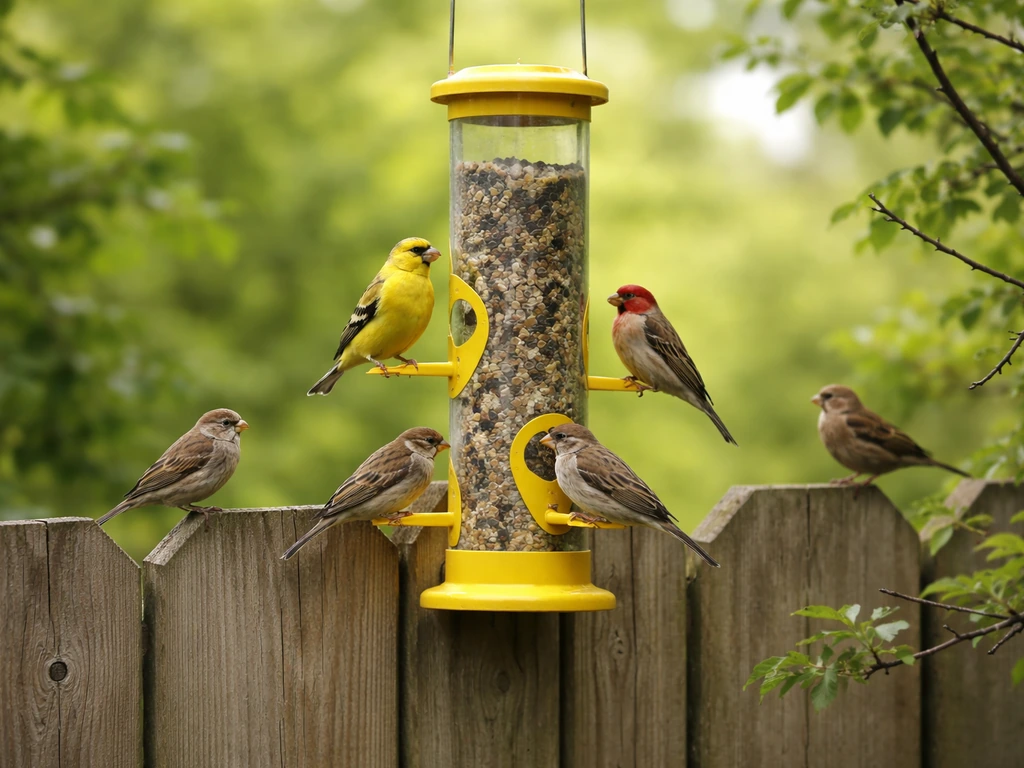
American Goldfinches are everywhere in Illinois from spring through fall, and a nyjer sock or a fine-port tube feeder is the only efficient way to serve them. Nyjer seeds are tiny and pass straight through standard tube ports, so you need a feeder specifically designed with fine slits or mesh. The Droll Yankees Finch Magnet (a mesh sock style) and the Aspects 367 HummZinger feeder (a tube design) are both durable enough for Illinois winters. One practical note: nyjer seed goes rancid faster than sunflower seed, especially through Illinois summer heat. Buy smaller bags, rotate stock, and shake feeders regularly. If goldfinches abandon a thistle feeder you know was busy, stale seed is almost always the reason.
Best nectar/hummingbird feeder
Ruby-throated Hummingbirds arrive in Illinois roughly between late April and early May and depart by mid-October, with peak activity in August. A glass-bodied nectar feeder outperforms plastic in Illinois summers because glass does not leach plasticizers into nectar at high temperatures and cleans more thoroughly. The Aspects HummZinger Excel (16 oz, saucer-style with a built-in ant moat) and the More Birds Diamond Glass feeder are both solid performers. Avoid red dye in nectar: plain 4:1 water-to-white-sugar solution is all you need. In temperatures above 85°F, change nectar every two days to prevent fermentation. Hummingbirds will reject cloudy or fermented nectar immediately.
Best smart/camera feeder
Smart bird feeder cameras have become genuinely useful in the last three years. The Bird Buddy and the Netvue Birdfy are the two most-tested options in this category. Both use on-device or cloud-assisted image recognition to identify visiting species and push notifications to a smartphone app. Bird Buddy uses a rechargeable solar-assisted battery and identifies birds using a visual AI model; it works well for common Illinois species like cardinals, chickadees, and goldfinches but struggles with similar-looking sparrow species in low light. The Netvue Birdfy connects via 2.4GHz Wi-Fi and records video clips, which is useful for reviewing activity you missed. Neither replaces deliberate field observation, but for passive monitoring of a busy yard they are genuinely fun and increasingly accurate. Privacy considerations apply: both send video data to cloud servers, which matters if your feeder overlooks a deck or yard where people move around.
Top picks by species
Species-specific recommendations let you spend your seed and feeder budget where it actually makes a difference. Here is how I approach each of the core Illinois feeder birds.
| Species | Best Feeder Style | Best Food | Notes for Illinois |
|---|---|---|---|
| Northern Cardinal | Hopper or wide platform tray | Black-oil sunflower, safflower | Safflower deters squirrels and grackles; cardinals readily accept it |
| American Goldfinch | Fine-mesh nyjer sock or tube | Nyjer (thistle) seed | Year-round resident; brightest plumage April–September |
| House Finch | Tube feeder, any port size | Black-oil sunflower, nyjer | Very common; tolerates crowded feeders well |
| Black-capped Chickadee | Tube or small hopper | Black-oil sunflower, shelled peanuts | Caches food; visits quickly and leaves |
| White-breasted Nuthatch | Tube, suet cage, or upside-down suet | Sunflower, peanut pieces, suet | Climbs headfirst down; upside-down suet ideal |
| Downy/Hairy Woodpecker | Suet cage with tail-prop extension | Suet, peanut pieces, sunflower chips | Hairy needs a larger cage; both avoid starling-proof upside-down style |
| Ruby-throated Hummingbird | Saucer-style glass nectar feeder | 4:1 water/white sugar nectar | Present May–October; change nectar every 2 days above 85°F |
| Mourning Dove | Ground or low platform feeder | Millet, sunflower, cracked corn | Prefers feeding below other birds; avoid high perch feeders |
| Common Grackle / European Starling | Caged or weight-sensitive feeder (to exclude) | N/A (target is exclusion) | Upside-down suet, weight-shutoff tubes, safflower seed all reduce access |
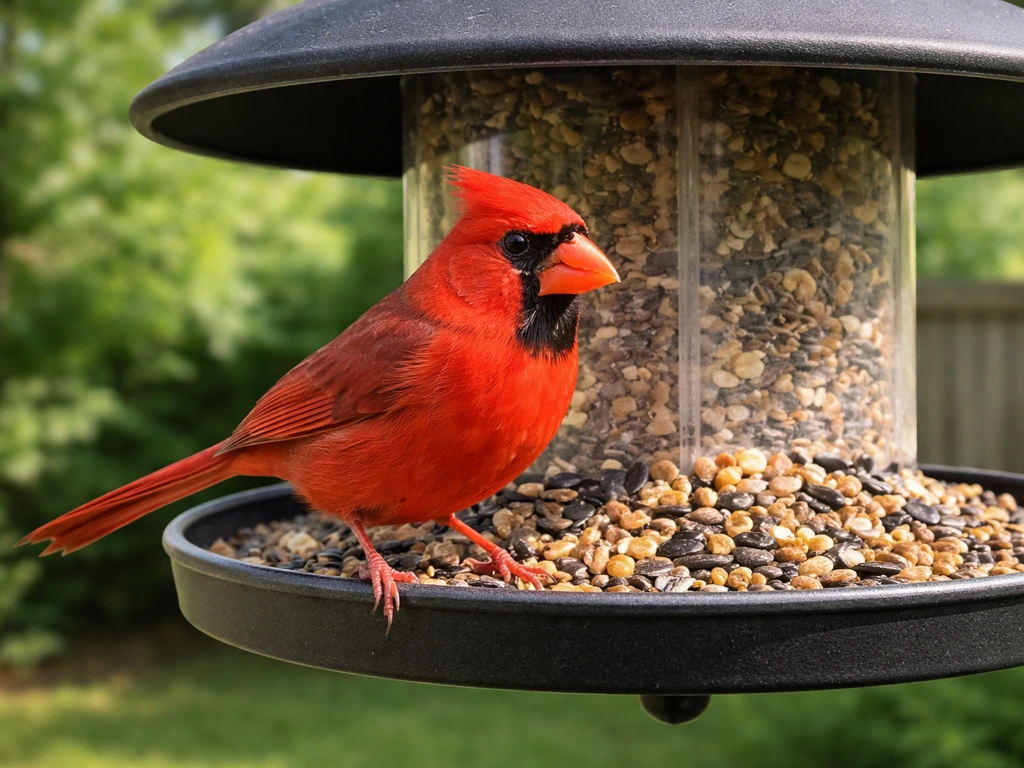
Cardinals are the feeder anchor for most Illinois yards. They show up year-round, and getting one male cardinal to your yard usually brings a pair and eventually a small winter flock. The key is offering safflower seed alongside or instead of sunflower. Safflower tastes bitter to squirrels, grackles, and most House Sparrows, but cardinals eat it readily. For goldfinches, freshness matters more than feeder brand: a $6 mesh sock with fresh nyjer will outperform a $40 tube feeder with seed that has been sitting since June. For grackles and starlings, the goal is exclusion rather than attraction. Upside-down suet feeders and weight-sensitive tube feeders are the two most effective tools without resorting to complete feeder removal.
Feeder type comparison: which style fits your setup
| Feeder Type | Best For | Illinois Advantages | Illinois Disadvantages | Pest Resistance |
|---|---|---|---|---|
| Tube | Finches, chickadees, nuthatches, House Finches | Easy to squirrel-proof with cage or weight mechanism; fast to refill | Smaller capacity; ports can crack in freeze-thaw without UV-stable materials | High (with cage or weight shutoff) |
| Hopper | Cardinals, finches, mixed flocks | Large capacity; covered seed stays drier in rain and snow | Wet seed can mold in sealed base without drainage holes; heavy to clean | Medium (add baffle on pole) |
| Platform/Tray | Cardinals, doves, sparrows, migrants | Maximum species variety; good for ground feeders | Seed fully exposed to weather; molds fastest; no pest barrier | Low (fully open) |
| Suet | Woodpeckers, nuthatches, chickadees | Year-round use; low mess; high caloric value for cold weather | Starlings and grackles raid standard cages; melts above 90°F | Medium (upside-down style deters starlings) |
| Thistle/Nyjer | Goldfinches, Pine Siskins, redpolls | Attracts birds squirrels largely ignore; low mess | Seed goes rancid quickly in heat; requires specialized feeder | High (squirrels rarely bother nyjer) |
| Nectar/Hummingbird | Ruby-throated Hummingbird | High engagement; no waste seed on ground | Nectar ferments rapidly in Illinois summer; must change every 2 days in heat | High (ant moat blocks most insects) |
If I had to pick one feeder for a first-time Illinois yard, it would be a weight-sensitive tube feeder filled with black-oil sunflower seed. It handles the broadest mix of common species, deters the most common pests, and is the easiest to keep clean. Add a suet cage second, especially from October through March when woodpeckers and nuthatches are most dependent on high-fat food. A nyjer feeder is worth adding once you see goldfinches in the yard, which in most of Illinois will happen by April.
Smart feeders and camera options: are they worth it for Illinois yards
The practical case for a smart feeder camera in an Illinois yard is stronger than it might seem. Illinois sits on a major migration corridor, and from late April through May and again in September and October, you can get species appearing at your feeder for just a day or two. A camera feeder set to push notifications to your phone means you can catch a Rose-breasted Grosbeak or a brief Purple Finch visit that you would otherwise miss entirely. That said, these are not magical devices, and the limitations are worth understanding before you spend $150 to $250 on one.
How the AI identification actually works
Current smart feeders like the Bird Buddy and Netvue Birdfy use image-based AI running either on the device or via cloud processing. Bird Buddy processes images locally for basic detection and sends uncertain cases to the cloud. Netvue Birdfy streams video to cloud servers for clip storage and species tagging. Research on automated bird identification (including work from the BirdNET team at Cornell Lab) consistently shows that AI accuracy varies significantly by species and context: common, visually distinctive birds like cardinals and goldfinches are identified correctly at high rates, while confusingly similar sparrow species, females versus males in non-breeding plumage, and juveniles produce more errors. Automated bird sound classifications produce occupancy model outputs similar to manual annotations, Cole et al., Ornithological Applications (2022) Automated bird sound classifications produce occupancy model outputs similar to manual annotations — Cole et al., Ornithological Applications (2022). Independent evaluations recommend treating AI identifications of common species with confidence and AI identifications of uncommon species as a prompt to verify rather than a confirmed record. For an Illinois yard focused on regular feeder birds, the accuracy is good enough to be genuinely useful.
Power, connectivity, and privacy
Both major smart feeder options require a 2.4GHz Wi-Fi network within range of your feeder location, which rules out mounting them at the back of a large yard far from the house router. Bird Buddy includes a small solar panel that helps maintain a battery charge but does not fully replace wired power in Illinois winters when days are short and overcast. Netvue Birdfy requires a USB power connection, which means running a weatherproof extension cord or positioning it near an outdoor outlet. Privacy is a real consideration: both platforms store video clips on cloud servers, and if your feeder overlooks a patio, deck, or door where household members move regularly, you are effectively operating a continuously recording outdoor camera. Read each platform's data retention and sharing policies before setup. For users uncomfortable with cloud video storage, a traditional feeder with a separate wildlife camera on a manual SD card is a reasonable alternative.
Midwest-specific performance notes
Cold temperatures affect both battery life and image quality. At temperatures below 20°F, lithium battery capacity drops noticeably, which is a real concern for Bird Buddy in northern Illinois during January cold snaps. The camera lens on both units can fog in the rapid temperature shifts common during Illinois spring and fall. Mounting the feeder in a south-facing position reduces lens fogging and maximizes solar charging efficiency. If you run a smart feeder through a full Illinois winter, expect to bring the unit inside for overnight charging during the coldest stretches.
Real-world testing insights: what actually matters in daily use
I have gone through enough Illinois winters with enough different feeders to have strong opinions about what matters in practice versus what sounds good in a product description. Here are the things that make or break a feeder in real use.
- Stability in wind: Illinois gets sustained wind of 20-30 mph on a regular basis, especially in open suburban and rural yards. A hanging feeder with a narrow hanger wire will spin continuously, spilling seed and eventually fatiguing the wire at the hook. Look for feeders with a wide-mouth hanger loop or a stabilizing cage design that reduces rotation.
- Refill frequency and access: Any feeder you dread refilling gets neglected, and neglected feeders develop moldy seed that can sicken birds. Wide-mouth openings, twist-off reservoirs, and top-access designs all beat bottom-fill or narrow-neck tubes for ease of refilling in cold weather when you are wearing gloves.
- Bird acceptance timelines: Birds do not discover new feeders instantly. In my experience, a new tube feeder placed in a familiar spot takes 3 to 10 days to get its first regular visitor, depending on how established the yard feeding population is. Chickadees are typically the first to investigate, followed by House Finches, then cardinals. Patience is required.
- Cleaning practicality: A feeder you cannot disassemble fully will develop mold in hidden corners. The CDC and Cornell Lab both recommend cleaning feeders with a 9:1 water-to-bleach solution every 1-2 weeks, more frequently in wet spring and summer conditions. Dishwasher-safe components are a genuine quality-of-life upgrade.
- Seed waste and ground mess: Tube feeders with short perches and weight-sensitive ports waste dramatically less seed than open hoppers or platforms. Seed on the ground attracts rats, mice, and raccoons in addition to ground-feeding birds, so this is worth managing actively. No-waste seed mixes (hulled sunflower, shelled peanuts, no filler millet in a tube) reduce shell debris significantly.
One thing that surprised me in testing: birds at a busy Illinois feeder develop strong feeder fidelity. Once a population of regulars has established at a specific feeder location, removing that feeder for even a few days during cleaning disrupts feeding patterns in ways that take another week to fully restore. If possible, have a spare identical or similar feeder to swap in while one is being cleaned, especially in winter when food availability matters most to birds.
Materials and build quality for Illinois weather
Illinois's climate puts feeders through genuine stress: sub-zero cold, freeze-thaw cycles several times per week in shoulder seasons, summer heat above 95°F, UV exposure, and ice storms that can coat everything in a quarter inch of ice. The material choices in a feeder's construction determine whether it lasts one season or five.
Plastics and polymers
Standard acrylic (PMMA) becomes brittle at low temperatures and develops UV yellowing and microcracking within two to three Illinois seasons. UV-stabilized polycarbonate (marketed under trade names like LEXAN and Makrolon) performs dramatically better: it retains impact resistance down to -40°F and resists UV yellowing with appropriate stabilizer additives. If a feeder listing does not specify UV-stabilized or UV-protected polycarbonate, assume it is standard acrylic and plan for a shorter useful life. Recycled HDPE (used in feeders like the Woodlink Going Green line) is also excellent: it is dense, weather-resistant, and does not crack in freeze-thaw cycles.
Metal components and hardware
Powder-coated steel is the standard for feeder frames, trays, and hanging hardware. Coating quality varies enormously: thick, properly cured powder coat over prepared steel holds up well for three to five years in Illinois conditions, while thin or poorly applied coatings chip within months, exposing bare steel that rusts quickly. Stainless steel hardware (hanger cables, perch rods, cage mesh) is worth paying for on any feeder. If your yard is near a salted road or sidewalk (common in Chicago suburbs), hardware-grade 316 stainless resists chloride pitting better than the more common 304 grade.
Wood components
Untreated cedar is the best wood for outdoor feeders in Illinois: it has natural decay resistance and handles moisture cycling without the warping that affects pine and poplar. Avoid pressure-treated lumber in any feeder component that contacts seed or birds, as preservative chemicals (historically CCA, now typically ACQ or CA formulations) are not appropriate for wildlife contact applications according to NPIC guidance. If a wooden hopper or platform roof is showing gray weathering, that is normal surface oxidation; if it is showing black streaks, soft spots, or swelling at joints, it needs replacement. A quality cedar hopper, properly maintained, should last five to eight Illinois winters.
Winterizing your feeders
A few practical steps make a real difference across an Illinois winter. Keep tube feeder ports clear of ice with a quick tap before morning feeding hours. Empty and dry suet cages during ice storms: ice-coated suet is inaccessible to birds and the added weight stresses hanging hardware. Store nyjer seed indoors; it degrades faster when repeatedly frozen and thawed. For nectar feeders, either bring them in when overnight temps drop below 32°F or keep a backup ready to swap in each morning (hummingbirds arrive at feeders at dawn and need nectar available immediately). A heated birdbath nearby significantly increases the attractiveness of your overall setup during dry cold spells when natural water sources freeze solid.
Squirrel-proofing, grackle control, and predator management
Pest management at Illinois feeders deserves its own serious section because it is where most setups fall apart. Squirrels are not just opportunistic: they are systematic. A squirrel that fails to access a feeder today will return and try a different approach tomorrow. Grackles are a different problem: they are native, protected under the Migratory Bird Treaty Act, and cannot be harassed or trapped, but they can be excluded through feeder design.
Squirrel strategies that actually work
- Mount feeders on a smooth metal pole at least 5 feet high with a wide dome or torpedo baffle below the feeder. The baffle needs to be at least 18 inches in diameter to prevent squirrels from wrapping around it.
- Maintain at least 10 feet of clearance from any potential launch point: trees, fence posts, deck railings, and even neighboring poles or utility lines.
- Use a weight-sensitive feeder (Brome Squirrel Buster line) as a secondary defense for tube feeders. Even if a squirrel reaches the feeder, the port closes under their weight.
- Switch to safflower seed in hopper and platform feeders. Most squirrels dislike the bitter taste and will ignore safflower while cardinals eat it enthusiastically.
- Do not use corn, mixed seed with millet, or cracked corn if squirrel pressure is high. These are squirrel favorites and actively draw them in.
Grackle and starling exclusion
Common Grackles are large (heavier than most songbirds), which makes weight-sensitive feeders effective against them too. But the most reliable approach for suet is the upside-down feeder design: woodpeckers and nuthatches cling and feed from below naturally; grackles and starlings do not have the instinct to try. For seed feeders, a cage that limits access to birds smaller than a certain size (typically excluding anything larger than a House Sparrow or House Finch) also excludes grackles. Tube feeders with short perches (under 0.5 inches) make it physically difficult for large birds to stabilize themselves. Offering safflower instead of sunflower in open feeders reduces grackle interest significantly, since most grackles prefer corn and sunflower.
HPAI and disease protocols
During HPAI (highly pathogenic avian influenza) outbreak events, the IDNR and USDA APHIS have recommended temporary removal of bird feeders and birdbaths, particularly for households near commercial poultry operations. Illinois had significant HPAI activity in 2022, and the IDNR issued specific guidance recommending feeder removal in affected counties. The standard post-event cleaning protocol is a 9:1 water-to-bleach soak for 10 minutes followed by thorough rinsing and drying. Regardless of HPAI status, cleaning feeders with this solution every one to two weeks year-round reduces bacterial and fungal contamination from moldy seed, wet hulls, and bird droppings.
Mounting and placement solutions
Where you physically put a feeder matters almost as much as which feeder you choose. Illinois yards range from small urban plots in Chicago with limited pole space to large rural properties where placement options are nearly unlimited. Each mounting approach has practical tradeoffs.
| Mounting Type | Best Feeder Types | Illinois Advantages | Limitations |
|---|---|---|---|
| Freestanding pole with baffle | Tube, hopper, platform, suet | Best squirrel protection; adjustable height; stable in wind | Requires clear 10-ft zone from any launch point; needs ground-set installation |
| Hanging from tree branch | Tube, nyjer, suet cage, nectar | Easy to install; looks natural | Squirrels access easily; tree movement spills seed; branch ice load dangerous |
| Deck rail mount | Tube, small hopper, nectar | Convenient for refilling; close viewing | Squirrels jump from rail; seed mess on deck; limited field of view for camera feeders |
| Window mount (suction cup) | Small tube, platform | Closest bird viewing; great for camera feeders | Weight limit low; fails in temperature extremes; birds need time to accept |
| Shepherd's hook | Light tube, suet cage, nectar | Inexpensive; portable; easy to reposition | Thin hooks bend under ice load; limited squirrel resistance without dedicated baffle |
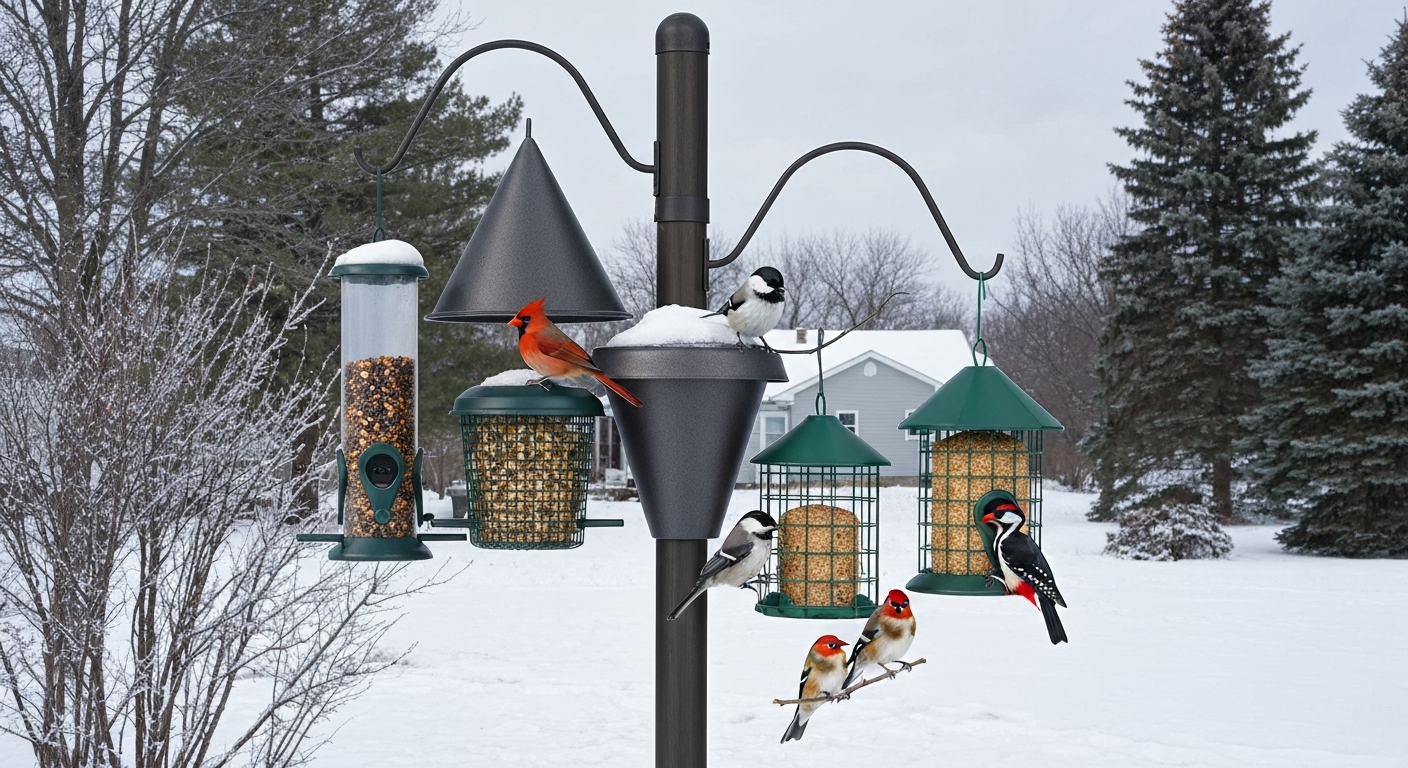
For most Illinois suburban yards, I recommend a dedicated 1-inch diameter steel pipe set 18 to 24 inches into the ground with a wide dome baffle and a two or three arm bracket for hanging multiple feeders. This setup can be moved seasonally, handles Illinois wind without tipping, and gives you a real squirrel barrier. Window feeders are a strong second addition, particularly for watching specific birds up close, and they work well for smart camera feeders that benefit from close proximity to subjects.
Seed, food recommendations, and seasonal care
Seed quality affects bird traffic more than most feeder buyers expect. Cheap mixed seed bags from big-box stores often contain high proportions of red milo and fillers that most Illinois feeder birds actively avoid. The result is a full feeder that gets ignored, seed left sitting until it molds, and a lot of wasted money. Here is what actually moves in an Illinois yard by season.
- Black-oil sunflower seed: the single best all-purpose choice. Thin shells are accessible to small birds; high fat content supports winter birds. Use it in every tube and hopper feeder.
- Safflower seed: a direct substitute for sunflower in cardinal-focused feeders. Deters squirrels, grackles, and most House Sparrows while remaining highly attractive to cardinals, chickadees, and doves.
- Nyjer (thistle) seed: essential for goldfinches, Pine Siskins, and Common Redpolls (winter visitors in northern Illinois). Store indoors; rotate frequently.
- Suet cakes: critical from October through March. High-fat standard rendered suet in winter; no-melt dough suet from May through September. Peanut-flavored or insect suet increases woodpecker interest.
- Shelled peanuts: excellent for chickadees, nuthatches, and Blue Jays. Use in a dedicated peanut feeder or mixed into a tray. Whole peanuts attract Blue Jays specifically.
- 4: 1 nectar (water:white sugar): for Ruby-throated Hummingbirds, May through mid-October. Never use honey, artificial sweeteners, or red dye.
- White proso millet: on ground or in a low tray for Mourning Doves, Dark-eyed Juncos, White-throated Sparrows, and other ground feeders.
- Avoid: red milo, oats, wheat, flax, golden millet, and most filler ingredients in cheap mixed bags. These are not consumed by most Illinois feeder birds and sit until they mold.
Seasonal feeding calendar for Illinois
In spring (March through May), increase seed availability to support migrating birds passing through. Orioles arrive in early May and are attracted by orange halves and grape jelly on a dedicated platform. Hummingbird feeders should go up by May 1 in northern Illinois and mid-April in the south. Summer (June through August) is the hummingbird peak; change nectar every two days in heat and switch to no-melt suet. Fall (September through November) brings migration waves; keep feeders full and varied. Winter (December through February) is the most critical period for resident birds: black-oil sunflower, suet, and a heated water source are the three highest-impact things you can offer. Goldfinches stay through winter in most of Illinois, just in duller plumage, so keep the nyjer feeder active year-round.
Installation, maintenance, and troubleshooting
Setting up a feeder station once and forgetting it is the fastest way to waste money on feeders and seed. A functioning feeder station needs a genuine maintenance routine, particularly in Illinois where weather creates problems faster than in more stable climates.
- Clean all feeders every 1-2 weeks with a 9: 1 water-to-bleach solution, rinse thoroughly, and allow to dry fully before refilling. In wet spring months, increase frequency to weekly.
- Check all port openings after ice storms. Even a thin film of ice sealing a tube port makes the feeder functionally empty to birds.
- Inspect hanger hardware (hooks, cables, s-hooks) at the start of each season. Replace any hardware showing rust, deformation, or cracking before adding feeder weight.
- Rake or remove seed hulls from under feeders every 2-4 weeks to prevent wet-hull mold accumulation and to reduce attraction for rats and mice.
- Rotate seed stock: pour older seed from the bottom of a container onto the ground for ground feeders, and refill the top with fresh stock. Never pour new seed on top of old seed in a tube feeder.
- In spring, check for wasp nests in hopper feeder roofs, ant columns reaching nectar ports, and aphid colonies on mounting poles, all of which are common in Illinois by June.
A quick buying checklist for Illinois shoppers
Before you finalize any feeder purchase, run through this checklist. It takes two minutes and prevents most common buying mistakes for Illinois conditions specifically.
- Material: UV-stabilized polycarbonate, recycled HDPE, glass, or untreated cedar? Avoid standard acrylic or untreated softwood for any feeder you want to last more than two seasons.
- Hardware: stainless steel or thick powder-coated steel for all metal components? Thin zinc plating rusts through in one to two Illinois winters.
- Capacity: does the seed-to-refill-frequency ratio match your schedule? A huge hopper you forget to check leads to mold; a tiny tube you refill daily is better if you are consistent.
- Pest resistance: does it include a baffle, cage, or weight-sensitive mechanism? Or have you planned a separate baffle on the mounting pole?
- Cleaning: can you fully disassemble it? Are any components dishwasher-safe?
- Species match: does the port size, perch length, and feeder orientation match the target birds in your yard?
- Smart features: if considering a camera feeder, is Wi-Fi coverage adequate at the mounting location? Is outdoor-rated USB power accessible, or is solar supplementation sufficient for your winter use pattern?
- Where to buy: local wild bird specialty stores (like Wild Birds Unlimited, which has multiple Illinois locations) offer quality product selection and staff who know local species. Amazon and big-box retailers carry more budget options but require more careful label-reading to identify material quality.
How these recommendations scale to neighboring states
If you are just across the border in Missouri or Michigan, the core recommendations here translate directly. For readers in Michigan, see our guide to common Michigan bird feeder birds for species- and climate-specific tips. For similar advice tailored to Missouri conditions, see our guide to the best bird feeders for Missouri. Northern cardinals, Black-capped Chickadees, American Goldfinches, Downy Woodpeckers, and Ruby-throated Hummingbirds are all present across the broader Midwest, and the climate stressors (freeze-thaw cycles, summer heat, squirrel pressure) are similar throughout the region. Missouri runs slightly milder winters than northern Illinois, which eases the UV-polycarbonate requirement somewhat, though it is still worth specifying. Michigan winters are longer and colder than most of Illinois, making material durability and heated water sources even more critical there. See our guide to the best bird feeders for Michigan for choices optimized for longer, colder winters. The species-specific timing differences are worth noting: hummingbirds arrive in Michigan a few weeks later and depart earlier than in southern Illinois. The broader Midwest feeder context follows most of the same logic as these Illinois-specific recommendations, with regional adjustments for climate severity. For a broader selection that covers state-by-state differences across the region, see our guide to the best bird feeders for the Midwest.
FAQ
What primary bird biology and species-occurrence sources should I consult for Illinois-specific feeder recommendations?
Use Cornell Lab of Ornithology resources (All About Birds species accounts and eBird Status & Trends for seasonal maps/abundance), Audubon Field Guide pages for range/migration context, and Illinois Natural History Survey (INHS) data (Breeding Bird Atlas, museum records). These provide diet, feeder-preference notes, timing, and long-term occurrence trends for Illinois and neighboring Midwest states.
Which climatology and weather-data sources are essential to evaluate feeder materials and maintenance for Illinois seasons?
Consult the Illinois State Climatologist/Illinois State Water Survey and NOAA NCEI U.S. Climate Normals and State Climate Summaries (1991–2020). Use station normals, freeze/thaw statistics, snowfall and wind/ice exposure data to assess UV, corrosion, snow-load, and freeze risks when selecting materials and winter care routines.
What technical/materials references are needed to assess feeder durability and weather resistance?
Use manufacturer datasheets and material-selection guides for stainless steels (304 vs 316) and UV-stabilized polycarbonate (e.g., LEXAN) for transparent parts. Review standards and peer-reviewed studies on powder-coating and polymer weathering (ISO/ASTM cyclic corrosion studies) to evaluate expected outdoor lifespan of metal/plastic coatings.
Where can I find authoritative guidance on wooden components, preservatives, and safe treatment options for feeder posts and mounts?
Reference U.S. Forest Service/USDA and NPIC resources on treated wood (ACQ, CA, CCA history) for decay resistance, preservative safety, fastener compatibility, and suitability in Midwest freeze–thaw and moisture cycles.
Which extension and practical outreach sources offer tested placement, predator, and squirrel-control strategies for Illinois yards?
Use University of Illinois Extension for region-specific siting relative to cover and plantings, and land-grant extension publications (e.g., Penn State Extension) for tested squirrel-control tactics (pole baffles, distance, weight-sensitive feeders, cages) and realistic expectations about 'squirrel-proof' claims.
What authoritative sources should inform disease-prevention, feeder/bath cleaning, and HPAI recommendations for Illinois?
Cite USDA APHIS HPAI guidance for national protocols on cleanup, temporary removal, and reporting, and Illinois Department of Natural Resources (IDNR) / Illinois Extension advisories for state-specific instructions and any temporary feeder/bath policies during outbreaks.