For most backyard setups, a powder-coated steel cage feeder with a removable base and lid is the best fat ball bird feeder you can buy. It handles weather, resists squirrel damage, fits standard 90g fat balls, and is easy to clean. If squirrels are a serious problem, pair it with a pole-mounted baffle. If you want to target smaller birds like blue tits and coal tits and lock out starlings, step down to a caged or covered mesh feeder with a smaller opening. The right choice comes down to your birds, your backyard layout, and how much grief you're willing to take from squirrels.
Best Fat Ball Bird Feeder: Buying Guide and Top Picks

Marcus Holloway
20 Jun 2026
What a fat ball feeder actually is (and which birds show up)
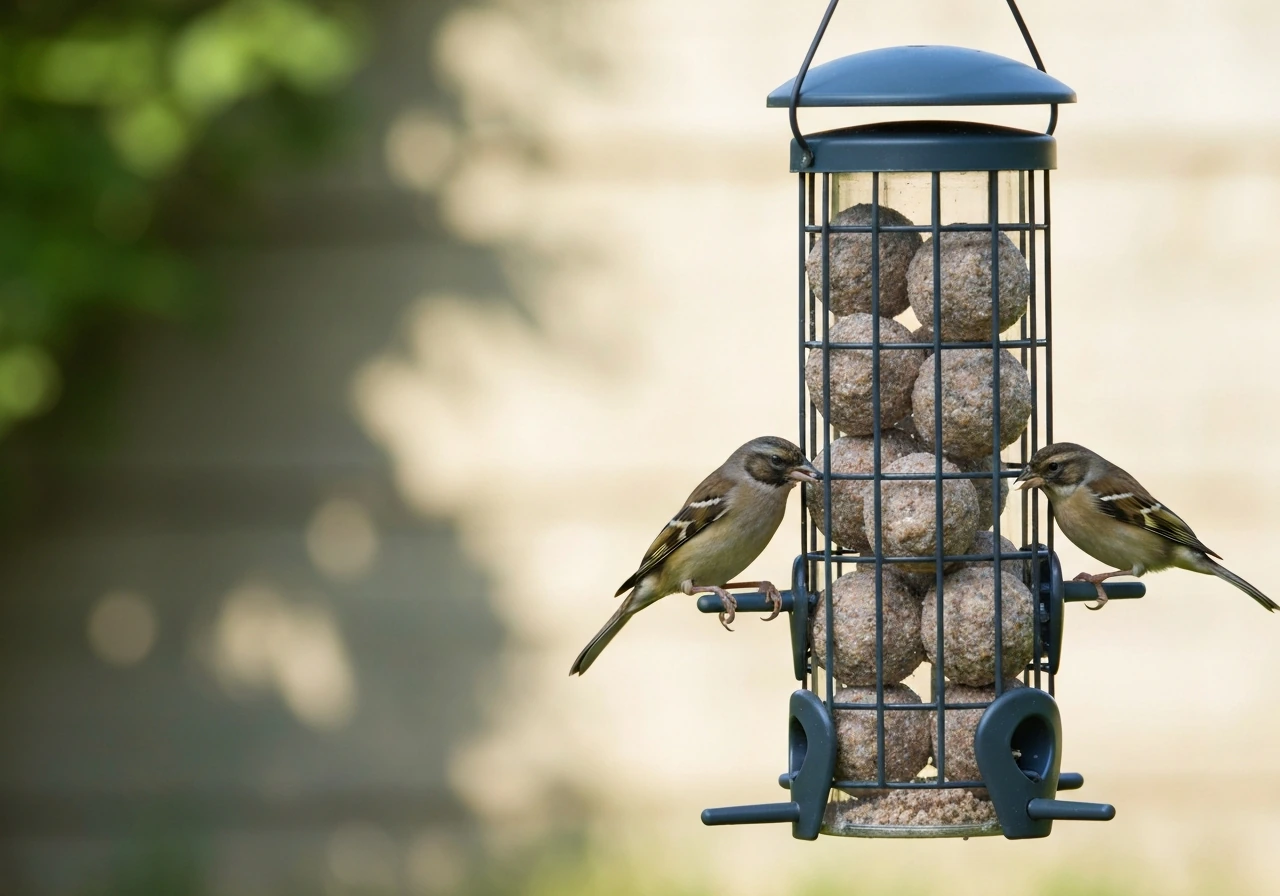
A fat ball feeder is any feeder designed to hold suet-based products: rendered fat mixed with seeds, insects, nuts, or berries, then pressed into balls, blocks, or cakes. The terms fat ball, suet ball, and suet cake are used interchangeably, though the shapes vary. Fat balls are typically 90g spheres sold in bags of 10 to 50. Suet blocks are rectangular slabs that sit in a cage or clip-on holder. Both serve the same purpose: a calorie-dense food source that birds can cling to and peck at.
In the UK, the birds that show up most reliably at fat ball feeders are blue tits, great tits, coal tits, long-tailed tits, nuthatches, robins, house sparrows, and starlings. Starlings are the loud, pushy guests nobody invited but everyone ends up feeding.
In North America, Cornell Lab confirms suet is particularly attractive to woodpeckers, nuthatches, chickadees, jays, and wrens. Audubon notes that suet feeders attract many small songbirds, including chickadees and wrens, when you are looking to identify what’s visiting woodpeckers, nuthatches, chickadees, jays, and wrens.
The Audubon Society adds Carolina wrens and downy woodpeckers to the short list of regulars. What all these birds share is a preference for high-fat food, especially in late autumn and winter when energy demands are highest and natural insect sources are gone.
The reason feeder design matters here more than it does for seed feeders is that fat balls attract both the birds you want (small, nimble species) and the ones you probably don't (starlings, corvids, grey squirrels). The feeder itself becomes the main tool for filtering who gets access. Get the wrong design and you'll be restocking daily while starlings hoover up everything before a single blue tit gets near it.
Key features to compare before you buy
Compatibility: does it actually fit your fat balls?
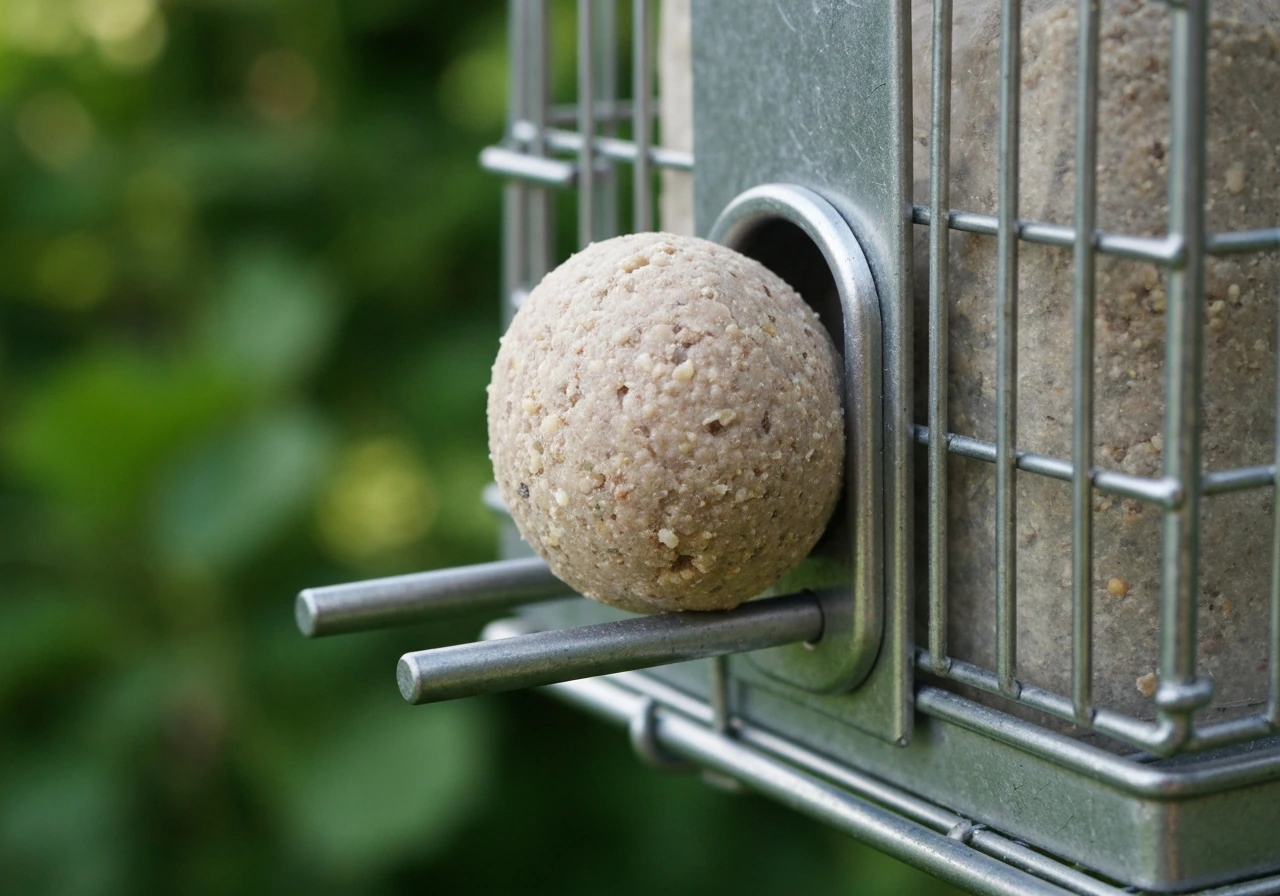
Standard fat balls sold in the UK are 90g and roughly 6 cm in diameter. Most cage feeders are designed around this size, but some cheaper imported feeders have openings slightly too small or too large, meaning balls drop through or get wedged. If you buy fat balls without plastic netting (which you should, since netting tangles birds' feet), double-check that the feeder's internal cage bars are spaced close enough to support the ball while still letting birds get their beaks in. Suet blocks require a completely different feeder, typically a flat rectangular cage that mounts vertically on a post or fence. Don't assume a fat ball feeder can double as a suet block holder without checking the dimensions.
Opening size and mesh: the 6 mm rule
The RSPB recommends a mesh opening of approximately 6 mm for suet pellet and peanut feeders as a compromise between letting birds access food and preventing large pieces being yanked out whole. The same principle applies to fat ball feeders. Too large an opening and starlings can grip a ball and fly off with it entirely. Too small and smaller birds struggle to get their beaks in, which defeats the whole point.
For mixed-species feeding, a cage with 35 to 40 mm bar spacing works well. For tit-only feeding, a caged feeder surrounded by a protective outer cage with roughly 30 mm spacing physically blocks starlings and larger birds. The Washington Department of Fish and Wildlife's suet feeder construction notes also suggest 1-inch (25 mm) entry holes for limb-mounted designs, which aligns with the goal of smaller-bird exclusion.
Capacity: how many balls?
Single-ball feeders are fine for quiet gardens with light traffic, but if you have a busy feeding station with multiple tit species, you'll be refilling it every day. A 6-ball or 12-ball feeder cuts refill frequency dramatically. The trade-off is size: a 12-ball feeder is heavy when full and needs a sturdy mount. I've found a 6-ball feeder to be the sweet spot for most gardens. It holds enough to last 3 to 5 days even with moderate traffic, but it's not so large that the top balls sit untouched long enough to go off in warm weather.
Materials: what holds up and what doesn't
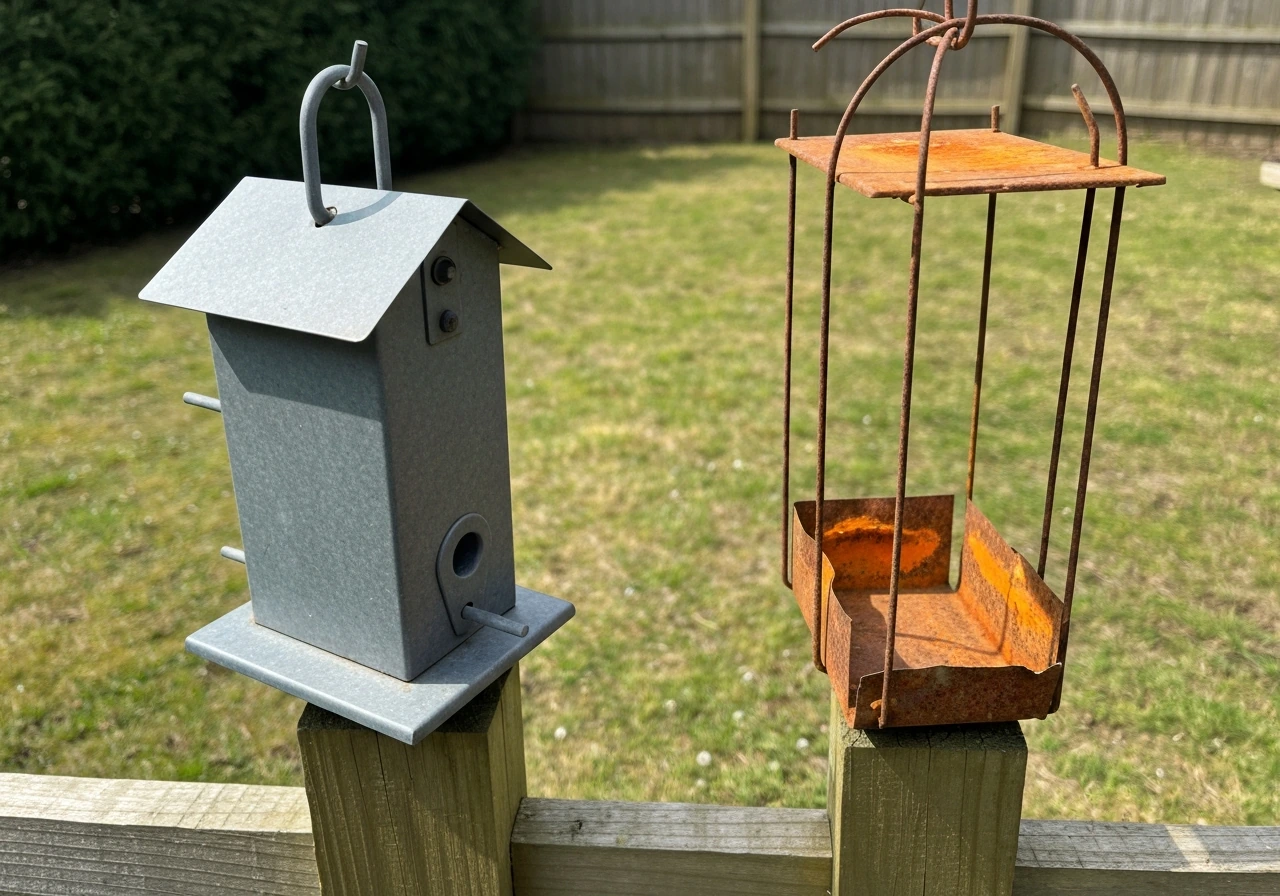
Powder-coated steel is the gold standard. It resists rust, handles squirrel chewing without giving way, and lasts years with basic maintenance. Galvanized steel is nearly as good and often cheaper, though the finish can look industrial after a season outdoors. Stainless steel is excellent but expensive. Plastic feeders are lighter and cheaper, but most can't survive sustained squirrel attack and tend to crack in hard frost. If you live somewhere with cold winters or persistent squirrels, avoid plastic as your primary feeder. Some covered designs use a plastic dome or roof over a metal cage body, which is a reasonable compromise as long as the metal cage itself is robust.
Ease of cleaning and loading
Suet and fat are greasy and go rancid. A feeder that's difficult to open means you'll clean it less often, which leads to mold and sick birds. Look for a feeder with a removable base or a simple hinged top. Some cage feeders have a screw-on lid that sounds convenient but is genuinely annoying when your hands are greasy. The best designs open with one hand and come apart into two or three sections that can go in a bucket of hot water and dish soap. Avoid feeders with interior corners or crossbars that trap debris.
Best feeder types for different setups
| Feeder Type | Best For | Downside | Squirrel Resistance |
|---|---|---|---|
| Metal cage (open) | General use, all common fat ball species | Starlings can dominate | Moderate (needs baffle) |
| Caged/guardian cage | Tits, nuthatches, small birds only | Larger birds excluded entirely | High (smaller outer cage) |
| Covered/roofed mesh | Wet climates, keeping fat fresh longer | Slightly harder to load | Moderate |
| Plastic net/mesh bag | Budget, temporary use | Entangles feet, cracks in cold | Low |
| Suet block cage (flat) | Woodpeckers, larger species | Doesn't fit round fat balls | Moderate to low |
Traditional metal cage feeders
This is the most common type and the right starting point for most people. A cylindrical powder-coated steel cage holds 2 to 12 fat balls, hangs from a hook or bracket, and gives all visiting species access. The downside is that it's democratic: starlings, house sparrows, and great tits all compete at the same feeder. If your garden is dominated by starlings and you never see the smaller tits getting a look in, you need to add a guardian cage or switch to a caged design.
Guardian cage feeders (caged within a cage)
These have an outer metal cage surrounding the fat ball cage, with gaps just large enough for small birds to squeeze through but too small for starlings or grey squirrels. Blue tits, coal tits, and nuthatches navigate them easily. Robins and great tits are borderline, depending on the cage gap size. Starlings are physically excluded. This is my personal go-to for winter feeding when starling flocks can strip a standard feeder in under an hour. The main drawback is that they're bulkier and slightly harder to refill, but the trade-off is worth it.
Covered and roofed mesh feeders
A metal or plastic roof over the feeder cage keeps direct rain off the fat balls, which meaningfully extends how long they stay fresh in wet climates. These are worth considering if you're in the north of the UK or anywhere with persistent autumn and winter rain. The roof also provides a little shelter for birds feeding at the top of the stack. They tend to cost a bit more and aren't always as easy to load from the top, but if fat balls are going off quickly in your feeder, a covered design is often the fix.
Net bags and plastic mesh: avoid these
The net bags that fat balls often come packaged in are not feeders, they're packaging. Birds' feet and claws get tangled in the netting, sometimes fatally. Always remove fat balls from netting bags before putting them in a feeder. Plastic mesh feeders sold cheaply online are similarly problematic: they crack in frost, don't clean well, and don't last a season. Spend a little more on metal and you'll replace it far less often.
Squirrel and predator-proofing that actually works
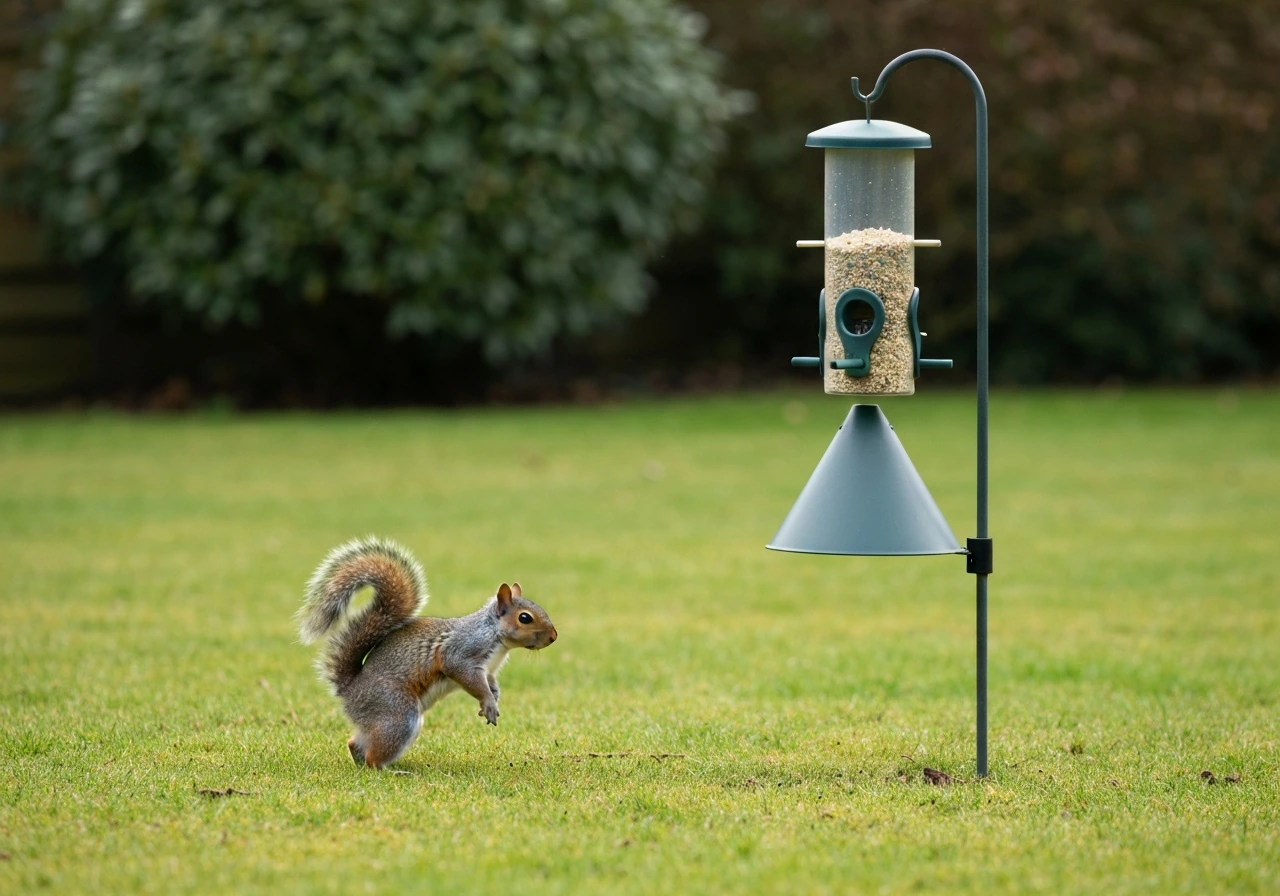
Grey squirrels are the primary fat ball thief in most UK and North American gardens. They chew through plastic feeders in minutes, force open poorly latched cages, and if the feeder hangs low enough, they'll grab the whole thing and run. Here's what genuinely works:
- Pole-mounted baffles: a smooth conical or cylindrical baffle fitted below the feeder on a smooth pole is the single most effective deterrent. Squirrels can't grip smooth metal poles and can't get past a properly sized baffle. The baffle should be at least 45 cm in diameter and positioned so the squirrel can't jump past it from below.
- Guardian cage feeders: the outer cage acts as both a squirrel deterrent and a starling excluder. A squirrel physically cannot reach the fat balls through a properly sized outer cage, even if it grabs the feeder with both paws.
- Hanging height and placement: hang feeders at least 1.5 metres off the ground and at least 2 metres from any fence, wall, tree trunk, or overhanging branch. Squirrels are strong jumpers. 2 metres horizontal clearance is the minimum, and even then a determined squirrel will sometimes make it.
- Smooth hanging wire: use fine metal wire rather than rope or chain to hang feeders. Squirrels can shimmy down rope and chain but struggle with thin smooth wire.
- Weight-activated cage feeders: some fat ball feeders (more common in the suet block category) have a weight-sensitive outer cage that drops to block access when a heavy animal lands on it. These work but cost significantly more.
Cats are a secondary concern but a real one. A feeder hung below eye level in a bush or close to the ground puts ground-feeding birds at risk from cats waiting underneath. Keep feeders high enough that birds have clear sightlines and quick escape routes in multiple directions.
Weather and hygiene: keeping fat balls fresh and preventing mold
Fat and suet go rancid faster than most people expect, especially in warm weather. In summer, fat balls can start to smell and soften within two or three days in direct sun. In winter, they last much longer but can still grow mold if rain gets in and the feeder doesn't drain. Here's how to stay ahead of the problem:
- Only put out what birds can eat in 3 to 5 days during cool weather, or 1 to 2 days in warm weather above 15°C. Don't overfill the feeder in summer.
- Position the feeder in shade during summer months. Morning sun is fine; afternoon direct sun on a full feeder of fat in July is a recipe for a rancid mess.
- Choose a feeder with drainage holes at the base so rainwater doesn't pool around the fat balls. A covered feeder helps even more.
- Clean the feeder at least once every two weeks with hot water and dish soap. Rinse thoroughly and let it dry before refilling. Grease and debris build up in the cage bars and create conditions for bacteria and mold to grow.
- If you see any fat balls with green or grey mold patches, remove and dispose of them. Don't just flip them to hide the moldy side. Mold on suet can make birds ill.
- In very hot weather (above 25°C), consider switching to no-melt suet fat balls, which are formulated with a higher melting point and hold their shape better in heat.
This is one area where fat ball feeders require more active management than seed feeders like thistle or sunflower seed feeders. If you're also considering a thistle bird feeder for finches, the basics are a bit different from feeding with fat balls or suet what is a thistle bird feeder. Seed feeders can sit a few extra days without much harm; suet feeders cannot. Build the cleaning habit into your routine from the start.
Mounting options and where to place your feeder
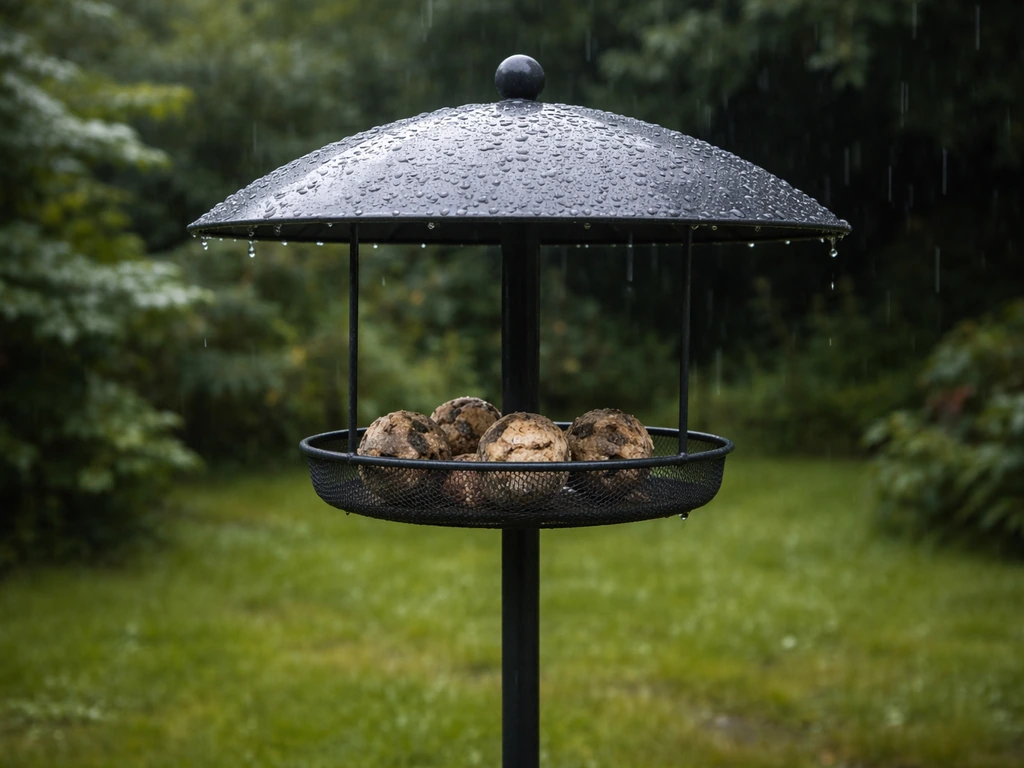
Hanging from a pole or feeding station
A dedicated bird feeding pole is the cleanest solution. You get full control over height, you can add a baffle below the feeder, and you can position the pole away from squirrel jump-off points. Most poles accept multiple hanging brackets, so you can run a fat ball feeder alongside a seed feeder or peanut feeder without them interfering. The Washington Department of Fish and Wildlife specifically recommends limb-mounted or pole-mounted suet feeder positions because they replicate the natural foraging position many woodpeckers and nuthatches prefer: clinging vertically to a surface. Aim for a pole height of at least 1.5 metres with the feeder hanging at roughly 1.5 to 1.8 metres total from the ground.
Tree or fence hooks
Screwing a hook directly into a tree or fence post is the cheapest and quickest option. The downside is that it gives squirrels a route straight to the feeder via the tree or fence. If you're using a tree hook, position the feeder on a branch that squirrels can't easily run along, and hang it on a length of thin wire rather than a clip. Fence hooks are convenient but put the feeder very close to a surface squirrels can climb and jump from.
Wall brackets and rail-mounted options
Wall brackets and deck rail mounts work well in smaller gardens or on patios where you want the feeder close to a window for bird watching. They're not ideal from a squirrel-proofing standpoint since they're attached to a structure squirrels can access, but if you're on a high balcony or the bracket places the feeder away from any ledge or surface, it can work. For apartment dwellers or those with no garden space, this is often the only practical option.
Where to put it: the placement rules
- Within sight of cover: place the feeder within 3 metres of a shrub or hedge so birds can retreat quickly if spooked, but not so close that cats can hide in the cover beneath.
- Away from windows: feeders placed closer than 1 metre or farther than 10 metres from a window reduce bird collision risk. The 1-metre zone is close enough that a startled bird won't build up fatal speed before hitting the glass.
- At least 2 metres from fences, walls, and trees to minimize squirrel jumping access.
- In a sheltered position during winter to reduce wind chill at the feeder and keep fat balls from freezing solid in extremely cold snaps.
- In partial shade during summer to slow the rate at which fat balls go rancid.
Which feeder should you actually buy? A quick guide
Here's where everything comes together. Match your situation to the recommendation below and you'll get it right first time without having to return anything.
| Your situation | Best feeder type | Key feature to prioritize |
|---|---|---|
| General garden, mixed small birds | Powder-coated steel cage, 6-ball capacity | Removable base, good drainage |
| Starling problem, want tits only | Guardian cage (cage within cage) | Outer cage gap 30–32 mm max |
| Wet climate, fat balls going off fast | Covered/roofed metal cage feeder | Watertight roof, base drainage holes |
| Serious squirrel problem | Guardian cage on a smooth pole + conical baffle | Smooth pole, 45 cm+ baffle diameter |
| Woodpeckers and larger birds (North America) | Flat suet block cage, vertically mounted | Downward-facing entry, rough clinging surface |
| Small garden or balcony | Single or double ball cage with wall bracket | Compact size, secure bracket mount |
| Budget-conscious beginner | Basic galvanized steel cage, 3–6 ball | Metal (not plastic), removable for cleaning |
Buyer decision checklist
- Is the feeder made of metal, not plastic? If not, skip it.
- Does it fit standard 90g fat balls without the balls dropping through or getting stuck?
- Does it have a removable base or lid so you can clean it properly?
- Are there drainage holes at the base to prevent water pooling?
- Do you have a serious starling or squirrel problem? If yes, go for a guardian cage design.
- Is your garden pole-mounted or tree/fence-mounted? If pole, add a squirrel baffle below.
- Will the feeder be in direct sun in summer? If yes, look for a covered design or commit to shorter refill windows.
- How many birds do you expect? Scale capacity accordingly (6-ball minimum for busy gardens).
- Can you clean it every one to two weeks? If not, buy something simpler that takes 60 seconds to disassemble.
If you're also feeding other food types alongside fat balls, it's worth thinking about how your fat ball feeder fits into your broader feeding station setup. Thistle and sunflower seed feeders attract overlapping species like goldfinches and blue tits, and placing them near your fat ball feeder creates a richer feeding zone that keeps birds coming back. The key is making sure each feeder type is spaced enough that dominant species at one feeder don't block access to another.
Start with one good metal cage feeder in a position that's at least 2 metres from anything a squirrel can launch from. Watch which birds show up and whether starlings are dominating. If they are, switch to a guardian cage. If fat balls are going off before they're eaten, reduce quantity and move to shade.
Most fat ball feeder problems come down to those three variables: the wrong cage design for the birds you have, bad placement for squirrels, and too much food out for too long in warm weather. Solve those three and everything else takes care of itself. If you want the best bird feeder for sunflower seeds, choose one sized for the seed type and placed to reduce waste and pests.
FAQ
Can I use kitchen suet or homemade fat balls in the same feeder as the 90g commercial ones?
Yes, but check consistency and size. Homemade suet can be softer and may slide out faster, so aim for balls that match the feeder’s opening and the cage bar spacing, and let them firm up in the fridge before hanging. If your mix contains lots of liquid, it can drip and foul the cage faster, which increases cleaning frequency.
What should I do if the balls keep getting stuck in the feeder cage or drop through?
First, verify the feeder is truly built for standard 90g balls, not just “fat ball” in general. If balls drop through, the bar spacing or internal support is wrong. If they wedge, the opening is too tight or the cage bars are misaligned, sometimes from bending in shipping. Trying a single spare ball and gently testing removal is the fastest way to confirm fit before committing to a full bag.
Do I need to remove the netting or any plastic wrap even if the fat ball is already sold as ready-to-hang?
If the product is still in a net bag, remove it before loading. Even if the ball seems secure, netting can trap birds’ claws and toes when they cling and it can also pull fibers into the feeder. If a brand uses a harmless internal wrap, look for instructions that explicitly say it is feeder-safe, otherwise treat any external netting as packaging.
How high should a fat ball feeder be to protect from squirrels and cats without making it hard for small birds?
A practical compromise is keeping it out of easy “jump reach” from perches while still leaving a clear escape path for tits. In general, aim for at least around 1.5 metres off the ground for pole setups, then move it further if squirrels are still reaching it. If cats are a concern, avoid placing it low near shrubs or under window cover where a cat can wait underneath.
Why are my fat balls going rancid or molding faster than expected?
The most common cause is moisture getting in, combined with limited cleaning. If fat is melting and then re-hardening in repeated wet periods, or if the feeder doesn’t drain, it can develop mold. Switch to a covered design in wet weather, reduce the number of balls if they are sitting too long, and clean the base each time you refill so old residue does not seed mold.
How often should I clean a fat ball feeder during winter?
At minimum, give it a thorough clean on every refill, and do an extra clean if you notice dark buildup, slime, or a sour smell. Fat gets sticky and accumulates in corners, and residue can harden into a “trap” that prevents proper drainage. If your feeder opens with multiple sections that come apart easily, use that to clean more thoroughly without delaying refills.
Can starlings get excluded completely with a guardian cage?
They can usually be reduced dramatically, not guaranteed to zero, because fit and placement matter. If starlings are still getting in, the gap size may be too large for your chosen feeder or the guardian cage could be positioned so starlings access it from an odd angle. Re-check bar spacing and make sure the outer cage fully surrounds the inner cage, with no gaps where a beak or foot can slip through.
Should I switch to smaller balls or a different feeder if I only want to attract small birds like blue tits?
If you already have a starling problem, switching to a feeder designed for smaller birds is more reliable than changing ball size. Guardian caged designs and feeders with appropriately sized openings improve access for small birds while limiting larger birds’ ability to grip and remove a whole ball. If you change only the product size, you may still end up feeding the wrong species efficiently.
Is it safe to stack multiple fat ball feeders close together?
It can work, but spacing matters. If two feeders are too close, dominant birds can monopolize one while others struggle to approach, and wasted fat can fall into the neighboring area. Keep each feeder type spaced enough that birds do not block the entry points, and place them so squirrels cannot “route” from one to the other using nearby branches or rails.
What do I do if squirrels keep opening the feeder even though it is metal?
Check the latch and access points. Many feeders fail at the lid fit or at hooks/brackets that allow a twist. Confirm the removable base is seated properly, consider a stronger mount that prevents twisting, and if possible use a pole-mounted setup with a baffle so squirrels cannot launch from nearby surfaces. Also verify you are not hanging it from an attachment that squirrels can climb.
Are covered fat ball feeders always better?
Not always. A roof helps in wet climates, but some covered designs are harder to load quickly and can trap heat in sunny weather, softening fat faster. If you live in a warmer or sunny area, use a covered feeder only if you also manage quantity and shade, so balls do not sit and overheat before birds consume them.