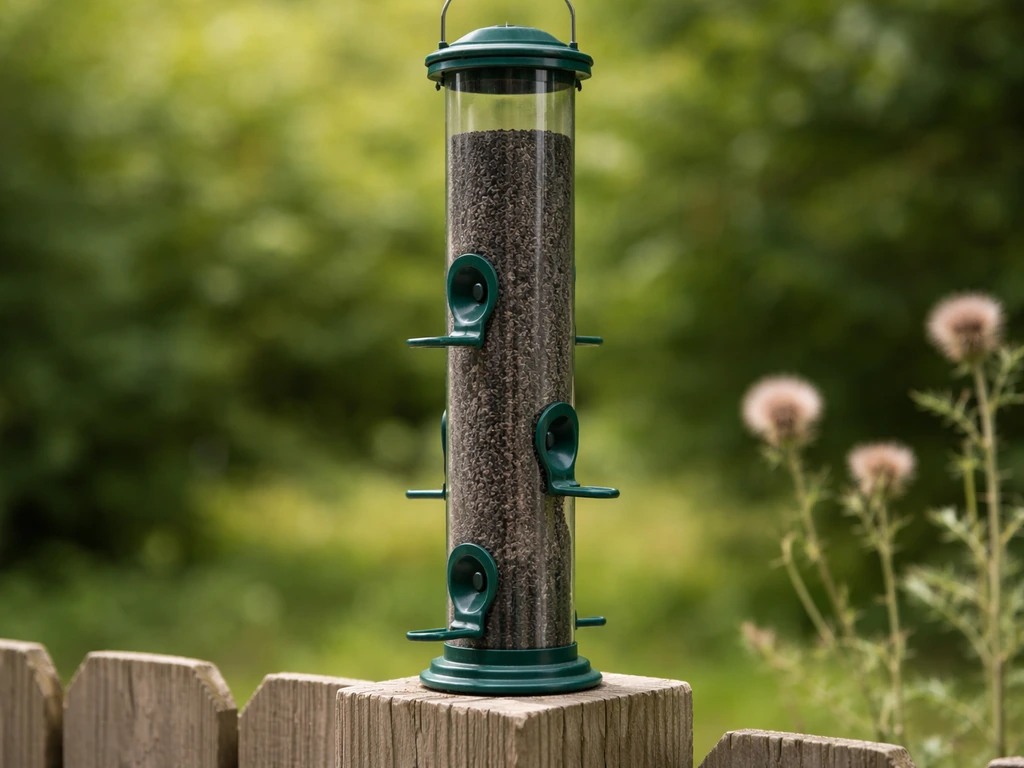
A thistle bird feeder is a specialty feeder designed to hold Nyjer (also called niger or nyger) seed, an oilseed that small finches like American Goldfinches, Pine Siskins, and Common Redpolls love. The defining feature of these feeders is very small ports or fine mesh openings that let finches extract seeds one at a time without spilling the expensive seed all over the ground. You can't just toss Nyjer into a standard tube feeder and expect good results, the ports are too wide, you waste seed, and larger birds crowd out the finches you actually want.
What Is a Thistle Bird Feeder: Nyjer Guide and Best Picks

Marcus Holloway
18 Jul 2026
What thistle (Nyjer) seed actually is
Despite the common name, Nyjer seed has nothing to do with true thistles. It comes from Guizotia abyssinica, a flowering plant native to Africa, and 'thistle' stuck as a trade nickname because the seed looks similar to thistle seed at a glance. The name 'Nyjer' itself is a trademark coined to distinguish the bird-feeding product from any association with weed thistles.
Every bag of Nyjer sold in the U.S. has been heat-treated and sterilized before import, so germination is not a concern if seeds fall to the ground. From a nutrition standpoint, Nyjer punches well above its weight: oil content typically runs around 30 to 40 percent, with crude protein in the 18 to 22 percent range depending on variety and processing. A high proportion of that fat is linoleic acid (omega-6), which makes Nyjer extremely calorie-dense. That energy profile is exactly what small, high-metabolism finches need, especially through winter.
Because Nyjer is oilseed, tiny, and imported, it costs noticeably more per pound than sunflower or mixed seed. That price reality is one reason feeder design matters so much, poorly designed feeders that scatter seed or let it get wet are literally expensive mistakes.
The birds that actually show up: goldfinches, siskins, and redpolls
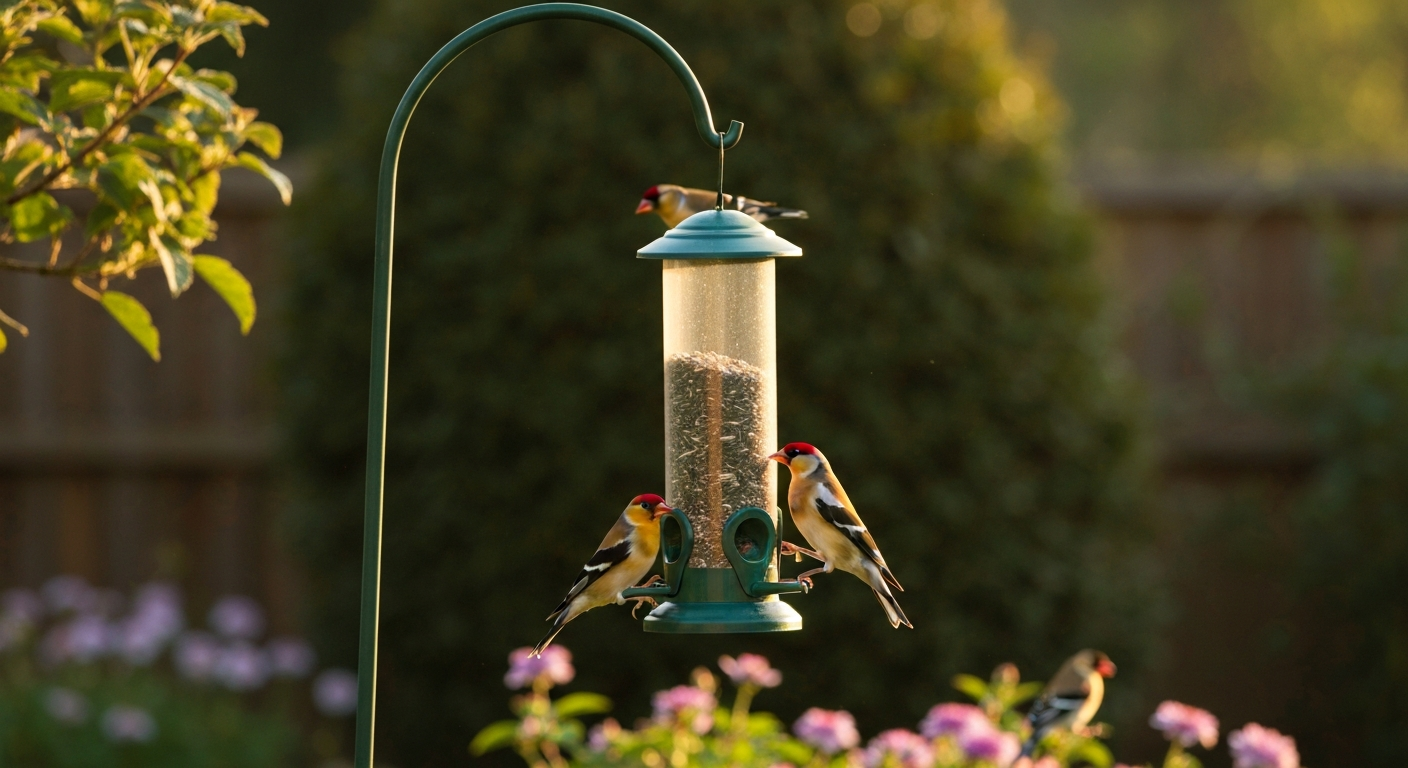
American Goldfinches are the flagship Nyjer visitors across most of North America. They're year-round in many regions, though winter birds lose their bright yellow plumage and can fool new birders into thinking a different species has arrived. Pine Siskins and Common Redpolls are the big winter bonus birds, both species irrupt in unpredictable numbers based on food availability further north. In a good irruption year you can wake up to a feeder covered in thirty siskins. In a mediocre year you might see none.
What all three species share is a small conical bill perfectly suited to manipulating tiny seeds, and the ability (and preference) to feed upside down. Goldfinches and siskins will happily hang from a mesh feeder or cling to a tube port that's positioned below the perch, which is actually a useful squirrel deterrent feature some manufacturers deliberately build in. Redpolls are less acrobatic but readily use the same feeders.
House Finches and Purple Finches also take Nyjer opportunistically, but they're more committed to sunflower seed. If your goal is to specifically attract the three finch species above, Nyjer in a dedicated finch feeder is your most targeted tool.
Why a dedicated thistle feeder matters for a finch-focused yard
The case for a dedicated thistle feeder comes down to three things: seed waste, competition, and signal. Standard tube feeders with wide ports allow Nyjer to pour out in the wind or get flicked out by birds grabbing at it. Squirrels and larger birds like House Sparrows and even grackles can monopolize an open feeder and push finches off. And because goldfinches in particular are cautious birds that rely on flock cues, a feeder that consistently holds fresh, accessible Nyjer acts as a long-term signal to them that your yard is worth visiting regularly.
I've run both dedicated finch feeders and mixed-seed setups simultaneously and the difference is stark. When Nyjer is in the right feeder, goldfinch visits are longer and more frequent. When it's mixed in with sunflower, the goldfinches often get crowded out by House Sparrows before they've had a real meal.
Types of thistle feeders: tubes, mesh socks, and vertical-port designs
There are three main design categories, each with real tradeoffs worth knowing before you buy.
Tube feeders with small ports
These are the most common style: a clear or opaque tube with multiple small feeding ports, each paired with a short perch. Port openings are specifically sized for Nyjer, too small for House Sparrows and starlings to feed comfortably, and too small to allow seed to pour out freely. Brome Bird Care's Squirrel Buster Finch is a well-known example, built with UV-stabilized polycarbonate and featuring weight-sensitive port closure that shuts off access when anything heavier than a small finch lands on it. Brome Bird Care publishes model specifications and product pages for finch feeders (including the Tube 100) and advertises a Lifetime Limited Warranty/Lifetime Care covering manufacturing defects Brome Bird Care — Tube 100 product page. Brome backs their feeders with a Lifetime Limited Warranty (covering manufacturing defects, not cosmetic weathering or animal damage), which is worth factoring into a higher upfront cost.
Mesh and nylon sock feeders
Mesh feeders, including simple disposable nylon 'finch socks' and more durable metal mesh tube feeders like those from Droll Yankees' Onyx and Clever Clean lines, let finches cling and feed anywhere on the surface. Finch socks are cheap, typically holding around 10 to 13 oz of seed, and they're a genuinely good way to introduce Nyjer to a new yard because finches can see and smell the seed easily. The downside is they tear, don't last more than a season in many cases, and the fine mesh can clog when wet. Metal mesh feeders solve the durability problem, Droll Yankees uses UV-stabilized polycarbonate or stainless steel mesh depending on the model, but they cost significantly more.
Vertical-port finch feeders
Some tube feeders place the port below the perch instead of above it, specifically to exploit goldfinch and siskin preference for upside-down feeding while discouraging less agile species. This works, though it can frustrate birds during the initial discovery phase. Perky-Pet makes adjustable models where you can flip the ports between a closed Nyjer position and an open mixed-seed setting, which is a practical option if you want one feeder to serve double duty across seasons.
Capacity, mounting, and feeder sizing
Finch feeders tend to run smaller than cardinal or general-purpose feeders, and for good reason. Nyjer goes stale and can mold if it sits too long. A feeder that's too large for your finch traffic means seed sits, clumps, and birds start rejecting it. If you're just getting started or live in an area with moderate finch populations, a feeder holding 1 to 1.5 lbs of seed is a reasonable starting point. For yards with heavy goldfinch or siskin traffic, larger capacity models (Brome's Mega 600, for example) make sense so you're not refilling daily.
For mounting, most thistle tube feeders hang from a hook or shepherd's crook pole. Hanging is generally preferred over pole-mounting for Nyjer feeders because the motion discourages squirrels slightly, and you can place the feeder away from jumping-off points. Some feeders are cage-compatible, where a wire cage surrounds the tube to physically block squirrels and larger birds, a worthwhile add-on if squirrel pressure is constant in your yard. Window-mount tube feeders exist for Nyjer but are less common; suction cup mounts need regular checking to prevent drops.
Evaluating feeders: weather resistance, durability, and squirrel-proofing
The material of a feeder is the single biggest determinant of how long it lasts. UV-stabilized polycarbonate is the best plastic for outdoor tube feeders, it retains clarity and impact resistance far longer than standard plastic, which turns brittle and yellow within a couple of seasons. For metal components, powder-coated steel or stainless steel mesh resists corrosion substantially better than untreated steel; I've seen uncoated metal feeders rust through within two winters in wet climates. Industry materials guide, outdoor plastics & metals (materials selection commentary) recommends stainless or powder coating for outdoor metal feeders to reduce rust and extend service life Industry materials guide — outdoor plastics & metals (materials selection commentary) recommends stainless or powder coating for outdoor metal feeders to reduce rust and extend service life..
Squirrel-proofing on thistle feeders generally takes one of two forms: weight-sensitive mechanisms (like Brome's Squirrel Buster series, which physically close the ports when a squirrel's weight is applied) or cage designs that surround the feeder body with wire spacing too narrow for squirrels to get through. Both work, but weight-sensitive designs require proper calibration and can be outwitted by squirrels that figure out how to grip the cage rather than the ports. Cages are more passive and lower-maintenance, though they add bulk and can slightly reduce port access for birds.
Grackles are a separate problem. They're too large for most small Nyjer ports and can't comfortably cling to mesh feeders, so a well-designed finch feeder passively deters them better than a general feeder does. If grackles are actively harassing birds at your feeder, positioning it closer to dense shrub cover (which finches prefer anyway) and further from open ground helps.
Feature tradeoffs worth thinking through before buying
| Feature | Advantage | Disadvantage |
|---|---|---|
| Mesh/sock design | Maximum visibility of seed, finches can feed from any angle, reduces seed wetting on surface | Fine mesh clogs when wet, nylon socks degrade quickly, metal mesh costs more |
| Small-port tube | Protects seed from weather, easy to fill, clear tube shows remaining seed | Ports can clog with oil residue, harder to clean thoroughly without brushes |
| Large capacity | Less frequent refilling needed during irruptions | Seed sits longer, higher mold risk in slow periods |
| Weight-sensitive squirrel-proofing | Hands-off deterrence without physical barrier | Requires calibration, can malfunction if spring wears down |
| Cage surround | Passive squirrel and large-bird deterrence, no moving parts | Bulkier, may slightly restrict finch access at ports |
| UV-stabilized polycarbonate | Long-lasting clarity and impact resistance outdoors | Higher cost than standard plastic |
| Adjustable ports (Nyjer/mixed mode) | Versatile across seed types and seasons | No single setting is optimized for either seed type |
Thistle feeders vs sunflower and fat-ball feeders: when to use which
Nyjer, sunflower, and fat balls serve genuinely different purposes in a backyard setup, and understanding that helps you avoid buying redundant feeders or offering the wrong seed.
Sunflower seed (particularly black oil sunflower) has a much broader appeal than Nyjer, cardinals, chickadees, nuthatches, woodpeckers, and House Finches all visit sunflower feeders. If you want diversity, sunflower is your workhorse. For guidance on choosing the best bird feeder for sunflower seeds, see our article on what is the best bird feeder for sunflower seeds. Nyjer, by contrast, is specifically calibrated for small finches. It costs more and attracts fewer species. The tradeoff is that when goldfinches and siskins arrive, they'll focus heavily on a Nyjer feeder in a way they rarely do on sunflower alone. For a finch-specific yard, running both types simultaneously in separate feeders is the best strategy.
Fat balls (suet balls) are an energy-rich winter food designed to attract clinging species: woodpeckers, titmice, nuthatches, and some finches will take suet, but it's not a Nyjer substitute. Fat-ball feeders use a wire cage or net holder design that's wholly different from a finch tube or mesh feeder. Some specialty fat-ball feeder cages can be filled with Nyjer socks as an add-on, but they're not interchangeable. For recommendations on durable holders and cages, see our guide to the best fat ball bird feeder. If you're building a multi-feeder yard, fat-ball feeders complement a thistle feeder setup rather than competing with it.
Top picks and why I recommend them
Brome Squirrel Buster Finch
This is my go-to recommendation for anyone dealing with squirrel pressure. For a broader comparison of options, see my guide to the best bird feeder for thistle seed to help you choose the right model for your yard. The weight-sensitive mechanism genuinely works in most setups, the UV-stabilized polycarbonate tube holds up well over multiple seasons, and the Lifetime Limited Warranty gives you real recourse if there's a manufacturing defect. Ports are sized specifically for Nyjer. It's not cheap, but the combination of squirrel-proofing and build quality makes the cost defensible over a two or three year horizon versus replacing cheap plastic feeders annually.
Droll Yankees Clever Clean Finch Feeder
The metal mesh design is genuinely easier to clean than tube feeders, and the stainless or UV-stabilized polycarbonate materials hold up better in wet climates than most competitors. The mesh also dries faster than a tube, which reduces mold risk between refills. It's heavier and pricier than nylon socks, but it's a permanent investment rather than a seasonal one. Good Housekeeping reviewers and several birding guides consistently rate Droll Yankees mesh feeders as top finch feeder options, and my own experience bears that out. Independent reviewers and buying guides (including Good Housekeeping) rate Droll Yankees and metal mesh finch feeders highly because mesh design reduces seed wetting, cleans more easily, and resists squirrels better than thin plastic feeders, though reviewers note tradeoffs such as higher cost and increased weight Good Housekeeping — Best bird feeders (reviews & expert commentary) lists Droll Yankees metal‑mesh finch feeders among top choices, noting mesh reduces seed wetting, is easier to clean, and resists squirrels better than thin plastics while trading off higher price and greater weight..
Disposable nylon finch socks
For getting started or testing a new location, a $3 finch sock is unbeatable. Finches find them fast, the mesh gives full visibility of the seed, and there's no commitment if the location doesn't pan out. Audubon-branded and similar finch socks hold around 10 to 13 oz and are sold at most garden centers and big-box stores. Replace them every season or when they start to fray.
Perky-Pet 2-in-1 adjustable tube feeder
If you want versatility, Perky-Pet's adjustable model lets you close ports down to Nyjer size or open them up for mixed seed. It won't outperform a dedicated finch feeder for attracting goldfinches, but it's a practical compromise for limited-space setups or for people who want to shift seed types by season without buying multiple feeders.
Where to place your thistle feeder and how to set it up
- Hang the feeder 5 to 6 feet off the ground from a shepherd's crook pole or tree branch, away from fence tops, roof edges, or overhanging limbs that give squirrels a jumping platform.
- Position it within 10 to 15 feet of shrubs or trees where finches can retreat to between feeding bouts — goldfinches are cautious and prefer cover nearby.
- Avoid placing it directly under a dense tree canopy where falling debris will clog ports and increase moisture exposure.
- If you're introducing Nyjer to a new yard, start with a nylon sock feeder alongside your regular setup so finches can easily detect the seed. Once birds are visiting reliably, transition to a tube or mesh feeder.
- Face the feeder so prevailing wind doesn't blow directly into the ports, which accelerates moisture accumulation inside the tube.
- If using a cage surround for squirrel-proofing, confirm the cage-to-feeder clearance allows small finches to reach ports without obstruction.
Keeping the feeder clean and the seed fresh
Nyjer's high oil content is what makes it attractive to finches, and it's also what makes it go rancid faster than sunflower or millet. In warm weather, seed in a tube feeder can start to clump or develop a sour smell within two to three weeks if traffic is low. In humid climates, that window is shorter.
- Empty and inspect the feeder every two to three weeks regardless of remaining seed level. Clumped, discolored, or sour-smelling Nyjer should be discarded entirely.
- Disassemble the feeder completely and scrub all parts (tube, ports, caps, perches) with a 1:9 bleach-to-water solution, then rinse thoroughly and allow to air-dry fully before refilling. Residual moisture is the main driver of mold.
- For mesh feeders, use a stiff bottle brush to clear clogged mesh openings; a toothbrush works for tube port interiors.
- Store bulk Nyjer seed in a sealed container in a cool, dry location. Seed stored in warm garages or sheds degrades faster.
- Buy Nyjer in quantities you'll use within 4 to 6 weeks to minimize storage degradation.
- After heavy rain, check tube feeders for moisture intrusion at the ports and shake or tap the tube to break up any surface clumping.
Troubleshooting: mold, seed waste, grackles, squirrels, and slow finch uptake
Mold and clumping seed
This is the most common complaint with Nyjer feeders. The cause is almost always moisture getting into ports combined with seed sitting too long. Fix it by cleaning on a regular schedule (not just when you notice a problem), switching to a mesh feeder style that drains and dries faster than a sealed tube, and buying fresher seed in smaller quantities.
Seed waste on the ground
If you're finding significant amounts of Nyjer on the ground, the ports are likely too large. Some feeders sold as 'finch feeders' have ports wide enough to allow seed to pour with normal bird activity. Verify your feeder is specifically rated for Nyjer (not just small seeds generally), and consider a mesh design where seed can only exit when a bird is actively pulling it.
Grackles and House Sparrows
Common Grackles are too large to comfortably use small-port tube feeders or mesh feeders designed for finches, so a properly sized feeder passively handles most grackle problems. House Sparrows are more agile and can sometimes use wide-port finch feeders. If sparrows are a problem, ensure your ports are as small as the manufacturer allows and consider a cage surround, which most sparrows avoid.
Squirrels
Standard tube feeders without squirrel-proofing will eventually be chewed or damaged. A shepherd's crook pole with a baffle below the feeder is your baseline defense. For persistent squirrels, the Brome Squirrel Buster Finch's weight-sensitive mechanism or a caged feeder adds a second layer. Avoid placing feeders close to fence lines, deck rails, or anything a squirrel can use as a launching point.
Finches ignoring a new feeder
Goldfinches in particular can take weeks to discover a new feeder, especially if there's no existing flock presence in your yard. Patience is genuinely the main fix here. Starting with a visible nylon sock feeder speeds discovery. Make sure the seed is fresh, finches reject stale Nyjer consistently, and that the feeder is placed near adequate nearby cover.
Species-specific buying notes
| Species | Key feeder preference | Best feeder style | Notes |
|---|---|---|---|
| American Goldfinch | Small ports or mesh, upside-down feeding position preferred | Tube or mesh feeder with below-perch ports | Year-round visitor in many areas; patient but consistent once established |
| Pine Siskin | Similar to goldfinch; agile clinger, comfortable on mesh | Mesh tube or metal mesh feeder | Irruptive; numbers highly variable by winter; can arrive in large flocks suddenly |
| Common Redpoll | Prefers mesh or small ports; less acrobatic than goldfinch | Small-port tube or mesh feeder | Northern visitor; most likely in irruption years; tolerates cold well |
Your buying checklist before you purchase
- Ports or mesh sized specifically for Nyjer seed (not just labeled 'small seed')
- Material: UV-stabilized polycarbonate tube or stainless/powder-coated metal mesh for multi-season durability
- Capacity matched to your expected finch traffic (1 to 1.5 lbs for light traffic, larger for heavy finch years)
- Squirrel-proofing strategy identified: weight-sensitive mechanism, cage surround, or baffle on pole
- Mounting method confirmed: hanging hook, shepherd's crook pole, or cage-compatible if needed
- Easy-disassemble design for regular cleaning (twist-off caps, removable perch rings)
- Placement location planned: near shrubs or cover, away from squirrel jumping points, sheltered from direct wind
- Seed freshness plan: small-batch purchasing, cool dry storage, two-to-three-week refill cycle
- Budget reality check: a mid-range durable feeder ($30 to $60) costs less over three years than replacing cheap feeders annually
FAQ
What is a thistle (Nyjer) bird feeder and what is 'nyjer' seed?
'Nyjer' (also spelled niger/nyger) is the trade name for seed from Guizotia abyssinica; in the bird‑feeding trade it’s commonly called thistle even though it isn’t a true thistle. Nyjer is a tiny, oil‑rich seed (typically ~30–40% oil, ~18–22% protein) that is heat‑treated/sterilized before import to prevent germination and contaminants. Thistle/Nyjer feeders are designed with very small ports or fine mesh so these tiny seeds don’t spill and so small finches can extract single seeds easily.
Which species are most likely to use a nyjer feeder?
The primary visitors documented to take nyjer in North America are American Goldfinch, Pine Siskin, and Common Redpoll. Local and seasonal variation occurs—siskins and redpolls may appear in larger numbers during irruption years—so results depend on your region and season.
Why do finches prefer nyjer seed and specific feeder designs?
Nyjer is oil‑rich and calorie‑dense, appealing to small conical‑billed finches that extract individual seeds. Feeders with very small openings or fine mesh match finch feeding mechanics (grasping single seeds and often feeding upside down) and reduce spillage and waste.
What feeder types are commonly used for nyjer and how do they differ?
Common types: tube feeders with multiple small ports (plastic or polycarbonate tubes with small metal/plastic ports); mesh/metal‑mesh feeders (stainless or powder‑coated mesh cylinders); and nylon/mesh 'finch socks' (hung mesh bags). Differences: tube feeders look like classic seed tubes and often have fixed small ports or flip settings; mesh feeders expose seed to air (dries faster), are easy to grip through the mesh, and often more durable; finch socks are cheap and portable but can soak or tangle in bad weather.
What materials and capacities should I look for?
Materials: UV‑stabilized polycarbonate or thick ABS plastics for clear tubes, and stainless steel or powder‑coated steel for metal/mesh feeders for best weather and corrosion resistance. Capacities vary—finch socks/mesh feeders often hold ~10–13 oz, tube models range from small (4–8 oz) up to larger 600 ml+/large volume models. Choose capacity based on how many birds visit and how fast seed is consumed to avoid stale or moldy seed.
How do I choose between a tube, mesh, or sock feeder for my yard?
Choose mesh or stainless/powder‑coated metal mesh if you want better drying, easier cleaning, and greater durability in wet climates; choose a clear polycarbonate tube if you prefer to watch seed levels and birds inside enclosed perches; choose a finch sock for low cost and portability where weather is usually dry. Consider local weather, number of birds, and whether you need anti‑squirrel features.
Next Article
Best Bird Feeder for Thistle Seed: Buy and Setup Guide
Pick the best thistle seed bird feeder with the right finch ports, mounting tips, and cleanup to prevent spoilage and sq