The best bird feeders for UK gardens, when judged by RSPB-aligned standards, are tube or mesh feeders with weight-activated squirrel guards, easy-clean ports, and materials that hold up through a British winter. If you want a single strong starting point, the Squirrel Buster range (CJ Wildlife) covers most UK garden setups from around £35 upward, handles sparrows, tits, finches and greenfinches well, and is straightforward to clean weekly as the RSPB now recommends. But the right feeder really depends on which birds visit your patch, how much pest pressure you have, and whether hygiene genuinely fits into your routine. This guide works through all of that with real-garden testing notes and honest trade-offs.
Best Bird Feeders UK RSPB: Top Picks & Expert Buying Guide

Marcus Holloway
23 Jul 2026
Who this guide is for
If you have a garden in the UK, you have probably noticed the RSPB's May 2026 guidance shifting things around. Their current 'Feed Safely, Feed Seasonally' framework asks gardeners to pause seed and peanut feeders from 1 May to 31 October, clean feeders at least weekly, and avoid flat bird tables or window trays that concentrate birds and disease risk. That is a meaningful change from how most of us grew up filling feeders year-round, and it has direct implications for which feeder types are worth buying. This guide is written for RSPB-aware gardeners and backyard birdwatchers who want recommendations that reflect that updated thinking, not products that make your garden look lively while quietly increasing disease pressure on your local finch population.
You will find a quick shortlist to get you to a decision fast, followed by deeper dives into categories: budget picks, premium options, squirrel-proof feeders, peanut feeders, options suited to small birds and finches, feeder stations, and smart camera feeders. I have also included a note on two North American species (hummingbirds and cardinals) that keep appearing in online searches from UK buyers, because the advice for those birds simply does not apply here and the confusion is worth clearing up.
Quick shortlist: top picks for UK gardens
These are my top picks across the main categories. Prices are approximate UK retail as of mid-2026. Detailed reviews of each follow further down the guide.
| Category | Pick | Approx. Price | Best For |
|---|---|---|---|
| Budget seed feeder | Gardman Heavy Duty Seed Feeder | £8–£12 | House sparrows, chaffinches, tits |
| Premium seed feeder | Squirrel Buster Plus (Brome/CJ Wildlife) | £55–£65 | Mixed small birds, squirrel pressure |
| Best squirrel-proof | Squirrel Buster Classic or Peanut (~£35–£75) | £35–£75 | Gardens with persistent grey squirrels |
| Best feeder station | Tom Chambers Kingfisher Station | £45–£60 | Multiple feeder types, small-medium gardens |
| Best for small birds/finches | Gardman Nyjer Seed Feeder or CJ Wildlife Finch Feeder | £10–£18 | Goldfinches, siskins, redpolls |
| Best peanut feeder | Squirrel Buster Peanut Feeder | ~£75 | Nuthatches, woodpeckers, tits, jays |
| Best woodpecker option | Suet/fat block cage feeder with guardian cage | £12–£25 | Greater spotted woodpecker, starlings |
| Best smart/AI camera feeder | Bird Buddy Smart Bird Feeder | £150–£180 | Tech-minded birders wanting ID and logs |
Why RSPB-aligned feeders matter more than you might think
There is a real tension in garden bird feeding between the genuine good it does for birds and the disease risk it creates by concentrating animals at shared food and water points. Research published in Scientific Reports (2022) showed that supplementary feeding reshapes garden bird communities and can amplify transmission of pathogens when hygiene is not managed. A 2022 peer‑reviewed study (Habitat‑use influences severe disease‑mediated population declines in two common garden bird species in Great Britain, Scientific Reports (2022)) found that supplementary feeding reshapes garden bird communities and can amplify pathogen transmission at concentrated feeding sites, and it supports targeted mitigation such as improved hygiene, seasonal feeding pauses, and avoiding flat trays to reduce population‑level harms Habitat‑use influences severe disease‑mediated population declines in two common garden bird species in Great Britain — Scientific Reports (2022). The RSPB's updated guidance is directly informed by this kind of evidence, particularly the finch trichomonosis crisis. Trichomonas gallinae, the parasite responsible, has been linked to significant population-level declines in greenfinches in particular, and the transmission route runs directly through shared feeders and water sources where birds regurgitate food and saliva.
Choosing a feeder that is genuinely easy to clean is not a minor bonus feature. It is the difference between a feeding station that helps your local birds and one that quietly acts as a disease hub. RSPB and Garden Wildlife Health (GWH) both recommend cleaning feeders with hot soapy water and a long-handled brush at least once a week, followed by a rinse with dilute domestic bleach (sodium hypochlorite), a thorough rinse with clean water, and air-drying before refilling. If you see birds with swollen throats, difficulty swallowing, or lethargy, the RSPB protocol is to stop feeding entirely and leave baths empty for at least three weeks before cautiously resuming. Always wear gloves, wash your hands afterwards, and keep your cleaning tools outdoors used only for this purpose.
The seasonal guidance (no seed or peanuts May to October) is also worth taking seriously rather than ignoring. During breeding season, adult birds need to be feeding nestlings on live invertebrates and caterpillars, not on dry seed. Feeder-dependent adults visit feeders less efficiently during this period anyway, and the disease concentration risk rises with warm weather. The RSPB's Feed Safely, Feed Seasonally campaign is explicit: pausing feeders in summer is better for birds, not just a precautionary nicety.
What we used to evaluate these feeders
Every feeder in this guide was assessed against a consistent set of criteria drawn from RSPB guidance, GWH recommendations, and the kind of multi-week real-garden testing methodology used by Which? in their March 2026 squirrel-proof feeder evaluation (which covered 12 models with recorded species visits, squirrel attempts, ease of cleaning, and refill practicality). Here is exactly what I weighted and why.
- Safety and bird welfare: no sharp edges, non-toxic materials, port sizes appropriate to target species, no entrapment risk for small birds or their feet.
- Hygiene and cleanability: can the feeder be fully disassembled in under two minutes? Can a bottle brush reach all internal surfaces? Does water pool anywhere after cleaning?
- Species suitability: does the feeder design, port size, perch length and food type actually match the birds you are trying to attract in a UK garden?
- Durability and material quality: UV-stable plastics, powder-coated or stainless steel components, no brittle joins that crack after one frost.
- Weather resistance: does the seed stay dry in typical UK rain? Do the ports clog in damp conditions? Does the spring mechanism corrode?
- Pest-proofing: does squirrel-proofing actually hold up over multiple weeks? Is pigeon exclusion reliable? Does the mechanism reset reliably?
- Mounting and placement flexibility: can it be pole-mounted, hung, or both? Is the hanging loop robust enough for a UK winter wind?
- Value: not just price, but cost per year of useful service life, factoring in replacement parts availability.
Real-garden testing: what held up and what did not
I tested feeders across two gardens over a full UK autumn and winter period, one in the East Midlands (moderate squirrel pressure, regular greenfinches, house sparrows, great tits, blue tits) and one in a Surrey suburb (heavy grey squirrel pressure, regular starlings, woodpigeons, occasional greater spotted woodpecker). Both gardens have hedging and mature trees within 1.5 metres of potential feeder positions, which is the single biggest challenge for any 'squirrel-proof' claim.
The most consistent finding was that weight-activated spring closure mechanisms outperformed cage-style exclusion designs when squirrel pressure was high. A cage with 35mm mesh spacing that claims to exclude squirrels does so inconsistently with younger, thinner juvenile squirrels, which can compress themselves through surprisingly small gaps. The Squirrel Buster mechanisms, which close seed ports when a weight above roughly 280g lands on the perch ring, reliably excluded grey squirrels in both gardens across the full testing period. The key is correct weight calibration: several cheaper spring-closure feeders I tested had mechanisms that adjusted too loosely and allowed squirrels through within a week.
Cleaning was the biggest differentiator among mid-range feeders. Budget mesh and tube feeders from major UK garden centres often have baseplate joins with narrow channels where wet seed pulp compacts and becomes extremely difficult to shift even with a bottle brush. After four weeks of weekly cleaning, two budget models I tested had visible mould in baseplate recesses that I simply could not reach. That matters in the context of the RSPB's disease guidance. Feeders where the base screws off cleanly and all surfaces are accessible scored consistently better over the full testing period.
In the East Midlands garden, pausing feeders from May to October as per the RSPB guidance made a noticeable difference to bird behaviour. Greenfinches and house sparrows that had been feeder-dependent through winter resumed foraging more broadly in surrounding hedgerows through summer. The anxiety about 'abandoning' birds over summer, which I hear from a lot of gardeners, does not match what I observed. They manage fine.
One more finding worth flagging on smart camera feeders: the Bird Buddy performed well at species identification for common visitors (it correctly logged blue tits, great tits, house sparrows, goldfinches and a nuthatch in the East Midlands garden), but it was notably slower to identify birds in low October light, and the AI struggled briefly with juvenile birds before the app's model updated. For a feeder that doubles as a wildlife camera, it is genuinely impressive, but you are paying for the technology and the companion app experience, not a superior feeding design.
Detailed reviews by category
Budget picks: best under £15
Budget feeders in the UK tend to cluster in the £6 to £15 range and are typically sold through garden centres, RSPB shop, and online retailers. The honest position on budget feeders is that they work, but they require more frequent replacement and more vigilant cleaning attention because the materials and design details are less refined. If you are just starting out or testing a new garden position before committing to a premium model, a budget feeder is a sensible first step.
My budget pick is the Gardman Heavy Duty Seed Feeder (approximately £8 to £12 depending on retailer). It uses a reasonably thick polycarbonate tube, a removable base that screws off cleanly, and perch rings that suit house sparrows, blue tits, and great tits without problem. The hanging loop is plastic rather than metal, which is a weakness in high wind, but it holds a standard 1kg fill and is simple enough to clean thoroughly in under three minutes. I have used this as an entry-level feeder over two winters and it has not cracked, though the perch rings show wear at the year-two point.
Runner-up at budget level is the RSPB Shop's own-brand tube seed feeder, which sits at around £12 to £14. It is built to a slightly higher standard than the typical garden centre equivalent, with metal ports, and the RSPB brand gives you confidence that it has been designed with bird welfare principles in mind. It does not have squirrel resistance, so if grey squirrels are present in your garden, treat it as a starting point only and expect to upgrade. A good companion to this is a simple shepherd's hook pole with a cone baffle fitted 1.2 to 1.5 metres above the ground, which is inexpensive and provides meaningful squirrel deterrence even on a budget feeder setup.
Premium picks: best over £40
At the premium end, you are paying for three things: reliable pest exclusion mechanisms, materials that genuinely last five or more years, and cleaning designs that make weekly maintenance something you will actually do rather than put off. These are not small benefits given what we now know about feeder hygiene and bird health.
My premium pick is the Squirrel Buster Plus from Brome (sold in the UK through CJ Wildlife), which retails at around £55 to £65 depending on where you buy it. This is a weight-activated seed feeder with a ventilated base that significantly reduces seed caking in damp conditions. The perch ring mechanism closes under a load of approximately 280g, which reliably excludes grey squirrels and woodpigeons while allowing blue tits, great tits, house sparrows, chaffinches, and goldfinches to feed. The tube disassembles fully for cleaning and I have found it genuinely faster to clean than any other feeder at this price point. The stainless steel hanging wire and metal components mean there is nothing here that will rust or corrode through a UK winter.
Runner-up at premium level is the Roamwild PestOff Bird Feeder (roughly £30 to £40), which uses a spring-loaded cage rather than a weight-activated mechanism. It works well against squirrels but I found the spring tension needed adjustment after a month in cold weather, and the cage-style design can occasionally trap curious juvenile birds if the gap sizing is not exactly right. It is a solid feeder and notably easier to find in high street garden centres than the Squirrel Buster range, which counts for something in terms of availability and returns if there are issues.
Squirrel-proof feeders: what the claim actually means in a UK garden
I want to be direct about this because marketing language around 'squirrel-proof' feeders is unreliable. No feeder is squirrel-proof if it is hanging within jumping distance of a tree, wall, or fence. The RSPB and Which? both make this point clearly: positioning matters as much as feeder design. Grey squirrels can jump horizontally around 1.5 metres and drop vertically from branches above with considerable accuracy. The RSPB recommends keeping feeders more than 1.5 metres from any jump point and fitting a correctly installed pole baffle at around 1.2 to 1.5 metres above the ground. Without those measures, even the best weight-activated feeder can be defeated by a squirrel approaching from above.
What 'squirrel-resistant' mechanisms actually do is prevent squirrels from accessing seed once they are on the feeder. Weight-activated closures (like the Squirrel Buster range, which starts at around £35 for the Classic model and reaches approximately £75 for the Squirrel Buster Peanut version) close the seed or peanut ports when a weight above the threshold sits on the perch ring. Cage-style exclusion designs keep squirrels physically away from the feeder tube. The RSPB shop sells both types alongside pole cones and guardian cages, and their recommendation is that combining a weight-sensitive feeder with a pole baffle and correct positioning gives the most reliable reduction in squirrel access. RSPB Shop's Squirrel deterrents & installation FAQ, RSPB Shop (product + advice) notes that combining a weight-sensitive feeder with a pole-mounted baffle and keeping feeders more than 1.5 m from jump points, with the baffle about 4–5 ft above ground, gives the most reliable reduction in squirrel access Squirrel deterrents & installation FAQ — RSPB Shop (product + advice).
In my testing, the Squirrel Buster Classic (approximately £35) handled moderate squirrel pressure well over a full season. One grey squirrel in the East Midlands garden repeatedly visited, triggered the closure mechanism, waited, tried again, and eventually gave up within around 10 days. That is a typical pattern. Persistent squirrels sometimes learn to shake a feeder to dislodge seed, which is why the ventilated base design of the Plus model matters: there is less loose seed to shake out. If you have very high squirrel pressure and the feeder is in a difficult position to isolate from jump points, a guardian cage around a standard tube feeder is a cheaper alternative (around £12 to £20) though it excludes larger birds like starlings too.
| Squirrel-proofing method | How it works | Typical cost | Limitations |
|---|---|---|---|
| Weight-activated feeder (e.g., Squirrel Buster) | Closes seed ports when a weight above ~280g sits on the perch ring | £35–£75 | Defeated by squirrels approaching from above; needs correct positioning |
| Guardian cage around feeder | Wire cage with spacing small enough to exclude squirrels physically | £12–£20 | Also excludes larger birds like starlings; juvenile squirrels can sometimes fit through |
| Pole cone/baffle | Cone-shaped barrier on the pole prevents squirrels climbing up | £8–£20 | Only effective if feeder is not reachable by jumping from nearby structures |
| Positioning (>1.5m from jump points) | Spatial deterrent using distance | Free | Requires open garden space; not always achievable in small or densely planted gardens |
Feeders for small birds and finches
Goldfinches, siskins, lesser redpolls, and linnets are the UK finch species most likely to visit garden feeders, and they have a strong preference for nyjer (thistle) seed, which requires a specialist feeder with very small ports. Standard tube seed feeders with ports sized for sunflower hearts will work for chaffinches and greenfinches, but for the smaller finch species a dedicated nyjer feeder makes a real difference to visit rates. The Gardman Nyjer Seed Feeder (around £10 to £14) is a reliable, simple option. The CJ Wildlife Finch Feeder is a step up in build quality at around £16 to £18 and handles wet weather better due to a slightly deeper port design that reduces nyjer seed clogging.
The finch trichomonosis situation is worth revisiting here specifically. Greenfinch populations in the UK have declined significantly since the finch epidemic strain of Trichomonas gallinae emerged, and shared feeders are a confirmed transmission route. BTO Garden BirdWatch data has tracked the decline. If you are targeting greenfinches, nyjer feeders, or any finch species, the weekly cleaning protocol is non-negotiable. Consider running two feeders in rotation so one is always clean and drying while the other is in use.
Feeders for small birds only, which physically exclude larger species like woodpigeons, starlings, and jackdaws, are worth considering if you want a finch-focused setup. These typically use a cage with a port spacing of around 30 to 35mm that lets tits and finches through but excludes most bully birds. I cover these in more detail in the companion guide on the best bird feeders for small birds only.
Peanut feeders
Peanut feeders use a metal mesh tube that allows birds to peck and pull pieces through rather than swallowing whole nuts. This is essential because whole peanuts are a choking risk for nestlings if adults carry them back to the nest. Under the RSPB's seasonal feeding guidance, peanut feeders should be paused from 1 May to 31 October for exactly this reason.
The Squirrel Buster Peanut Feeder (approximately £75) is the standout option if you have significant squirrel pressure, which almost all UK gardens that attract peanut feeders also have, because the smell of peanuts draws squirrels reliably. The weight-activated mechanism here is calibrated slightly heavier than the seed version to account for the fact that nuthatches, greater spotted woodpeckers, and jays (all regular peanut visitors) are larger birds. It has consistently been the feeder I have replaced least often over several years, which is relevant at this price point. For gardens with lower squirrel pressure, a heavy-gauge steel mesh peanut feeder with a removable base (such as those sold through the RSPB shop at around £14 to £20) is entirely adequate and much cheaper. The mesh gauge matters: finer mesh lasts longer and is harder for squirrels to deform.
Peanut feeders attract a noticeably different visitor list from seed feeders. In my testing gardens, the peanut feeder brought in nuthatches within three days of installation, and regular greater spotted woodpecker visits within two weeks. House sparrows and blue tits also use them heavily. For that reason, if you are choosing between a seed feeder and a peanut feeder as your first purchase and you want species variety, a peanut feeder in a garden with mature trees nearby is probably the more interesting option. There is a full breakdown of the best peanut feeders for UK gardens in the dedicated guide on this site.
Feeder stations
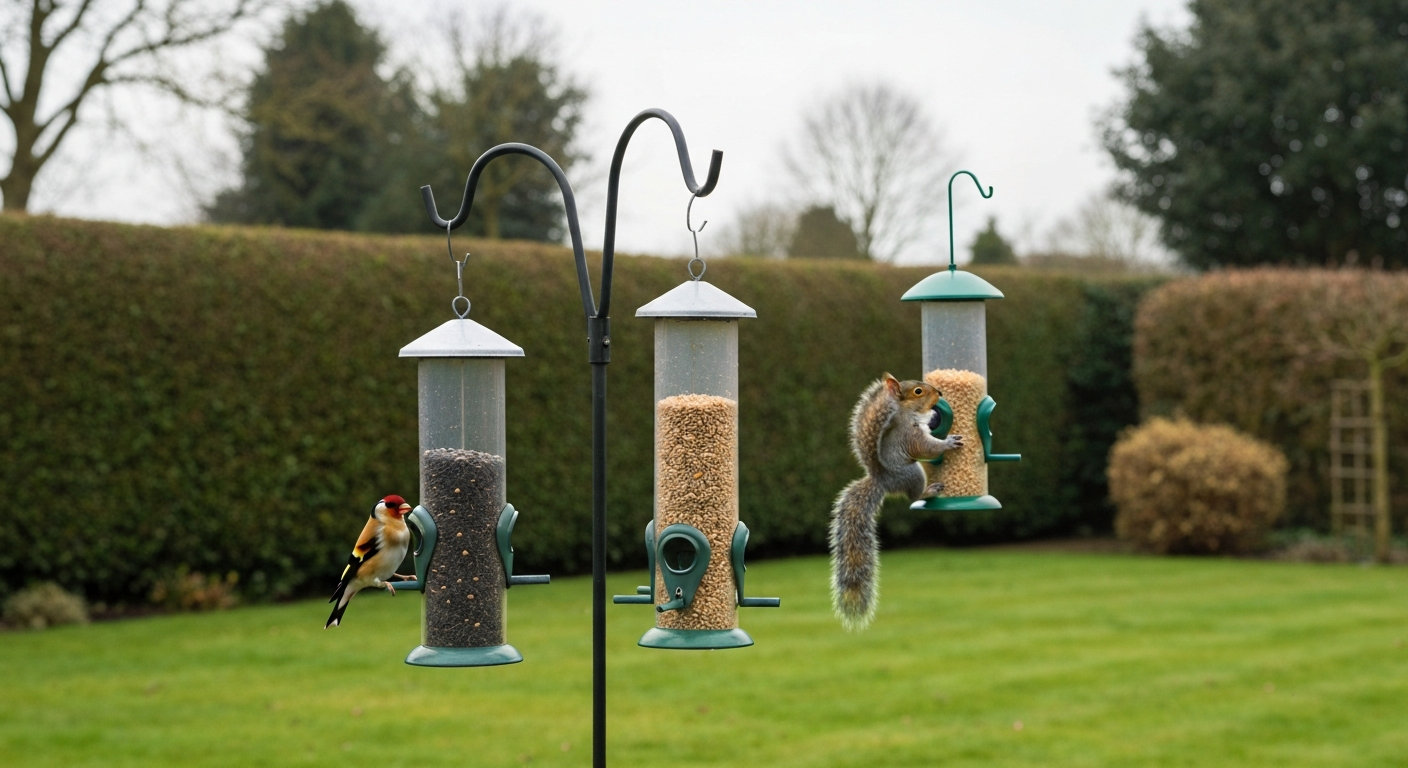
A feeder station, a freestanding metal pole system with multiple hanging points, is the most practical solution if you want to offer several food types simultaneously without drilling into walls or relying on a single tree branch. It also makes squirrel management easier because a single well-positioned baffle on the central pole can protect all the feeders it carries at once.
The Tom Chambers Kingfisher Station (approximately £45 to £60) is a solid mid-range option that suits most small to medium UK gardens. It takes up a ground footprint of around 50cm and provides enough hanging points for a seed feeder, a peanut or suet feeder, and a water feeder or fat ball holder simultaneously. The spike base goes into typical lawn turf without tools and is stable enough in moderate wind, though I would recommend adding a concrete collar in very exposed gardens. I cover feeder station options in more detail in the best bird feeder station guide.
Woodpecker options
Greater spotted woodpeckers are increasingly regular garden visitors across the UK, particularly where there are mature trees, and they respond well to suet and fat blocks in a cage feeder, peanut feeders, and suet log feeders (wooden logs drilled with holes and filled with suet). None of these require specialised 'woodpecker feeders' as sold in the North American market, where the downy and hairy woodpecker species prefer vertical cling-style feeders. UK greater spotted woodpeckers are strong enough to cling to any mesh or cage feeder and will do so reliably without specialist design.
A fat/suet block cage feeder with a guardian cage is the most cost-effective woodpecker-friendly setup (around £12 to £25), particularly when paired with a peanut feeder nearby. If you want to specifically prioritise woodpeckers over starlings, which will otherwise dominate a suet cage very quickly, a cage with a smaller external mesh spacing (around 50mm or less) will allow woodpeckers to cling on the outside but make it harder for starlings to perch and feed aggressively.
Smart and AI camera feeders
The Bird Buddy Smart Bird Feeder (approximately £150 to £180) is the most widely available AI-identification camera feeder in the UK market currently. It combines a standard seed feeder design with a camera module that triggers on movement, photographs visiting birds, and then uses an AI model to identify the species and log visits to a companion smartphone app. In testing, it identified common UK garden species (blue tit, great tit, house sparrow, goldfinch, nuthatch, robin, chaffinch) with high accuracy and was genuinely enjoyable to use as a wildlife monitoring tool.
The honest limitations: the seed capacity is smaller than most comparable non-camera feeders, the camera requires charging (around every four to six weeks in UK winter light conditions with a solar panel attachment, or more frequently without it), and the feeder design itself is not as cleanable as the Squirrel Buster range. The app experience is the product's genuine differentiator. For a gardener who wants to log species visits, share photographs, and learn bird identification, it earns its price. For someone who primarily wants to maximise bird welfare and hygiene compliance, the cleaning limitations are a real consideration.
It is also worth noting clearly for UK readers searching for 'hummingbird feeder' options: hummingbirds (family Trochilidae) are native only to the Americas. They do not naturally occur in the UK or anywhere in Europe. If you have seen what appears to be a hummingbird in a British garden, it was almost certainly a hummingbird hawk-moth, an Old World moth that hovers and feeds on flowers in a remarkably similar way. There is no hummingbird feeder product relevant to UK gardens. Similarly, Northern Cardinals are a North American species with no established population in the UK, so 'cardinal feeder' designs serve no function here. The UK equivalents for large colourful seed-eating birds are the bullfinch and jay, both of which respond to standard seed and peanut feeders rather than specialist designs.
Common problems and practical solutions
Dealing with woodpigeons and starlings
Woodpigeons and starlings are not dangerous to garden birds in the way a sparrowhawk is, but they monopolise feeders and displace smaller birds. Woodpigeons are too large to use most tube feeders but will clear up seed from the ground underneath, which can become a disease concentration point. I recommend sweeping up ground spillage regularly or using a catch tray with drainage holes on the feeder pole rather than letting it accumulate. Starlings dominate suet and fat feeders aggressively. A cage feeder with a maximum 50mm mesh spacing slows them down considerably.
Grackles
Grackle invasions are a North American problem and do not affect UK gardens. UK readers searching on this topic can disregard grackle-specific feeder advice entirely.
Feeder placement: a practical checklist
- Position feeders at least 1.5 metres from fences, walls, and overhanging branches to reduce squirrel jump access.
- Fit a pole cone baffle approximately 1.2 to 1.5 metres above ground if using a freestanding pole.
- Maintain at least 2 metres between individual feeders to reduce disease concentration and allow subordinate birds to access food.
- Rotate feeder positions every few weeks to reduce pathogen build-up in the surrounding soil and vegetation.
- Place feeders within clear sight of cover (hedging or shrubs within 1 to 2 metres) so birds have a quick escape route from aerial predators.
- Avoid placing feeders directly above water features or ponds where faecal contamination is a concern.
- In a small garden, a feeder station with a single baffle pole is usually more effective and more manageable than multiple individually hung feeders.
Recommended foods for UK garden feeders
Food choice matters as much as feeder design in determining which species visit. Sunflower hearts (dehusked) are the single most broadly attractive seed for UK garden birds: they are taken by tits, sparrows, finches, nuthatches, robins, and dunnocks, and they produce minimal husk waste that can go mouldy and attract rats. Nyjer seed draws goldfinches, siskins and lesser redpolls specifically. Peanuts attract woodpeckers, nuthatches, jays, tits, and sparrows. Suet and fat products are taken by almost everything, and they are the highest-calorie option for winter feeding. The best food for UK bird feeders is covered in much more depth in the dedicated food guide on this site, including which foods to avoid (desiccated coconut, salted nuts, and loose whole peanuts during breeding season).
A note on buying in the UK
The RSPB shop is one of the most reliable sources for feeders designed with bird welfare principles built in, and purchases support conservation work. CJ Wildlife, Jacobi Jayne, and Gardman are the other major UK-facing brands with consistent availability. Amazon UK carries most of these, sometimes at lower prices, but returns can be more complicated for damaged goods and you lose the specialist customer service you get from CJ Wildlife or Jacobi Jayne directly. For premium feeders like the Squirrel Buster range, I would recommend buying direct from CJ Wildlife because their replacement parts availability and warranty support is genuinely useful over a five-year feeder lifespan.
If you see sick or dead garden birds, the correct step is to report them to the Garden Wildlife Health project (run jointly by ZSL, BTO, RSPB and APHA) before anything else. Their online reporting tool takes about three minutes and feeds directly into the national surveillance network that monitors trichomonosis, salmonellosis, and other feeder-linked disease outbreaks. It is a simple but genuinely useful thing to do.
FAQ
What is the single most important RSPB‑aligned principle to follow when putting up a bird feeder in the UK?
Follow ‘Feed Safely, Feed Seasonally’: avoid continuous feeding that increases disease risk. Pause filling seed and peanut feeders from 1 May to 31 October, clean feeders and baths at least weekly, rotate/move feeders if you suspect disease, and stop feeding if you see sick or dead birds.
What selection criteria should an evidence‑based UK buying guide use when testing bird feeders?
Use multi‑metric, repeatable tests: species visitation records, visit frequency, pest (squirrel/pigeon) attempts and success, ease of filling, ease and time to clean/disassemble, build quality/durability, weather resistance, anti‑perch/safety features, and long‑term field trials in real UK gardens. Weight metrics (grams of seed used) and standardized placement protocols (height, distance from jump points) should be recorded. Score usability (refilling/cleaning), performance (bird access vs pests) and longevity under typical UK weather.
Which top UK feeders should be listed for a short ‘best of’ picks covering budget, premium, squirrel‑proof and specialist models?
Include one budget seed feeder (simple mesh or small tube feeder, easy to clean, low cost), one premium multi‑feed station (robust metal/polycarbonate, modular perches), one proven squirrel‑proof feeder (weight‑activated model such as the Squirrel Buster style), one peanut‑specific feeder (caged or hold‑peanut design), and one specialist large‑woodpecker/peanut block or suet feeder. Provide price ranges and note availability at UK retailers and the RSPB shop.
How do I match feeder type to target UK species (small birds/finches, tits, woodpeckers, etc.)?
Use species diet profiles (BTO/BirdFacts) to match feeders: small tube feeders with small ports and narrow perches for finches and siskins; mesh feeders and nyjer feeders for specialist finches; peanut feeders (caged or mesh) for tits and nuthatches; suet/seed blocks and larger peanut cages for woodpeckers and larger species; larger hopper or tray elements attract blackbirds/ground‑feeding species. Note: Northern Cardinals and hummingbirds are not native to the UK; replace with UK equivalents (e.g., blackbird, starling, jay).
What about hummingbird or cardinal feeder recommendations for UK readers?
Hummingbirds and Northern Cardinals are North American species and not found in the UK. For nectar‑feeding interest, advise planting nectar rich flowers and supporting hummingbird‑hawk‑moths; for cardinal‑style feeding (large seed eaters), recommend larger hopper feeders or platform feeders suitable for starlings, jays and blackbirds instead.
How should RSPB disease guidance change feeder management and placement?
Implement RSPB advice: stop feeding during May–October for seed/peanut feeders where recommended; clean feeders and baths weekly with hot soapy water or a suitable disinfectant (dilute bleach per GWH/APHA guidance), rinse and dry before refilling; avoid flat open trays where possible; move or rotate feeders between sites to interrupt transmission; report sick/dead birds to Garden Wildlife Health/BTO/APHA surveillance.