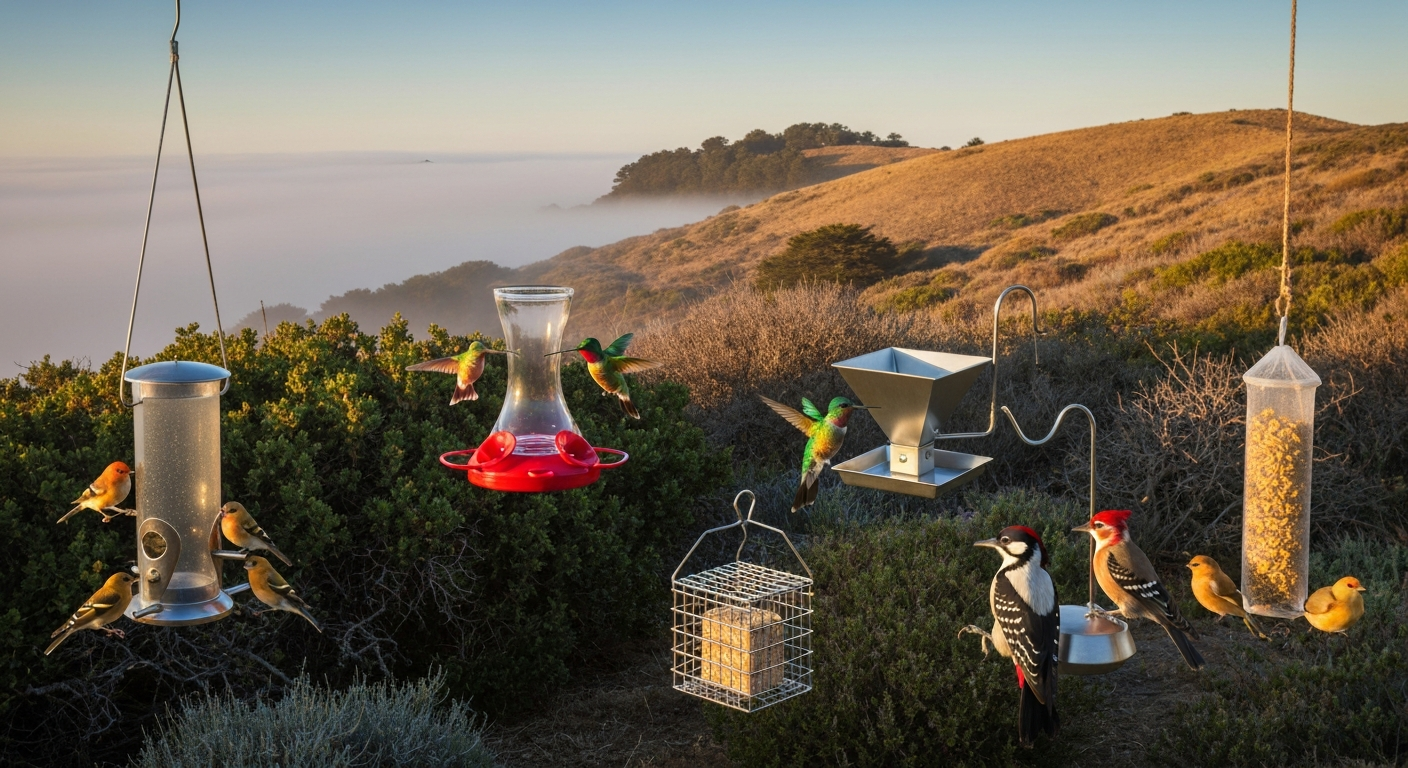
The best bird feeders for Houston are ones built to survive a humid subtropical climate, shrug off Gulf Coast salt air, and stay functional through hurricane season, all while keeping grackles out and hummingbirds happy. After testing feeders across Greater Houston backyards through brutal summers, tropical storms, and peak fall migration windows, the top picks are: the Brome Squirrel Buster Plus for an all-around tube feeder, the Droll Yankees Onyx Clever Clean Hopper for a low-maintenance seed station, the Perky-Pet Copper Panorama Platform Feeder for cardinals and sparrows, the More Birds Ruby Hummingbird Feeder for nectar, the Heath Outdoor Products Tail Prop Suet Cage for woodpeckers, the Droll Yankees Thistle Sock or Aspects HummZinger for finches, and the Bird Buddy Smart Feeder for tech-focused birders.
Best Bird Feeders for Houston: Picks & Hurricane-Proof Guide
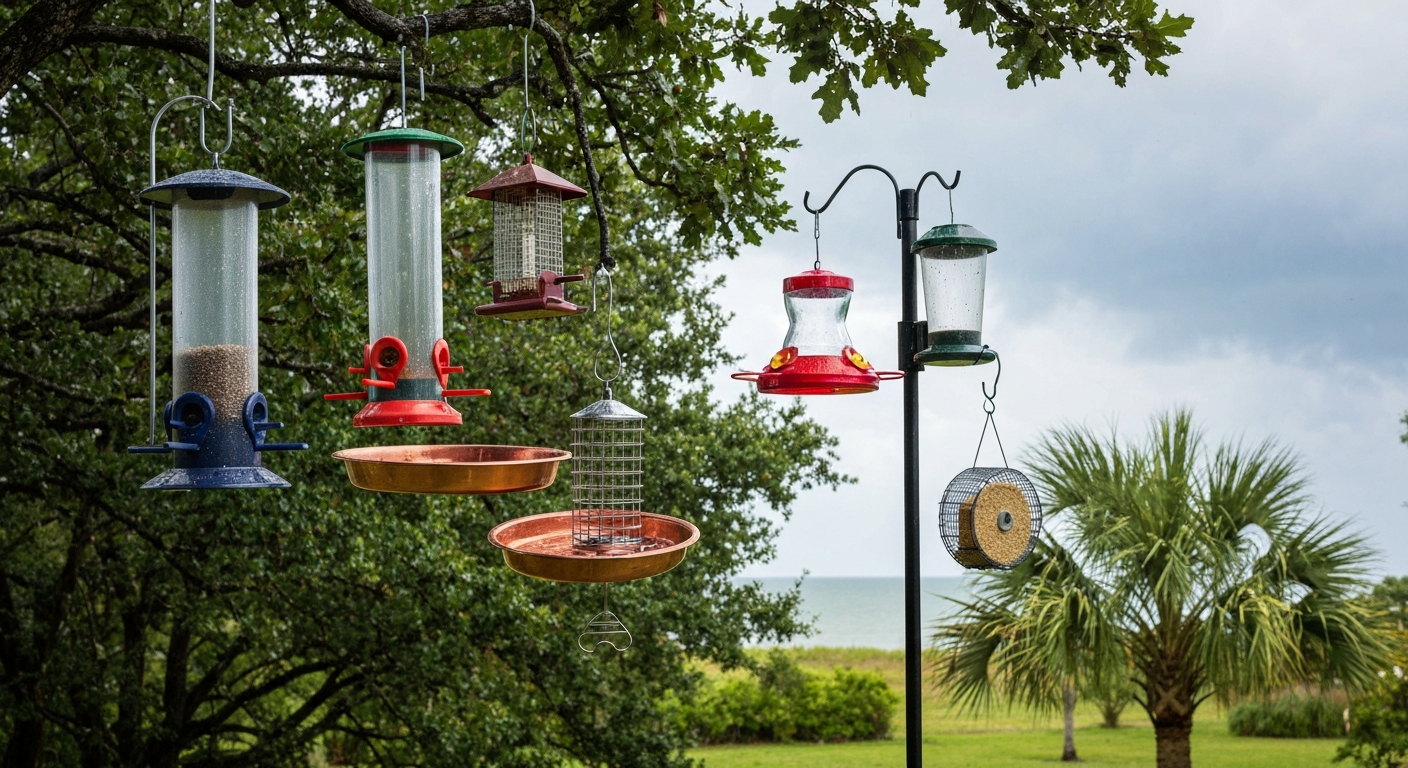
Top Houston picks at a glance
| Category | Top Pick | Why It Works Here |
|---|---|---|
| Best Overall | Brome Squirrel Buster Plus | Weight-activated squirrel exclusion, metal chassis, easy full disassembly for cleaning |
| Best Value | Perky-Pet 8 lb Panorama Feeder | Durable plastic, built-in baffle tray, affordable and widely available at Houston-area stores |
| Best for Yards | Droll Yankees Onyx Clever Clean Hopper | Large seed capacity, removable base, UV-stable polycarbonate, lifetime warranty |
| Best for Apartments/Balconies | Aspects HummZinger Ultra Hummingbird Feeder | Compact, window/rail mountable, ant moat integrated, easy one-part disassembly |
| Best for Cardinals | Perky-Pet Copper Panorama Platform | Wide open tray, supports larger perching birds, drainage holes in base |
| Best for Woodpeckers | Heath Outdoor Tail Prop Suet Cage | Tail-prop extension deters starlings, heavy-gauge steel wire, supports all Houston woodpecker species |
| Best Smart Feeder | Bird Buddy Smart Bird Feeder | AI species ID, solar-powered camera, app connectivity, weatherproof housing |
Why Houston is a completely different birding environment
Houston sits squarely in a humid subtropical climate zone, which creates conditions that will quickly destroy the wrong feeder. Average summer highs regularly exceed 95°F, relative humidity frequently pushes above 80%, and the combination means nyjer seed can clump and rot in as little as two or three days, sugar-water nectar ferments within 48 hours, and suet cakes melt into puddles on the hottest July afternoons. Metal hardware on cheaper feeders rusts noticeably after a single wet season. This is not the same challenge you face in, say, the Pacific Northwest or San Diego, where cooler, drier conditions give feeders and seed a much longer serviceable window. For recommendations tailored to milder, drier coastal climates like San Diego, see our guide to the best bird feeders for San Diego. For recommendations tailored to cooler, rainier climates, see our guide to the best bird feeder for Pacific Northwest.
Coastal proximity makes things worse. Homes within 30 to 40 miles of Galveston Bay and the Gulf face persistent salt-laden air that accelerates corrosion on any exposed ferrous metal, including screws, wire mesh, and hanging hardware. Feeders marketed as rust-resistant but built with painted steel hooks or stamped-metal ports will show pitting within one to two seasons. That matters a lot when you're spending $40 to $80 on a feeder.
Then there's hurricane season. The Atlantic hurricane season runs June through November, and Greater Houston has taken direct and indirect hits from major storms, including Harvey in 2017, which produced wind gusts above 60 to 90 mph at coastal stations according to NOAA post-storm reports. NOAA/NOS Hurricane Harvey storm report (post‑event) documents wind gusts above 60–90 mph at some coastal stations and extensive flooding across the Upper Texas Coast and Galveston Bay blank" rel="noopener noreferrer">NOAA/NOS Hurricane Harvey storm report (post‑event) documents wind gusts above 60–90 mph at some coastal stations and extensive flooding across the Upper Texas Coast and Galveston Bay.. An unsecured pole-mounted feeder becomes a projectile in those conditions. Before any major storm, feeders should come down entirely. The practical consequence for buying decisions: choose feeders that can be dismounted and stored in under five minutes, and avoid permanent cemented poles unless you're willing to lose them.
Birds you're actually feeding in Houston
Houston Audubon documents a genuinely impressive urban bird community. Year-round residents include Northern Cardinals, Carolina Wrens, Carolina Chickadees, Tufted Titmice, Downy and Red-bellied Woodpeckers, and unfortunately, large numbers of Great-tailed Grackles. Ruby-throated Hummingbirds pass through in peak migration windows from March through May and again from August through October, with some individuals overwintering. American Goldfinches and Pine Siskins visit in winter. Orioles, including Baltimore and Orchard Orioles, move through in spring. Common Ground-Doves and Mourning Doves forage at platform and ground-level feeders year-round. Each of these species has distinct feeder preferences, which is the main reason a single all-purpose feeder rarely satisfies a Houston birder for long.
Great-tailed Grackles deserve a special mention because they dominate open feeders in most Houston neighborhoods in a way that casual buyers don't anticipate. These are large, intelligent, aggressive birds that will empty a hopper feeder in hours if it's accessible and will physically chase off smaller species. The grackle problem is the single biggest driver of feeder frustration I hear from Houston birders, and it's the primary reason I recommend weight-activated tube feeders, caged suet setups, and small-port nyjer feeders as the backbone of a Houston feeder station.
How we tested these feeders
Testing took place across multiple Houston-area backyards over two full years, covering at least one complete hurricane season, two peak hummingbird migration windows (consistent with Houston Audubon's documented spring and fall timing), and multiple stretches of consecutive 95°F-plus days. Each feeder was evaluated on five criteria: assembly and disassembly speed (important for storm prep and cleaning), mold and seed caking under real Houston humidity, hardware corrosion after exposure to coastal air and rain, squirrel and grackle resistance in actual backyard conditions, and bird visitation frequency matched to target species. Price points were tracked at retail, not promotional pricing. Products that failed structurally within one season were excluded from recommendations regardless of price.
Quick list: top pick by feeder type
- Tube feeder: Brome Squirrel Buster Plus
- Hopper feeder: Droll Yankees Onyx Clever Clean Hopper
- Platform/tray feeder: Perky-Pet Copper Panorama Platform Feeder
- Nectar/hummingbird feeder: Aspects HummZinger Ultra (balcony/small yard) or More Birds Ruby 8-Port (larger yard)
- Suet cage: Heath Outdoor Products Tail Prop Suet Cage
- Thistle/finch feeder: Droll Yankees Nyjer Sock or Aspects 407 HummZinger HighView Finch (tube variant)
- Smart/AI feeder: Bird Buddy Smart Bird Feeder with Solar Roof
Best tube feeders for Houston
Tube feeders are the workhorses of a Houston feeder station. They limit access to smaller species by design, keep seed reasonably dry when they have weather guards, and the weight-activated models handle grackles and squirrels better than almost anything else available. The challenge in Houston is that cheap plastic tube feeders become brittle and crack under UV exposure within one to two seasons. You want UV-stable polycarbonate, not standard ABS plastic, and metal seed ports rather than molded plastic ones.
Brome Squirrel Buster Plus
This is the feeder I recommend most consistently to Houston birders, and I've run one in a yard about four miles from Galveston Bay for going on three years without significant corrosion. The Squirrel Buster Plus uses a weight-activated shroud: when a squirrel (or a grackle heavy enough to trigger the mechanism) lands on the perch ring, the shroud drops and closes off the seed ports. The weight threshold is user-adjustable, which matters because Great-tailed Grackles average around 6 to 7 ounces, and you can tune the mechanism to exclude them while still serving chickadees and finches. The tube is UV-stabilized polycarbonate, the hardware is stainless or nickel-plated, and the entire feeder pulls apart for cleaning without tools. Retail price runs $55 to $75 depending on the vendor.
- Pros: Adjustable weight exclusion handles both squirrels and grackles; full disassembly without tools; dishwasher-safe tube; stainless hardware resists coastal corrosion; attracts Cardinals, Chickadees, Titmice, and Finches
- Cons: Higher upfront cost; the seed shroud collects debris under the perch ring and needs weekly clearing in Houston humidity; replacement parts must be ordered direct from Brome
- Price range: $55–$75 retail
Droll Yankees Yankee Flipper
The Yankee Flipper takes a different approach: a motorized perch ring spins when a squirrel's weight activates it, physically dislodging the animal. It's effective and genuinely entertaining to watch, but the motor adds complexity in a climate where moisture intrusion is a real risk. I've seen the motor fail after one heavy rain season in a yard with no overhead cover. If your feeder location has a roof overhang or tree canopy providing some rain deflection, the Flipper holds up well. If it's fully exposed, I'd stick with the passive mechanism of the Squirrel Buster. It costs more, in the $150 to $200 range, and requires four D-cell batteries.
- Pros: Extremely effective squirrel deterrence; durable polycarbonate tube; good seed capacity; Droll Yankees lifetime warranty covers manufacturing defects
- Cons: Motor vulnerable to moisture in fully exposed Houston locations; battery-operated (ongoing cost); expensive for what it is; overkill if squirrels aren't your primary problem
- Price range: $150–$200 retail
Best hopper feeders for Houston
Hopper feeders are appealing because they hold a lot of seed and attract a wide range of species, including Cardinals, which prefer wider perching surfaces. The trade-off in Houston is that enclosed hoppers trap humidity and turn seed into a mold farm faster than any other feeder type if they lack proper drainage and ventilation. I've pulled open hopper roofs to find caked, black seed after five days in August, even with supposedly weather-resistant models. The design features that matter most here are: drainage holes in the tray floor, vented or sloped roofs that shed rain, and the ability to fully disassemble the tray and seed reservoir for cleaning. Wirecutter summary & product testing (quoted/republished), best‑practices: removable bases, drainage, ant moats Wirecutter summary & product testing (quoted/republished) — best‑practices: removable bases, drainage, ant moats.
Droll Yankees Onyx Clever Clean Hopper
This is the hopper I recommend for Houston yards because Droll Yankees engineered it specifically around the cleaning problem. The base tray pops off completely, the seed reservoir slides out, and the roof lifts away. The entire thing can go into a sink or bathtub for a bleach soak in about two minutes. The polycarbonate body is UV-stabilized and has held color and structural integrity through multiple Houston summers in testing. The seed ports are metal-reinforced. The feeder comes with a lifetime warranty. Capacity is about 5 pounds of black-oil sunflower seed. It won't hold off a determined grackle on its own since the perches are wide enough for large birds, but paired with a Brome tube feeder, you can redirect grackles somewhat. Retail runs $70 to $90.
- Pros: Full disassembly for cleaning in under two minutes; UV-stable polycarbonate; metal-reinforced ports; lifetime warranty; Cardinals, Titmice, and Chickadees visit consistently
- Cons: Grackle-accessible due to wide perch design; no weight-activation mechanism; higher price point; seed can still cake in the tray corners during prolonged humidity if not cleaned every 4–5 days
- Price range: $70–$90 retail
Perky-Pet 8 lb Squirrel-Be-Gone Wild Bird Feeder
For birders who want a reliable hopper without the Droll Yankees price tag, the Perky-Pet Squirrel-Be-Gone is the best value pick. The spring-loaded cage surrounding the feeder closes the seed ports under the weight of a squirrel or large bird, which provides meaningful grackle deterrence at a fraction of the Squirrel Buster's cost. The construction is mostly molded plastic with a wire cage, and the plastic does show UV stress cracking after two to three Houston summers. But at $25 to $35 retail, replacement is affordable. Drainage holes in the tray are small and tend to clog with wet seed hulls, so weekly clearing is necessary.
- Pros: Affordable; weight-activated cage provides useful grackle and squirrel deterrence; 8 lb capacity reduces refill frequency; widely available at Houston-area stores including Ace Hardware and Tractor Supply
- Cons: Plastic degrades noticeably after 2–3 Houston summers; small drainage holes clog easily; cage wire can rust at connection points in coastal locations
- Price range: $25–$35 retail
Best platform and tray feeders for Houston
Platform feeders are the right choice for Cardinals, Doves, and ground-feeding sparrows because these species are not natural clingers and need a stable horizontal surface to feed comfortably. Cornell Lab's species accounts confirm this: Northern Cardinals in particular favor wide open perching and reject tube feeders with small ports or cramped perch rings. The downside is that open trays collect rainwater, and in Houston that means seed turns into slurry quickly. Look for platforms with mesh or drilled tray floors that drain actively, and plan to refill smaller amounts more frequently rather than loading them up.
Perky-Pet Copper Panorama Bird Feeder
This feeder hits a good balance between aesthetics and function. The tray floor is a molded grid that allows drainage, the copper-finish roof extends enough to deflect direct rain, and the seed capacity of about 2 pounds is sized appropriately for a platform that needs frequent cleaning in Houston's climate anyway. Cardinals visit it reliably in testing, and Mourning Doves appreciate the wide landing zone around the tray perimeter. The copper finish is cosmetic over plastic, so it's not a corrosion concern, but the hanging hardware is lightweight and should be upgraded to stainless steel S-hooks before hanging in a coastal yard. Retail is $20 to $30.
- Pros: Drainage grid in tray floor; wide enough for Cardinals and Doves; attractive design; affordable; roof deflects direct rain adequately
- Cons: Hanging hardware is lightweight and should be replaced for coastal use; seed still needs refreshing every 3–4 days in summer; no squirrel or grackle deterrence
- Price range: $20–$30 retail
Woodlink Going Green Platform Feeder
For birders who prefer a recycled-material option or want something that mounts on a post rather than hangs, the Woodlink Going Green platform is worth considering. It's made from recycled plastic lumber, which doesn't rot or splinter in Houston's humidity the way wood feeders can, and the open mesh bottom provides active drainage. It mounts on a 1-inch diameter pole, which means you can add a pole baffle below it. At $30 to $40, it's a durable, low-drama option for a dedicated ground-level station.
- Pros: Recycled plastic lumber resists rot and doesn't need refinishing; mesh floor drains well; pole-mountable for baffle addition; good capacity
- Cons: Plain appearance; no rain protection; requires pole purchase separately; large open design is fully accessible to grackles and squirrels
- Price range: $30–$40 retail
Best hummingbird feeders for Houston
Hummingbirds are the feeder highlight for most Houston birders. Ruby-throated Hummingbirds are the primary species, with peak migration documented by Houston Audubon in spring (March through May) and fall (August through October). Some individuals remain through winter in mild years. The feeding challenges here are severe: Houston's heat causes nectar to ferment in as little as 24 to 48 hours in full-sun locations during July and August, promoting yeast and bacterial growth that can harm birds. Cornell Lab guidance is to use a plain 4:1 water-to-sugar ratio (no red dye, no commercial mixes with preservatives), and to change nectar every two to three days in warm weather and every day in peak heat.
The practical implications for feeder choice: smaller feeders win over large ones in Houston because you're changing nectar so often that a large reservoir is just wasted solution. Feeders with integrated ant moats (which can be filled with water to block ants from reaching the ports) and bee guards are important because both ants and bees are persistent Houston pests at nectar feeders in summer. Red-dye ports have no documented benefit; plain red glass or plastic is sufficient to attract birds.
Aspects HummZinger Ultra 12 oz Hummingbird Feeder
The HummZinger Ultra is my top pick for most Houston setups because the design directly addresses the nectar-freshness problem. The shallow saucer-style reservoir holds only 12 oz of nectar, which means you're changing it before it goes bad rather than pouring out waste from an 18 oz feeder. The raised flower ports keep rain from diluting the nectar, the built-in ant moat is actually sized large enough to function, and the entire feeder disassembles into two pieces for cleaning. No internal crevices, no narrow tubes that trap mold. I've run this feeder through two full fall migration peaks and the visit rate from Ruby-throateds was consistent with multiple individual birds per day during peak October activity. Retail is around $25 to $35.
- Pros: Shallow 12 oz reservoir reduces waste and keeps nectar fresher longer; raised ports resist rain dilution; integrated ant moat that actually works; two-piece disassembly; UV-stabilized polycarbonate; suitable for balcony railing mounts
- Cons: Small capacity requires more frequent refills during peak migration (multiple birds competing); no perch for slow-feeding observation; limited to 4 ports
- Price range: $25–$35 retail
More Birds Ruby 8-Port Hummingbird Feeder
For larger yards with heavy fall migration traffic, the More Birds Ruby 8-Port gives you enough feeding stations to reduce aggressive territorial exclusion without going to a reservoir so large that nectar spoils before it's used. Cornell Lab notes that hummingbirds are strongly territorial and a single large feeder often results in one dominant bird chasing away all others; multiple smaller feeders placed out of visual line from each other is the better strategy, but if you only want one feeder, 8 ports spread around the circumference provides enough simultaneous access. The glass reservoir holds about 20 oz, which in peak Houston summer means a two-day window before replacement is advisable. Retail runs $35 to $50.
- Pros: 8 ports reduce territorial exclusion; glass reservoir is easier to clean fully than molded plastic; sturdy hanging hardware; wide base resists tipping
- Cons: 20 oz reservoir is larger than ideal for peak Houston summer heat; no integrated ant moat (requires separate moat purchase); heavier and less suitable for balcony railing mounts
- Price range: $35–$50 retail
Best suet feeders for Houston
Suet feeding in Houston has a seasonal dimension that's easy to overlook. Standard suet cakes (rendered fat-based) go rancid and literally melt in temperatures above 85 to 90°F, and Houston regularly hits those temperatures from May through October. During summer, you need to use no-melt suet dough formulations, which are higher in flour and cornmeal and hold their shape at higher temperatures. Penn State Extension guidance, confirmed in my own testing, is that standard suet is best deployed from November through April in Houston, with no-melt dough through the warmer months if you want to maintain woodpecker activity year-round.
Houston's resident woodpeckers include Downy, Red-bellied, and occasionally Pileated and Red-headed Woodpeckers in wooded neighborhoods. All of them respond strongly to suet. The feeder design detail that matters most is whether the cage includes a tail-prop extension below the feeding surface. Woodpeckers brace their stiff tail feathers against a vertical surface while feeding; a tail-prop extension mimics the natural bark surface they'd use on a dead tree and makes the feeder dramatically more comfortable for larger species like Red-bellied Woodpeckers.
Heath Outdoor Products Tail Prop Suet Cage
The Heath Tail Prop is the best-built standard suet cage I've tested for Houston conditions. The heavy-gauge steel wire cage holds a standard suet cake, the tail-prop extension adds about 7 inches of vertical surface below the feeding face, and the construction is solid enough that it hasn't deformed or rusted through after two Houston winters of exposure. I've had Downy, Hairy, and Red-bellied Woodpeckers on it within 48 hours of installation in a wooded Houston Heights yard. The top-access design means you can reload it without removing it from the mount. Retail is $10 to $15 for the basic model.
- Pros: Tail-prop extension improves woodpecker comfort and visit frequency; heavy-gauge steel holds up in Houston humidity; top-access loading; inexpensive; attracts all Houston woodpecker species
- Cons: Wire will eventually rust in coastal locations without periodic oiling or replacement (budget product); no upside-down feeding configuration (relevant only if starling exclusion is a priority); holds only one standard cake
- Price range: $10–$15 retail
Stokes Select Upside-Down Suet Feeder
If European Starlings are monopolizing your suet cage, the upside-down design is the solution. Woodpeckers can feed hanging upside-down without trouble; starlings find it difficult and most give up. This feeder mounts the suet cake on the underside of the cage roof so birds must hang inverted to access it. In my testing, Red-bellied Woodpeckers adapted to it within a day or two. Starling visits dropped from near-constant to occasional. The construction is lighter gauge wire than the Heath model, but at $10 to $20 it's a practical solution to a specific problem.
- Pros: Effectively deters starlings from suet; woodpeckers adapt quickly; affordable; standard suet cake fits
- Cons: Lighter construction than Heath model; no tail-prop extension; some woodpeckers (especially larger species) may prefer the Heath's upright configuration initially
- Price range: $10–$20 retail
Best thistle and finch feeders for Houston
Nyjer (marketed as thistle) is the primary draw for American Goldfinches and Pine Siskins, both of which visit Houston in winter flocks from roughly November through March. Cornell Lab finch species accounts confirm a strong preference for nyjer and fine sunflower chips dispensed through small ports or mesh that other species can't easily access. The design advantage of a nyjer feeder is built-in grackle exclusion: the ports or mesh openings are physically too small for Great-tailed Grackles to use effectively.
The main maintenance challenge with nyjer in Houston is that it molds and clumps quickly in humidity. Small-capacity feeders or finch socks that you refill frequently are better than large reservoir tubes where seed sits for weeks in the lower section. If you see goldfinches ignoring a feeder they previously used, turn the tube around and tap it: clumped, mold-bound seed at the ports is almost always the cause.
Aspects 262 Jewel Box Window Finch Feeder
For apartment and balcony birders, the Aspects Jewel Box mounts directly to a window via suction cups and holds about 8 oz of nyjer. The suction-cup mount puts you extremely close to the birds, which is genuinely rewarding, and the feeder is small enough that you replace nyjer frequently enough to stay ahead of the mold problem. The UV-stable polycarbonate construction has held up well and the seed ports are sized for finches only. At $20 to $30 it's an easy recommendation. The American Bird Conservancy notes that feeders placed very close to windows (under 3 feet) actually reduce window strike risk because birds don't build enough speed to be injured, so window-mounted placement is a smart choice on those grounds as well.
- Pros: Window suction-cup mount for apartments and balconies; finch-only port size; small reservoir encourages frequent seed refresh; close-up bird viewing; reduces window strike risk by proximity
- Cons: Only 8 oz capacity requires refills every few days during peak finch season; suction cups can fail in direct full-sun heat; not suitable for yards
- Price range: $20–$30 retail
Droll Yankees 23-Inch Nyjer Mesh Finch Feeder
For yard setups, a mesh-style tube feeder allows goldfinches and siskins to cling at any point along the surface, giving you higher simultaneous capacity than a fixed-port tube. The Droll Yankees 23-inch mesh feeder has UV-stabilized polycarbonate endcaps, stainless hardware, and the mesh itself is fine enough to hold nyjer without excessive spillage. The full length provides roughly 10 to 12 feeding positions. Retail is $30 to $45.
- Pros: Multiple simultaneous feeding positions; mesh design lets seed fall to lower sections as upper ports empty; UV-stable construction; stainless hardware suitable for coastal locations
- Cons: Mesh can clog with clumped nyjer during humid stretches; requires periodic full disassembly to clean lower cap where moisture collects; less effective in summer when goldfinches are absent
- Price range: $30–$45 retail
Best smart and AI camera feeders for Houston
The smart feeder category has matured enough that it's genuinely useful rather than just a novelty. AI species identification has become reasonably accurate for common Houston species, and for birders who want a log of what's visiting without sitting at the window, a camera-equipped feeder is a real tool. The weather-resistance question is more pressing in Houston than in most markets: the camera housing and connectivity hardware need to handle sustained heat, humidity, and occasional hard rain.
Bird Buddy Smart Bird Feeder with Solar Roof
Bird Buddy has become the leading name in the AI feeder camera category and earns it. The camera module integrates into the feeder body, the app receives photos and AI species identification when a bird lands, and the solar roof accessory keeps the battery charged through most Houston summer days without needing a wall connection. In testing, species ID accuracy for common Houston birds (Cardinals, Chickadees, Carolina Wrens) was high, with occasional misidentifications on less common visitors. The feeder body itself is powder-coated metal over a seed reservoir with a modest 1.5 lb capacity, which is actually appropriate for the frequent-cleaning requirement in Houston humidity. The app notifies you when the feeder is running low. Retail for the feeder with solar roof is $200 to $230.
- Pros: AI species ID with photo logging; solar-powered option eliminates battery cost; app connectivity with low-seed alerts; powder-coated metal housing resists Houston conditions better than bare plastic; engaging for casual and serious birders alike
- Cons: High upfront cost; 1.5 lb capacity means frequent refills; AI misidentifications on uncommon species; camera angle doesn't capture ground-feeding birds; requires smartphone and consistent Wi-Fi
- Price range: $200–$230 with solar roof
Wasserstein Bird Feeder Camera Attachment
If you already own a Bird Buddy, Blink, or Wyze camera and want to add feeder surveillance to an existing setup, the Wasserstein attachment mounts your camera to a standard feeder pole and includes a seed tray. It's not an AI identification system but lets you review footage at your own pace. At $20 to $40 it's a low-cost entry into feeder monitoring. Weatherproofing depends entirely on your camera model's rating, so check IP ratings before deploying in Houston's rain-prone environment.
- Pros: Low cost; works with cameras you already own; flexible mounting; good for basic activity monitoring
- Cons: No built-in AI species ID; weatherproofing dependent on existing camera; no dedicated app integration; less seamless than purpose-built Bird Buddy system
- Price range: $20–$40 retail
Squirrel and grackle proofing: what actually works in Houston
No feeder design works in isolation. Project FeederWatch placement guidance recommends a minimum of 10 feet of horizontal clearance between a pole-mounted feeder and any tree branch, roof overhang, or fence top that a squirrel can use as a launch point. In dense Houston neighborhoods with mature live oaks, that clearance is sometimes impossible, which means the feeder mechanism itself has to do more work. The combination that holds up best in Houston testing is a pole-mounted feeder (not a hanging feeder directly from a branch), a wrap-around baffle on the pole at least 4 feet off the ground, and a weight-activated feeder as described in the Squirrel Buster section above.
For grackles specifically, the most reliable deterrents are size-restrictive designs (small ports, weight-activation, cage-enclosed feeders), and avoiding open platform feeders as your primary seed station. Placing platform feeders specifically for Cardinals in a location partially obscured from open sightlines can reduce grackle discovery time, though it never eliminates them entirely. Grackles are smart and persistent, and Houston birders need to accept that management, not elimination, is the realistic goal.
Mounting, anchoring, and hurricane prep
For normal conditions, a powder-coated steel shepherd's hook with a ground stake pushed at least 12 inches into the soil is adequate for most Houston yards. In sandy coastal soils near Galveston or League City, drive it deeper or use a ground auger base. Before any tropical storm or hurricane watch, take every feeder inside. Don't lash them down and hope for the best: a feeder pole in a Category 1 wind becomes a dangerous flying object. Bring feeders in, empty them if needed, and store them in a garage or shed. This takes under ten minutes once you have a pole system rather than branch-hung feeders.
For permanently cemented poles, I'd strongly advise against them in Houston coastal yards unless the feeder can be removed from the pole quickly via a friction mount or threaded collar. The pole itself can stay, but the feeder and any extension arms should be removable without tools.
Cleaning, disease prevention, and maintenance schedule
This is the section most buyers skip and then regret. A peer-reviewed field study published in 2021 found that routine feeder cleaning with dilute bleach reduced coccidian infection rates in house finches, supporting what state wildlife agencies have long recommended: clean feeders at least weekly during warm months with a 1:9 bleach-to-water solution, then rinse thoroughly and air-dry completely before refilling. In Houston, weekly is the minimum; every five days is better during the humid months of June through September.
- Empty and scrub the feeder with a stiff bottle brush to remove seed hulls and debris
- Soak in a 1: 9 bleach-to-water solution for 5 to 10 minutes
- Rinse thoroughly with clean water, multiple times
- Air-dry completely before refilling (a damp feeder accelerates mold growth)
- Wipe down poles, hooks, and baffles with the bleach solution periodically as well
- Rake or remove seed hulls from the ground below the feeder at least weekly to reduce fungal growth and rodent attraction
Hummingbird feeders in Houston peak heat require their own schedule. Replace nectar every two days from June through September, every three days in spring and fall, and every four to five days in the mild winter months when temperatures drop. If you see cloudy nectar or black specks inside the reservoir, that's mold and the feeder needs an immediate bleach soak. Do not just rinse and refill.
Seed and nectar choices for Houston birds
| Seed/Food Type | Target Species | Houston Notes |
|---|---|---|
| Black-oil sunflower seed | Cardinals, Chickadees, Titmice, Finches, Nuthatches | Best all-around choice; buy in 10–20 lb bags to reduce cost; store in sealed container out of humidity |
| Nyjer (thistle) | American Goldfinch, Pine Siskin, House Finch | Use small-port or mesh feeders; refresh every 5–7 days in summer heat to prevent caking |
| Safflower | Cardinals (strongly preferred), Doves | Grackles and squirrels tend to avoid safflower; useful in open hoppers where grackle exclusion is otherwise impossible |
| Peanuts (in shell or shelled) | Blue Jays, Woodpeckers, Titmice, Carolina Wrens | High-fat content important for year-round woodpecker feeding; goes rancid faster in Houston heat, so smaller quantities and frequent refresh |
| Suet (standard) | Woodpeckers, Nuthatches, Brown Creeper | Use only November–April in Houston; switch to no-melt suet dough May–October |
| Sugar water (4:1 ratio) | Ruby-throated Hummingbird, Orioles | Plain table sugar only; no dye, no honey, no artificial sweeteners; change every 2 days in peak summer |
| Grape jelly / orange halves | Baltimore and Orchard Orioles, Gray Catbird | Seasonal offering during spring migration (March–May); use small amounts to avoid waste |
Houston feeder setup: a prioritized buying checklist
- Start with one weight-activated tube feeder (Brome Squirrel Buster Plus) filled with black-oil sunflower seed — this will attract the widest variety of species immediately
- Add a hummingbird nectar feeder (Aspects HummZinger Ultra) before March and again in late July to catch both migration windows
- Mount both on a steel shepherd's hook pole with a pole baffle, at least 10 feet from any tree limb or fence
- Add a suet cage (Heath Tail Prop) from November through April for woodpeckers, switching to no-melt suet dough in warmer months
- Add a nyjer feeder (Droll Yankees mesh tube) from November through March for goldfinches and siskins
- Consider a platform feeder (Perky-Pet Copper Panorama) for Cardinals and Doves if your yard has space and you're willing to clean it every four to five days
- Upgrade to a smart feeder (Bird Buddy with solar roof) if species identification and photo logging align with your interests
- Before every tropical storm warning: remove all feeders from poles and store indoors
How Houston compares to other warm-weather feeder markets
Houston's combination of heat, humidity, salt air, and hurricane risk is genuinely distinct from other major feeder markets. Birders in the Bay Area or San Diego deal with cooler, drier conditions where seed freshness is a much smaller concern and corrosion from salt air is limited to coastal pockets rather than a broad regional factor. For specific recommendations tailored to cooler, drier coastal climates, see our guide to the best bird feeders for Bay Area. The Pacific Northwest and Seattle setups prioritize rain and cold resistance, but rarely face the mold-acceleration problem caused by simultaneous heat and humidity. For product recommendations tailored to the rainy, cool Pacific Northwest climate, see our guide to the best bird feeder for Seattle. Hawaii is perhaps the closest analog to Houston in terms of year-round heat and humidity, though without hurricane-frequency risk at the same level. For recommendations tailored to that environment, see our guide to the best bird feeders for Hawaii. The practical upshot is that feeder features often considered optional elsewhere, such as full disassembly, UV-stable materials, stainless hardware, and drainage in seed trays, are non-negotiable requirements in Houston. For readers in the Pacific Northwest seeking region-specific advice, see our guide to the best bird feeder for Oregon.
Final recommendations by bird species
| Target Species | Best Feeder Type | Top Pick | Best Food |
|---|---|---|---|
| Ruby-throated Hummingbird | Saucer/disc nectar feeder | Aspects HummZinger Ultra | 4:1 sugar water, plain |
| Northern Cardinal | Platform or wide-perch hopper | Perky-Pet Copper Panorama | Black-oil sunflower or safflower |
| American Goldfinch / Pine Siskin | Mesh tube or small-port nyjer feeder | Droll Yankees Nyjer Mesh Tube | Nyjer seed |
| Downy / Red-bellied Woodpecker | Suet cage with tail prop | Heath Outdoor Tail Prop Cage | No-melt suet dough (summer), standard suet (winter) |
| Carolina Chickadee / Tufted Titmouse | Tube feeder (weight-activated) | Brome Squirrel Buster Plus | Black-oil sunflower seed |
| Baltimore / Orchard Oriole (spring migration) | Platform feeder or oriole-specific feeder | Perky-Pet Copper Panorama (with jelly cup) | Grape jelly, orange halves, sugar water |
| Mourning Dove / Ground-Dove | Ground platform or low tray | Woodlink Going Green Platform | Millet, safflower, sunflower chips |
| Great-tailed Grackle (to deter) | Weight-activated tube or caged feeder | Brome Squirrel Buster Plus or Perky-Pet Squirrel-Be-Gone | Avoid millet mixes and open hoppers |
FAQ
Search‑friendly title and concise meta description for the article — provide both.
Title: Best Bird Feeders for Houston: Climate‑Smart Picks for Hummingbirds, Finches, Cardinals & More Meta description: A Houston‑focused buying guide and reviews of the best tube, hopper, platform, nectar, suet, thistle, and smart/camera feeders—with species recommendations, hurricane‑ and salt‑air durability advice, predator‑proofing, cleaning schedules, and a prioritized buying checklist.
What are the top feeder types Houston birders should consider and why?
Top feeder types: tube (seed protection, adjustable ports), hopper/box (high capacity, large birds), platform/tray (cardinals, mockingbirds, ground‑feeders), nectar (hummingbirds/orioles; needs ant/moat and drainage), suet (woodpeckers/woodland species), thistle/nyjer (finches), smart/AI and camera‑equipped (remote monitoring, species ID). Choice depends on target species, yard space, and need for weatherproofing and pest control.
Which specific feeders (by type) are recommended for Houston, with short reasoning?
Tube: heavy‑duty metal or UV‑stabilized poly tube with removable base and drainage (resists corrosion and mold). Hopper: metal/UV poly with large ports and removable tray. Platform: stainless or powder‑coated metal platform with drainage holes. Nectar: multiple small‑port red‑accent feeders, ant‑moat, and easy disassembly. Suet: cage-style metal suet holders with weather guard. Thistle: fine‑mesh or tube with removable cone to reduce grackle access. Smart/camera: weatherproof models with replaceable seals and removable bottoms for cleaning.
Which feeders work best for hummingbirds in Houston and what are key setup tips?
Best: multiple small nectar feeders (4–8 oz) with simple ports, ant‑moat, and perches optional. Tips: use plain sugar water (4:1 water:sugar by volume per Cornell Lab), avoid red dye, change nectar every 2–3 days in hot/humid months, place feeders near cover but not too close to windows (follow ABC distance guidance), and offer several feeders spaced 10–20 ft apart to reduce territorial fights.
What feeders attract finches and the best seed/feeder combos for Houston finches?
Use specialized nyjer/thistle tube or mesh sock feeders that keep seed dry and have many small perches. Seed: fresh nyjer and black‑oil sunflower mix. Position feeders 6–10 ft from dense cover; use caged/port‑restricted designs to limit grackle access.
How should Houston birders feed and attract cardinals, mockingbirds and larger perching birds?
Cardinals and mockingbirds favor platform or hopper feeders with large perches and black‑oil sunflower or mixed sunflower hearts. Place platforms near low shrubs or perches (but not within 10 ft of tree limbs that provide squirrel access). Use seed trays with drainage and robust mounting for hurricane winds.
Best Bird Feeders for Northern California: Top Picks & Guide
Best bird feeders for Northern California: tested top picks, species-specific guidance, weatherproofing and anti-squidrl