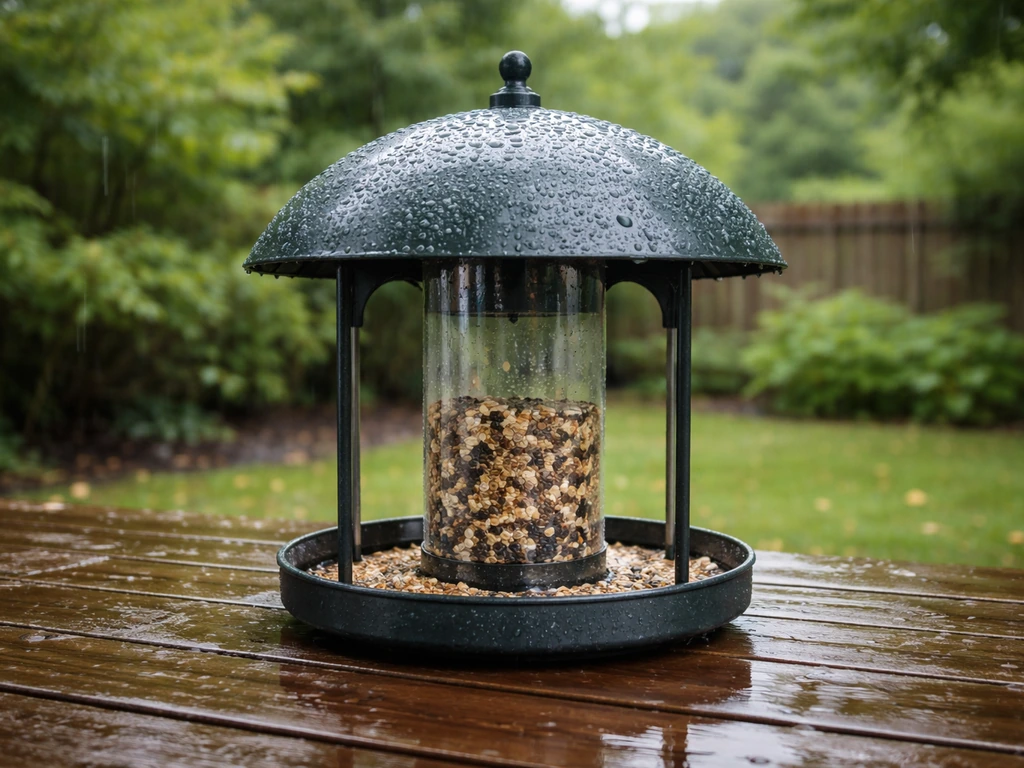
The best weatherproof bird feeders are covered hopper feeders and tube feeders with wide roof overhangs, made from powder-coated metal or UV-stabilized polycarbonate, and fitted with drainage holes or mesh bottoms. Those two design elements, a roof that extends well past the seed ports and a way for water to escape, do most of the heavy lifting in keeping seed dry through driving rain, wet snow, and weeks of high humidity. If you want a single pick that works for most backyard setups, a large hopper feeder with a steeply pitched metal roof and a drainage gap at the base of the seed reservoir is the most reliable all-weather choice.
Best Weatherproof Bird Feeder Guide for Rain Proof Feeding
Marcus Holloway
2 May 2026
What 'weatherproof' actually means for a bird feeder
Marketers stamp 'weatherproof' on almost everything, so it's worth being specific about what you actually need a feeder to survive. In real backyard terms, weatherproof means the feeder keeps seed usable through: driving rain blowing in at an angle, not just drizzle falling straight down; wet snow and ice that builds up around ports and seed openings; prolonged humidity that soaks into stored seed even without direct rainfall; and freeze-thaw cycles that can crack plastic and warp poorly fitted lids.
A feeder that handles all of those is genuinely all-weather. One that just sheds light rain is not. The related problems, seed sprouting, molding, or compacting into a wet clump that blocks ports, are what you're actually trying to prevent. Rain resistance and dryness inside the seed chamber are the goal, not just structural survival.
It's also worth separating weatherproof from waterproof. A truly waterproof feeder would be sealed against any moisture, which is actually counterproductive because you need airflow and drainage to prevent condensation from building up inside. What you want is a feeder that sheds external water aggressively and drains any that gets in, not one that traps moisture in a closed compartment. If you’re shopping for the best waterproof bird feeder, start by prioritizing a roof with enough overhang and drainage that keeps seed from sitting in water.
Which feeder types actually hold up in rain
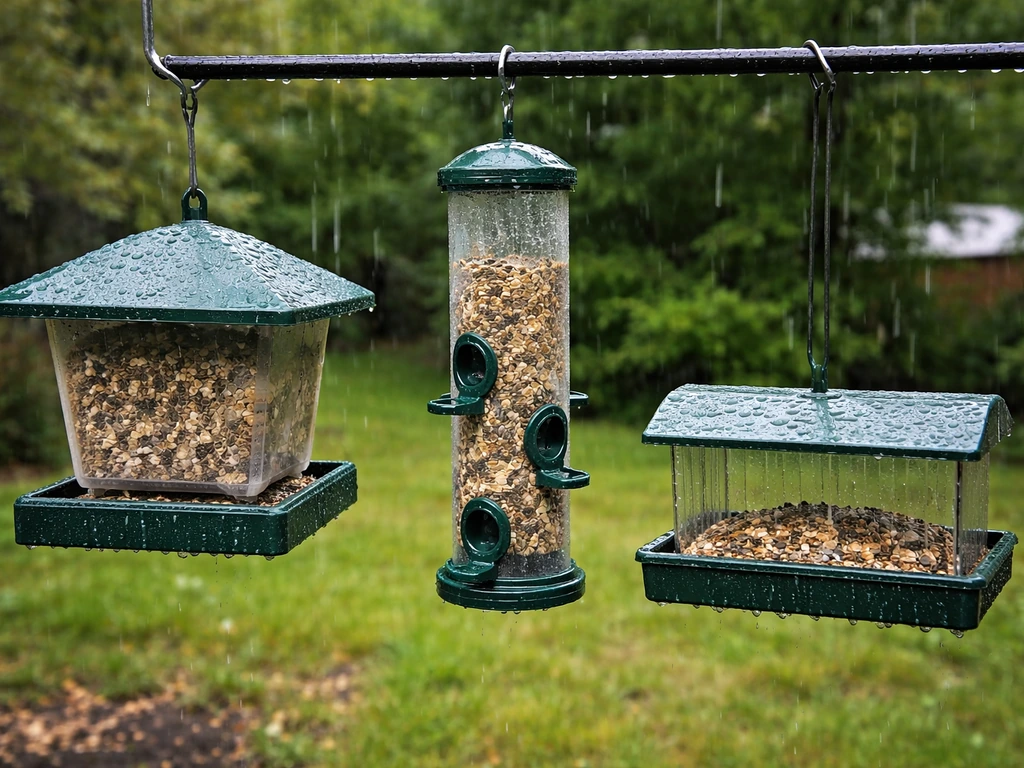
Not all feeder styles handle weather equally. Here is how the main types stack up based on how their design interacts with rain and humidity.
Hopper feeders: the best all-around choice
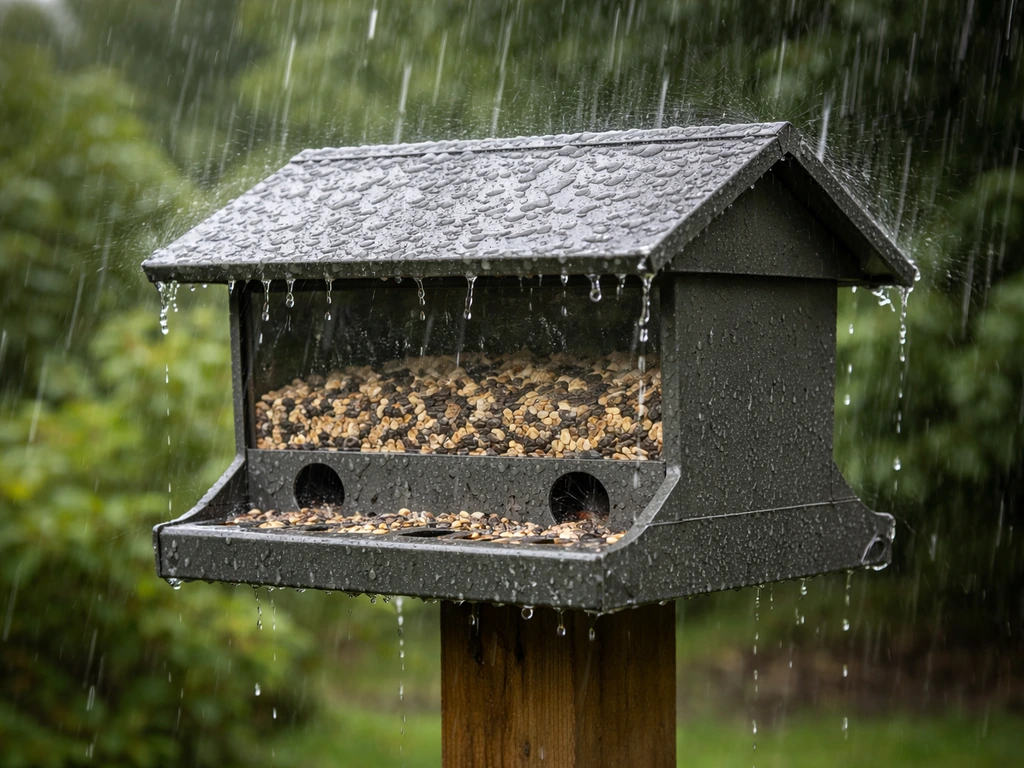
Hopper feeders are purpose-built for weather resistance. The seed sits inside a walled chamber with a roof above and dispenses through a narrow trough or slot at the base. Cornell Lab's Project FeederWatch describes them as a platform with walls and a roof that form a hopper specifically to protect seed from weather, and that description is accurate to how they perform.
The seed never sits exposed. A well-designed hopper with a roof overhang of at least three to four inches on each side will keep seed dry even in a moderate sideways rain. They attract a wide range of birds including cardinals, chickadees, nuthatches, house finches, and sparrows, which makes them the most versatile all-weather option. If you're dealing with frequent rainy stretches, these weatherproof hopper features help you choose the best bird feeders for rainy weather.
Tube feeders: good but not perfect
Tube feeders keep seed reasonably dry because it sits inside a sealed cylinder and only small amounts are exposed at each port at a time. Project FeederWatch notes that tube feeders 'keep seed fairly dry,' which matches my experience. The problem is the bottom reservoir. In cheaper tube feeders, the base cap doesn't drain well and seed at the very bottom can sit in a pool of water after heavy rain. Look for tube feeders with drainage holes drilled into the base cap or a mesh bottom insert. Tube feeders are great for nyjer (thistle) and smaller sunflower chips, and they're the go-to choice for finches, siskins, and redpolls.
Platform and tray feeders: the most vulnerable type
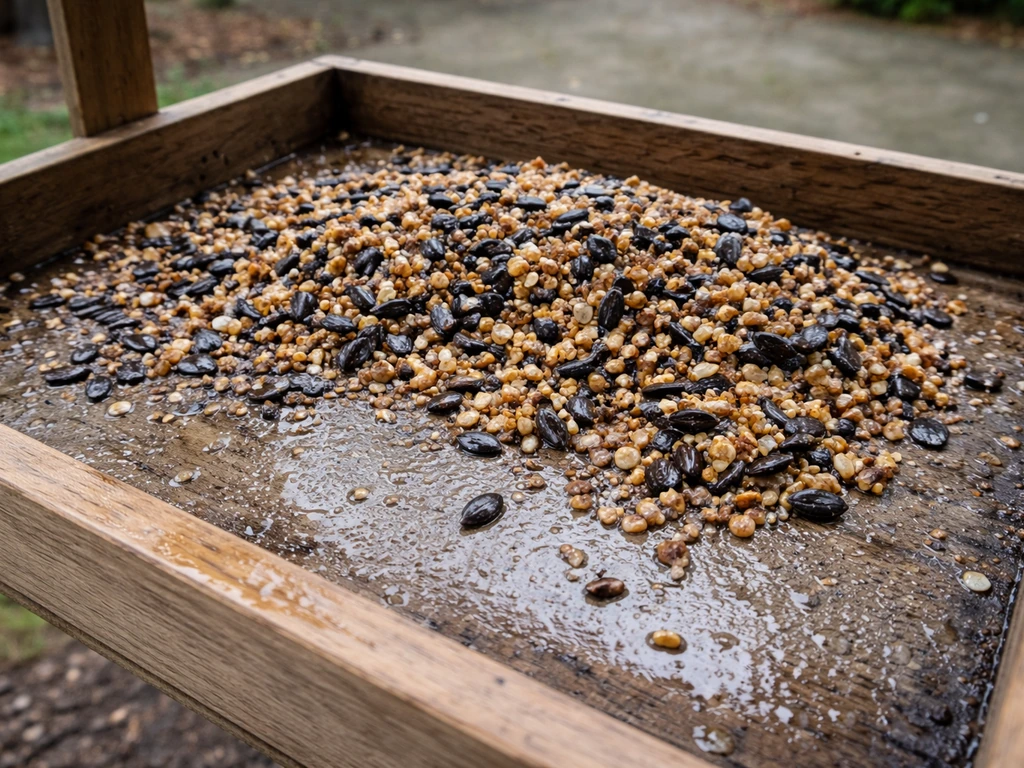
Platform feeders are the hardest style to make weatherproof. All About Birds puts it plainly: open tray feeders don't protect against rain or snow, and wet seed can sprout, mold, or spoil quickly. If you want a tray-style feeder (they're great for attracting ground-feeding birds like doves, towhees, and juncos), the minimum requirement is a screened or mesh bottom rather than a solid one, so water drains through immediately instead of pooling. Plenty of drainage holes are non-negotiable. Some platform feeders come with a roof cover, which helps significantly, but even a covered platform lets in more wind-driven rain than a hopper or tube. I'd recommend platform feeders as a secondary feeder, not your main all-weather station.
Suet feeders and hummingbird feeders in wet conditions
Suet feeders are less affected by rain than seed feeders because suet is rendered fat and doesn't absorb water or mold quickly in cool weather. In summer heat and rain combined, though, suet can go rancid fast, so cage-style feeders with a roof or tail-prop design that shields the cake are worth the small upgrade. Hummingbird feeders face a different issue: nectar dilutes in rain and ferments faster in humid heat.
The BirdNet guidance on this is to replace nectar every one to two days in hot weather and every two to three days in cooler conditions. A feeder with a good drip guard and a tight seal on the reservoir is the main thing to look for in wet climates.
Materials and design features that make a real difference
The material a feeder is made from determines how long it survives weather exposure, not just how it handles a single storm. Here is what actually matters.
| Material | Weather Performance | Durability | Best For |
|---|---|---|---|
| Powder-coated steel | Excellent, sheds water fast, heavy enough to resist wind | High, resists rust if coating is intact | Hopper frames, pole mounts, squirrel-resistant models |
| UV-stabilized polycarbonate | Very good, doesn't crack in freeze-thaw, clear for seed visibility | High, handles temperature swings well | Tube feeder cylinders, hopper windows |
| Recycled poly lumber / HDPE | Excellent, won't rot, warp, or absorb moisture | Very high, often 10+ year lifespans | Hopper bodies, platform feeder trays |
| Untreated wood (cedar/pine) | Moderate, natural rot resistance but absorbs moisture over time | Medium, needs sealing and annual maintenance | Decorative hoppers, sheltered setups only |
| Standard polystyrene plastic | Poor, cracks in cold, warps in heat, yellows with UV | Low | Avoid for all-weather use |
| Copper / brushed aluminum | Good, naturally corrosion-resistant | High, develops patina rather than rust | Tube feeder caps, accent feeders |
Roof design is the biggest single factor
A feeder's roof overhang is the design detail I look at first. The overhang should extend at least three to four inches past the seed openings on all sides. A steeply pitched roof sheds water faster than a shallow one. Metal roofs are better than plastic ones in cold climates because they don't retain snow weight or crack when ice forms along the edges. Some higher-end feeders use baffled or layered rooflines that deflect wind-driven rain upward, which is a meaningful upgrade if you live somewhere with frequent storms coming in at an angle.
Drainage: the feature most people overlook
Even a well-roofed feeder will accumulate some water, especially at the base of the seed trough or the bottom of the reservoir. Drainage holes or a mesh floor at the base of the seed chamber let that water escape before it soaks into the seed. All About Birds specifically recommends a screened rather than solid bottom for tray feeders, and the same principle applies to hopper troughs. When I'm evaluating a feeder in person, I flip it over and look at the base. If there's no drainage provision at all, I pass.
Ports, seams, and assembly gaps
Water finds gaps. On cheaper hopper feeders, the joint between the roof and the seed chamber walls is often just a friction fit or a single screw, and rain works its way in over time. Look for feeders where the roof has a lip or channel that directs water away from those joints. On tube feeders, check that the port openings sit slightly above the bottom of the tube body rather than flush with it, so water draining down the cylinder doesn't pool directly at the seed.
Best weatherproof feeder picks by setup
Rather than ranking feeders in a single list, I find it more useful to match them to the actual situation in your yard. Here are the setups I see most often and what I'd reach for in each one.
Best for most backyards: a large hopper with a metal roof
A large-capacity hopper feeder made from recycled poly lumber or powder-coated steel, with a steeply pitched metal roof and a drainage gap at the trough base, is the pick for most people. Models in the 5 to 8 pound seed capacity range are practical because you refill less often, which matters in bad weather when you'd rather not go outside. These feeders work for cardinals, chickadees, nuthatches, titmice, house finches, and sparrows, which covers the majority of common backyard visitors. If squirrels are a problem, look for a hopper with a weight-sensitive perch that closes the seed ports when something heavier than a songbird lands, as the best all-weather models often bundle squirrel resistance with better construction quality generally.
Best for finches and small birds: a quality tube feeder
For goldfinches, house finches, pine siskins, and similar small birds, a UV-stabilized polycarbonate tube feeder with metal ports and a drainage base is the right call. Metal ports matter because squirrels and even persistent house sparrows can gnaw through plastic ports quickly, which then creates gaps for rain to enter. Fill these with nyjer or fine sunflower chips. In rainy climates, consider a tube feeder with a weather dome (a large plastic or metal dome placed above) that acts as an umbrella and cuts down on how much rain reaches the ports directly.
Best for open or windy yards: a covered platform with mesh floor
If you're set on attracting ground-feeding species and want a platform feeder, choose a covered tray model with a full roof and a mesh or screened floor. Put smaller amounts of seed in it and replenish more often, since even a good mesh floor won't save seed that's been completely soaked in a heavy storm. Keeping a smaller volume in the tray means wet seed can be cleared out and replaced without waste. This connects directly to the topic of keeping seed dry more broadly: covered platforms in windy or exposed yards benefit most from smart placement, which I cover in the mounting section below.
Best for winter and snow: a hopper with a large-capacity reservoir and baffled roof
Winter weather adds snow and ice to the rain problem. For a closely related winter-focused option, see the best bird feeder for winter guide to match your setup to snow and ice realities. A hopper feeder with a large reservoir (so birds can access food even when you can't get outside to refill it), a heavy roof that sheds snow load without collapsing or warping, and metal hardware throughout is the winter-specific pick.
Poly lumber bodies hold up especially well in freeze-thaw because they don't absorb moisture and expand like wood does. If you're dealing with ice storms specifically, a roof with a slight pitch on all four sides rather than a simple peaked gable drains in all wind directions.
Keeping seed dry and feeders clean in real conditions
Even the best weatherproof feeder requires active management in wet conditions. The feeder design buys you time, but you still need a cleaning and refill routine that matches your climate.
How often to clean
Project FeederWatch recommends cleaning seed feeders every two weeks as a baseline, with more frequent cleaning when conditions are wet. Virginia DWR also advises cleaning feeder stations every two weeks, more often during heavy use and damp or wet weather cleaning seed feeders every two weeks.
Audubon is more direct: cleaning more frequently is best, most especially in humid and hotter weather. In my experience, every one to two weeks is workable in mild conditions, but after a multi-day rain event, I check the seed immediately. If it's clumped, damp, or starting to smell, it gets emptied into the trash and the feeder gets cleaned before anything goes back in.
BirdNet's guidance is clear on this: wet seed goes in the trash, not back into the feeder.
How to clean properly
- Empty the feeder completely, discarding any damp or clumped seed.
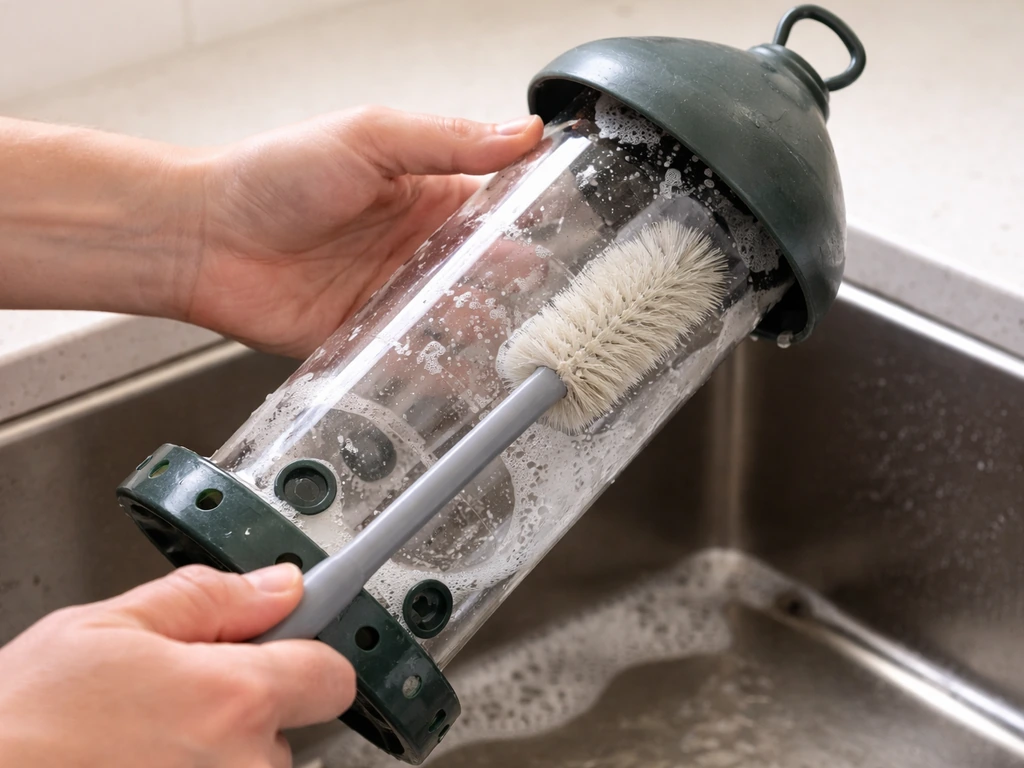
- Scrub all surfaces with hot soapy water and a dedicated bottle brush, reaching into corners and drainage holes.
- Sanitize with either a 50/50 vinegar-and-water soak (Audubon's recommendation) or a 9-parts-water to 1-part-bleach solution (per the National Wildlife Health Center guidance cited by Audubon). Both work; bleach is more effective against bacteria per Project FeederWatch.
- Rinse thoroughly so no cleaning residue remains.
- Dry completely before refilling. Audubon is emphatic on this point: a damp feeder refilled with dry seed immediately creates moisture inside the seed chamber.
Seed choices that help in wet conditions
No feeder design fully compensates for seed that holds moisture. Whole peanuts and whole sunflower seeds in the shell resist moisture longer than hulled chips or millet, which absorb water and mold quickly. In very wet conditions, consider switching to no-mess or hulled blends only in covered feeders, and reserve open trays for drier periods. Nyjer (thistle) seed molds fast when wet, so it should only go in tube feeders with good drainage and be replaced more frequently during rainy stretches.
Where you put the feeder matters as much as what you buy
Placement is an underrated part of weatherproofing. A great feeder in a bad spot will still have wet seed problems. A decent feeder in a well-chosen spot often outperforms an expensive one in a fully exposed location.
Use natural windbreaks and structures
Positioning a feeder on the leeward side of a tree, large shrub, fence, or building wall cuts down dramatically on wind-driven rain reaching the seed ports. In practice, this often means placing your feeder within six to ten feet of a dense shrub or evergreen. That proximity also gives birds a quick escape route, which they prefer anyway. The feeder should still be visible from multiple angles so birds can spot it, but the shrub or structure should be upwind from the direction your hardest rain typically comes from. Check your local prevailing wind direction if you're not sure.
Pole mounting vs. hanging: what holds up better in storms
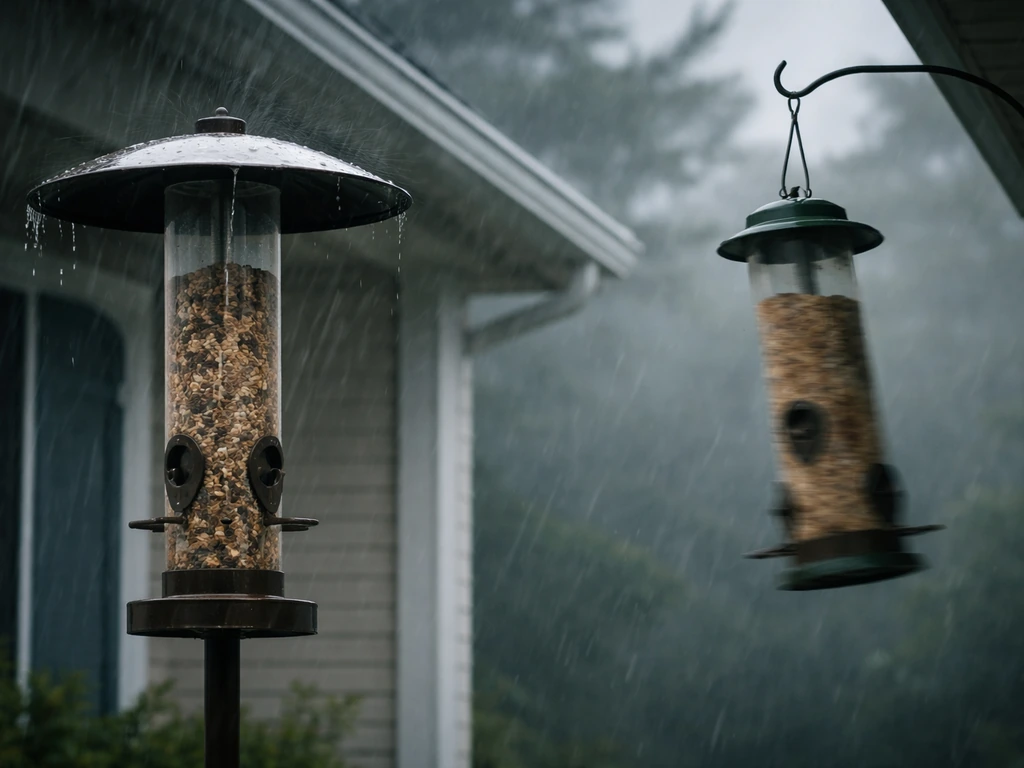
Hanging feeders swing in wind, which can tip seed out of troughs and loosen roof joints over time. A sturdy pole-mounted setup with a weather baffle above the feeder (which also keeps squirrels off) is more stable and keeps the feeder level so seed and drainage function as designed. If you prefer hanging feeders, use a short, stiff hanger rather than a long chain, and choose a hook location that's sheltered by an overhang or tree canopy above. A feeder swinging freely under open sky in a storm is going to have wet seed no matter how good the roof design is.
Add a weather dome if your setup is exposed
A dedicated weather dome or baffle mounted above a hanging feeder is one of the best simple upgrades for exposed locations. A dome 12 to 15 inches in diameter positioned a few inches above the feeder's own roof blocks the majority of direct rain and most of the wind-driven rain that would otherwise reach the ports from above. It also deters squirrels from dropping down onto the feeder from above, so it does double duty. This is worth doing even if your feeder already has its own roof.
Don't place feeders where runoff collects
The ground directly under a feeder matters too. Wet seed shells and hulls that accumulate beneath a feeder in a low spot or compacted soil area create a mold and bacteria problem that can circle back to affect the birds visiting the feeder above. Choose a location with good ground drainage, or place a catch tray with drainage holes beneath a pole-mounted setup. Raking out seed debris after rain events is a straightforward habit that pays off in bird health over time and cuts down on rodent attraction as well.
If you're also thinking about feeder performance specifically in high winds or heavy winter conditions, those scenarios each have their own design considerations worth digging into separately, since wind stability and snow load resistance involve slightly different trade-offs than pure rain resistance. The core advice here, covered hopper or tube design, metal or poly construction, drainage, and sheltered placement, covers the broadest range of all-weather conditions you'll actually encounter in a typical backyard.
FAQ
Can a feeder be called weatherproof and still let seed get wet inside?
Usually, no. A feeder that drains well and sheds most rain can still leak humidity into the seed chamber, especially during multi-day storms. If the seed becomes clumped, smells off, or you see sprouts, treat it as a moisture failure and switch to more rain-tolerant seed and tighter cleaning intervals.
What are the most important drainage features to look for before buying?
Check for a drainage provision at the base, not just holes on the roof. For hopper feeders, look for an actual gap or channel at the trough base that lets water exit, and for tube feeders confirm the bottom cap drains (holes drilled into the cap or a mesh insert). If you can flip the feeder and water pools at the bottom, it is a poor match for heavy rain.
What should I do if my feeder ports start clogging after rain?
If you see seeds stuck in a damp mat, the fastest fix is to empty the feeder, discard wet seed, and clean all contact surfaces before refilling. Avoid shaking the feeder while leaving damp seed behind, because compacted clumps often break loose and block ports again.
Are there specific seed types that handle wet weather better than others?
In most wet climates, hulled seed and small chips are riskier because they absorb moisture and mold quickly. Whole peanuts, and whole sunflower kernels in shells generally tolerate damp stretches longer. Keep open platforms as the last resort for wet weather, and reserve mess-prone blends for covered feeders only.
How often should I check the feeder during a rainy week?
“Weatherproof” can still mean the feeder face gets wet, so you should plan on extra monitoring after storms. A good rule is to inspect right after heavy rain and again 24 to 48 hours later, especially if humidity stays high. If seeds are clumped or you see any swelling or sprouting, clean immediately.
Is a sealed feeder actually better for wet climates?
A tight seal can be a problem if it blocks airflow. The goal is to keep external rain from entering the ports and to allow any incidental moisture to escape through drainage. If your model is advertised as sealed, confirm it still has an intended drainage path and does not rely on trapped internal air to stay dry.
Should I prioritize placement or materials when choosing the best weatherproof bird feeder?
In many cases, yes. If your yard has strong wind exposure, use the sheltered placement strategy first (leeward side of a dense structure) and add a weather dome or baffle above the ports. This combo reduces wind-driven rain far more than switching materials alone.
Why do hanging feeders sometimes fail in rain even if the roof looks good?
For hanging feeders, swing can loosen fit points and change how drainage works. Keep the feeder stable with a short, stiff hanger and position the hook so it stays under an overhang or canopy when possible. For higher reliability in storms, a pole-mounted setup with a weather baffle is usually less trouble than a freely hanging unit.
Can I use a tarp or cover to make my feeder more weatherproof?
Do not rely on a feeder cover designed for “dust protection” or leaving seed outdoors for only light drizzle. After heavy rain, covers can trap moisture and prevent drying. If you use a cover, choose one that still allows airflow and confirm the drainage pathway remains unobstructed.
What changes should I make for weatherproofing during freeze-thaw conditions?
Yes, especially in winter freeze-thaw. Look for metal hardware and bodies that do not absorb and expand like untreated wood, poly lumber that holds up to repeated cycling, and a roof that sheds snow load without creating ice dams. Before refilling, check for any ice buildup at or around ports and remove it safely to restore flow.
Which feeder style is safest when I get both driving rain and wet snow?
Mixed-genre feeders can work, but birds also prefer predictable access. If your area gets frequent wet snow, a hopper with strong roof overhang plus drainage is generally more forgiving than a tray. Tube feeders can be excellent for small seeds, but only if the base drains and you refresh more often after humid spells.
Next Article
Best Bird Feeders for Rainy Weather: Top Picks and Setup Tips
Top rainy-weather bird feeders with weatherproof features, species picks, setup tips, and cleaning to prevent mess and s