The best all-around bird feeder for Massachusetts is a weight-activated, squirrel-proof tube feeder paired with a powder-coated steel pole and a torpedo baffle, and if you add a nyjer sock or thistle tube and a suet cage to that same setup, you'll cover most of what flies through a Massachusetts backyard across all four seasons. That combination handles the goldfinches and chickadees that stay year-round, the cardinals that hunker down through January, and the woodpeckers that get aggressive the moment temperatures drop. The specific products, feed types, and placement strategies that make that setup work in Massachusetts, where you're dealing with everything from coastal salt air on the South Shore to inland ice storms in Worcester County, are what this guide covers in full.
Best Bird Feeders for Massachusetts: Top Picks & Seasonal Guide
Quick Picks: Top Bird Feeders for Massachusetts
These are the feeders I'd actually recommend buying first, grouped by category and budget. Each one earns its place based on how it handles Massachusetts winters, resist squirrel pressure, and serves the species most likely to show up in your yard.
| Category | Top Pick | Budget Alternative | Best Feature for MA |
|---|---|---|---|
| Squirrel-Proof Tube | Brome Squirrel Buster Plus | Perky-Pet Squirrel-Be-Gone Max | Weight-activated ports close under squirrel weight; all-weather seals |
| Nyjer / Finch | Droll Yankees Finch Flocker (nyjer tube) | Woodlink Natube 9 | UV-stable polycarbonate; mesh sock optional for goldfinch volume |
| Nectar / Hummingbird | Aspects HummZinger Excel 16 oz | First Nature 32 oz Red Feeder | Ant moat built in; wide-mouth basin easy to clean in cold weather |
| Cardinal / Hopper | Stokes Select Birds-Choice Hopper | Perky-Pet Panorama | Wide tray for safflower and peanut chips; roof protects in snow |
| Suet / Woodpecker | Heath Outdoor Tail-Prop Suet Feeder | Aspects 397 Upside-Down Suet | Tail prop bar supports large downies and pileateds; starling resistant if inverted |
| Chickadee / Small Birds | Droll Yankees A-6 Yankee Classic Tube | Kaytee Finch Station | Tight port spacing limits grackles; easy disassembly for cleaning |
| Smart / AI Camera Feeder | Bird Buddy Smart Bird Feeder | Netvue Birdfy Feeder Cam | Species ID via app; heated models or weatherproof housing for MA winters |
| Budget Starter Set | Perky-Pet Copper Panorama + baffle kit | N/A | Under $40; decent capacity and weather cover for casual feeding |
Massachusetts Backyard Birds and Seasonal Feeding Notes
Massachusetts sits at a productive intersection of year-round residents, overwintering visitors, and spring-fall migrants. According to eBird regional data and Mass Audubon species accounts, the core feeder birds you can reliably count on by season look like this.
Year-Round Residents
Black-capped chickadees, tufted titmice, white-breasted nuthatches, downy woodpeckers, hairy woodpeckers, northern cardinals, house finches, and American goldfinches (in duller winter plumage) all stay put year-round in Massachusetts. These birds visit feeders every month and are the foundation of any Massachusetts feeding program. Blue jays, mourning doves, and dark-eyed juncos round out the regular crowd, with juncos shifting from breeding areas further north to winter visitors across the state from roughly October through April.
Seasonal Visitors
- Ruby-throated hummingbirds: late April through mid-October; peak migration push in late August through September when you should keep nectar feeders up even after your resident birds seem to have left
- Purple finches and pine siskins: irruptive winter visitors, showing up in force during poor cone crop years in Canada — unpredictable, but worth having a nyjer or mixed finch feeder ready October through March
- Common redpolls: occasional irruptive visitors in deep winter, particularly in northern and central Massachusetts in high-flight years
- Rose-breasted grosbeaks: reliable May migrants and occasional breeding birds; they'll work a cardinal-style platform feeder hard during spring stopover
- Common grackles and European starlings: arrive in late February/early March and can overwhelm feeders through summer — planning for their presence is worth building into your setup from the start
- Red-breasted nuthatches: irruptive fall/winter visitors whose presence often signals a good finch year
The practical takeaway is that Massachusetts feeders need to be flexible across seasons. A setup that handles a February ice storm and a March grackle flock, while still welcoming a May grosbeak and an August hummingbird, is genuinely earning its place. That's a harder ask than most other states in the region, and it's why material quality and design versatility matter more here than in, say, Virginia or Maryland, where winters are milder.
Buyer's Checklist: What Massachusetts Feeders Must Deliver
I've gone through more feeders than I'd like to admit because I underestimated what Massachusetts weather actually does to outdoor equipment. Here's what a feeder genuinely needs to handle here.
Winter Durability and Freeze-Thaw Cycles
Massachusetts sits in USDA Plant Hardiness Zones 5b through 7a depending on location, inland Worcester County regularly sees lows below -10°F, while coastal areas like Cape Cod and the South Shore rarely dip below 10°F. The bigger structural threat isn't sustained cold but repeated freeze-thaw cycling, which cracks cheap acrylic tubes, seizes metal hardware, and warps poorly made hoppers. Look for polycarbonate or UV-stabilized HDPE plastic (not acrylic), stainless steel hardware rather than galvanized or zinc-plated screws, and powder-coated steel frames over painted steel. For coastal buyers, this matters even more: salt air accelerates oxidation of any exposed ferrous metal, and galvanized hardware near the ocean typically shows rust within one to two seasons. Stainless steel grade 304 is adequate for most coastal setups; grade 316 is overkill unless you're within a hundred yards of the water.
Squirrel and Predator Proofing
Squirrels are the single most common reason feeders get replaced in Massachusetts. The standard Cornell Lab guidance holds here: mount pole feeders at least 5 feet high and 10 to 12 feet from any launch point (tree branches, fences, sheds). Add a torpedo or wrap-around baffle at least 18 inches in diameter mounted no lower than 4 feet from the ground. For hanging feeders, a weight-activated design like the Brome Squirrel Buster line is the most reliable mechanical deterrent I've tested, the ports physically close under the weight of a squirrel and open for birds under roughly 2 oz. No baffle or cage is 100% foolproof against a persistent gray squirrel, but this combination gets you to about 90% over a full season.
Capacity and Refill Practicality
In peak winter, a busy Massachusetts feeder station can burn through 3 to 5 pounds of black-oil sunflower seed in two to three days. A tube feeder with a 3-cup capacity is going to need daily refills, which is fine in mild weather but genuinely unpleasant in a January ice storm. I'd recommend a minimum of 4 to 5 cups capacity for primary seed feeders in winter, with a hopper feeder in the 6 to 8 cup range if you want a few days of buffer. Nyjer tubes can be smaller since goldfinches feed more slowly.
Roof and Drainage Design
Massachusetts gets average annual snowfall ranging from about 30 inches on the coast to over 65 inches in parts of Worcester and Franklin counties, plus regular ice events. Any hopper or platform feeder without a solid roof will fill with ice and wet seed, which clumps, molds, and stops dispensing entirely. A steep-pitched metal roof with at least 2 inches of overhang over the seed ports makes a significant practical difference. Drainage holes in the feeder floor are not optional, they're essential.
Cleaning Access and Disease Prevention
Salmonellosis outbreaks tied to bird feeders have been documented in Massachusetts, particularly in the finch population. The standard prevention protocol is cleaning tube feeders with a 1:9 bleach-water solution every two weeks in warm weather and monthly in winter, letting them dry completely before refilling. Feeders that don't come apart for cleaning, particularly tube feeders with fixed bottoms, are worth avoiding. I pull feeder bottoms apart, scrub with a bottle brush, and soak in dilute bleach routinely. It adds about 15 minutes per feeder, but it keeps birds healthy.
Species-Specific Recommendations: Finches and Nyjer
American goldfinches are year-round residents in Massachusetts, but the key thing to understand about nyjer (thistle) feeding is that goldfinches don't typically start coming to nyjer feeders heavily until late summer, even though they're present all year. My experience is that July through November is peak nyjer consumption, driven by molting goldfinches and early-arriving pine siskins. Purple finches and house finches also work nyjer, though both species are more enthusiastic about sunflower chips.
The Droll Yankees Finch Flocker tube is my top pick because the ports are precisely sized for nyjer, small enough to reduce waste and prevent larger birds from raiding it, and the UV-stable polycarbonate holds up through multiple New England winters without cracking. The Woodlink Natube 9 costs about half the price and performs well, though I've found the seed ports tend to clog more readily when nyjer gets damp. For high-volume feeding during irruption years with siskins and redpolls, a mesh-style nyjer sock lets birds cling anywhere along the surface and accommodates more birds simultaneously, though the socks themselves degrade faster and need replacement every season.
One practical note: nyjer seed goes rancid faster than sunflower seed, especially in humid summer conditions. If birds stop visiting a nyjer feeder that seemed popular, try pinching a seed and smelling it, stale nyjer is detectable and birds will avoid it. Buy in smaller quantities and store in a cool, dry space.
Species-Specific Recommendations: Hummingbirds and Nectar
Ruby-throated hummingbirds arrive in Massachusetts from late April onward, with most backyards seeing consistent activity from mid-May through mid-September. The conventional advice to take feeders down after Labor Day is actually counterproductive, fall migrants from further north move through Massachusetts in September and into early October, and keeping nectar out through mid-October costs nothing and genuinely helps birds fueling for a long migration. I've had hummingbirds at feeders in coastal Massachusetts as late as the third week of October.
The Aspects HummZinger Excel is my consistent recommendation here for several reasons. The wide-mouth basin design means you can actually clean the interior properly, a detail that matters a lot when nectar ferments in Massachusetts summer heat (which routinely reaches the high 80s and occasionally 90s inland). The built-in ant moat works reliably when kept filled with water, eliminating the need for a separate moat accessory. The red coloring is sufficient to attract birds without needing to add dye to the nectar. Standard nectar ratio is 1 part white granulated sugar to 4 parts water, boiled and cooled, no red dye, no honey, no brown sugar.
In hot weather (above 80°F), nectar should be changed every two to three days before it begins to ferment and grow mold. Position nectar feeders in partial shade to slow spoilage and reduce the feeding frequency required. Near windows, the First Nature 32 oz red feeder is a reasonable budget pick, larger capacity reduces refill frequency, though the cleaning access is slightly less convenient than the HummZinger.
Species-Specific Recommendations: Cardinals and Safflower
Northern cardinals are one of Massachusetts's most reliable winter feeder birds and one of the few that genuinely prefer a wide, open feeding platform over a tube. They're heavy-bodied enough that they struggle with narrow perches and tend to avoid feeders where they can't spread their weight. A hopper or platform feeder with a tray at least 8 to 10 inches wide gives them the foothold they need.
The seed that does the most work for cardinals, and simultaneously reduces grackle activity, is safflower. Safflower is bitter-tasting to common grackles and European starlings, both of which are serious feeder pests in Massachusetts from March through October. Cardinals eat it readily, as do house finches, chickadees, and doves. Mixing safflower with peanut chips (not whole peanuts, which favor jays) gives cardinals and titmice a high-energy winter blend without giving grackles a reason to mob the feeder. This is genuinely one of the most effective grackle-reduction strategies I've used, more practical than cage exclusion feeders in some settings.
The Stokes Select Birds-Choice Hopper is my pick for a cardinal-focused setup. The cedar frame is pre-treated, holds up to repeated wet-dry cycles reasonably well, and the roof pitch sheds snow effectively. The Perky-Pet Panorama is a decent budget option, though the plastic tray cracks in cold weather after two or three seasons. If you want a dedicated platform feeder rather than a hopper, a tray feeder mounted on a pole with a baffle below works well for cardinals and grosbeaks during spring migration.
Species-Specific Recommendations: Woodpeckers and Suet
Massachusetts has a solid year-round woodpecker lineup: downy, hairy, red-bellied, and pileated woodpeckers are all recorded on eBird year-round across the state, with red-bellied expanding its range steadily northward into central and eastern Massachusetts over the past decade. Suet is the most efficient way to bring them in reliably, and it's especially important in winter when insects are unavailable.
Standard rendered suet cakes in wire cage holders work fine from October through April when temperatures stay below 50°F consistently. Above that temperature, standard suet goes rancid quickly and can melt and mat feathers, switch to no-melt suet dough formulations in late spring and summer if you want to feed woodpeckers year-round. The Heath Outdoor Tail-Prop Suet Feeder is my recommendation because the tail prop bar, an extended wooden ledge below the cage, accommodates larger birds like hairy woodpeckers and red-bellied woodpeckers that need full-body bracing. Without it, large woodpeckers will work at a standard cage feeder but visit less consistently.
For reducing European starling access to suet, starlings can strip a suet cake in a day when they flock, the inverted or upside-down suet feeder design is highly effective. Birds like the Aspects 397 require visitors to cling upside-down to access the suet. Woodpeckers do this without difficulty; starlings generally don't, and visitation drops dramatically. I've used upside-down suet feeders in central Massachusetts and seen starling access drop by roughly 80% compared to a standard cage feeder in the same location. The trade-off is that some smaller woodpeckers, particularly the downy, occasionally seem to prefer a more upright feeding posture, so a nearby standard cage feeder still has value.
Species-Specific Recommendations: Chickadees, Nuthatches, and Tube Feeders
Black-capped chickadees and white-breasted nuthatches are the workhorses of a Massachusetts feeder station, they're there every day, they cache seed for winter, and they tolerate cold better than almost anything else at the feeder. Both species prefer sunflower seeds (black-oil or chips) and will work a tube feeder or hopper readily. Tufted titmice behave similarly and have the same seed preferences.
The Droll Yankees A-6 Yankee Classic tube feeder is the benchmark here for good reason. The polycarbonate tube, stainless steel hardware, and UV-stable construction mean it genuinely holds up through Massachusetts winters without cracking or seizing. The port spacing is tight enough that it excludes most grackles and starlings, which can't comfortable perch and feed at the small ports. It disassembles completely for cleaning, bottom pops off, tube slides free, which makes the biweekly bleach cleaning practical rather than theoretical. After testing a lot of feeders over several seasons, feeders that are annoying to clean simply don't get cleaned as often, which leads to disease issues. The A-6 removes that excuse.
For window feeding, a suction-cup mounted tube feeder or platform feeder can bring chickadees and nuthatches within arm's length, which is genuinely rewarding. This is also where smart camera feeders shine: the Bird Buddy and Netvue Birdfy both have window-adjacent mounting options and use AI species identification to log visits to an app. The Bird Buddy's species recognition is more accurate in my experience, but both struggle with consistent species ID in low-light conditions or when multiple birds overlap in frame. Cold-weather battery performance is the other caveat, lithium batteries in smart feeders lose 20 to 30% of capacity at temperatures below 20°F, so expect more frequent charging or use a wired power option if available during peak winter.
Dealing With Squirrels, Grackles, and Starlings
These three are the most persistent feeder management challenges in Massachusetts, and they require different approaches. Squirrels are a physical access problem, solvable with baffles and weight-activated feeders. Grackles and starlings are a food preference and feeder design problem.
Squirrel Strategy
- Mount pole feeders at least 5 feet high on a smooth metal pole
- Install a 18-inch or larger torpedo baffle at 4 feet, OR a wrap-around cone baffle at the same height
- Keep the feeder at least 10 to 12 feet from any branch, fence, or structure a squirrel could jump from
- Use a weight-activated tube feeder (Brome Squirrel Buster line) as a backup layer — ports close under squirrel weight
- Clear any seed spillage from the ground beneath the feeder; ground seed attracts squirrels as much as the feeder itself
Grackle and Starling Strategy
- Switch primary feeder seed to safflower — common grackles strongly dislike it and visits typically drop sharply within a week
- Use cage-exclusion tube feeders where cage bar spacing is 1.5 inches or less, which allows chickadees and finches through but blocks grackles
- Deploy inverted suet feeders to exclude starlings from suet while retaining woodpecker access
- Avoid cracked corn, millet, and mixed seed blends during grackle season (March through October) — these are their preferred foods
- Remove platform feeders or switch them to safflower only during peak grackle flocking in spring and fall
Mounting and Placement for Massachusetts Conditions
Placement decisions in Massachusetts have to account for wind exposure, snow accumulation, and in coastal areas, salt spray. Massachusetts State Climatologist, Mass.gov publishes localized climate assessments and regional reports that inform planning for salt‑air exposure, coastal microclimates, and extreme weather impacts on feeder placement and materials Massachusetts State Climatologist — Mass.gov. For pole-mounted feeders, positioning on the southeast side of a windbreak (fence, hedge, building wall) reduces wind exposure without blocking morning light, which birds use for orientation. Avoid placing feeders directly under large conifers, the dripping resin and dropped needles contaminate seed and attract pests. Keep feeders either within 3 feet of a window (to reduce fatal window strike velocity if a bird hits the glass) or more than 30 feet away, where birds have time to bank away before hitting.
For coastal locations on Cape Cod, the South Shore, or the North Shore, the priority shifts toward corrosion-resistant hardware. Replace any zinc or galvanized screws and hooks with stainless steel equivalents. Choose feeders with powder-coated frames over painted steel. In particularly exposed coastal settings, cedar or recycled-plastic lumber feeders (like those from Duncraft or Birds Choice) outlast metal-trimmed feeders significantly. I've had powder-coated pole systems last over eight years near the coast in Massachusetts without meaningful rust when the hardware was stainless; the same setup with galvanized hooks showed corrosion within 18 months.
Smart and Camera-Enabled Feeders Worth Considering
Smart feeders have improved substantially in the last two years and are now worth serious consideration for Massachusetts birders who want species logging, remote monitoring, or simply the entertainment of a phone-connected feeder cam. The two most practical options in this space are the Bird Buddy and the Netvue Birdfy.
| Feature | Bird Buddy | Netvue Birdfy |
|---|---|---|
| AI Species ID | Strong; integrated with large dataset | Moderate; improving via updates |
| Camera Resolution | 1080p | 1080p |
| Cold-Weather Performance | Fair; battery drains faster below 20°F | Fair; similar cold limitations |
| Power Options | Solar lid available; USB charging | Solar panel available; USB charging |
| Wi-Fi Connectivity | 2.4GHz only | 2.4GHz only |
| Waterproofing Rating | IP45 | IP65 (better rain resistance) |
| App Quality | Polished; strong community features | Functional; fewer social features |
| Price Range | $199–$249 | $99–$149 |
| Best For | Species ID accuracy and community logging | Budget-conscious buyers, rain-heavy spots |
The biggest practical limitation in Massachusetts is winter battery performance. Both feeders rely on lithium cells that lose meaningful capacity below 20°F, which is a regular occurrence in inland Massachusetts from December through February. If you're mounting in a spot with a power outlet nearby, a USB-wired version of either feeder avoids this problem entirely. Solar performance in Massachusetts winter is also limited, the shorter days and lower sun angle mean solar charging barely keeps pace with camera operation on overcast days. Set realistic expectations: these are fantastic tools from April through November; in deep winter, plan to charge more often or wire for power.
Price Ranges and What You're Actually Getting
Bird feeders in Massachusetts run from under $10 for a basic thistle sock to over $300 for a smart feeder camera combo. Here's an honest breakdown of what different price points deliver in terms of durability, function, and Massachusetts suitability.
| Price Range | What You Get | Massachusetts-Specific Trade-offs |
|---|---|---|
| Under $20 | Basic tube or platform feeders; acrylic or thin plastic construction | Acrylic cracks in freeze-thaw cycles; hardware often rusts within 1–2 seasons |
| $20–$50 | Decent polycarbonate tubes, basic hoppers with roofs, mesh finch feeders | Adequate for inland suburban use; coastal salt air will degrade hardware faster |
| $50–$100 | Quality squirrel-resistant tubes (Brome, Droll Yankees), cedar hoppers, good suet setups | Solid multi-season performers; look for stainless hardware and UV-stable plastic |
| $100–$200 | Premium squirrel-proof systems, heavy-gauge pole kits with baffles, specialty cardinal or woodpecker feeders | Best durability; coastal-appropriate if hardware is stainless; worth it for primary feeder |
| $200+ | Smart camera feeders, full pole system kits, AI-enabled species logging | Excellent if used April–November; plan for charging support in deep winter months |
How Massachusetts Compares to Nearby States
Massachusetts sits in the middle of a range of feeder environments across the Northeast. Birders in Maine deal with even harsher winters and more limited species diversity at feeders, heating suet and cold-hardy hardware matter even more there. New Jersey and Maryland feeders can expect milder winters but more aggressive grackle and starling pressure through the shoulder seasons. For recommendations tailored to that state's milder winters and heavier grackle pressure, see our guide to the best bird feeders for New Jersey (e6caa311-6ae8-4501-ac0b-90f2e5f011de). For readers in Maryland, see our guide on the best bird feeders for Maryland for tailored recommendations that account for milder winters and heavier grackle pressure. Pennsylvania's interior has winters comparable to central Massachusetts but without the coastal salt-air dimension. For recommendations tailored to that climate, see our guide to the best bird feeders for Pennsylvania. Virginia's longer growing season pushes hummingbird feeders into early April and keeps them relevant into October, similar to coastal Massachusetts but with less freeze risk. If you're comparing notes with birders across the region, the feeder principles here translate well, but Massachusetts's combination of coastal corrosion risk, hard winters, and strong spring-fall migration makes it one of the more demanding environments in the Northeast for feeder hardware.
Building a Complete Massachusetts Feeder Station
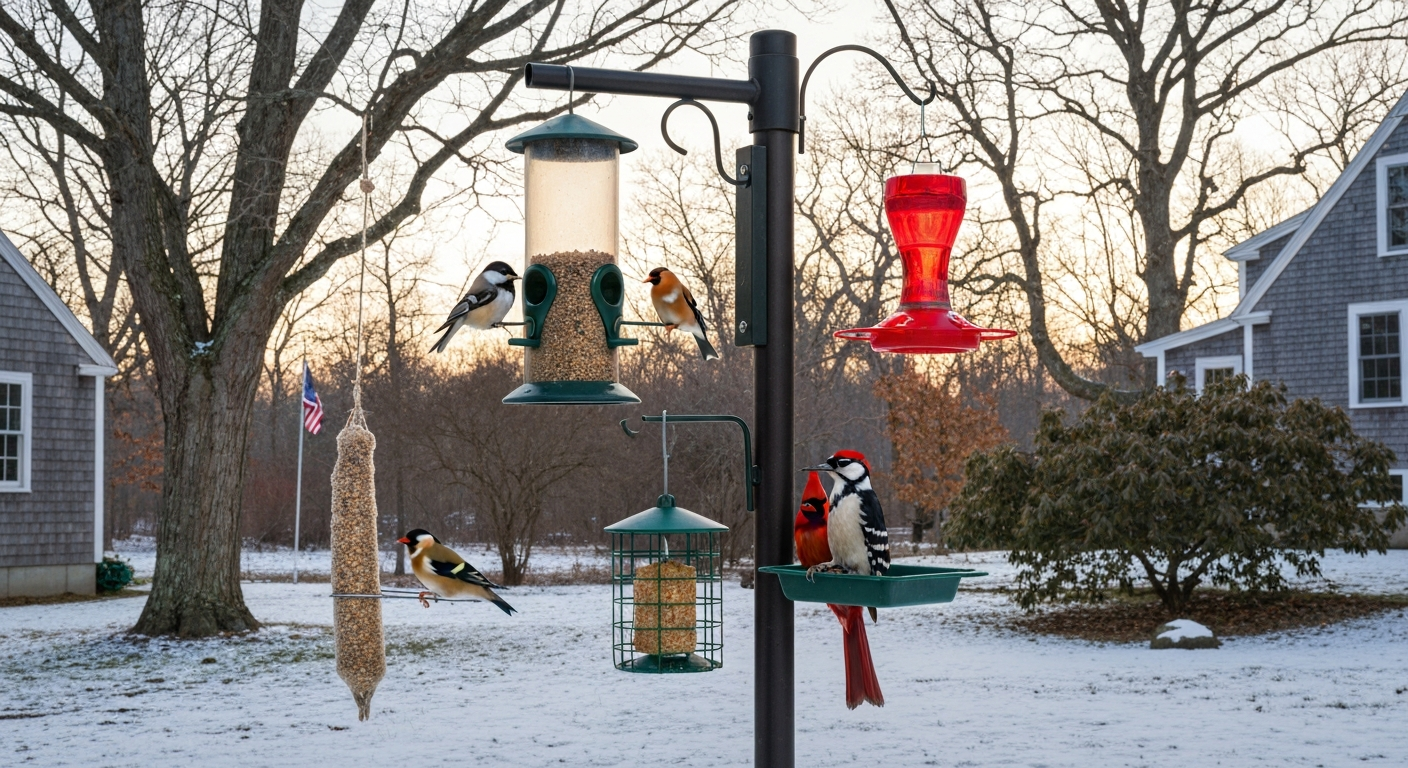
The most effective Massachusetts setup I've settled on combines four feeding stations within a 15-foot radius: a squirrel-proof tube with black-oil sunflower on a baffled pole for chickadees, nuthatches, and titmice; an inverted suet cage on a nearby tree or separate arm for woodpeckers; a nyjer tube or mesh sock hung from a shepherd's hook for goldfinches; and a roofed hopper with safflower filling the cardinal and grosbeak role. A nectar feeder goes up May 1 and comes down after the first genuine frost, usually mid-October. That covers roughly 25 species across the year with reasonable maintenance demands.
Start with the tube feeder and pole system if you're building from scratch, it's the investment that pays dividends every month of the year. For broader options and regional recommendations, see our guide to the best bird feeders for New England. Add the nyjer tube in late summer. Get suet up before the first hard freeze in October. Add the hopper when grackle season winds down in late fall and you can fill it with safflower without it being stripped in hours. Work up to the smart feeder cam once you have the fundamentals running. That sequence prevents the common beginner mistake of spending heavily on a feature-rich feeder that then fails because the squirrel deterrence or mounting system wasn't addressed first.
FAQ
What primary biological datasets are essential to link feeder recommendations to Massachusetts bird species and seasons?
Use eBird Massachusetts region occurrence and seasonal abundance data for target groups (finches, hummingbirds, cardinals, woodpeckers, chickadees, grackles, starlings, jays, nuthatches, doves) plus Mass Audubon species accounts for state-specific seasonality and habitat notes. These datasets let you match feeder types and seed/food to presence windows (e.g., nyjer in winter/spring for finches; ruby-throated hummingbird timings).
Which climate and microclimate data are needed to make state-appropriate durability and weatherization recommendations?
County- and station-level climate normals and historical extremes from NOAA/NCEI, gridded PRISM datasets, USDA hardiness zones, and reports from the Massachusetts State Climatologist. Use these to characterize winter lows, freeze–thaw cycles, snowfall/ice frequency, coastal salt‑air exposure, and inland vs coastal microclimates to guide material, finish, and winterized feeder design choices.
What material-performance standards and manufacturer information should be collected to evaluate corrosion, UV, and salt‑air resistance?
Reference ASTM standards for salt spray (ASTM B117) and accelerated UV/weathering (ASTM G154 or ISO 4892). Gather manufacturer technical datasheets for finishes and materials (powder-coated steel, coated aluminum, 304 vs 316 stainless steel, HDPE, polycarbonate). Supplement with corrosion guidance from AMPP/NACE to interpret likely lifetimes in coastal Massachusetts conditions.
What design and operational metrics must field testing capture to produce defensible, publication-ready feeder comparisons?
Standardize metrics: seed retention/spillage (g/day), refill frequency (days), visitation rates by species (visits/hour), species diversity, squirrel/predator breach incidents (count/week), cleaning frequency and time (minutes/clean), mechanical failures (type and time-to-failure), and photographic evidence of use/failures. Log site metadata (GPS, habitat type, height, mounting), weather, and seed type used.
What sampling and experimental design is recommended for real-world feeder tests across Massachusetts?
Deploy across replicated strata: coastal salt‑air, suburban, and inland/rural — minimum ~5 sites per strata. Run tests for at least 12 months to capture one winter and breeding season. Use randomized rotation of feeder models per site, consistent seed types per species-target test, and standardized observer/camera protocols to reduce bias.
Which camera and remote-monitoring specifications are needed to measure visitation and support AI species ID?
Inventory trail and feeder cameras with high-resolution daytime imaging, good low-light/IR sensitivity, cold-weather battery performance, fast trigger speed, and mounting flexibility (e.g., Reconyx, Bushnell). Capture vendor specs for power (battery life, cold-weather performance), solar compatibility, connectivity (Wi‑Fi vs cellular), and cloud/data policies. Test integration with AI ID tools (Cornell/Merlin, commercial systems) and validate ID accuracy on Massachusetts species.