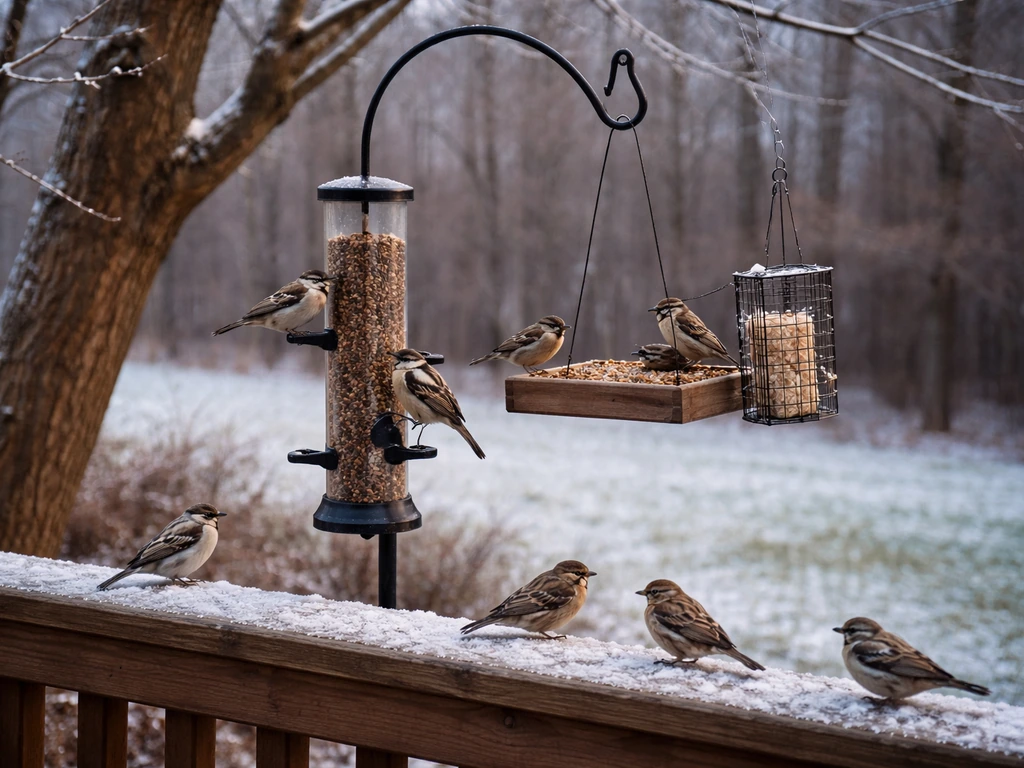
The best all-around feeder setup for a Wisconsin backyard combines a weight-activated squirrel-proof tube feeder loaded with black-oil sunflower seed, a suet cage for year-round woodpecker and nuthatch action, and a nyjer sock or tube feeder for goldfinches. That trio covers the majority of what you'll see at a Wisconsin feeder twelve months a year. From there, you layer in a platform feeder for cardinals and juncos, a nectar feeder from late April through early October for Ruby-throated Hummingbirds, and a caged or cage-surrounded tube feeder if grackles or starlings have already found your yard. The rest of this guide explains exactly why those choices make sense for Wisconsin specifically, which models hold up through our winters, and how to keep the whole setup running without it becoming a second job.
Best Bird Feeders for Wisconsin: Top Picks & Buying Guide
Why Wisconsin needs its own feeder guide
Wisconsin is not a generic Midwestern state when it comes to backyard birding. The northern third of the state, from Ashland and Iron counties down through the Northwoods, regularly sees January lows below -20°F and more than 100 inches of snow in the lake-effect belt along Lake Superior. Madison and the southern tier sit in a different world: average January lows around 10°F, far less snow, and a substantially longer hummingbird season. Those regional differences matter enormously when you are choosing feeder materials, deciding whether to invest in a heated water source, or figuring out how much seed capacity you actually need between refills in February. A thin plastic hopper feeder that survives five winters in Cincinnati will crack and warp after one Northwoods January. This guide is built around what actually works across Wisconsin's climate zones, not what happens to be popular nationally.
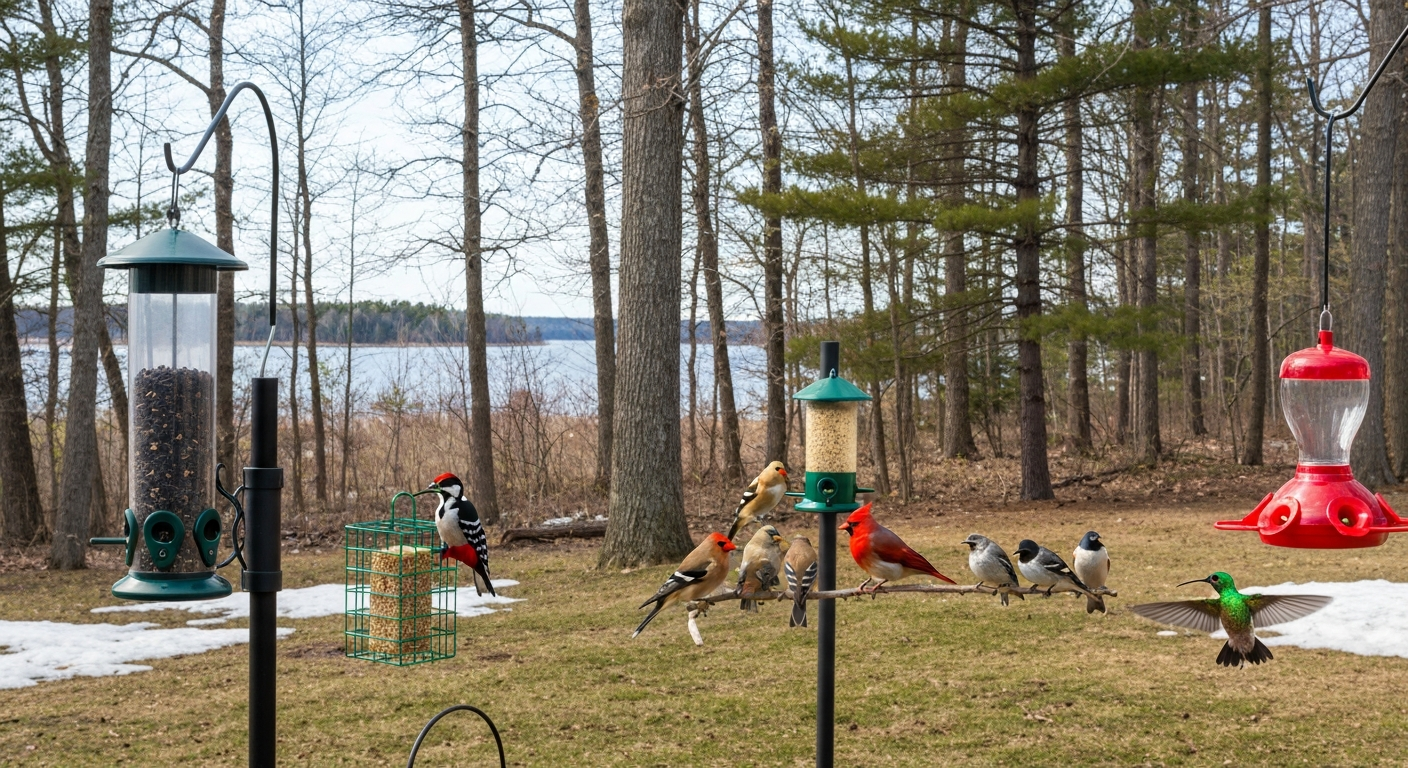
Wisconsin's checklist runs to roughly 284 native bird species, according to the Wisconsin Society for Ornithology, but the practical backyard list is much shorter and heavily weighted toward year-round residents: Black-capped Chickadees, White-breasted Nuthatches, Downy and Hairy Woodpeckers, Dark-eyed Juncos (October through April), American Goldfinches, Northern Cardinals, and House Finches are the backbone of a Wisconsin feeder yard through all four seasons. Layered on top are migrants and winter irruptives: Pine Siskins, Common Redpolls, Evening Grosbeaks, and Purple Finches show up in cold-weather years, while Ruby-throated Hummingbirds and Baltimore Orioles arrive in late April or May and are gone by September or early October. Getting the right feeders in place before those windows open and closed is half the battle.
Quick picks: top Wisconsin feeders by type and species
If you want the short version before diving into the details, here are the feeder categories and top-performing picks based on real-world use in Wisconsin conditions. Prices are approximate retail as of mid-2026.
| Category | Top Pick | Best For | Approx. Price | Why It Works in WI |
|---|---|---|---|---|
| Squirrel-proof tube feeder | Brome Squirrel Buster Plus | Chickadees, finches, nuthatches, titmice | $55–$70 | Weight-activated ports, RoxResin build survives cold snaps, limited lifetime warranty |
| Hopper / house feeder | Droll Yankees Yankee Whipper or Heritage Farms Absolute II | Cardinals, Blue Jays, juncos, sparrows | $40–$80 | Large capacity reduces winter refill frequency; powder-coated or UV-stabilized versions hold up to WI freeze-thaw cycles |
| Platform / tray feeder | Woodlink Going Green Ground/Platform Tray | Cardinals, juncos, sparrows, Mourning Doves | $20–$30 | Simple, easy to clean; mount on pole with baffle for squirrel control |
| Suet cage | Stokes Select Double Suet Cage or Heath Outdoor DD-1 | Downy/Hairy Woodpeckers, nuthatches, chickadees | $10–$20 | Rust-resistant coating; upside-down version deters starlings |
| Nyjer / thistle tube | Droll Yankees Thistle Sock or Aspects 394 Nyjer feeder | American Goldfinches, Pine Siskins, redpolls | $15–$40 | Fine ports exclude large birds; polycarbonate tube handles cold without cracking |
| Hummingbird nectar feeder | More Birds Vintage 8-port or Aspects HummZinger Excel | Ruby-throated Hummingbirds | $20–$35 | Wide-mouth design is easy to clean; red base eliminates need for dyed nectar |
| Oriole feeder | Birds Choice Oriole Feeder or Nature's Way Jelly/Nectar combo | Baltimore Orioles | $20–$35 | Orange color cues + jelly port + nectar; relevant May–August in WI |
| Smart/camera feeder | Bird Buddy Pro or Netvue Birdfy Feeder Cam | Any species; monitoring and ID | $100–$180 | AI species ID, app logging; rechargeable via solar; works in WI summer and mild winter |
| Caged feeder (pest control) | Brome Squirrel Buster Standard with cage accessory or Droll Yankees YF-M Caged | Finches, chickadees; excludes grackles/starlings | $40–$65 | Wire cage excludes large aggressive birds without stopping target species |
How Wisconsin's climate and seasons should drive your feeder decisions
Wisconsin's climate is genuinely variable enough that the state's own climatology office tracks freeze-date data at the station level, and those differences ripple into feeder decisions in practical ways. The northern highlands around Rhinelander and Minocqua can see first autumn frosts in mid-September and last spring frosts as late as mid-May. That means your hummingbird feeder window is roughly 20 weeks in the north versus 24-plus weeks in Kenosha or Racine. For suet, the danger zone is the opposite: high summer heat in southern Wisconsin (Milwaukee, Madison) can melt standard suet cakes into greasy messes, so no-melt or hot-weather suet formulas are worth the extra cost from June through August.
Freeze-thaw cycling is the single biggest enemy of feeder materials in Wisconsin. When temperatures swing from 35°F during the day down to 5°F overnight, water trapped in seams, cracks, and seed ports expands and works on any structural weakness. Standard injection-molded polystyrene (the cheap, glossy plastic in bargain-bin feeders) becomes brittle and cracks within one or two Wisconsin winters. UV-stabilized polycarbonate, acrylic, and reinforced composite materials like Brome's RoxResin handle this cycling far better. Metal components are fine as long as they are powder-coated or made from stainless steel; standard hardware-store galvanized steel can rust within a season when repeatedly wet and frozen.
Seed moisture is a year-round problem. In winter, snow and freezing rain can pack seed ports and cause tube feeders to clump and stop feeding. Look for feeders with drainage holes in the base and ports that are angled or covered to shed precipitation. In spring and fall, extended rainy stretches can soak seed in open platform and hopper feeders, leading to mold and the kind of fermented, toxic seed clumps that sicken birds. Shorter, more frequent refills during wet periods beat large-capacity feeders loaded to the top every two weeks.
Seasonal timing is also worth building into your routine. Here is how I approach it across the calendar year in central Wisconsin:
- Late April: put up hummingbird and oriole feeders before the first reported arrivals in your county (check local eBird data for your region). A day early is better than a day late.
- May through June: prime migration window. Platform and hopper feeders will see the widest species variety of the year. Clean everything before peak activity.
- July through August: watch suet for melting; switch to no-melt formulas. Clean nectar feeders every 2 days in heat above 85°F.
- September through October: keep hummingbird feeders up at least two weeks after your last sighting; late migrants still pass through. First juncos arrive, signaling time to load up platform feeders with millet.
- November through March: your most critical feeder window. Maximize calorie-dense offerings (suet, black-oil sunflower, peanuts). Check feeders after every ice storm for clogged ports.
- January through February: irruptive finch years can bring Redpolls and Siskins in large numbers to nyjer feeders. Keep a sock or tube feeder stocked through winter.
Common Wisconsin backyard birds and what they actually want to eat
Matching feeder type to bird species starts with knowing who is coming to your yard and when. The following birds are the most consistent and common Wisconsin feeder visitors, based on eBird abundance data for the state and my own multi-year experience across three yards in central and southern Wisconsin.
| Species | Resident or Seasonal | Preferred Food | Best Feeder Type | Notes |
|---|---|---|---|---|
| Black-capped Chickadee | Year-round | Black-oil sunflower, peanuts, suet | Tube, suet cage, peanut feeder | One of the most reliable WI year-round visitors; will use almost any feeder |
| American Goldfinch | Year-round (dull in winter) | Nyjer/thistle, sunflower chips | Nyjer tube or sock feeder | Year-round in WI; flocks swell in late summer and fall before color change |
| Northern Cardinal | Year-round | Black-oil sunflower, safflower | Hopper, platform, wide-perch tube | Needs wider perch or tray; tube feeders with short ports frustrate them |
| Dark-eyed Junco | Oct–Apr (some year-round in north) | White millet, sunflower chips, cracked corn | Platform/ground tray | Primarily ground feeders; low trays work better than elevated tube feeders |
| Downy Woodpecker | Year-round | Suet, peanuts, sunflower | Suet cage, peanut tube feeder | Smallest WI woodpecker; uses most suet cage styles |
| Hairy Woodpecker | Year-round | Suet, peanuts | Suet cage (larger) | Needs sturdier, larger cage than Downy; often avoids flimsy single-cake cages |
| White-breasted Nuthatch | Year-round | Sunflower, suet, peanuts | Tube, suet cage | Characteristically hangs upside-down; will use most feeder types |
| House Finch | Year-round | Black-oil sunflower, nyjer | Tube feeder | Susceptible to mycoplasmal conjunctivitis; clean tube feeders frequently |
| Purple Finch | Migration and winter visitor | Sunflower, nyjer | Tube feeder | Less common than House Finch; peak Oct–Nov and Apr |
| Pine Siskin | Irruptive winter visitor | Nyjer, sunflower chips | Nyjer tube feeder | Appears in force during cone-crop failure years in the north |
| Common Redpoll | Irruptive winter visitor | Nyjer, small sunflower chips | Nyjer tube or sock | Northern WI more likely; arrives Jan–Feb in irruption years |
| Ruby-throated Hummingbird | Late Apr–early Oct | Sugar water (1:4 sugar:water) | Nectar feeder with red elements | Only hummingbird species breeding in WI; departs by mid-September in south |
| Baltimore Oriole | May–Aug | Grape jelly, nectar, orange halves | Oriole feeder with jelly tray | Reliable in WI; arrives reliably after May 1 in southern counties |
| Red-breasted Nuthatch | Irruptive fall/winter visitor | Sunflower chips, suet, peanuts | Tube, suet cage | More common in WI in spruce/fir cone failure years |
| Blue Jay | Year-round | Whole peanuts, sunflower, corn | Hopper, platform, peanut feeder | Bold and aggressive; needs large feeder or dedicated peanut station |
Feeder types compared: tube, hopper, platform, nectar, and suet
Each feeder design exists for a reason, and each one comes with real trade-offs. Here is an honest breakdown of how each type actually performs in a Wisconsin backyard, not just what the marketing copy says.
Tube feeders
Tube feeders are the workhorses of the Wisconsin backyard. A clear or semi-opaque polycarbonate tube with multiple seed ports handles black-oil sunflower, sunflower chips, or safflower and attracts chickadees, finches, nuthatches, and titmice. The enclosed design protects seed from rain and snow better than any open feeder, and smaller ports naturally limit access to smaller birds. The downside is that seed at the bottom of a tall tube can stay damp and clump, especially if the feeder lacks drainage holes. I've lost more seed to mold in deep tubes during Wisconsin's shoulder seasons (April and October) than in any other feeder type. Look for tubes with drainage ports in the base and avoid filling more than two-thirds full during wet stretches. Quality polycarbonate tubes, like those from Droll Yankees or Brome, hold up through sustained cold without cracking; cheap polystyrene tubes are a false economy in Wisconsin.
Hopper feeders
A hopper feeder, sometimes called a house feeder, has a seed reservoir that gravity-feeds onto a tray or ledge. Cardinals love them because the wide tray accommodates their bulk and length, and Blue Jays work them hard. The capacity is usually high, which is a genuine convenience in winter, but that same capacity becomes a liability when seed gets wet. If a hopper feeder does not have a solid roof with meaningful overhang, rain and snow will soak the tray and the bottom of the reservoir. I've had Heritage Farms Absolute II hoppers with a locking, squirrel-resistant base hold up well for three-plus Wisconsin winters; cheaper wood-and-plexi hopper kits from craft stores rarely make it through year two before the roof starts peeling and the floor rots. For Wisconsin, stick to hoppers with metal or poly roofs, not painted wood.
Platform and tray feeders
Platform feeders are the most species-inclusive option you can put out, and they are the right choice for ground-feeding birds like juncos, Song Sparrows, Mourning Doves, and Cardinals who dislike clinging to tube ports. The problem is obvious: an open tray has no protection from weather, and seed gets wet, freezes in winter, or sprouts in spring. I use a platform feeder on a pole with a squirrel baffle and load it with white millet from October through April, refilling every two days rather than every week. Shallow platforms with mesh bottoms drain better than solid-floor trays. In a heavy Wisconsin winter, you may need to scrape frozen seed and snow off the platform every morning during storm systems, so place it where you can reach it easily.
Nectar feeders
For Ruby-throated Hummingbirds, the feeder design matters less than the nectar quality and cleaning frequency. Audubon and Cornell both specify the same recipe: 1 part plain white granulated sugar dissolved in 4 parts water, no red dye, no honey, no artificial sweeteners. Honey ferments quickly and can cause fatal fungal infections; dye is unnecessary because hummingbirds are already attracted to the feeder's red components. In Wisconsin summers, when July and August temperatures in the 80s and 90s are common, change nectar every two days. In cooler May or September weather, every four to five days is sufficient. The feeders I've had the best results with are wide-mouth designs (HummZinger Excel, More Birds Vintage series) that can be disassembled completely for cleaning without a bottle brush. Narrow-necked bottle-style feeders are harder to clean and will grow mold faster.
Suet feeders
Suet is arguably the highest-value offering for a Wisconsin winter feeder station, pulling in Downy and Hairy Woodpeckers, White-breasted and Red-breasted Nuthatches, Black-capped Chickadees, and occasionally Brown Creepers. A simple wire cage holds a standard 11-ounce suet cake and costs under $15, making it the most affordable high-impact feeder you can add. The one refinement worth making: an upside-down suet feeder, where birds must hang beneath the cage to access the suet, dramatically reduces European Starling pressure because starlings strongly prefer to feed right-side up. The Woodlink Upside Down Suet Feeder and similar designs from Heath Outdoor work well for this purpose. In summer, swap to no-melt or dough suet formulas to prevent the cake from going rancid or dripping into a greasy puddle.
| Feeder Type | Best Species | Weather Resistance | Squirrel Vulnerability | Maintenance Effort | Price Range |
|---|---|---|---|---|---|
| Tube (polycarbonate) | Chickadees, finches, nuthatches | High | Moderate (baffles needed) | Low–Moderate | $20–$70 |
| Hopper | Cardinals, jays, juncos, sparrows | Moderate–High (roof dependent) | High without cage/baffle | Moderate | $30–$90 |
| Platform/Tray | Cardinals, juncos, doves, sparrows | Low (open design) | High (needs baffle) | High (frequent refills) | $15–$40 |
| Nectar (hummingbird) | Ruby-throated Hummingbird | Moderate (freeze risk in cold snaps) | Low | High (2–5 day cleaning) | $15–$45 |
| Suet Cage | Woodpeckers, nuthatches, chickadees | High | Low–Moderate | Low (bi-weekly) | $8–$25 |
Specialty feeders for finches, hummingbirds, cardinals, and woodpeckers
Goldfinch and finch feeders
American Goldfinches are present in Wisconsin year-round, but their numbers at feeders spike dramatically in late summer (August through September) when flocks form before and during migration, and again in winter when they shift from breeding plumage. Nyjer, also sold as thistle seed, is the dominant draw. A dedicated nyjer tube feeder with small, narrow ports or a mesh nyjer sock is the right tool. The sock feeder is the cheapest entry point ($5–$10) and goldfinches genuinely prefer the ability to cling anywhere along its surface rather than competing for fixed ports. The downside: socks deteriorate quickly, and wet nyjer in a sock can mold in a week. Rigid nyjer tube feeders from Aspects or Droll Yankees are more durable and easier to clean, and their fine ports also work for Pine Siskins and Common Redpolls during irruption years. In heavy irruption winters, I run both a sock and a rigid tube simultaneously because the volume of small finches can empty a standard tube in a day.
Cardinal-focused feeders
Northern Cardinals are large, ground-oriented birds with wide bills. They are genuinely frustrated by small tube ports and short perches, which is why you often see them trying to work a tube feeder designed for chickadees and giving up. The ideal cardinal feeder has a wide perch or extended tray, large port openings, and loads black-oil sunflower or safflower. Safflower is worth using strategically: cardinals take it readily, but squirrels, grackles, and House Sparrows tend to ignore it, making it a useful tool if those pests are a problem. A hopper feeder with a wide base tray, or a dedicated platform feeder at a convenient height, will serve cardinals better than most tube feeders. Cardinals also feed most actively at dawn and dusk, which is worth knowing for placement (put the feeder where you can see it from a window in low light).
Woodpecker-specific setups
Downy Woodpeckers are small enough to use almost any suet cage. Hairy Woodpeckers, which are noticeably larger, need a cage with a solid backing panel or tail-prop area that lets them brace their stiff tail feathers while they feed. Look for suet feeders with a 'tail prop' extension below the cake slot, sometimes called a log or extended-back feeder. For larger woodpeckers like Red-bellied Woodpeckers (which are expanding northward in Wisconsin) and Pileated Woodpeckers (more common in the Northwoods), a large log-style or bark-butter feeder works better than a cage. Pileated Woodpeckers are spectacular feeder visitors, but they require a big, solid feeding station; commercial peanut butter or bark butter spread directly on a log section is often more effective than any commercial cage for that species. Woodpeckers also come to peanut-in-shell feeders and whole-peanut cylinder feeders reliably, which gives you an alternative or supplement to suet.
Hummingbird feeder specifics for Wisconsin
Wisconsin's Ruby-throated Hummingbirds typically arrive in southern counties between April 28 and May 5, with northern arrivals one to two weeks later. They depart south from most of the state by mid-September, though stragglers push into early October in mild years. That gives you roughly a 20-week window in the north and 24 weeks in the south. During that window, the feeder that works best is one you will actually clean every two to three days: a wide-mouth, dish-style feeder with a removable base and a top-fill port beats any elegant glass bottle feeder that requires a bottle brush and fifteen minutes to clean. The HummZinger Excel 16 oz by Aspects is a reliable performer for this reason. Avoid feeders with yellow bee guards, which attract bees and wasps; stick to red-dominant designs. If ants are a problem, an ant moat filled with plain water and mounted above the feeder solves it without pesticides.
Smart feeders and AI camera options: what they do well and where they fall short
The Bird Buddy Pro and the Netvue Birdfy Feeder Cam are the two most widely available AI-enabled feeder cameras in 2026, and they do something genuinely useful: they photograph or video birds at the feeder, use on-device or cloud AI to identify the species, and log visits to an app on your phone. For casual watchers who want to know what visited while they were at work, or for someone building a personal yard list, that is a real and legitimate value. The Bird Buddy Pro costs around $150–$180 with the solar charging roof accessory; the Netvue Birdfy runs $100–$140 and also offers a solar panel add-on. Both work acceptably in Wisconsin summers. The honest limitation is winter performance: solar recharging drops sharply in Wisconsin's short December and January days, and camera batteries drain faster in cold. Users in northern Wisconsin should expect to bring the camera portion inside for charging more frequently in winter, or rely on a corded power solution.
The AI identification is genuinely good for common species but makes more errors with less common visitors, immature plumages, and birds photographed from awkward angles. I've had Bird Buddy correctly identify a Pine Siskin, a Common Redpoll, and a Red-breasted Nuthatch in the same winter session, but it consistently misidentified a first-year male Purple Finch as a House Finch. That is a common AI error and one that most human beginners also make, so it is not a disqualifying flaw. The app logs are the strongest feature for tracking patterns: you can see which species visited at 6 AM versus 4 PM and how visit frequency changes week to week. What smart feeders do not do is replace the actual feeder seed capacity or build quality of a dedicated feeder. The Bird Buddy's integrated feeder is smaller than a standard tube feeder, holds less seed, and can run empty faster. Some users mount the camera on a separate pole adjacent to a full-size feeder and attach the camera housing as a monitoring unit rather than the primary feeder, which is a smarter setup for a serious Wisconsin feeder station.
- Best use case: species logging, photo capture, and yard bird list building for casual to intermediate watchers
- Realistic winter limitation: reduced solar charging in northern Wisconsin; plan for supplemental charging
- AI accuracy: excellent for common resident species, less reliable on immature plumages and rare visitors
- Seed capacity: smart feeders hold less than dedicated tube or hopper feeders; consider pairing with a full-size feeder
- App features to prioritize: species history log, push notifications for new species, and photo saving
- Price range: $100–$180 for camera-equipped smart feeder; solar add-on usually $20–$30 extra
Materials and build quality: what holds up in Wisconsin and what does not
Material selection is where Wisconsin birders should spend the most time when evaluating feeders, because the gap between a feeder that lasts two seasons and one that lasts a decade is almost entirely about how the materials handle cold, UV exposure, and moisture cycling. Here is how the main options compare in practice.
| Material | Cold Resistance | UV Resistance | Weight | Typical Lifespan in WI | Best Used For |
|---|---|---|---|---|---|
| Standard polystyrene (cheap plastic) | Poor (brittle below 0°F) | Poor (yellows and cracks) | Light | 1–2 seasons | Avoid for Wisconsin winters |
| UV-stabilized polycarbonate | Excellent (stable to -40°F) | Good | Light–Moderate | 5–10+ years | Tube feeders, hopper windows, suet cages |
| RoxResin composite (Brome) | Excellent | Excellent | Moderate | 10+ years (lifetime warranty) | Premium tube and squirrel-proof feeders |
| Powder-coated steel | Excellent | Good (depends on coating quality) | Heavy | 8–15 years | Poles, frames, hopper structures |
| Stainless steel hardware | Excellent | Excellent | Varies | Indefinite with cleaning | Screws, springs, wire mesh on quality feeders |
| Untreated cedar/redwood | Moderate (swells and cracks over years) | Moderate (greying, checking) | Moderate | 3–6 seasons with maintenance | Hopper feeders; requires annual sealing |
| Acrylic (clear panels) | Moderate (can crack in hard impacts at low temp) | Moderate (may yellow after 5+ years) | Light | 4–7 years | Hopper windows, viewing panels |
Brome's RoxResin material, used in the Squirrel Buster line, is one of the best-performing plastics I've tested in Wisconsin conditions: it does not crack, fade significantly, or become brittle after five winters. Droll Yankees products use UV-stabilized polycarbonate and powder-coated metal components and back them with a limited lifetime warranty, which matters when you are spending $50–$70 on a feeder. Cheaply made feeders from big-box retailers often use thin polystyrene or low-grade acrylic that goes brittle in the first hard freeze, and the metal components rust before the second season. The metal mesh on bargain suet cages often starts rusting within a year; look for PVC-coated or vinyl-coated wire mesh in suet cages for longer life.
Squirrel-proofing, grackle control, and predator protection in Wisconsin yards
Squirrels destroyed the first three feeders I ever put up, so I take this section seriously. No single method is foolproof, but combining two or three tactics gets you close to a squirrel-free feeding station. The most reliable approach in Wisconsin yards is pole mounting with a correctly sized baffle plus a weight-activated or caged feeder. For the pole and baffle system: mount a smooth steel pole at least 5 feet off the ground, keep the feeder 10 or more feet from any jump-off point (tree trunk, fence, roof overhang), and install a dome or conical baffle below the feeder on the pole. Baffles need to be at least 15–17 inches in diameter to prevent a squirrel from simply reaching around them. The Wildlife Damage Management literature references a useful field rule: maintain at least 5 feet of vertical clearance from the baffle bottom to the feeder, 10 feet of horizontal clearance from any elevated structure, and position the pole at least 10 feet from the nearest jump-off point.
Weight-activated feeders like the Brome Squirrel Buster Plus close their seed ports under the weight of a squirrel but remain open for lighter birds. They work very well in my experience and Brome backs them with a limited lifetime warranty against squirrel damage, which is a genuine differentiator. The Droll Yankees Yankee Flipper uses a weight-activated spinning ring that physically rotates squirrels off the feeder; it works, it is entertaining to watch, and it costs around $70–$90. The trade-off for both is price. If budget is tight, a pole-and-baffle system with safflower seed in a hopper feeder (which squirrels find less appealing than sunflower) is a lower-cost partial solution.
Grackles and European Starlings are the Wisconsin backyard's most disruptive large birds, and the most effective counter is a caged feeder: a standard tube feeder surrounded by a wire cage with openings large enough for small birds but too small for grackles or starlings. Most grids with approximately 1.5-inch openings work. Brome's cage accessory for the Squirrel Buster and Droll Yankees' caged models both accomplish this. As Cornell Lab's guidance notes, offering safflower instead of black-oil sunflower reduces grackle and starling interest noticeably, because both species strongly prefer sunflower. An upside-down suet feeder handles the starling problem at the suet station specifically. For Red-winged Blackbirds, which can move through in huge flocks during spring migration, temporarily removing platform feeders for a few days is sometimes the most practical solution.
Window collisions are a feeder placement issue that Wisconsin birders need to take seriously. The American Bird Conservancy's research-backed rule is straightforward: place feeders either within 3 feet of a window (too close for a bird to build dangerous speed before impact) or farther than 30 feet away. The danger zone is the middle distance of 5–25 feet, where birds leave the feeder fast enough to hit glass with lethal force. If your preferred feeder location falls in that range, external window treatments like ABC BirdTape, Feather Friendly dot patterns, or external netting can significantly reduce collision risk without eliminating the viewing value of the feeder.
Mounting, placement, and winter feeder care
Placement is something most beginners get wrong on the first setup. The goal is a location visible from a window you actually sit near, within reach for refilling without a major hike (you will refill far less often if the feeder is inconveniently located), positioned away from dense shrubs that provide cover for cats and Sharp-shinned or Cooper's Hawks to ambush from directly beneath the feeder. A feeder in the open is actually safer for birds than one tucked into heavy brush, because arriving birds can see aerial predators from a distance. Some cover within 10–15 feet (a deciduous shrub or conifer) gives spooked birds a quick refuge without providing predator ambush cover directly below.
For winter specifically: check tube feeders and hopper trays after every ice storm or wet snowfall, because ports can ice over and starve birds who have come to depend on the feeder. A quick wipe with a dry cloth or a brief indoor warm-up for frozen components is all it takes. Suet cages are the most weather-tolerant feeder type in winter and require almost no winter maintenance beyond a new cake every one to three weeks depending on woodpecker traffic. If you are going to leave for a week in February, prioritize leaving a full suet cage and a large hopper loaded with sunflower over a half-filled tube feeder with frozen ports.
Cleaning, maintenance, and disease prevention
Project FeederWatch and Cornell Lab recommend cleaning seed feeders every one to two weeks under normal conditions, with a deeper bleach-solution soak (1 part bleach to 9 parts water) when there is evidence of sick birds or disease spread. Hummingbird feeders need cleaning with each nectar change, which in Wisconsin summers means every two to three days when it is hot. This sounds like a lot of maintenance, but feeders designed for easy disassembly (no-tool takedown, wide-mouth ports, accessible interiors) reduce cleaning time from fifteen minutes per feeder to three or four. That design criterion should be on your checklist when buying.
House Finches in Wisconsin are susceptible to mycoplasmal conjunctivitis, a bacterial eye disease that spreads at tube feeders where infected birds wipe their eyes on ports while feeding. If you see House Finches or American Goldfinches with swollen, crusty eyes at your feeder, take the feeder down immediately, clean it with bleach solution, and leave it down for at least a week. This is not alarmist: the Cornell/Project FeederWatch research consistently shows that feeder cleaning reduces disease severity. Similarly, if your local Wisconsin DNR or wildlife health office issues a Highly Pathogenic Avian Influenza (HPAI) advisory, follow their guidance on feeder removal. HPAI risk at typical backyard songbird feeders is low, per CDC and USFWS guidance, but temporarily removing feeders if sick or dead birds appear locally is the right call.
- Tube and hopper feeders: clean every 1–2 weeks; full bleach soak (1:9 bleach:water) if disease is suspected
- Platform feeders: scrub and dry every 5–7 days; remove and discard any wet or clumped seed immediately
- Suet cages: rinse and dry each time you replace the cake; full soak monthly
- Hummingbird feeders: clean with each nectar change (every 2–3 days in heat above 80°F; 4–5 days in cooler weather)
- Nectar formula: 1 part plain white sugar dissolved in 4 parts water; no dye, no honey, no additives
- If sick birds are observed: remove and clean all feeders; contact Wisconsin DNR Wildlife Health for guidance
Seed and food recommendations for Wisconsin feeders
Seed quality and type matters as much as feeder design. Black-oil sunflower seed is the single highest-value offering for a Wisconsin feeder station: it attracts the widest range of species, has a thinner shell than striped sunflower (making it accessible to smaller birds), and has the highest fat content per seed. Sunflower chips (hulled sunflower kernels) are even more attractive to many species and eliminate the shell mess under the feeder, but they cost more and should not be left in open platform feeders during rain because they go rancid quickly. Nyjer seed is essential if you want goldfinches and siskins. White proso millet draws juncos, sparrows, and doves to ground or platform feeders and is the right choice for those species rather than trying to force them onto tube feeders. Whole peanuts in shell attract Blue Jays and large woodpeckers; shelled peanuts in a mesh feeder attract smaller woodpeckers, nuthatches, and chickadees. Avoid cheap mixed seed bags that are heavy on red milo, wheat, and oats: most Wisconsin feeder birds ignore those fillers, and they end up as waste on the ground.
How Wisconsin compares to neighboring state setups
Wisconsin's feeder challenges overlap significantly with those of Minnesota to the northwest and Michigan's Upper Peninsula to the east: severe winters, freeze-thaw material stress, and the prospect of irruptive winter finches all feature in all three states. Minnesota birders face even harsher average winters, particularly in the north, and deal with a higher frequency of Common Redpoll and Pine Siskin irruptions. Wisconsin's southern tier transitions toward the conditions that Ohio and Indiana birders deal with: milder winters, less material stress, and a slightly longer hummingbird season. For readers in Indiana, see our guide to the best bird feeders for Indiana for tailored recommendations. If you are reading this guide from a southern Wisconsin county like Kenosha, Racine, or Rock, many of the platform and hopper feeder recommendations for Ohio birding environments will also apply to your situation. If you're in Iowa, similar recommendations apply, see our guide to the best bird feeders for Iowa for state-specific choices and timing. See our guide to the best bird feeders for Ohio for model-specific recommendations that apply to southern Wisconsin.
Before you buy: a practical checklist
Before you add anything to your cart, work through this checklist. It catches the most common buying mistakes Wisconsin birders make.
- Identify your target species first: cardinals need a different feeder than goldfinches. Buy for the birds you actually have, not the ones you wish you had.
- Check the material: avoid polystyrene in any feeder you intend to use through a Wisconsin winter. Polycarbonate, RoxResin, powder-coated metal, or stainless hardware are your minimum standard.
- Look for drainage: any feeder that holds seed needs drainage holes in the base. No drainage means moldy seed, guaranteed.
- Assess your squirrel pressure: if squirrels are active in your yard, buy a weight-activated feeder or budget for a pole-and-baffle system at the same time as the feeder. A great feeder without squirrel protection is a squirrel feeder.
- Consider maintenance time honestly: a beautiful glass hummingbird feeder you won't clean every 2–3 days in summer is worse than a plain plastic one you will. Pick feeders you'll actually maintain.
- Check warranty terms: Brome and Droll Yankees offer limited lifetime warranties. For a $60–$80 feeder, that matters.
- Plan your mounting before you buy: hanging from a tree branch within jumping distance of squirrels is usually a failure. Decide on pole or bracket mounting first and buy a baffle at the same time.
- For smart feeders: verify Wi-Fi compatibility and check whether the app requires a subscription for full features before purchasing.
- Where to buy: Wild Birds Unlimited stores (available in Madison, Milwaukee, Green Bay, and other Wisconsin cities) offer knowledgeable staff and species-specific seed options. Amazon, Chewy, and Home Depot carry most feeder brands but staff expertise is limited. Buying direct from Brome or Droll Yankees online ensures warranty registration.
- Budget guidance: a functional, durable Wisconsin feeder station (tube feeder + suet cage + pole with baffle) can be assembled for $60–$100. A premium station with squirrel-proof feeder, hopper, nyjer tube, suet cage, and hummingbird feeder runs $150–$250 and should last a decade or more with proper care.
FAQ
Which specific feeder models are best for year‑round Wisconsin backyard birding and why?
Top practical picks for Wisconsin year‑round performance: - Tube feeder (e.g., Droll Yankees Yankee Flipper or Perky‑Pet Classic Tube): durable, weather‑resistant, good for finches, chickadees, nuthatches; price ~$25–$90. - Squirrel‑proof tube (Brome Squirrel Buster Classic/Plus): excellent for sunflower/black‑oil seed, weight‑activated squirrel exclusion and strong warranty; price ~$60–$120. - Hopper/box feeder (e.g., Wild Birds Unlimited/Perky‑Pet large hopper): high capacity for cardinals and mixed flocks, good snow/rain protection; price ~$40–$150. - Platform/ground feeder (e.g., heated platform or tray with edge): attracts ground‑feeders and juncos; heated versions for winter use to avoid snow cover. - Nyjer/thistle sock or specialized finch feeder (e.g., Droll Yankees Thistle Feeder): for American Goldfinch; small ports limit larger birds. - Suet cages (Stokes Select or Droll Yankees suet feeders): for woodpeckers and nuthatches; use in winter. - Hummingbird bottle/petite feeders (e.g., First Nature, Aspects HummZinger): compact, easy to clean; heated nectar feeders can prevent freezing in cold snaps but require outdoor‑rated power. Choose models built with UV‑stabilized polycarbonate, powder‑coated steel or stainless hardware for Wisconsin winters; expect tradeoffs between capacity (less frequent refills) and refill ease/weight when icy.
How should I match feeder types and seeds to common Wisconsin species seasonally?
Seasonal/species matching: - Winter year‑round residents (black‑capped/chestnut‑backed chickadees, white‑breasted nuthatches, downy/ hairy woodpeckers): suet cages, tube feeders with black‑oil sunflower. - Finches (American Goldfinch, siskins): nyjer/thistle feeders or small‑port tube feeders; goldfinches peak in late summer/fall and molt periods. - Cardinals, grosbeaks: hopper or platform with large sunflower or safflower; cardinals prefer tray/hopper access. - Hummingbirds (ruby‑throated): nectar feeders in late spring–summer; use 1:4 sugar:water, replace every 2–3 days in heat. - Grackles/starlings: use caged tube feeders or small‑port feeders and offer safflower or hulled sunflower to deter large blackbirds. - Migrants: offer mixed seed and maintain feeders through migration windows (use eBird/State DNR timing per county). Adjust feeder types by month using local eBird trends; swap to higher‑energy foods (suet, peanuts) in late winter/spring cold snaps.
What practical mounting, baffle sizing and placement rules work best in Wisconsin yards to deter squirrels and predators?
Mounting and baffle guidance: - Use pole mounting with a properly sized baffle: dome or conical baffle 18–24 inches diameter for ground‑climbing squirrels; position at least 5–10 ft horizontally from jump‑off points (trees, roofs) and 4–6 ft above ground depending on species. - Vertical clearances: follow 5–7–9 type rules (baffle centered between feeder and nearest jump point). - Use weight‑activated feeders (Brome Squirrel Buster) and mechanical deterrents (Yankee Flipper) as layered defenses. - For predator safety (cats, raptors): place feeder 10–12 ft from dense cover where ambush predators hide, and keep perches short to reduce hawk perching. - For windows, follow the American Bird Conservancy rule: place feeders very close (<3 ft) or far (>30 ft) from glass to reduce collisions.
How should I adapt feeders and care routines for Wisconsin winters (freeze/thaw, snow, ice)?
Winter adaptations: - Use feeders made of metal or UV‑stabilized polycarbonate with stainless hardware to resist embrittlement and corrosion. - Choose feeders with larger roofs or integrated snow shields; consider heated nectar feeders or heated platform trays for hummingbirds and ground feeders during prolonged freezes (requires safe outdoor electrical supply). - Increase feeder capacity or use hopper feeders to reduce refills during storms, but balance against seed spoilage risk. - Check and clear snow/ice from perches daily in storms; bring hummingbird feeders inside when temps will remain below freezing for several days unless heated. - Store backup seed under cover and keep replacement parts (baffles, perches) accessible; expect plastic feeders to become brittle over many Wisconsin winters and replace as needed.
What cleaning and disease‑prevention schedule is recommended for feeders in Wisconsin?
Cleaning cadence and methods: - Seed feeders: clean every 1–2 weeks under normal use; more frequently if many birds congregate or in outbreaks. - Hummingbird feeders: replace nectar and clean every 2–3 days in warm weather, every 4–7 days in cool weather. - Suet cages: remove spoiled suet and clean as needed; more often in warm, damp weather. - Use a 1:9 bleach:water soak or a dedicated wildlife‑safe disinfectant for 10–15 minutes when cleaning, rinse thoroughly and air‑dry. - Temporarily remove feeders and notify local DNR/CDC guidance if sick/dead birds with unusual symptoms are found nearby (heightened sanitation recommended during avian influenza events). - Reduce crowding by using multiple smaller feeders rather than one large platform to lower disease transmission risk.
Which anti‑grackle, starling and bully‑bird strategies work best without excluding smaller target species?
Selective exclusion tactics: - Use caged tube feeders or cages around hopper feeders with spacing sized to allow cardinals/finches but exclude larger blackbirds. - Offer safflower seed or hulled sunflower; grackles and starlings dislike safflower and may avoid feeders offering primarily safflower. - Install multiple small feeders to reduce crowding and give shy species options away from aggressive birds. - Position feeders over 10–12 ft from large open loafing areas that attract starlings. - Rotate feeding locations and use baffles/height adjustments to complicate large‑bird monopolization.
Best Bird Feeders for Indiana: Top Picks by Species and Season
Top bird feeder picks for Indiana by species and season, with anti-squirrel tips, placement, and winter-ready features.