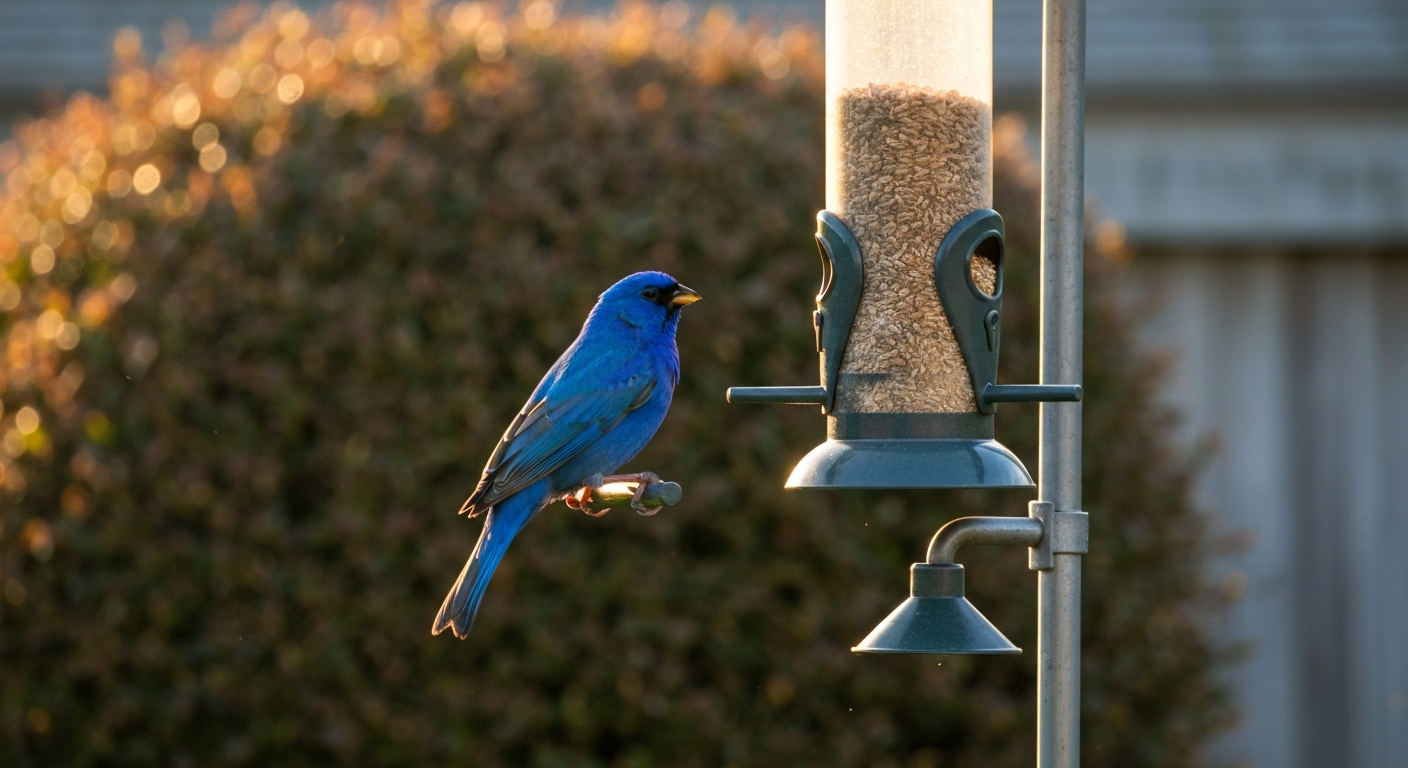
The single best feeder for indigo buntings is a narrow-port tube feeder or wire mesh finch feeder loaded with nyjer (thistle) seed or white proso millet. Buntings are small-billed birds that prefer tiny seeds, and a finch-style feeder without a wide catch tray naturally excludes the grackles and starlings that would otherwise push them out. If you want a quick shortlist without reading everything below, skip to the top picks. If you want to understand why the feeder type and seed choice matter as much as any brand name, read on.
Best Bird Feeder for Indigo Bunting: Top Picks & Setup Guide

Marcus Holloway
8 Aug 2026
Quick top picks by use case
- Best overall: narrow-port nyjer tube feeder (no catch tray, powder-coated steel or UV-stabilized plastic) — keeps grackles out, holds fine seed without spillage, easy to clean.
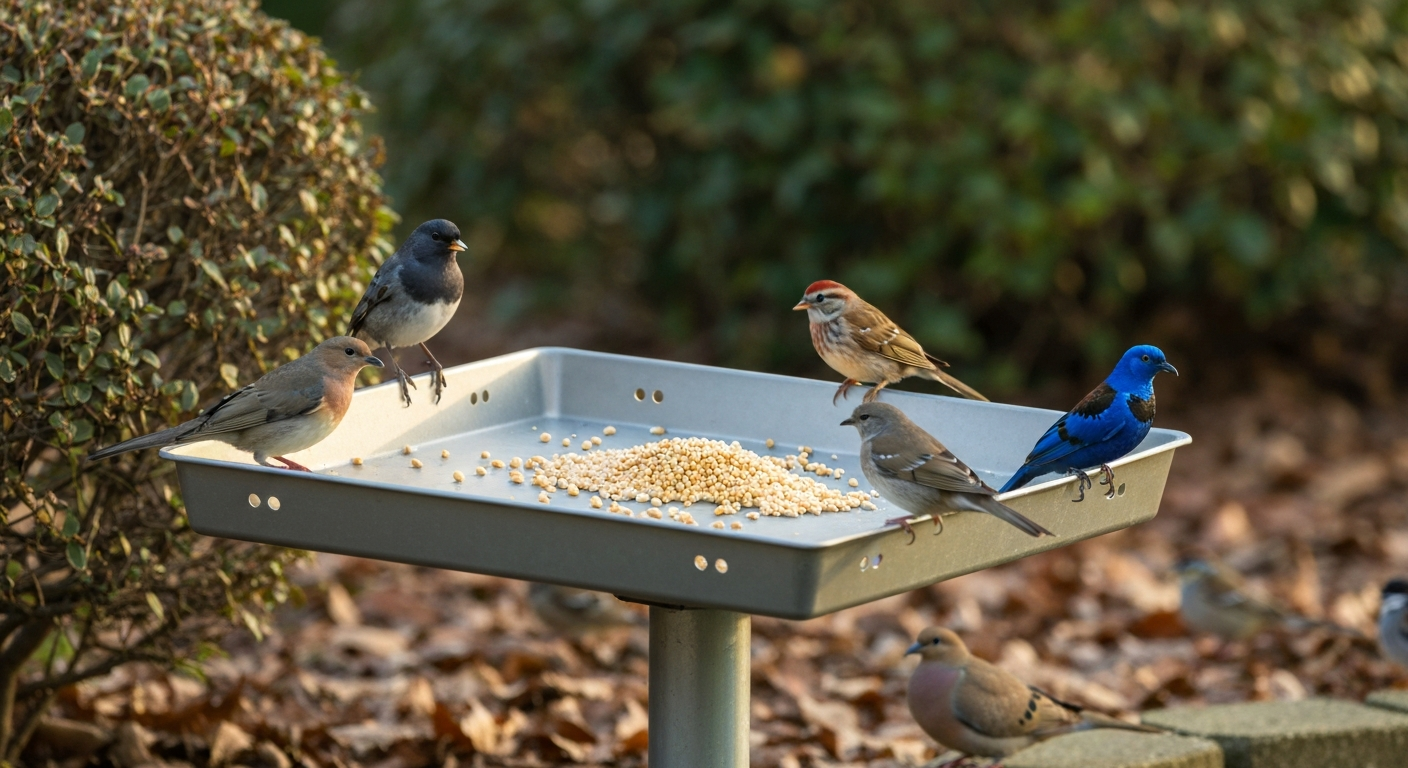
- Best for white millet: low platform or tray feeder placed near shrub cover — mirrors how buntings forage naturally at or near ground level.
- Best for mixed-species yards with squirrels: weight-activated tube feeder (e.g., Squirrel Buster-style) set to trigger at squirrel weight — protects seed without blocking small buntings.
- Best budget option: sock-style or wire mesh nyjer feeder — inexpensive, clinging design that large birds struggle to use.
- Best for grackle-heavy yards: caged tube feeder with a 1.5-inch (38 mm) wire exclusion cage — physically blocks grackles and starlings while small buntings pass right through.
- Best for smart/camera monitoring: AI-enabled feeder camera (e.g., Bird Buddy or similar) mounted above a small platform — lets you confirm bunting visits and log species activity without being present.
Why feeder choice actually matters for indigo buntings
Indigo buntings (Passerina cyanea) are not regular feeder birds the way house finches or chickadees are. During breeding season they are largely insectivorous, which means you will not see many at feeders from late May through midsummer. The prime feeder window is spring migration (late April to early May) and fall migration (August through October), with the occasional winter visitor in the southern United States. During those windows they are actively seeking high-calorie small seeds to fuel movement, and that is exactly when a well-chosen feeder can pull them in reliably.
The biology matters for feeder design in two concrete ways. First, buntings are small birds with small bills, around 12 cm in length and weighing roughly 12–13 grams. A weight-activated feeder that closes ports at squirrel weights (typically above 70–100 grams) will stay open for a bunting without any adjustment. Second, buntings are naturally shy and skittish. Open, exposed platform feeders in the middle of a lawn will get ignored. Feeders placed near shrub cover with clear flight lines (roughly 3 to 5 meters from protective branches, with open space around the feeder itself) will get used. I have moved feeders just 4 feet closer to a brush edge and seen bunting visits increase noticeably within a week.
What indigo buntings actually eat at feeders
Cornell Lab of Ornithology's All About Birds is explicit: small seeds including nyjer (thistle) are the feeder foods most likely to attract indigo buntings. White proso millet is the other heavy hitter, confirmed repeatedly by regional Audubon groups and backyard observers. Buntings will also pick up sunflower chips (hulled sunflower) from trays, but millet and nyjer are the seeds they actively seek rather than accept as second choice.
Nyjer is oil-rich (roughly 30 to 40% oil by weight), which makes it calorically dense and highly attractive during migration. That same oil content is a double-edged sword: nyjer goes rancid quickly if stored warm or left in a wet feeder. Buy in quantities you can use within two to three months, store it in a sealed container in a cool spot, and refresh the feeder every one to two weeks. White millet is a harder, drier seed that ages more stably, which makes it more forgiving on a platform feeder where rain can accumulate. For more on how white millet performs across different feeder setups, the best bird feeder for white millet topic covers product-specific options in depth.
Feeder types at a glance
Before going type by type, here is a quick reference so you can see where each style lands for bunting use. I'll expand on each one after the table.
| Feeder Type | Best Seed | Bunting Suitability | Grackle/Squirrel Risk | Maintenance Level |
|---|---|---|---|---|
| Narrow-port tube | Nyjer, millet | Excellent | Low (small ports) | Medium |
| Wire mesh / sock | Nyjer | Excellent | Low (clinging only) | Low |
| Hopper (box) | Millet, sunflower chips | Good | Medium-High without cage | Low-Medium |
| Platform / tray | White millet, mixed small seed | Good (with cover nearby) | High if open | Medium-High |
| Caged tube | Nyjer, millet | Excellent | Very Low | Medium |
| Weight-activated tube | Nyjer, millet, sunflower chips | Excellent | Very Low (squirrels) | Medium |
Tube feeders: the practical workhorse for buntings
Tube feeders are where I start almost every bunting setup. The narrow cylindrical body and small seed ports do two things at once: they dispense tiny seeds cleanly without dumping them on the ground, and they physically prevent large-bodied birds like grackles from getting a stable feeding position. A grackle can try to cling to a narrow tube feeder port, but without a wide perch or a catch tray underneath, it cannot stabilize long enough to eat effectively. Buntings, house finches, and goldfinches have no such problem.
The specific design features that matter most: look for ports with a diameter of about 3/16 inch (roughly 5 mm) or smaller for nyjer, and slightly wider for millet. Metal port surrounds rather than plastic ones resist chewing from squirrels and resist wear from heavy bird traffic. UV-stabilized polycarbonate or powder-coated steel tubes outlast standard plastic in outdoor conditions, especially in direct sun where cheap plastic yellows and cracks within a season or two. A removable base makes cleaning possible, and cleaning matters more than most people realize (more on that below).
Tube feeder pros and cons
| Pros | Cons |
|---|---|
| Small ports naturally deter grackles and starlings | Can clog with wet nyjer if not cleaned regularly |
| Works for both nyjer and millet with port-size variation | Seed at bottom of long tubes can go stale before birds reach it |
| Easy to hang from pole, shepherd's hook, or tree branch | Capacity lower than hoppers; needs more frequent refilling during peak migration |
| Wide range of price points; durable models available under $30 | Squirrels will chew ports on plastic models if not protected |
One practical tip I use: hang the tube feeder on a smooth metal pole with a cone baffle below rather than from a branch or shepherd's hook without protection. Squirrels will figure out a hook quickly. On a smooth pole with a 17-inch (43 cm) or wider dome baffle positioned about 5 feet off the ground, squirrel access drops dramatically. Field trials using pole-and-baffle setups consistently show markedly reduced squirrel interference when the baffle is properly sized and positioned.
Hopper feeders: decent for buntings with some caveats
Hopper feeders (the classic house-shaped box feeders with a roof and wide perch) hold more seed than tubes, which is convenient during the peak migration windows when bunting activity spikes. The problem is that hoppers also invite every other bird in the yard. Grackles love hopper feeders because the perch is wide and stable, and the open seed trough is easy to access. If you run a hopper without any exclusion hardware, you will be feeding grackles and squirrels far more often than buntings.
The fix is a surrounding cage. A 1.5-inch (38 mm) wire mesh exclusion cage around a hopper feeder physically blocks Common Grackles, European Starlings, and squirrels while allowing small birds like buntings, juncos, and finches to pass through and feed inside. Wild Birds Unlimited and similar specialty retailers sell caged hopper models off the shelf, or you can retrofit an existing hopper with a separately purchased cage. If you are already thinking about feeders for similar small-seed species, the topic covering the best bird feeder for juncos is worth a read alongside this one, since many of the caged-hopper recommendations overlap.
Hopper feeder pros and cons
| Pros | Cons |
|---|---|
| High seed capacity; less frequent refilling | Open design attracts grackles, starlings, and squirrels by default |
| Covered roof protects seed from rain better than open trays | Wide perches give large birds stable footing |
| Works well with white millet and mixed small-seed blends | Caged models cost more upfront (typically $35–$70 range) |
| Good for mixed-species yards when caged | Heavier; needs a sturdy mounting point |
Platform and tray feeders: low and slow, the bunting way
Indigo buntings are ground-level foragers by nature. In the wild, they pick seeds off low vegetation and the ground surface, which is exactly why white millet on a low platform feeder works so well. A tray or platform feeder set 12 to 18 inches off the ground, loaded with white proso millet and positioned within a few meters of shrubby cover, can be one of the most consistently productive bunting setups during migration. I have had buntings visit a $12 hardware-store tray feeder more reliably than a $50 tube feeder simply because the platform was closer to how they naturally forage.
The trade-off is that open platforms are the least defensible feeder type against grackles. Large flocks of grackles or starlings will monopolize an open platform and consume seed faster than you can refill it, while also driving smaller birds away entirely. The practical solutions are: (1) use the platform feeder only during active bunting migration windows and remove or stop filling it during grackle movement periods, (2) place a caged tube feeder as your primary setup and use the platform as a secondary option near denser cover where grackles are less comfortable landing, or (3) run a decoy feeding station with cheap cracked corn or large sunflower heads away from your focal area to divert the grackles. Option three sounds counterintuitive but it genuinely reduces pressure on the primary bunting feeder.
Drainage matters on platform feeders. Millet absorbs moisture and can sour quickly on a flat tray with no holes. Choose a platform feeder with a screened or slatted base that allows water to drain through. Check and refresh millet every two to three days in wet weather.
Thistle, mesh, and nyjer feeders: getting the details right
Nyjer feeders come in two main forms: tube feeders with tiny ports (discussed above) and wire mesh or fabric sock feeders where birds cling directly to the mesh surface and pull seeds through. Both styles work for indigo buntings, but the mesh version has an advantage in that large birds almost never manage it. Grackles and starlings need a solid perch to feed; clinging to a swaying mesh tube is not their style. Buntings, goldfinches, and redpolls handle it easily.
What mesh size actually works
For nyjer seed specifically, a mesh opening of approximately 3/16 inch (roughly 5 mm) is the practical standard. It is small enough to hold nyjer seeds (which are slender and about 4 to 5 mm long) without them pouring through, but open enough for small-billed finches and buntings to extract individual seeds. Go larger and you get significant seed loss and waste. There is a full breakdown of mesh sizing for different seed types in the article on what size mesh for bird feeder if you want the numbers for other seed types. For nyjer specifically: 3/16 inch is the target.
Fabric sock feeders (the fine-mesh nylon or polypropylene bags sold at most wild bird stores) use an even finer mesh, typically around 1/16 to 1/8 inch openings, and birds pull seeds through the weave. They work well, cost almost nothing, and can be discarded rather than cleaned. The downside is durability: a sock feeder will last one season at best, and they offer no weather protection for the seed inside. In consistently rainy climates, a mesh tube feeder made from coated steel wire is more practical than a fabric sock.
Nyjer vs. white millet: which one to lead with
Both seeds attract indigo buntings, but they serve slightly different situations. Nyjer is your go-to if you already have finches (goldfinches, house finches, purple finches) visiting, since you can add buntings to an existing feeding station without changing the setup. Nyjer in a narrow-port or mesh feeder also passively deters grackles without any additional hardware. White millet on a platform feeder pulls in buntings that are actively ground-foraging, and it also attracts juncos, sparrows, doves, and grosbeaks, making it the better choice if you want a species-diverse yard rather than a finch-specific station. The best bird feeder for grosbeaks topic covers how to balance grosbeak and bunting needs at the same station if that is relevant to your setup.
Squirrel and grackle proofing: what actually works
Squirrels are the easier problem to solve. A weight-activated feeder (the Brome Squirrel Buster family being the most widely tested commercial example) uses a spring-loaded mechanism that closes seed ports when weight exceeds a set threshold. A 12-gram indigo bunting sits comfortably below the trigger weight; a 400-gram squirrel does not. Manufacturers and independent tests both confirm these work as advertised when properly set up. Combine one with a pole-mounted cone or torpedo baffle and you have a near-complete squirrel solution without needing to position the feeder the prescribed 10 feet away from every jump-off point in your yard.
Grackles are trickier because they are lighter than squirrels and smart enough to adapt. The most reliable physical solutions are: narrow tube feeders without trays, caged feeders with approximately 1.5-inch (38 mm) mesh openings that exclude common grackles by body size, and simply switching to nyjer-only feeders where grackles have no food motivation to persist. If you get large blackbird flocks in fall, removing or stopping fills on your open feeders temporarily during those movement periods is the most effective short-term response. Providing a diversion station (cracked corn or milo in an exposed area away from your primary feeders) can keep flocks occupied without sacrificing bunting access at your focal spot.
Placement: where you put it matters as much as what you buy
Indigo buntings need clear visual sightlines when they feed, but they also need nearby cover to retreat to. The sweet spot is a feeder positioned 10 to 15 feet from a shrub hedge, brush pile, or dense perennial border. Close enough that a spooked bird can reach cover in under two seconds, but far enough from low branches that a crouching cat cannot ambush from directly underneath. Conservation guidance commonly recommends several meters of open flight space between the feeder and any dense cover at ground level for exactly this reason.
Height-wise, tube and mesh feeders hung at 4 to 6 feet off the ground are about right. Platform feeders for millet work best at 12 to 18 inches, as mentioned earlier. Avoid placing feeders directly under trees if squirrels are a problem, as launching from overhead branches defeats even a well-placed baffle.
Feeder materials and durability
This is an area where spending slightly more upfront saves money over a multi-year horizon. Powder-coated steel, stainless steel hardware, and UV-stabilized polycarbonate all hold up to the outdoor environment significantly better than standard clear plastic or untreated wood. Clear plastic tubes can turn brittle and discolor within a single summer of direct sun exposure in hot climates. Untreated softwood platform feeders absorb moisture, warp, and harbor mold. If budget matters, a metal mesh feeder is often both cheaper and more durable than a comparably priced plastic tube feeder.
Smart feeders and camera integration
AI-enabled feeder cameras (Bird Buddy being the most widely available example as of 2026) can identify visiting species and log visit times, which is genuinely useful for confirming whether buntings are actually using your feeder or just passing through your yard without stopping. Buntings are often present for shorter windows than casual observation reveals, and a camera with species ID helps you time seed freshness and feeder positioning adjustments. The trade-off is that most camera feeders are designed as standalone units and use their own seed reservoir rather than adapting to a mesh or narrow-port design. If grackle exclusion is your primary concern, a camera feeder alone is not the answer; pair it with a caged or narrow-tube primary feeding station nearby and use the camera feeder for monitoring rather than as your main feeding point.
Cleaning and maintenance: the part most people skip
A fouled feeder is a health risk to the birds you are trying to attract. Mississippi State University Extension and CDC guidance both recommend cleaning feeders with a 10% bleach solution (one part household bleach to nine parts water), rinsing thoroughly, and allowing the feeder to air-dry completely before refilling. CDC guidance on wildlife and disease prevention (includes feeder/bath cleaning recommendations) endorses removal of feeders and cleaning/disinfection with a 10% bleach solution, then thorough rinsing and air-drying before refilling. For heavily used feeders or those in warm, humid climates, a weekly clean is appropriate. For lighter-use setups, every two to four weeks is a reasonable baseline. If you ever see sick or dead birds at or near your feeder, remove and disinfect immediately and hold off refilling for several days.
Nyjer feeders need cleaning more often than millet platforms because the oily seed residue can turn rancid and the fine particles pack into ports. A bottle brush that fits inside the tube and a quick soak in the bleach solution every two to three weeks keeps nyjer feeders functional and hygienic. Mesh and sock feeders are lower maintenance but should still be replaced or washed at least once per season.
Comparing indigo bunting feeders vs. similar species setups
If you share yard space with juncos, grosbeaks, or other small-seed species, most bunting-optimized setups will also serve those birds reasonably well. Juncos are ground and low-tray feeders that share white millet as a preferred food, so a well-placed millet platform is effectively a dual-purpose setup. Grosbeaks are larger and prefer sunflower seeds, but the caged-feeder approach used for bunting protection does not conflict with a separate hopper feeder for grosbeaks placed elsewhere in the yard. The main tension is with grackle-diversion strategy: if you are actively running a diversion station to keep grackles off your bunting feeder, make sure it is positioned far enough from any open grosbeak or junco feeder that you are not simply moving the grackle problem around.
Your buying checklist before you purchase
- Decide on seed first: nyjer for a finch-style clinging feeder, white millet for a platform, or both if you have the space for two stations.
- Match feeder type to seed: narrow-port or mesh tube for nyjer, screened or slatted platform for millet.
- Check materials: powder-coated steel, UV-stabilized polycarbonate, or stainless hardware. Avoid raw wood or standard clear plastic for long-term use.
- Assess your squirrel pressure: if heavy, prioritize a weight-activated tube feeder or add a pole baffle to any hanging feeder.
- Assess your grackle pressure: if heavy, add a 1.5-inch wire exclusion cage or switch fully to narrow-port nyjer feeders without trays.
- Confirm your placement spot: 10 to 15 feet from cover, clear of overhead branches, 4 to 6 feet high for tubes, 12 to 18 inches for platforms.
- Plan your cleaning routine before you buy: does the feeder have a removable base or disassemble easily? If not, cleaning becomes a chore you will skip.
- Consider a camera feeder or standalone camera clip as a secondary tool to confirm visit patterns and guide seed-freshness timing.
FAQ
What feeder type most reliably attracts indigo buntings while excluding grackles and starlings?
A no‑tray finch/nyjer feeder with very small mesh or narrow feeding ports is the top choice. Rationale: nyjer/thistle and small-port feeders favor small-billed birds like indigo buntings and finches; the tiny ports and mesh make it difficult for larger-billed grackles and starlings to access seed. Choose powder‑coated steel or stainless models for weather resistance and buy a caged finch feeder or one with a 1.5‑inch exclusion cage if grackle pressure is moderate to high.
Should I use nyjer (thistle) or white/proso millet to attract indigo buntings?
Both work, but use them differently. Nyjer in narrow/mesh finch feeders is best to favor small perching buntings and reduce large-bird access. White/proso millet on low platforms or on-ground trays will also attract buntings—especially during migration/winter when they eat more seeds—but platforms are more likely to draw sparrows and doves and increase spilled seed that attracts grackles and pigeons. For targeted bunting attraction, prioritize nyjer; for mixed-species yards where buntings forage on the ground, offer small amounts of millet on a low, sheltered platform.
Which feeder designs should I avoid if I want to minimize grackle and squirrel interference?
Avoid open, high-capacity hopper feeders and large platform feeders without guards—these are easily monopolized by grackles and starlings and provide easy access for squirrels. Also avoid trays under feeders that collect spilled mixed seed. If you want mixed feed, use caged hopper feeders or place them away from bunting-focused feeders.
What mesh size or port diameter is ideal for bunting-focused feeders?
For nyjer/finch feeders: very small mesh (fine thistle mesh) or feeding ports under ~6–8 mm (1/4–5/16 inch) prevent larger bills from reaching seed. If using exclusion cages, 1.5‑inch (≈38 mm) cage openings around tubes exclude larger nuisance birds while allowing buntings and other small songbirds to feed.
How can I make feeders squirrel‑proof and also discourage grackles?
Combine multiple tactics: (1) Use weight‑activated feeders (e.g., Squirrel Buster style) that close for heavy animals. (2) Mount feeders on smooth metal poles with a properly sized dome or conical baffle placed at least 18–24 inches below the feeder. (3) Use caged tube/finch feeders (no tray) to limit access by grackles. (4) Place larger, high-calorie feed (sunflower, corn) in a separate “sacrifice” station away from bunting feeders to divert grackles. (5) Keep feeders at least 10–15 ft from dense low cover that squirrels and ambush predators can use.
Where should I place bunting feeders (height, distance from cover, and orientation)?
Placement: 3–6 ft off the ground for platform or low-tray millet feeders (buntings often feed low) and 5–7 ft for tube/nyjer finch feeders. Provide nearby cover (shrubs/hedgerow) within 10–20 ft so buntings can fly to safety, but avoid placing feeders immediately adjacent to dense cover where ambush predators or squirrels can launch. Ensure clear sightlines so birds can detect predators. Position feeders where they are shielded from prevailing wind and heavy rain and where you can attach camera equipment if desired.
Next Article
Best Bird Feeder for White Millet: Top Picks & Buying Guide
Best bird feeder for white millet: tested picks, mesh/port sizing, mounting, squirrel/grackle fixes, and maintenance.