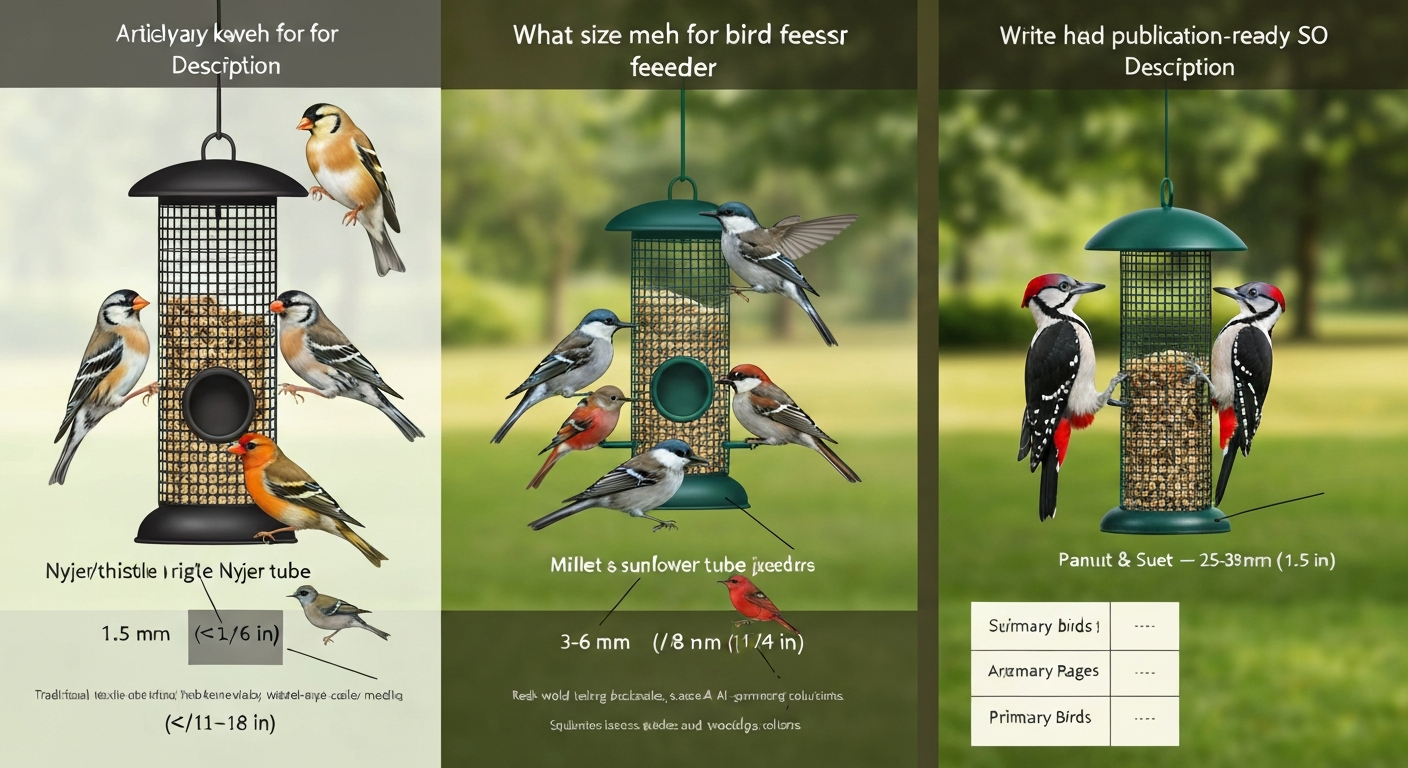
For most bird feeders, the mesh or port size you need falls into three practical ranges: roughly 1.0 to 1.5 mm (about 1/16 inch) for Nyjer/thistle feeders targeting goldfinches and siskins; 3 to 6 mm (1/8 to 1/4 inch) for sunflower, safflower, and millet feeders serving sparrows, juncos, finches, and grosbeaks; and 25 to 38 mm (1 to 1.5 inches) for peanut and suet cages that need to hold large chunks while giving woodpeckers and nuthatches a solid grip. Get one of those three ranges right and you will exclude most pests, reduce spillage, and actually attract the birds you are after.
What Size Mesh for Bird Feeder: Mesh Sizes by Species & Seed

Marcus Holloway
10 Aug 2026
Mesh size at a glance
| Feeder use | Aperture (inches) | Aperture (mm) | Primary birds served |
|---|---|---|---|
| Nyjer/thistle sock or tube | 1/16" – 1/8" | 1.5 – 3 mm | American Goldfinch, Pine Siskin, Lesser Goldfinch |
| White millet tube or platform | 1/8" – 3/16" | 3 – 5 mm | Dark-eyed Junco, White-crowned Sparrow, Doves |
| Hulled sunflower tube | 3/16" – 1/4" | 5 – 6 mm | Chickadees, Finches, Nuthatches |
| Black-oil sunflower (whole seed) | 1/4" – 3/8" | 6 – 9 mm | Cardinals, Grosbeaks, House Finches |
| Safflower seed | 1/4" – 3/8" | 6 – 9 mm | Cardinals, Doves, Chickadees |
| Cracked corn | 3/8" – 1/2" | 9 – 12 mm | Jays, Doves, Sparrows |
| Peanuts in shell / whole kernels | 1" – 1.5" | 25 – 38 mm | Woodpeckers, Nuthatches, Jays, Squirrels (if you allow) |
| Suet cages (standard) | 1" – 1.5" | 25 – 38 mm | Woodpeckers, Starling deterrence at 1" |
| Platform/hopper drainage floor | 1/4" – 3/8" | 6 – 9 mm | General mixed seed; allows water out, retains seed |
What mesh size, aperture, and wire gauge actually mean
The word 'mesh' gets used loosely in feeder descriptions, and that causes real confusion when you are trying to buy a replacement screen or build your own feeder. Technically, mesh count is the number of openings per linear inch of woven wire cloth. A 16-mesh screen has 16 openings per inch; a 4-mesh screen has 4. But the number that actually matters for birds and seeds is the aperture, which is the clear opening between the wires, not the overall spacing from wire center to wire center.
The aperture formula is straightforward: Aperture (inches) = (1 / mesh count) minus wire diameter (inches). So a 16-mesh screen made from 0.025-inch wire has an aperture of (1/16) minus 0.025 = 0.0375 inches, or roughly 1 mm. That same math works in metric: Aperture (mm) = (25.4 / mesh count) minus wire diameter (mm). Wire gauge matters more than people expect. Two screens with the same mesh count but different wire diameters can have apertures that differ by 30 percent or more.
How to measure the mesh on a feeder you already own
- Lay a ruler across the mesh surface and count how many complete openings fit within exactly 25.4 mm (1 inch). That gives you the mesh count.
- Use digital calipers to measure the diameter of one wire. If you do not have calipers, a micrometer or even a careful ruler measurement works for coarser meshes.
- Calculate aperture using the formula above, or simply measure the clear opening across one hole directly with the calipers.
- For port holes (tube feeders, hopper ports), just measure the diameter of the circular or oval opening with calipers. Most commercial Nyjer ports run 1.5 to 3 mm; standard sunflower ports are typically 9 to 12 mm.
Inches to millimetres conversion chart for common feeder mesh apertures
| Aperture (fractions of an inch) | Aperture (decimal inches) | Aperture (millimetres) | Typical feeder application |
|---|---|---|---|
| 1/32" | 0.031" | 0.8 mm | Ultra-fine Nyjer sock (specialty) |
| 1/16" | 0.063" | 1.6 mm | Fine Nyjer tube mesh |
| 3/32" | 0.094" | 2.4 mm | Nyjer/thistle standard mesh |
| 1/8" | 0.125" | 3.2 mm | Fine millet / small finch tube |
| 3/16" | 0.188" | 4.8 mm | Millet tube, hulled sunflower lower limit |
| 1/4" | 0.250" | 6.4 mm | Sunflower/safflower tube, drainage mesh |
| 3/8" | 0.375" | 9.5 mm | Cracked corn, mixed seed drainage |
| 1/2" | 0.500" | 12.7 mm | Coarse drainage, peanut heart feeders |
| 1" | 1.000" | 25.4 mm | Standard suet cage, peanut-in-shell feeder |
| 1.5" | 1.500" | 38.1 mm | Large suet/peanut cage, woodpecker feeders |
One inch equals exactly 25.4 mm by international definition, so all the conversions above are exact to the decimal shown. When a product listing gives a port size in millimetres and you need to compare it to an inch-based spec, just divide by 25.4.
Matching mesh size to the seed you are offering
The simplest rule for mesh feeders is this: if you want the seed to stay inside the feeder until a bird pulls it out, the aperture must be smaller than the seed's narrowest cross-section. If you want free drainage or want seeds to fall onto a tray, the aperture needs to be larger than the seed width. Research on physical seed dimensions gives us concrete numbers to work with here.
Nyjer (thistle)
Nyjer kernels are tiny: measured dimensions show a width of roughly 1 mm and a length of around 4 mm. To keep Nyjer in the feeder rather than blowing out, your mesh aperture should be 1.5 to 3 mm. The sweet spot most finch-sock manufacturers hit is around 1.5 mm (close to 1/16 inch). Go much finer than 1 mm and seeds struggle to come out even when a goldfinch tugs; go coarser than 3 mm and the seed pours out in wind.
White millet
White proso millet kernels run about 2 to 2.5 mm wide and 3 to 4 mm long. That means a mesh aperture of 3 to 5 mm (1/8 to 3/16 inch) will retain millet while still letting birds pull seeds out easily. For recommendations on specific models and designs tailored to those dimensions, see our guide to the best bird feeder for white millet. Much smaller and the seeds jam; much larger and millet falls through freely onto the ground, which can attract rats and unwanted species. Juncos and sparrows love millet offered on platform feeders, where mesh serves primarily as a drainage floor rather than a seed-retention device.
Hulled (chips/hearts) and whole black-oil sunflower
Hulled sunflower chips have a kernel width of roughly 5 to 5.5 mm. To hold chips in a mesh tube, keep apertures at or below about 5 mm (3/16 inch). Peer‑reviewed measurements report black‑oil sunflower kernel width of approximately 5–6 mm, so use a mesh aperture smaller than the kernel's minimum cross‑sectional width to retain kernels black‑oil sunflower kernel width ≈5–6 mm. Whole black-oil sunflower seeds are larger: typically 10 to 12 mm long and 6 to 8 mm wide. Mesh tubes designed for whole sunflower seed usually use apertures in the 6 to 9 mm (1/4 to 3/8 inch) range so the birds can get a grip on the seed without the whole batch pouring out.
Safflower
Safflower seeds measure roughly 6 to 8 mm long and 3 to 4 mm wide. Treat safflower like whole sunflower for mesh purposes: a 6 to 9 mm aperture (1/4 to 3/8 inch) works in tube feeders. The same mesh size used for black-oil sunflower doubles well for safflower without modification, which makes mixed-use mesh feeders practical.
Cracked corn
Cracked corn particles from commercial mixes typically fall in the 2 to 6 mm range depending on how coarsely the corn was processed, with common fractions around 4 to 5 mm. For a drainage mesh under cracked corn on a platform feeder, use 3/8 to 1/2 inch (9 to 12 mm) openings so water drains freely without losing too much seed through the floor. If you are using mesh as the only retaining surface, drop to 3/16 to 1/4 inch (5 to 6 mm) to capture most particles.
Peanuts
Shelled whole peanut kernels range from about 13 to 16 mm long, making them the largest common feeder seed. Peanut hearts (splits/pieces) are smaller but still in the 8 to 12 mm range. For a cage-style peanut feeder, 1 to 1.5 inch (25 to 38 mm) mesh is the standard because it lets larger birds like woodpeckers, nuthatches, and jays get a firm grip and pull chunks out. Finer mesh frustrates the birds you are targeting.
Mesh size recommendations by target species
Bill width is the real driver here. A bird can only access a port or mesh opening that is at least as wide as its bill. Bill-width data from morphological studies gives practical lower bounds for port and aperture sizing. LaBarbera et al. (2017) measured bill length, width, and depth on over 800 Dark‑eyed Junco specimens and report that bill width is a standard, repeatable museum metric usable to estimate gape/access LaBarbera et al. (2017) measured bill length, width, and depth on over 800 Dark‑eyed Junco specimens and report that bill width is a standard, repeatable museum metric usable to estimate gape/access..
| Species | Approximate bill width | Minimum port/aperture | Recommended feeder mesh/port range | Preferred seed |
|---|---|---|---|---|
| American Goldfinch | ~4–5 mm | 1.5 mm (mesh) | 1.5–3 mm mesh (Nyjer sock/tube) | Nyjer, hulled sunflower chips |
| Pine Siskin | ~3–4 mm | 1.5 mm (mesh) | 1.5–3 mm mesh | Nyjer, fine sunflower chips |
| Dark-eyed Junco | ~5–6 mm | 3 mm | 3–5 mm or open platform | White millet, cracked corn, sunflower chips |
| House Finch | ~7–7.3 mm | 5 mm | 5–9 mm port or mesh | Black-oil sunflower, safflower, millet |
| Indigo Bunting | ~5–6 mm | 3 mm | 3–5 mm tube or platform | White millet, Nyjer, small sunflower chips |
| Rose-breasted Grosbeak | ~9–11 mm | 9 mm | 9–12 mm port, hopper or platform | Sunflower, safflower, peanut hearts |
| Evening Grosbeak | ~11–13 mm | 11 mm | 12–15 mm port, hopper or large tube | Sunflower seeds, safflower |
| Northern Cardinal | ~9–10 mm | 9 mm | 9–12 mm port, hopper or platform | Sunflower, safflower |
| Black-capped Chickadee | ~5–6 mm | 5 mm | 5–9 mm tube or mesh | Sunflower chips, whole sunflower, suet |
| White-breasted Nuthatch | ~6–8 mm | 6 mm | 9–25 mm mesh or suet cage | Sunflower, suet, peanut hearts |
| Downy Woodpecker | ~6–8 mm | 6 mm | 25–38 mm suet cage | Suet, peanuts |
| Blue Jay | ~10–12 mm | 10 mm | 25–38 mm peanut cage or open tray | Peanuts, sunflower, cracked corn |
| Common Grackle | ~9–11 mm | N/A (exclude) | Avoid ports > 9 mm on tube feeders; use caged feeder | Opportunist — minimize access |
Juncos are a good example of the mismatch that happens when you use the wrong feeder design. Their bill is plenty wide enough to work a 3 to 5 mm port, but juncos are ground-feeding birds by nature. They rarely cling to a tube. Platform feeders with a 3 to 5 mm drainage mesh floor, loaded with white millet, consistently outperform tube feeders for juncos. Similarly, grosbeaks have powerful, wide bills (approaching 11 to 13 mm in evening grosbeaks) and need larger ports or open hopper feeders with wide tray openings. Forcing a grosbeak onto a small-port finch feeder is a frustrating experience for both the bird and the backyard birder.
Indigo buntings are small birds with relatively narrow bills, similar in size to finches. They will use a Nyjer tube in a pinch but are far more reliably attracted to small millet offered in a low platform or on the ground. A mesh aperture of 3 to 5 mm on a shallow platform tray works well. Because buntings tend to be shy and easily displaced, keeping grackles and house sparrows off the platform with a mesh cage surround (1.5 inch openings, which buntings can pass through but grackles cannot) makes a real difference.
Mesh tube feeders and sock feeders: aperture, port, and placement
Mesh tube feeders are the workhorses of finch feeding. The design works because small-billed birds like goldfinches and siskins can cling anywhere on the surface and pull seeds through the mesh, while larger birds physically cannot fit their bills into small openings. There are two sub-types worth distinguishing: rigid wire-mesh tubes and flexible fabric sock feeders.
Rigid wire-mesh tube feeders
For Nyjer, use a rigid tube with a welded or woven wire mesh aperture of 1.5 to 3 mm. I have tested several brands and found that 2 mm aperture hits the best balance: seeds stay put in moderate wind, goldfinches pull them out without struggling, and house sparrows (with bill widths around 8 to 9 mm) cannot get a useful grip. For hulled sunflower chips on a mesh tube, move up to 5 to 6 mm aperture (3/16 to 1/4 inch). Coarser-mesh tubes in the 6 to 9 mm range work for whole black-oil sunflower and safflower. The wire gauge matters for durability: 19-gauge (0.9 mm diameter) or heavier is worth the extra cost because lighter wire bends when squirrels grab the tube.
Fabric sock feeders
Nyjer socks are the simplest and cheapest option. Mesh openings on quality socks are typically 1 to 2 mm. They work, but fabric degrades in UV and moisture faster than wire, so plan to replace them every one or two seasons. Do not try to use a Nyjer sock for sunflower chips: the seeds are too wide and will jam rather than dispense cleanly. Socks also hold less seed than a rigid tube, which means more refilling if you have an active flock.
Port placement and spacing
On tube feeders with discrete ports (holes rather than full-surface mesh), port diameter should match the seed. For Nyjer the standard is 3 to 4 mm diameter circular ports. For sunflower, 9 to 12 mm. Space ports at least 75 to 100 mm apart vertically so birds do not crowd each other off the perch. If you are targeting clinging species like chickadees and nuthatches, adding ports near the bottom of the tube or even upside-down ports (which discourage house sparrows and starlings that prefer to feed right-side-up) helps with species selectivity.
Suet cages and suet-block holders: hole size, spacing, and material
Standard commercial suet cages use 1 inch (25.4 mm) square mesh openings, and that size has become the default because it fits a standard 11 to 12 ounce suet block and gives woodpeckers a solid surface to brace against while they chip pieces out. Going narrower than 1 inch is counterproductive: the suet does not dispense efficiently and birds like the hairy woodpecker and red-bellied woodpecker get frustrated. Going much wider than 1.5 inches (38 mm) lets starlings and grackles access the suet easily, which most backyard birders want to avoid.
Starling-resistant suet feeders use a cage-within-a-cage design or an upside-down suet holder. The outer cage or access restriction forces birds to cling and hang upside-down to reach the suet. Starlings and grackles can technically manage this but dislike it enough to move on. The inner mesh on these feeders still uses the standard 1 inch opening; the deterrence comes from access orientation, not aperture size.
Wire gauge for suet cages should be 14 to 16 gauge (1.6 to 2.0 mm diameter wire) for anything hung outdoors year-round. Lighter gauge cages rust faster and bend when squirrels pry at them. Powder-coated or galvanized steel cages outlast bare wire significantly. I have had powder-coated 16-gauge cages run four or five years without significant rust; bare-wire cheaper cages from discount stores often start corroding in their first winter.
Peanut cage feeders
Peanut-in-shell feeders need 1 to 1.5 inch (25 to 38 mm) mesh to let jays and woodpeckers pry whole nuts out. Feeders for peanut hearts (shelled pieces) can use tighter mesh in the 1/2 to 3/4 inch (12 to 19 mm) range because the pieces are smaller and birds extract them by chipping rather than pulling whole nuts. If squirrels are a problem, mounting a peanut cage on a baffled pole is far more effective than trying to go finer with the mesh: squirrels are patient enough to work around any aperture design given enough time.
Platform and hopper feeders: drainage mesh, floor apertures, and seed retention
Platform and hopper feeders do not rely on mesh to retain seed the way tube feeders do. Instead, mesh on these designs serves two functions: drainage (keeping the seed bed dry) and, in open platform trays, squirrel and pest deterrence when a cage surrounds the feeding area. Getting the drainage mesh right is underrated and directly affects how long your seed stays fresh.
Drainage mesh for platform floors
The ideal drainage aperture lets water pass quickly while retaining the seed you are offering. For millet and fine seeds, use 3 to 5 mm (1/8 to 3/16 inch) mesh floors. For whole sunflower or safflower, 6 to 9 mm (1/4 to 3/8 inch) works. For mixed seed that includes cracked corn, 9 mm (3/8 inch) is the minimum that lets water clear without losing large fractions of seed through the floor. I have used 1/4 inch hardware cloth cut to size as a replacement drainage floor on multiple platform feeders with good results: it is cheap, cuts easily, and lasts years.
One trade-off to watch: finer drainage mesh clogs faster with seed hulls, wet debris, and mold. A 3 mm mesh under millet or milo needs clearing every few days in wet weather. Coarser 9 mm mesh under mixed sunflower drains better but lets small seeds fall through, which lands on the ground below and can attract rodents. Matching the mesh to the seed type you are actually offering is the best resolution to this trade-off.
Cage surrounds for platform and hopper feeders
Adding a wire cage surround to a platform or hopper feeder is one of the most effective ways to exclude starlings, grackles, and squirrels without blocking smaller target birds. The standard recommendation is a 1.5 inch (38 mm) opening on the cage surround. Juncos, sparrows, indigo buntings, cardinals, and small finches pass through 1.5 inch openings with no trouble. Common grackles and European starlings are too large. Squirrels will still try, but a 1.5 inch opening makes it much harder for them to get their head and shoulders inside. For birds on the borderline (large female cardinals, for example), a 1.75 inch opening provides a more comfortable passage while still deterring most grackles.
Hopper feeder exit ports
Hopper feeders release seed through a gap or port at the base of the reservoir. This is not a mesh application strictly, but the gap width matters for seed flow. For whole sunflower or safflower, a 12 to 15 mm (1/2 inch) gap works well. For millet, tighten to 5 to 8 mm to prevent the smaller seeds from flooding the tray and spilling. Many commercial hoppers are designed around sunflower and get bridging (seed clogging) with millet because the exit gap is too wide and the seed mass settles into it. A small piece of 3/16 inch hardware cloth inserted as a screen at the hopper exit fixes this problem on DIY and modified feeders.
Material, wire gauge, and weatherproofing
Material choice affects how long your mesh lasts more than almost any other variable. Here is how the main options stack up in practice.
| Material | Typical gauge range | Rust resistance | Squirrel resistance | Best use |
|---|---|---|---|---|
| Galvanized steel (welded wire) | 14–19 gauge | Good (zinc coating) | Good if 14–16 gauge | All-purpose outdoor feeder mesh |
| Powder-coated steel | 14–18 gauge | Very good | Good | Suet cages, peanut feeders, tube feeders |
| Stainless steel | 19–22 gauge | Excellent | Moderate (lighter wire) | Fine Nyjer mesh, long-term use |
| Plastic-coated wire | 16–19 gauge | Moderate (coating cracks) | Moderate | Budget mesh feeders, short-term |
| Nylon/polyester fabric (socks) | N/A | Poor (UV/moisture) | Poor (chewed) | Temporary Nyjer socks, warm-season use |
| Copper mesh | 19–22 gauge | Excellent (patinas) | Moderate | Decorative/specialty feeders |
For most backyard setups, 16-gauge galvanized or powder-coated steel is the sweet spot. It is heavy enough to resist casual squirrel bending, holds up in rain and snow, and is widely available in hardware stores. Finer 19 to 22 gauge wire is fine for Nyjer feeders where squirrel access is controlled by other means (baffles, pole placement), but I would not rely on fine wire alone in a squirrel-heavy yard.
Cleaning, maintenance, and when to replace mesh
Mesh feeders need more active maintenance than smooth hopper feeders because seed debris, hulls, and mold accumulate in the openings. A practical routine is to scrub mesh with a stiff bottle brush and a 1:9 bleach-to-water solution every two to four weeks during warm, wet weather, and monthly in dry weather. Rinse thoroughly and let dry completely before refilling. Wet seed in fine mesh is the fastest way to generate mold and aspergillosis risk for your birds.
Replace wire mesh when you see any of the following: visible rust that flakes rather than just discolors, bent sections that have changed the aperture by more than about 20 percent, broken wires with sharp exposed ends (these injure birds), or structural deformation from squirrel activity that leaves gaps larger than 50 mm. On powder-coated feeders, check the coating annually around mounting points and seams where water pools. Hardware cloth replacement panels can be bought by the foot at any hardware store and cut to size with tin snips, making DIY repairs straightforward.
Squirrel and pest deterrence: where mesh fits into the larger strategy
Mesh size alone will not solve a squirrel problem. Squirrels will chew through nylon socks in minutes and bend lightweight wire mesh given enough motivation. The realistic role of mesh in pest management is species selectivity for birds, not physical exclusion of mammals. For squirrels, the effective tools are: mounting on smooth poles with baffles (at least 1.5 m or 5 feet off the ground, at least 3 m or 10 feet from jump-off points), caged feeder surrounds as described above, and weight-sensitive perch systems that close ports when heavier animals land. Mesh aperture choice contributes by limiting which bird species can feed, which reduces competition and waste, but it is a secondary pest-control tool compared to pole placement and physical barriers.
Grackles are a different problem. They are large enough that a 1 to 1.5 inch cage surround around a platform feeder is usually effective. On tube feeders, keeping port size at or below 9 mm does not physically exclude grackles (whose bills are easily 10 mm wide) but does slow them down. The most reliable anti-grackle strategy on tube feeders is switching to a caged tube design where the outer cage aperture is 1.5 inches: small songbirds enter freely, grackles cannot.
Mounting considerations and mesh placement
Where you mount a mesh feeder affects which mesh size is practical. Feeders on poles give you the most control: you can use finer mesh because squirrel access is managed at the pole. Feeders hung from tree branches or eaves need heavier wire and more robust mounting hardware because they swing and absorb more mechanical stress. For window-mounted mesh feeders, lighter 19-gauge stainless steel is a good choice because it stays attractive and rust-free close to glass, and the smaller birds these feeders attract (chickadees, finches) do not exert enough force to deform fine wire.
Vertical clearance under the feeder also matters when drainage mesh is part of the design. A platform feeder's drainage mesh should have at least 100 to 150 mm of clear space below it so wet seed and hulls can fall through rather than building up and re-blocking the mesh from underneath. If your mounting setup does not allow that clearance, build a slight tray tilt (5 to 10 degrees) so water runs off to one draining edge.
Quick buying checklist: choosing the right mesh feeder
- Identify your target species first: small finches and siskins need 1.5 to 3 mm Nyjer mesh; juncos and sparrows work best on platforms with 3 to 5 mm drainage mesh; grosbeaks and cardinals need 9 to 12 mm ports or open hoppers; woodpeckers need 25 to 38 mm suet or peanut cages.
- Match seed to mesh: measure (or look up) your seed's narrowest width and choose a mesh aperture slightly smaller than that to retain seed, or slightly larger if drainage is the goal.
- Choose 16-gauge or heavier steel for squirrel-accessible locations; 19-gauge stainless or powder-coated steel is fine for pole-mounted or window feeders.
- Look for galvanized or powder-coated finish, not bare wire, for anything left outdoors year-round.
- If grackles or starlings are a problem, buy or add a cage surround with 1.5 inch openings, or choose an upside-down suet holder for suet.
- Budget for replacement: fabric sock feeders last one to two seasons; quality wire-mesh feeders should last four or more years with regular cleaning.
- Check that drainage mesh on platform and hopper feeders matches your seed size, and confirm there is 100 mm or more of clearance below the mesh floor for debris to fall clear.
- For pole-mounted feeders, invest in a squirrel baffle before obsessing over mesh gauge; the baffle does more work than the wire.
FAQ
What mesh aperture (size) should I use for Nyjer (thistle) feeders to attract goldfinches and siskins while excluding larger birds?
Use a very fine aperture of about 1.0–2.0 mm (≈1/32"–1/16"). This range matches Nyjer kernel cross‑sections (~1 mm) and gives small finches access while preventing most larger birds and seed spillage. For woven wire cloth, that typically corresponds to very high mesh counts (e.g., 16–32 mesh depending on wire diameter) or purpose‑made Nyjer socks/tubes.
What mesh aperture is best for white (proso) millet feeders (for juncos, sparrows)?
Proso millet grains are roughly 2–4 mm long and ~1.5–2.5 mm wide. To retain millet in a mesh tube or tray you want apertures smaller than the grain width — aim for ~1.5–3.0 mm (≈1/16"–1/8"). For species like Dark‑eyed Juncos that feed on millet on the ground or in trays, platform feeders or hopper feeders with small drainage holes and shallow lip work best; very fine mesh tubes are unnecessary.
What mesh aperture should I use for black‑oil sunflower and safflower seed feeders?
Whole black‑oil sunflower seeds and safflower seeds are several millimeters across (kernels ~5 mm wide; safflower often 3–8 mm). To retain these seeds in a mesh tube or cage, use apertures smaller than the smallest cross‑section you want to keep. Practical choices: for sunflower kernels, use apertures ≤4 mm (≈5–6 mesh depending on wire gauge) if you want the mesh to limit spillage; for safflower, apertures ≤3–4 mm. Many commercial mesh sunflower cages use 1/4" (≈6.35 mm) grid but rely on perches/ports rather than mesh to control species access.
How do I convert mesh count to an actual opening (aperture) in mm/inches?
For woven wire cloth: Aperture (in) = (1 / mesh_count) − wire_diameter (in). Convert inches to millimetres using 1 in = 25.4 mm. Practically, you can count openings per 25.4 mm (1 inch) to get mesh_count, measure the wire diameter with calipers, and compute the aperture. If you can, directly measure one opening with calipers for the quickest result.
How should I measure mesh at home if packaging only lists 'mesh' or a model name?
Lay the mesh flat and (a) count the number of openings across a 25.4 mm (1 in) span to get mesh_count; (b) measure a single wire’s thickness with calipers or a ruler to estimate wire_diameter; then compute aperture = (25.4/mm_per_inch ÷ mesh_count) − wire_diameter_mm, or simply measure the open gap with calipers. If you don’t have calipers, use a clear metric ruler and photograph with a coin for scale and estimate to the nearest 0.5 mm.
Which feeder designs work best with different mesh sizes (tube/sock, suet cage, platform/hopper)?
- Nyjer/thistle: fine‑mesh socks or tubes (1–2 mm openings) or purpose Nyjer ports. - Suet cages: use 6–12 mm (or larger) square/rectangular openings so clinging birds (woodpeckers, nuthatches) can grasp and pull suet; for insectivores prefer wire gauge that supports suet cakes. - Mesh tube cages for sunflower/safflower: 3–6 mm apertures retain seeds but allow clinging; larger openings (≥6 mm) rely on perches/ports instead. - Platform/hopper: minimal mesh needed — use fine drainage holes (~2–3 mm) to shed water, and use tray lips and cage height to control access rather than mesh.