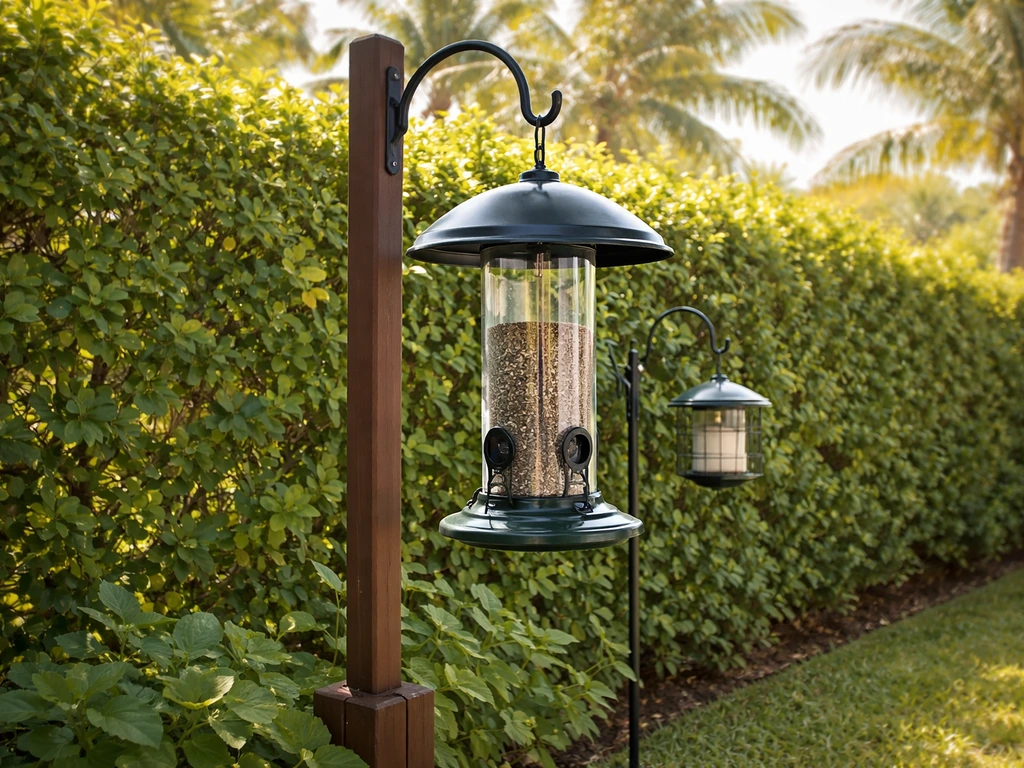
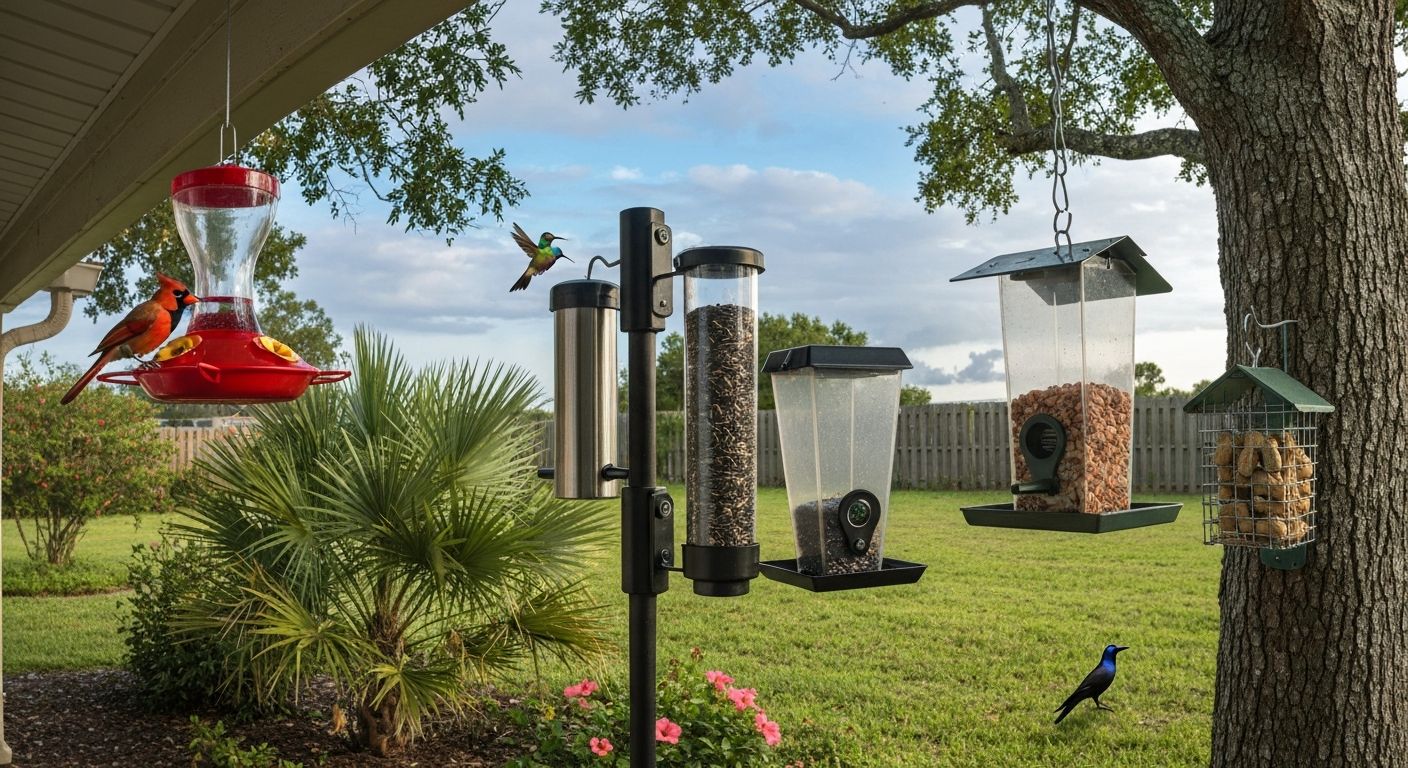
The best bird feeders for Central Florida are ones built to survive heat, daily summer downpours, and an endless parade of grackles and squirrels, while still attracting the birds you actually want. For hummingbirds, a UV-resistant saucer nectar feeder with a built-in ant moat is the top pick. For cardinals and general seed-eaters, a weight-sensitive tube or caged hopper feeder filled with black-oil sunflower seed is hard to beat. For finches, a stainless-mesh nyjer tube wins on longevity. Suet works best only in the cooler months here (roughly November through March) since Central Florida summers hover in the low 90s°F and suet turns rancid fast. Whatever type you choose, rust-proof materials, easy disassembly for cleaning, and a pest-management plan are non-negotiable in this climate.
Best Bird Feeders for Central Florida: Top Picks & Care
Why Central Florida backyards need their own feeder guide
I moved my feeding setup from North Carolina to the Orlando area a few years back and quickly learned that a feeder that lasted five seasons up north can look like a science experiment within a single Florida summer. For recommendations tailored to cooler climates, see our guide to the best bird feeders for North Carolina. The combination of roughly 50 to 52 inches of annual rainfall, a wet season that runs from May through October with nearly daily afternoon thunderstorms, summer highs locked in the low 90s°F, and salt-laden air closer to the coasts creates conditions that destroy ordinary feeders and spoil seed or nectar in days rather than weeks. Humidity alone accelerates mold growth inside tubes and hoppers to a degree that surprises most people new to Florida birding.
Then there are the biological challenges. Common Grackles are a persistent problem across Central Florida, and they will monopolize any open platform or hopper feeder in numbers that drive away cardinals, finches, and other smaller birds. Squirrels are year-round relentless here, not just seasonal. Raccoons and rats are also active feeders after dark, especially if you are using platform or ground-level setups. And hurricane season runs officially from June 1 through November 30, meaning any permanent pole installation needs a quick-removal plan for named storms. All of those realities change which feeders make sense and which ones are a waste of money. If you are also comparing conditions across Florida, feeders recommended for South Florida face even greater salt exposure and year-round tropical humidity, while a guide focused on just the broader state naturally generalizes across climates that are genuinely different. For readers in different climates, see our guide to the best bird feeder for North Texas for region-specific recommendations.
Your quick buyer checklist before you order anything
Before you spend money, answer five questions. Which species are you targeting? That single decision drives feeder type, seed choice, and port size more than anything else. What pests are already in your yard? A yard with heavy squirrel pressure needs weight-sensitive or caged designs from day one, not as an afterthought. Where will the feeder live? Shade is your friend in Central Florida for both nectar longevity and seed freshness, but some locations make pole installation impractical, so you may be hanging from a tree or bracket. What is your realistic maintenance schedule? Hummingbird nectar feeders need cleaning every three to five days in normal warm weather and daily when temperatures exceed about 90°F, which is most of the summer. If that is not realistic for you, a nectar feeder will do more harm than good. Finally, what is your budget, and are you open to replacing plastics more frequently or investing upfront in stainless and UV polycarbonate that lasts years?
- Species target: hummingbirds, finches, cardinals, woodpeckers, or a mixed yard flock
- Pest audit: squirrels, grackles, raccoons, rats, ants, bees or wasps
- Placement constraints: tree, pole, bracket, balcony, or open yard
- Maintenance commitment: how often can you realistically clean and refill
- Material preference: UV polycarbonate, stainless steel mesh, powder-coated metal, or recyclable plastic
- Budget tier: entry-level (under $25), mid-range ($25 to $60), or premium ($60 and up)
- Hurricane plan: can you bring feeders in quickly or do you need a permanent buried pole with a slip-sleeve
Which feeder and feed to use for each species
Getting species-specific is the fastest way to cut waste and frustration. A single all-purpose feeder loaded with a cheap mixed seed blend will mostly attract House Sparrows and Grackles in a Central Florida yard. Match the feeder to the bird you want, and you will see results within days.
Hummingbirds (Ruby-throated and occasional others)
Ruby-throated Hummingbirds are the species you will see most reliably in Central Florida, with peak presence during spring and fall migration and a smaller year-round resident population. Use a saucer or dish-style nectar feeder rather than a bottle-style one. Saucers are easier to fully clean, less prone to leaking in heat, and harder for bees to access. Mix your own nectar: one part plain white granulated sugar dissolved in four parts water. Never use red dye, honey, artificial sweeteners, or brown sugar. In summer, change nectar every one to two days when daytime highs are above 90°F, or every three to five days in milder weather. Hang feeders in a shaded location under a tree or on a north-facing porch to slow fermentation. Placement height of five to six feet works well, with some clearance from dense shrubs where cats can hide.
Finches and nyjer (goldfinches, House Finches)
American Goldfinches visit Central Florida mainly as winter residents (roughly October through April), while House Finches are year-round. Both respond strongly to nyjer (thistle) seed, and a small-port tube feeder or stainless mesh sock is the right tool. The stainless mesh tube holds up far better than nylon socks in repeated rain cycles. Place these feeders five to six feet high, away from large-perch feeders that attract Grackles, and clean them every two to three weeks at minimum since nyjer can mold quickly when moisture wicks into ports.
Northern Cardinals
Cardinals are year-round residents and one of the most reliably attracted backyard birds in Central Florida. They strongly prefer black-oil sunflower seed and sunflower chips over mixed blends, and they need a feeder with a wide, stable perch because they are not agile clingers. A hopper feeder with a wide tray, or a caged platform feeder, works better for cardinals than a narrow tube. The challenge in Florida is keeping the hopper dry: look for models with a steep roof overhang and drainage holes in the tray. Place cardinal feeders in partial shade, four to five feet off the ground, near shrubs or trees they can retreat to quickly.
Woodpeckers (Red-bellied, Downy, Pileated)
Red-bellied Woodpeckers are very common in Central Florida and will visit suet, peanut, and cylinder feeders readily. blank" rel="noopener noreferrer">BIRD FEEDING BASICS (Audubon guide to birdseed) reports that woodpeckers visit suet and peanut feeders more often than standard seed tubes and recommends placing such feeders off the ground in shade to reduce spoilage. Downy Woodpeckers prefer suet cage feeders placed against a tree trunk or on a pole with a rough surface they can brace against. The critical rule in Florida: suet is a cooler-months food only. From roughly April through October, standard suet cakes soften to an oily mess above 80°F. Switch to peanut feeders (whole peanuts in a wire mesh cage) or sunflower cylinder feeders during warm months. Place woodpecker feeders in shade, mounted on a pole or hung from a tree branch, at a height of five to seven feet.
General seed-eaters (Chickadees, Titmice, Nuthatches, Doves)
Carolina Chickadees, Tufted Titmice, and Brown-headed Nuthatches are all resident year-round and love black-oil sunflower seed in a standard tube or small hopper. Mourning Doves prefer ground-feeding but will use a large platform tray. For the tray, a mesh-bottom design that drains rain is essential. Avoid millet-heavy blends in Central Florida backyards: they attract large flocks of sparrows and Grackles without offering much to the birds most people want to see.
Best feeder types for Central Florida, with specific model picks
Here is how each feeder type performs in the Florida environment, with budget and premium examples. I have tested or closely evaluated all of these in humid subtropical conditions and the trade-offs below reflect that directly.
Tube feeders
Tube feeders are versatile and relatively squirrel-resistant when paired with a baffle, but the material matters enormously in Florida. Clear polycarbonate tubes hold up better than thin acrylic or styrene, which crack and yellow within one to two seasons of UV exposure. For a budget pick, the Perky-Pet Squirrel-Be-Gone II (around $20) is a caged tube that physically blocks squirrels and Grackles. For a premium option, the Droll Yankees Yankee Flipper or Squirrel Proof Plus (around $80 to $100) uses weight-sensitive mechanics that spin or close ports when a squirrel lands. The downside of any tube in Florida is that seeds at the bottom can pack and mold during the wet season, so check the base weekly and tap out clumped seed.
Hopper and box feeders
Hoppers look great and hold a good volume of seed, but they are the feeder type I recommend most cautiously for Florida. An enclosed hopper that does not drain well traps humid air inside and turns sunflower seed into a moldy brick within days during the wet season. If you go with a hopper, look for one with a metal (not wood) body, drainage holes in the floor, and a steep roof. The Woodlink Going Green Hopper Feeder (recycled plastic, around $35) is a decent mid-range choice that resists rot better than cedar models. Avoid wooden hoppers entirely unless you are prepared to sand, repaint, or replace them annually.
Tray and platform feeders
Open trays attract the widest variety of birds but are also the most maintenance-intensive in Florida. A mesh-bottom tray (like the Aspects Quick-Clean Seed Tray, around $20 to $30) that lets rain drain immediately is dramatically better than a solid-bottom tray. I use a covered platform feeder (a tray with a weather-guard roof overhead) to keep direct rain off, which extends seed life from about one day to two to three days in the wet season. Platform feeders are Grackle magnets, so pair them with a caged surround or accept that you will have a mixed-species free-for-all.
Nyjer and finch feeders
A stainless steel mesh nyjer tube is the best long-term investment for finches in Florida. Nylon thistle socks work but degrade quickly under UV and repeated wetting, needing replacement every few months. For a mid-range pick, the Brome Seed Halo (around $40) or the Aspects High-Perch Nyjer Finch Feeder (around $25) both perform well. For budget, a simple tube with small ports from Perky-Pet (around $10 to $15) works but plan to replace the tube every one to two seasons as the plastic yellows. During the off-season (May through September), many goldfinches have migrated north, so scale back nyjer refills to reduce waste and mold.
Nectar and hummingbird feeders
This is where I see the biggest mistakes from Central Florida beginners. Bottle-style feeders with vacuum-seal tops leak when heated, dripping nectar that attracts ants and bees. Saucer feeders like the HummZinger Ultra (Aspects, around $25 to $30) are far better: they sit low, do not drip, have a built-in ant moat channel, and can be fully disassembled and cleaned in under two minutes. For a budget entry, the More Birds Hummingbird Feeder Saucer (around $12 to $15) works the same way at a lower price point. For a premium option, the Perky-Pet 203CPBN Pinch-Waist Glass Hummingbird Feeder (around $20 to $25) uses a glass reservoir that does not absorb odors and is dishwasher-safe, though the bottle style requires more frequent leak checks in heat.
Suet and specialty feeders
A simple wire suet cage (under $10) is fine for cooler months, but switch to a peanut feeder or sunflower-chip cylinder holder from April onward. The Kettle Moraine Recycled Plastic Suet Feeder (around $15 to $20) is one of the more durable budget options and drains better than pressed-wire versions. For woodpeckers specifically, a tail-prop suet feeder (a cage with a flat extension below it for the bird to brace its tail against) increases visits noticeably compared to a standard two-sided cage.
| Feeder Type | Best For | Budget Pick (approx.) | Premium Pick (approx.) | Florida Durability Note |
|---|---|---|---|---|
| Tube (caged) | Mixed seed, squirrel-proofing | Perky-Pet Squirrel-Be-Gone II (~$20) | Droll Yankees Squirrel Proof Plus (~$90) | Polycarbonate tubes outlast acrylic by 2–3 seasons |
| Hopper/Box | Cardinals, larger seed mixes | Woodlink Going Green Hopper (~$35) | Brome Big Easy Feeder (~$75) | Metal body essential; avoid wood in Florida humidity |
| Tray/Platform | Mixed flock, doves, cardinals | Aspects Quick-Clean Tray (~$25) | Coveside Covered Platform (~$45) | Mesh-bottom required; daily check in wet season |
| Nyjer/Finch Tube | Goldfinches, House Finches | Perky-Pet Nyjer Tube (~$12) | Aspects HiPerch Nyjer Feeder (~$40) | Stainless mesh far outlasts nylon socks |
| Saucer Nectar | Hummingbirds | More Birds Saucer (~$14) | Aspects HummZinger Ultra (~$28) | Saucer style prevents leaking/dripping in heat |
| Suet Cage | Woodpeckers (cool months only) | Standard wire cage (~$8) | Kettle Moraine Recycled Suet Feeder (~$18) | Switch to peanut feeder April–October |
| Peanut/Cylinder | Woodpeckers (warm months) | Basic wire peanut feeder (~$10) | Stokes Select Peanut Feeder (~$30) | Shade placement essential; check for mold weekly |
Smart feeders and AI-powered bird cameras worth considering
Smart feeders with built-in cameras and AI species identification have become genuinely useful in the past two to three years, and Central Florida is a solid test environment for them because of the species diversity. The Bird Buddy Smart Bird Feeder (around $99 to $149 depending on the bundle) combines a physical seed feeder with a camera module that uses on-device AI to identify visiting species and sends photo notifications to your phone. I have found it reliably identifies Cardinals, Woodpeckers, and Titmice but occasionally misfires on Florida-specific species that are less represented in its training data, like Sandhill Cranes wandering into a suburban yard. The Bird Buddy Pro adds higher-resolution imaging and improved low-light performance.
A more flexible approach is pairing a standard weather-resistant feeder with an outdoor smart camera and a free AI app. A Wyze Cam Outdoor v2 (around $40) pointed at any feeder works well in Florida conditions; it is IP65-rated and handles rain and heat reliably. Pair the camera footage with the BirdNET app (free, from Cornell Lab) or Merlin Bird ID (also free, Cornell Lab) to identify species from sound or uploaded images. This setup costs less than a dedicated smart feeder, lets you keep using your existing feeders, and gives you audio-based ID that cameras alone cannot do.
For Florida-specific setup tips: mount any camera-equipped feeder under an eave or use a weatherproof housing, because direct rain on a lens during summer storms produces blurry or washed-out footage. Avoid south-facing placement in the afternoon since direct sun blows out the exposure. A north- or east-facing orientation gives even, shadow-free light for most of the day and keeps the electronics cooler. Clean the lens housing weekly during the wet season since spider webs and condensation accumulate fast.
- Bird Buddy Smart Feeder: integrated camera + AI ID, good for casual users, ~$99 to $149
- Bird Buddy Pro: higher resolution, improved low-light, ~$149 to $199
- Wyze Cam Outdoor v2 + BirdNET or Merlin: flexible DIY pairing, IP65-rated, ~$40 for the camera
- Ring Spotlight Cam (outdoor): higher-end option with motion alerts, works well for large feeder setups, ~$100+
- Merlin Bird ID (Cornell Lab): free app, audio ID from ambient sound, excellent Florida species database
- BirdNET (Cornell Lab): free, sound-based ID from recordings, works offline
Materials and weather resistance: what actually survives Florida
I have killed enough feeders to have strong opinions on this. Materials are not an afterthought in Central Florida; they are the primary factor in long-term cost per use. Here is an honest breakdown of how each common feeder material performs.
| Material | UV Resistance | Corrosion/Rust Risk | Mold/Moisture Risk | Typical Lifespan (Central FL) | Best Use |
|---|---|---|---|---|---|
| UV-stabilized polycarbonate | High | None | Low (non-porous) | 4–6 seasons | Tube bodies, hoppers, nectar reservoirs |
| Standard clear acrylic/styrene | Low | None | Low | 1–2 seasons (yellows, cracks) | Avoid; use polycarbonate instead |
| Stainless steel mesh | N/A | Very low | Low (drains well) | 8–10+ seasons | Nyjer tubes, peanut feeders, suet cages |
| Powder-coated steel | High (if intact) | Low-moderate (chips expose base metal) | Low | 4–7 seasons | Pole systems, cage surrounds, hopper bodies |
| Galvanized steel | N/A | Moderate (saltier areas) | Low | 3–5 seasons | Budget suet cages, baffles |
| Recycled/HDPE plastic | Moderate-High | None | Low | 5–8 seasons | Hopper bodies, platform trays |
| Cedar/untreated wood | Low | N/A | Very high (rots rapidly) | 1–2 seasons | Avoid in Florida wet season |
| Cast iron / raw iron hardware | N/A | Very high | N/A | Under 1 season | Avoid entirely in Florida |
Coastal salt corrosion is a real concern within roughly 10 to 20 miles of the ocean or the Gulf, which covers a meaningful portion of Central Florida's eastern coast (Space Coast, Brevard County area) and anyone within range of sea-breeze-driven salt spray. In those zones, galvanized hardware degrades noticeably faster, and powder-coated finishes that have been chipped will rust within a single wet season. For coastal setups, spend up on stainless steel or marine-grade powder coat, rinse metal hardware with fresh water periodically, and inspect mounting hardware monthly. Compared to South Florida, which faces year-round tropical humidity and heavier salt exposure at lower elevations, Central Florida has a slight advantage, but the Space Coast and Indian River Lagoon areas are still salty enough that material choice matters. For a comparison with different climate concerns, see our guide to the best bird feeders for South Carolina.
Dealing with squirrels, grackles, raccoons, and other pests
This is probably where I get the most questions from Central Florida readers, and understandably. A new feeder in this region will be discovered by squirrels within 24 hours and by Grackles within 48. The good news is that the combination of the right feeder design, the right mounting system, and a baffle handles most of it effectively.
Squirrel-proofing
Weight-sensitive feeders (like the Droll Yankees Yankee Flipper or the Brome Squirrel Buster series) physically close or spin under a squirrel's weight. They work well if installed correctly. The most common mistake is mounting the feeder too close to a launch point: squirrels can jump roughly 10 feet horizontally and 4 feet vertically, so position feeders at least 10 feet from any fence, roof edge, tree trunk, or branch. A squirrel baffle on the pole below the feeder (the torpedo or dome style, at least 17 inches in diameter) is the essential complement. Without a baffle, even a weight-sensitive feeder can be defeated by a squirrel climbing the pole. Caged feeders (tube or hopper surrounded by a wire grid) are a simpler and cheaper alternative if you are willing to limit the feeder to smaller birds.
Grackle mitigation
Common Grackles are large enough that caged feeders with openings sized for smaller birds physically exclude them. A cage with roughly 1.5-inch spacing blocks Grackles while allowing Cardinals, Chickadees, Titmice, and finches to pass. Alternatively, weight-sensitive tube feeders set to close at a lower threshold (some models let you adjust this) will trip under a Grackle's weight of about 4 to 5 ounces. Avoid millet-heavy mixes, which Grackles prefer. Removing ground-scattered seed also reduces Grackle pressure significantly because they forage heavily at ground level and spilled seed is their primary draw.
Raccoons, rats, and after-dark raiders
Raccoons are strong enough to pull down most hanging feeders and dexterous enough to open many hoppers. A smooth metal pole with a wide dome baffle (at least 20 inches) placed roughly 5 feet above ground stops most raccoons. Bringing seed feeders in at dusk is the most reliable prevention, especially if rats are a concern. In Central Florida, roof rats (the local arboreal species) will climb poles and eat seed overnight, and they are a real vector for disease at feeding stations. Platform feeders are particularly vulnerable to overnight rat visits, so either bring them in after dark or invest in a motion-activated deterrent light.
Ants, bees, and wasps at hummingbird feeders
Ant moats are essential at any nectar feeder in Florida, not optional. Fill the moat with plain water and check it every few days, because Florida heat evaporates it quickly. Never use petroleum jelly, cooking oil, or any grease at feeder ports: it contaminates nectar and can coat hummingbird feathers. For bees and wasps, shading the feeder and using a saucer-style feeder (where nectar sits below the port level and bees cannot reach it through the short flower ports) is the most effective solution. Do not use insect repellent near feeders.
Mounting and placement: making it work in a Florida yard
Shade is the number-one placement rule in Central Florida. Nectar that would last four to five days in partial shade will cloud and ferment in two days in full summer sun. Seed in a shaded tube feeder stays drier and fresher during afternoon rainstorms than seed in an exposed feeder that bakes and then gets soaked repeatedly. Aim for a spot that gets morning sun (birds are most active then) and afternoon shade. A north-facing eave, the east side of a tree, or a covered patio edge are ideal.
For pole systems, a steel shepherd's hook driven 12 to 18 inches into the ground works for lighter feeders, but it flexes in strong winds and will walk out of sandy Florida soil over time. A better long-term solution is a sectional metal pole system (like the Erva Feeder Pole or Squirrel-Free Pole systems) with a driven anchor stake or a cement-footing sleeve for larger setups. Bury the anchor at least 18 to 24 inches in Central Florida's sandy soil to prevent tipping. For a hurricane plan, choose a pole system that allows you to slide the feeder off quickly rather than one that requires tools. During a named storm, bring all feeders inside. Flying debris can turn a glass nectar feeder into a projectile.
Height recommendations depend on species. Hummingbird feeders at 5 to 6 feet from the ground are accessible for humans to reach and refill daily without a step stool. Cardinal and seed feeders at 4 to 6 feet work well and put birds at an easy viewing height from inside the house. Woodpecker suet or peanut feeders can go higher, at 5 to 8 feet, mounted on a pole or hung from a sturdy branch. Avoid hanging anything directly over a concrete patio without a catch tray: seed hulls and nectar drips attract ants and create a staining mess that is harder to clean than the feeder itself.
- Place all feeders in morning sun, afternoon shade to slow spoilage and reduce ant activity
- Position feeders at least 10 feet from squirrel launch points (trees, fences, structures)
- Use a pole with a torpedo or dome baffle at least 17 to 20 inches in diameter, mounted 4.5 to 5 feet above ground
- For coastal locations (Space Coast, Indian River area), choose stainless steel or marine powder-coat hardware
- Anchor poles 18 to 24 inches deep in sandy Florida soil; use a cement sleeve for permanent setups
- Develop a 30-minute hurricane prep plan: know which feeders come in, which poles need to be pulled
- Keep feeders at least 10 feet from windows to reduce bird-strike risk, or less than 3 feet (too close to build up lethal speed)
- Place a catch tray or gravel bed under feeders to collect hulls and prevent rat attractant accumulation
Cleaning schedules and maintenance (mold and disease prevention)
This is not the exciting part of backyard birding, but it is genuinely important in a way that goes beyond just keeping feeders looking nice. A multistate Salmonella outbreak in 2020 and 2021 was epidemiologically linked to songbird feeders and seed, and House Finch conjunctivitis (caused by Mycoplasma gallisepticum) spreads readily at crowded feeders. Both risks are reduced by the same practices: regular cleaning, good airflow, and not allowing wet seed or mold to accumulate.
For seed feeders, wash with hot water and a stiff brush weekly during the wet season, and monthly during dry winter months. Every one to two months, do a deeper sanitizing soak in a solution of one part bleach to nine parts water for about 10 minutes, then rinse thoroughly and let the feeder air-dry completely before refilling. Skipping the drying step is as bad as not cleaning: a damp feeder with fresh seed molds faster than a dirty dry one. For nyjer tube feeders, remove any wet or clumped seed before it molds, and replace the entire seed load if it smells off.
For hummingbird nectar feeders, the cleaning frequency is driven by temperature. When daytime highs are above 90°F (most of the Central Florida summer), clean and replace nectar every one to two days. If the nectar looks cloudy or has black mold spots inside the ports, clean with the dilute bleach solution, rinse extensively, and air-dry before refilling. A bottle brush and port-cleaning brush (usually included with quality saucer feeders) make quick work of this if you build it into a daily habit alongside watering plants or checking the mail.
Suet and peanut feeders during cooler months need checking every one to two weeks for rancidity: rancid suet smells sour and has a greasy yellow tinge. Discard it, scrub the cage with hot soapy water, rinse, and dry before adding fresh suet. In summer, switch to peanut feeders and inspect for mold every five to seven days, more often after heavy rain. Wearing disposable gloves while handling feeders and seed, and washing hands afterward, is a sensible practice given the documented disease transmission risks at feeding stations.
Seasonality: what to feed (and when to scale back) in Central Florida
Central Florida does not have a true winter in the northern sense, but the seasons still drive significant changes in bird activity and feeder use. Understanding them prevents waste and focuses your effort.
| Season | Active Species | Best Feeder Types | Key Maintenance Notes |
|---|---|---|---|
| Winter (Nov–Feb) | Cardinals, Titmice, Chickadees, Nuthatches, goldfinches (peak), Ruby-crowned Kinglets | Tube, hopper, nyjer, suet cage, platform | Suet appropriate in this window; scale up nyjer for peak goldfinch season |
| Spring migration (Mar–Apr) | Hummingbirds (peak passage), warblers, finches departing | Nectar saucer, tube, hopper | Clean nectar feeders more frequently as temps rise; reduce nyjer as goldfinches leave |
| Summer (May–Sep) | Resident Cardinals, Woodpeckers, Chickadees, Titmice; some hummingbirds | Tube (shaded), saucer nectar, peanut feeder | Daily/every-2-day nectar changes; no standard suet; check seed for mold after each storm |
| Fall migration (Sep–Oct) | Hummingbirds (second passage), returning goldfinches, sparrows | Nectar saucer, nyjer tube, tube seed feeder | Restart nyjer supply in late September; maintain nectar through October |
One practical tip for summer: reduce the volume of seed you put out at a time. During the wet season, I load my seed tubes only about one-third full rather than topping them off. That way any seed that gets damp at the bottom is replaced every few days rather than sitting for weeks under a full load. It uses roughly the same total amount of seed but with far less mold waste.
Budget vs premium: where to spend and where to save
Florida's conditions punish cheap materials harder than milder climates do, so the calculus on budget versus premium is a little different here than it would be in, say, North Carolina or the Carolinas, where a $15 plastic tube feeder might last several seasons. In Florida, the same feeder might be yellowed and cracked after one summer. That said, you do not need to spend at the top of every category. Here is where I would allocate budget if I were starting fresh.
Spend on quality for: the nectar feeder (a $25 to $30 saucer feeder with an ant moat will last years and save you daily frustration versus a $10 bottle feeder that leaks and grows mold), the pole and baffle system (a cheap shepherd's hook falls over in sandy soil and a thin-gauge baffle bends when a raccoon hits it), and any feeder in a coastal salt-spray zone (the material upgrade to stainless or marine-grade powder coat pays for itself in the first year). Save on: nyjer tube bodies (replace them every one to two seasons anyway due to UV wear, so a $12 to $15 tube is fine), suet cages (a $8 wire cage works as well as a $20 recycled plastic one for suet; save the premium for summer peanut feeders that live outside longer), and platform trays (a $20 to $25 mesh-bottom tray does the job; spending $60 does not significantly improve performance in a platform).
Where to buy and a few sourcing notes
Wild Birds Unlimited stores are scattered across the Orlando metro area and carry Florida-relevant products with staff who actually know local species, which is worth something when you are choosing between two nyjer feeders or asking which baffles fit a specific pole. Online, Amazon and Chewy carry most major brands with fast shipping. Home Depot and Lowe's carry a reasonable selection of entry-level feeders and pole systems in their garden sections, which is useful if you want to inspect a feeder in person before buying. For specialty items like marine-grade hardware, UV polycarbonate replacement tubes, or large-volume nyjer seed, an online bird supply retailer like DunCraft or Birds Choice often has better selection than local big-box stores. Buy seed in quantities you will use within four to six weeks and store it in a sealed, rodent-proof container in a cool location, because even un-moldy seed loses attractiveness as the natural oils oxidize in Florida heat.
FAQ
Which specific feeder types best attract hummingbirds, finches (nyjer), cardinals, woodpeckers and general seed‑eaters in Central Florida?
Hummingbirds: hanging nectar feeders with multiple ports and built‑in ant moats or add‑on moats; offer 1:4 sugar water and change frequently. Finches (goldfinches, house finches): nyjer (thistle) tube feeders with very small ports or fine‑mesh thistle socks. Cardinals: larger‑port tube or hopper feeders and platform/tray feeders loaded with black‑oil sunflower or sunflower chips. Woodpeckers: suet cages or peanut feeders and deep hopper feeders on trunks/near trees. General seed‑eaters (sparrows, doves, buntings): large-capacity hopper or platform feeders with sunflower and mixed seed; mesh‑bottom platforms help drain rain.
What are the best materials and construction features for feeders in hot, humid, and coastal Central Florida?
Look for feeders made of powder‑coated steel, marine‑grade stainless steel (304/316 for coastal salt tolerance), UV‑stabilized polycarbonate or thick acrylic, and heavy‑duty silicone seals. Avoid thin painted metals that rust quickly and low‑grade plastics that fog, crack or yellow. Features to prefer: sealed seed ports, drainage holes or mesh bottoms, replaceable parts (perches, ports), and corrosion‑resistant hardware (stainless steel or brass).
How can I pest‑proof my feeders against squirrels, grackles, ants and bees common in Central Florida?
Squirrels: use weight‑sensitive baffle poles, spring‑loaded squirrel‑resistant tube feeders, or mount feeders on 4–5 ft smooth metal poles with baffles 18–24 inches above the top. Grackles/large birds: use feeders with small perches or weight‑sensitive ports, offer nyjer in separate small feeders, and use multiple small feeder stations to reduce monopolization. Ants: install ant moats or use water‑filled moats above nectar feeders. Bees/wasps: shade nectar feeders, move feeders temporarily, or use bee guards that reduce access without blocking hummingbirds. Avoid oil/grease barriers.
What mounting and placement strategies work best in Central Florida yards to maximize visits and reduce spoilage?
Place feeders in partial shade to slow nectar and seed spoilage and to keep birds comfortable. Hang nectar feeders under eaves or low branches; place seed feeders 10–20 feet from dense cover to let birds feed and escape cover quickly. Mount suet and peanut feeders near tree trunks 4–6 feet high for woodpeckers. For coastal yards, place feeders where they’re sheltered from prevailing winds and salt spray. During hurricane season, bring feeders inside or secure them low and tightly fastened.
How often should I clean and refill hummingbird nectar and other feeders in Central Florida?
Nectar feeders: change every 2–3 days in typical Central Florida summer heat; daily if temperatures exceed ~90°F or if nectar looks cloudy. Seed feeders: check weekly for moldy or clumped seed; replace seed every 1–2 weeks in humid months. Suet/peanut feeders: remove spoiled/soft suet promptly; in summer favor shade and consider no‑melt suet cautiously or switch to nut feeders. Clean feeders with hot soapy water routinely and deep‑clean with a 1:9 bleach:water soak periodically, then rinse and air‑dry completely.
How do I prevent mold, fermentation and disease transmission at feeders?
Use frequent cleaning, rotate seed, keep feeders shaded and drained, use mesh bottoms or well‑draining hopper designs, and remove wet/ clumped seed immediately. For nectar, use the 1:4 sugar water recipe, change frequently, avoid red dye, and clean with hot water and periodic diluted bleach soaks. Reduce crowding by offering multiple feeding stations and spacing feeders apart to lower disease spread. Wear gloves and wash hands after handling feeders and seed to minimize zoonotic risk.
Best Bird Feeders for South Florida: Top Picks and Buying Guide
Best bird feeders for South Florida: top picks by type, plus anti-squirrel and anti-grackle mounting, cleaning, and pest