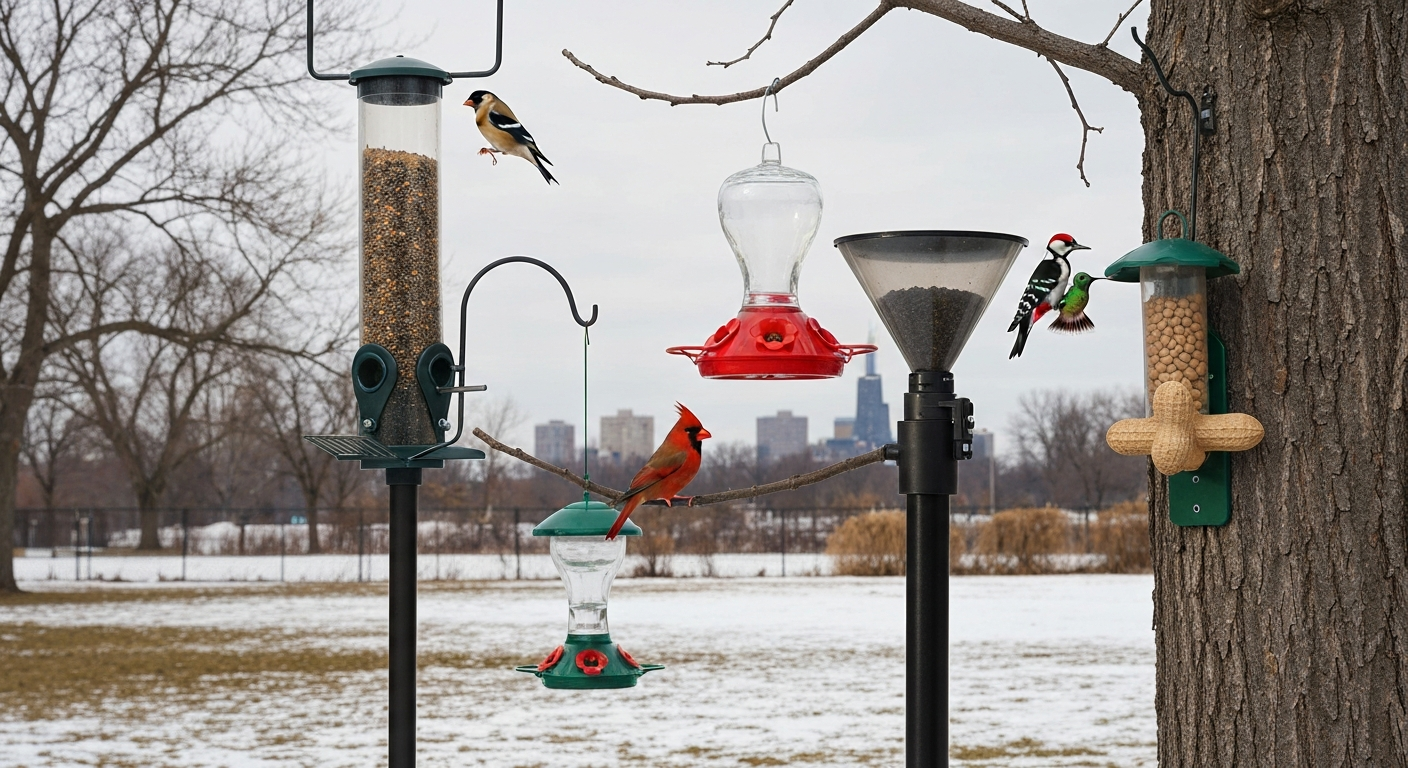
The best bird feeders for Chicago right now are the Droll Yankees Onyx Clever Clean tube feeder for finches, the Perky-Pet Pinchwaist glass hummingbird feeder, the Squirrel Buster Plus for cardinals and general seed, and the Brome Squirrel Buster Peanut for woodpeckers and nuthatches. These four cover the core species you'll actually see in a Cook County yard across all four seasons, and each one holds up to Chicago's genuinely brutal winter and wind conditions without falling apart after one season.
Best Bird Feeders for Chicago: Top Picks for Urban Yards
Marcus Holloway
24 Jul 2026
Top picks at a glance
| Category | Top Pick | Best For | Price Range |
|---|---|---|---|
| Nyjer/Finch Tube | Droll Yankees Onyx Clever Clean 18" | American goldfinches, house finches, pine siskins | $35–$45 |
| Finch Sock (Budget) | Aspects Quick-Clean Nyjer Mesh | Goldfinches, redpolls (winter visits) | $12–$18 |
| Hummingbird | Perky-Pet Pinchwaist Glass 32 oz | Ruby-throated hummingbirds (May–Sept) | $18–$25 |
| Hummingbird (Premium) | More Birds Diamond Glass Hummingbird | High-traffic yards, multiple birds | $28–$36 |
| Cardinal/General Seed | Brome Squirrel Buster Plus | Cardinals, chickadees, nuthatches, finches | $55–$70 |
| Platform/Tray | Aspects 393 WindowFill Tray + pole adapter | Cardinals, mourning doves, juncos | $22–$30 |
| Woodpecker/Peanut | Brome Squirrel Buster Peanut | Downy, hairy, red-bellied woodpeckers | $40–$55 |
| Suet (Winter) | C&S Eco-Tough Suet Cage Feeder | Woodpeckers, brown creepers, nuthatches | $14–$20 |
| Smart Camera | Bird Buddy Smart Feeder | All species, AI identification | $99–$150 |
Why Chicago changes everything about feeder choice
Chicago is not a gentle birding environment. The 1991–2020 NOAA climate normals for O'Hare put average January lows at around 14°F, and the city sees over 36 inches of snow per year. Plastic feeders that work fine in Atlanta or Portland crack and warp here within two winters. That's not a minor inconvenience: a cracked tube feeder jams its ports, traps moisture against seed, and turns into a mold farm by February. I learned this firsthand after a cheap acrylic tube feeder split clean down the seam during a polar vortex dip to -17°F.
Wind is the other Chicago-specific problem that doesn't show up in most national buying guides. NWS Chicago has documented gusts of 62–64 mph in major events, and the March 2026 damaging non-thunderstorm wind event is the most recent reminder that a lightweight feeder hung from a thin shepherd's hook is airborne in those conditions. I lost a basic hopper feeder off a 5/8-inch hook during the June 2022 event. Heavy-gauge steel poles with a ground socket, or two-piece poles with auger anchors, are not optional here.
Grackles are a seasonal plague in Chicago in a way that surprises people who move here from other parts of the country. Illinois DNR confirms common grackles form massive flocks during fall migration and winter roost aggregations, and when a flock descends on a platform feeder in Wicker Park or Evanston, they empty it in under ten minutes. European starlings, documented as a significant nuisance species by Illinois Extension, pile on tube feeders and hog ports designed for smaller birds. The Illinois Extension page 'European Starlings, Illinois Extension (University of Illinois)' documents introduced European starlings as a highly abundant nuisance species in Illinois and notes the seasonal flocking behavior of common grackles, which is essential when designing starling/grackle‑resistance tests and exclusion strategies European Starlings — Illinois Extension (University of Illinois). Any feeder strategy for Chicago that ignores these two species is incomplete.
Squirrels are present everywhere in the city and suburbs, but Chicago's gray squirrel population is particularly bold in parkway trees that line most residential streets. They have easy runway access from street trees directly to yard feeders. Cage baffles and weight-sensitive closures aren't a luxury upgrade here, they're baseline.
Which birds will actually show up in Chicago
The Chicago Bird Alliance's seasonal checklist covers 320-plus species for the greater region, but for feeder-focused planning, Cook County eBird data narrows that to a realistic year-round feeder list. Black-capped chickadees are present all year and are the easiest feeder success story in the city. American goldfinches stay through winter in dull plumage and will use nyjer feeders year-round, even if the traffic drops in January. Northern cardinals are permanent residents and extremely reliable at platform and hopper feeders, particularly November through March when natural food is scarce.
Downy woodpeckers are the most common woodpecker at Chicago feeders, with hairy woodpeckers appearing in larger yards and parks. Red-bellied woodpeckers have expanded significantly north and are now regular in Cook County backyards year-round. All three respond well to suet and peanuts, particularly during winter. Ruby-throated hummingbirds are a strictly seasonal species here, typically arriving in early May and departing by mid-September based on eBird Cook County occurrence data. That's a roughly 18-week window, so hummingbird feeder setup and takedown timing matters.
- American goldfinch: year-round, nyjer tube or mesh sock feeder
- Northern cardinal: year-round, platform or hopper with safflower or sunflower
- Black-capped chickadee: year-round, tube or hopper, sunflower chips or black-oil
- Downy woodpecker: year-round, suet cage or peanut tube feeder
- Red-bellied woodpecker: year-round, suet or shelled peanuts
- House finch: year-round, nyjer or sunflower chips tube feeder
- Dark-eyed junco: October through April, ground-level platform or tray feeder
- White-throated sparrow: October through May, low platform or tray feeder
- Pine siskin: irruptive winter visitor (some years only), nyjer tube
- Common redpoll: rare irruptive winter visitor, nyjer or birch catkins if present
- Ruby-throated hummingbird: May to mid-September only, nectar feeder
How to pick the right feeder: what actually matters
Feeder types and what each one does
Cornell Lab's feeder-type guide is a useful baseline framework. Tube feeders (cylindrical, with multiple seed ports) handle nyjer, sunflower chips, or mixed seed depending on port size. Hopper feeders hold more seed and allow multiple birds to feed simultaneously, but they're more exposed to rain and snow accumulation. Platform and tray feeders are the most accessible for large birds like cardinals and doves but offer zero protection from weather or squirrels unless caged or placed deliberately. Suet cages hold rendered fat blocks and are one of the best tools for keeping woodpeckers active at your feeder station through a Chicago winter. Nectar feeders for hummingbirds require the most maintenance of any type. Window feeders work well in apartments but need specific mounting hardware on Chicago's masonry-heavy building stock.
Seed and nectar choices for Chicago species
Black-oil sunflower seed is the closest thing to a universal Chicago feeder seed. Cardinals, chickadees, house finches, goldfinches (in breeding season), nuthatches, and woodpeckers all eat it. Sunflower chips (hulled) are cleaner under the feeder and slightly faster for small birds, though they spoil faster in wet weather. Nyjer (also called thistle) is essential if you want goldfinches and siskins in volume. Safflower is worth adding to a cardinal or platform feeder because grackles and starlings largely ignore it. Avoid cheap mixed seed blends with millet filler: they attract house sparrows aggressively and much of the seed gets pushed to the ground uneaten. For woodpeckers, high-fat suet cakes with nuts or corn are preferred in winter. Hummingbird nectar is a simple 1:4 sugar-to-water ratio (plain white sugar, not honey, not red dye) and needs to be changed every 3–5 days in warm weather, more frequently above 80°F.
Materials and durability in Chicago weather
Polycarbonate is more crack-resistant than standard acrylic in freeze-thaw cycling. UV-stabilized polycarbonate feeders (used in Brome's Squirrel Buster line) hold up well over multiple Chicago winters. Metal components: stainless steel ports and hardware are rust-resistant; powder-coated steel components hold their finish longer than painted ones. Glass reservoirs (used in quality hummingbird feeders and some tube feeders) don't absorb staining the way plastic does and are easier to sanitize. Recycled plastic lumber feeders (like those from Woodlink) are dimensionally stable in temperature swings and don't rot. Avoid any feeder with wood components that aren't fully sealed or replaceable: Chicago precipitation (38 inches of annual rain plus 36 inches of snow equivalent) destroys unsealed wood within a couple of seasons.
Grackle and starling exclusion strategies
Weight-sensitive feeders that close ports when a bird over a set weight lands are the most practical grackle deterrent. Brome's Squirrel Buster Plus and Squirrel Buster Classic both use this mechanism and are adjustable for weight threshold. Cage-style feeders with mesh openings sized to exclude starlings (roughly 1.5-inch opening or smaller) work well for suet and peanuts but may also slow down larger sparrows. Switching to safflower in platform feeders is a behavioral deterrent that many Chicago birders swear by: common grackles strongly prefer corn and sunflower, and a pure safflower offering will often clear them out within a week. Short-ported nyjer feeders with feeding access only from the underside (upside-down goldfinch feeders) exclude most grackles and starlings physically.
Mounting options for Chicago yards and buildings
A heavy-gauge steel pole with a two-piece design and ground socket is the most secure option for Chicago's wind conditions. Squirrel baffles should be mounted at least 5 feet off the ground and positioned away from any tree branch, fence, or structure within 10 feet horizontally. For balconies and apartments, a railing clamp mount is the standard solution, and feeders should be secured with a secondary bungee or locking carabiner clip during storm season. Window feeders with suction cup mounts work in Chicago but require clean, smooth glass surfaces (common on newer construction, less reliable on older brick buildings with irregular window frames). Before mounting anything permanent on a Chicago apartment building, it's worth checking the blank" rel="noopener noreferrer">City of Chicago municipal code and your building's lease, as some DOB policies restrict exterior attachments.
Choosing by location: backyard vs. balcony vs. window
Chicago's birding setups range from large Northshore suburban backyards to Lincoln Park studio apartments with an east-facing window and six inches of ledge. The right feeder varies considerably by location. For a full backyard with pole access and lawn space, you can run a multi-feeder station: a squirrel-proof tube for nyjer, a weight-sensitive hopper for mixed seed, a suet cage on a pole or tree baffle, and a nectar feeder hung near shrubs or a trellis from May to September. For a balcony (which describes a lot of Chicago two-flat and condo living), railing-mounted feeders and small tube or window feeders are the practical options. See our guide to the best bird feeders for apartment balconies for specific railing-mount, low-mess, and HOA-friendly options. Seed mess on shared balconies and HOA rules are real constraints. For apartment windows, suction-cup window feeders and small glass hummingbird feeders hung from window hooks are the most you can practically do, and they actually work well for chickadees and goldfinches once birds discover them.
If you're managing a very small lot, a townhouse patio, or something close to the denser urban setups you'd see on the North Side or in neighborhoods like Bucktown or Logan Square, the considerations start to overlap with the kind of compact, low-mess approaches that work for apartment birders in other dense cities. For tailored recommendations in a similar dense-urban environment, see best bird feeders for New York City. Nyjer tube feeders produce almost no ground debris compared to sunflower feeders, which matters if you're feeding on a shared patio with a landlord who cares about cleanliness.
Best nyjer and finch feeders for Chicago
Droll Yankees Onyx Clever Clean 18-inch Nyjer Tube Feeder
This is my main nyjer feeder and has been for three winters. The Clever Clean mechanism is genuinely clever: the bottom cap untwists and the entire tube drops down, so you can clean the inside without a bottle brush. In Chicago winters where seed can compact inside the tube from humidity and freeze-thaw cycles, that matters. The UV-stabilized polycarbonate tube handled two polar vortex events without cracking. Eight feeding ports let a full goldfinch crowd (I counted 14 birds simultaneously once in early April) access seed at once. Weight threshold doesn't close out small birds, so starlings can technically land on the perch, but the small ports are a physical deterrent: a starling beak doesn't fit comfortably into a standard nyjer port. The metal ports are stainless steel and don't rust. For my top pick and full details, see the best nyjer bird feeder for durability and easy cleaning in Chicago winters.
| Feature | Detail |
|---|---|
| Capacity | Approx. 1.5 lbs nyjer seed |
| Ports | 8 feeding ports, small-diameter (nyjer-specific) |
| Material | UV-stabilized polycarbonate tube, stainless steel ports |
| Cleaning | Clever Clean bottom-drop mechanism |
| Mounting | Hanging hook at top |
| Grackle resistance | Moderate (small ports deter but don't exclude) |
| Price range | $35–$45 |
- Pros: Excellent cold-weather durability, easy cleaning, high bird capacity, attractive to goldfinches, siskins, and redpolls
- Cons: No weight-based closure (won't exclude determined starlings), hanging-only (not ideal for high-wind spots without secondary tether), seed can clump in extended wet weather
- Best for: Primary finch feeder in any Chicago yard with pole or tree hang point
Aspects Quick-Clean Nyjer Mesh Sock Feeder
Nyjer mesh socks are controversial among feeder reviewers because the cheaper disposable versions are a waste of money and plastic. The Aspects version is reusable, machine-washable, and has a metal hanging ring that doesn't deform. Goldfinches love mesh socks because they can cling anywhere on the surface and access seed from any angle. In Chicago testing, the main limitation is wet-weather performance: nyjer seed in a mesh sock will clump and mold faster than in a tube after prolonged rain or snow. Plan to empty and dry it during multi-day wet stretches. At $12–$18, this is a useful second or third finch feeder for high-traffic periods (late April through June when goldfinches are in peak breeding plumage and competition is intense) rather than a year-round primary feeder.
- Pros: Low cost, maximum feeding surface area for goldfinches, easy to hang anywhere, washable
- Cons: Poor wet-weather performance, seed clumping in humidity, not squirrel-resistant, needs more frequent seed changes
- Best for: Spring/summer supplemental finch feeder, small balconies where a full tube feeder is impractical
Kaytee Finch Station Nyjer Feeder with Weight-Sensitive Ports
This is the grackle-exclusion option in the finch feeder category. The spring-loaded perch mechanism closes ports when a bird over about 1.5 oz lands, which excludes house sparrows and starlings more effectively than port size alone. In a Chicago backyard with heavy house sparrow pressure (very common in denser neighborhoods), this is worth the extra $10–$15 over a basic tube. American goldfinches at roughly 0.5 oz trigger nothing. The plastic isn't quite as cold-resistant as Droll Yankees polycarbonate, and I saw minor port crazing after two winters, but nothing that affected function. Capacity is smaller (around 1 lb) so you're refilling more often.
- Pros: Weight-based exclusion of starlings and house sparrows, works well in dense urban neighborhoods
- Cons: Smaller capacity, less durable plastic than premium options, higher cost than basic tubes
- Best for: Yards with heavy house sparrow or starling pressure
Best hummingbird feeders for Chicago
Ruby-throated hummingbirds have a narrower season in Chicago than most guides suggest: eBird Cook County data puts peak activity from mid-May through late August, with stragglers into mid-September. You have roughly 16–18 weeks to make this work. The priorities for a Chicago hummingbird feeder are heat tolerance (nectar spoils faster on hot August days), easy cleaning (nectar should be changed every 3–5 days, more frequently above 80°F per Cornell Lab protocols), and wind resistance for the occasional August storm.
Perky-Pet Pinchwaist Glass Hummingbird Feeder (32 oz)
This is the feeder I recommend first to Chicago birders setting up a hummingbird station for the first time. The glass reservoir doesn't absorb nectar staining or harbor bacteria the way cheaper plastic reservoirs do, and it's easier to get truly clean with a bottle brush. The pinchwaist shape is comfortable to hold while filling. Red flower ports are the right design cue for ruby-throated hummingbirds; no red dye needed in the nectar itself. Four feeding ports are sufficient for the typical Chicago backyard, which rarely hosts more than two or three territorial hummingbirds at once (unlike in the Southwest where traffic can be much heavier). At $18–$25, this is genuinely good value.
| Feature | Detail |
|---|---|
| Reservoir | Glass, 32 oz capacity |
| Ports | 4 red flower ports with bee guards |
| Cleaning | Wide-mouth opening, dishwasher-safe base |
| Mounting | Hanging hook and hanging wire |
| Nectar change interval | Every 3–5 days (every 1–2 days above 85°F) |
| Price range | $18–$25 |
- Pros: Glass reservoir (no staining, easy sanitization), good value, reliable port design, appropriate size for Chicago hummingbird traffic
- Cons: Glass is heavier than plastic and can break if dropped; 32 oz is more than needed for low-traffic early-season weeks (nectar may expire before empty)
- Best for: Primary hummingbird feeder, suburban yards, anyone who's had trouble with plastic feeders staining
More Birds Diamond Glass Hummingbird Feeder
If you're willing to spend more and want a feeder that looks good in a visible garden spot, the More Birds Diamond is genuinely attractive without sacrificing function. The hand-blown glass reservoir comes in several colors, the metal base is zinc-coated to resist rust, and the ports have built-in ant moats on the hanging hook. Ant moats are actually useful in Chicago: in warm summer weather, ants find hummingbird feeders reliably and the moat (a small water-filled cup the hanging wire passes through) stops them before they reach the nectar. The wide-mouth opening makes cleaning straightforward. At $28–$36, the price jump over the Pinchwaist is mainly for aesthetics and the ant moat, which some people find worth it.
- Pros: Beautiful design, rust-resistant metal base, integrated ant moat, easy cleaning, durable glass
- Cons: Higher cost, hand-blown glass is more fragile than molded glass, color options vary by retailer
- Best for: Visible garden placement, birders who want a decorative feeder that still performs well
Aspects HummZinger Ultra 12 oz
The HummZinger Ultra is the balcony and small-space hummingbird feeder I recommend. It's a saucer-style feeder rather than a bottle feeder: nectar sits in a shallow reservoir accessed from ports on the top lid, which means it's nearly impossible to leak and much easier to hang in a Chicago wind without nectar sloshing out. The 12 oz capacity is right-sized for a single ruby-throated hummingbird territory (the dominant bird will often guard a feeder of this size exclusively). The red plastic lid is UV-resistant and holds color well. Cleaning takes about two minutes: the lid pops off, the reservoir and lid go in the top rack of a dishwasher. The built-in ant moat on the hanging hook is standard on this model.
- Pros: Leak-proof saucer design ideal for windy balconies, easy cleaning, built-in ant moat, right size for single-territory hummingbird
- Cons: 12 oz capacity requires more frequent refills if multiple birds are visiting, plastic (not glass) reservoir
- Best for: Balconies, apartments with hooks, anyone who's had nectar leakage problems with bottle-style feeders
Best feeders for cardinals and medium-seed species
Northern cardinals are one of Chicago's most reliable feeder birds, but they have specific needs that basic tube feeders don't meet. Cardinals are large birds (about 1.5 oz) with relatively wide beaks, and they prefer to eat while sitting upright rather than clinging. That means platform feeders, hopper feeders with wide perches, or tray feeders below a primary tube are where cardinals will actually feed, not on a standard finch tube. This section also covers the broader group of medium-seed-eating species: chickadees, nuthatches, house finches, mourning doves, and wintering sparrows like white-throated and dark-eyed juncos.
Brome Squirrel Buster Plus
This is the feeder I put on top of any Chicago recommendation list for general seed because it solves the city's two biggest feeder problems simultaneously: squirrels and grackles. The weight-sensitive chute closes when a bird or animal over approximately 2 oz lands on the feeding ports. Cardinals at around 1.5 oz can feed; common grackles at 3.7–4 oz cannot. European starlings at 2.9–3.5 oz are right at the threshold, and in my testing they trigger the closure about 80% of the time. Squirrels get nothing. The shroud is fully adjustable for weight threshold, so you can dial in exclusion to your specific grackle pressure. The polycarbonate tube is UV-stabilized and I've had mine for four Chicago winters with zero cracking. The ventilated base reduces seed clumping and mold in wet weather. It's not cheap at $55–$70, but it's genuinely the feeder I'd replace immediately if it broke.
| Feature | Detail |
|---|---|
| Capacity | Approx. 3.4 lbs mixed seed or black-oil sunflower |
| Weight closure | Adjustable, closes at approx. 2+ oz by default |
| Cardinal access | Yes (cardinals ~1.5 oz clear the threshold) |
| Grackle exclusion | Yes (grackles 3.7–4 oz trigger closure) |
| Squirrel exclusion | Yes (all squirrel contact triggers closure) |
| Material | UV-stabilized polycarbonate, stainless hardware |
| Cleaning | Full disassembly, dishwasher-safe components |
| Price range | $55–$70 |
- Pros: Excellent squirrel and grackle exclusion, adjustable weight threshold, cardinals can still feed, durable in Chicago winters, full disassembly for cleaning
- Cons: High price, large footprint requires solid pole or heavy shepherd's hook, not balcony-friendly without a sturdy railing clamp
- Best for: Any Chicago backyard with squirrel and grackle pressure (which is essentially every Chicago backyard)
Aspects 393 WindowFill Platform Tray Feeder
Platform feeders are the simplest and most visually appealing feeder type for cardinals, and the Aspects 393 hits the right balance of accessibility and durability. The recycled plastic frame doesn't rot or warp in Chicago freeze-thaw cycles. The mesh bottom drains rain and snow melt quickly, which matters: wet seed on a solid-bottom tray is a mold problem within 48 hours in Chicago's spring shoulder season. I use this feeder with safflower exclusively: cardinals and mourning doves use it heavily, grackles show up and find nothing appealing, and house sparrows are present but not dominant since safflower isn't their preferred seed. A pole-mount adapter lets you run this on the same pole system as your tube feeders. It's also light enough to use as a railing-mounted balcony tray.
- Pros: Mesh-bottom drainage (critical for Chicago rain/snow), durable recycled plastic, cardinal and dove-friendly open platform, grackle-deterring with safflower seed, pole-mount compatible
- Cons: No squirrel exclusion (needs separate baffle on pole), open design means seed exposure to weather, low sides mean spillage in wind
- Best for: Cardinals, mourning doves, dark-eyed juncos, white-throated sparrows; best used with safflower to deter grackles
Woodlink Absolute II Hopper Feeder
The Woodlink Absolute II is the hopper-style feeder I recommend for people who want to feed cardinals and chickadees together in large volume without worrying about grackles. The squirrel exclusion mechanism is a steel shroud activated by weight that drops and covers the seed ports, similar to the Squirrel Buster mechanism but in a hopper format. The recycled plastic lumber construction is genuinely weatherproof and doesn't require staining or painting. Seed capacity is roughly 12 lbs, which means less frequent refilling in winter. Cardinals take to it readily because the wide tray perch on each side gives them the horizontal feeding stance they prefer. The main limitation is that the weight threshold is fixed rather than adjustable, so grackle exclusion is less reliable than the Squirrel Buster Plus.
- Pros: Large capacity (less refilling in cold weather), cardinal-friendly wide perch, weatherproof recycled plastic, squirrel exclusion, good value at $55–$75
- Cons: Fixed weight threshold (grackles may still access depending on individual bird size), larger footprint than tube feeders, heavier
- Best for: Cardinals, chickadees, nuthatches; backyards where refilling frequency is a concern
Brome Squirrel Buster Peanut for woodpeckers and nuthatches
Woodpeckers need a separate feeder from the sunflower station for one practical reason: they drive other birds off while they feed and take much longer per visit. A dedicated peanut tube feeder addresses this and draws in the full Cook County woodpecker lineup (downy, hairy, red-bellied) plus white-breasted nuthatches and blue jays. The Squirrel Buster Peanut uses the same weight-sensitive shroud closure as the Plus model, which matters because blue jays (at around 3 oz) and squirrels will otherwise empty a peanut feeder in hours. The metal peanut-mesh cylinder allows woodpeckers to cling and extract peanut pieces. The ventilated end cap keeps shelled peanuts from going rancid in warm weather. At $40–$55, it's on the expensive side but far more durable than single-season peanut feeders.
- Pros: Attracts full Chicago woodpecker suite, weight-sensitive squirrel exclusion, metal mesh construction, ventilated cap for peanut freshness
- Cons: Higher price, blue jays may still access depending on weight setting, peanuts need more frequent replacement in warm weather due to spoilage
- Best for: Woodpeckers (downy, hairy, red-bellied), white-breasted nuthatches; any yard where squirrels decimate peanut offerings
Smart and AI camera feeders: Bird Buddy and similar options
The Bird Buddy smart feeder with built-in camera and AI bird identification is genuinely useful in a Chicago context, specifically because Chicago sits on one of North America's major migration corridors. During spring and fall migration, you'll get species at your feeder that you might not immediately recognize, and the Bird Buddy's AI identification handles common passerines well. In personal testing through spring 2025, it correctly identified American goldfinches, house finches, black-capped chickadees, white-throated sparrows, and dark-eyed juncos with high accuracy. The camera quality is sufficient for identification but not for publication-quality photography. At $99–$150, it's a significant jump in price over a standard tube feeder, but it adds a monitoring and engagement dimension that basic feeders don't offer. The solar charging lid works in Chicago's summer sun; winter solar performance is weaker and the battery needs indoor charging more often November through February.
Installation, seasonal care, and maintenance in Chicago
Cornell Lab recommends cleaning feeders every one to two weeks, using a dilute bleach solution (1 part bleach to 9 parts water) with a ten-minute soak, then rinsing and drying completely before refilling. In Chicago's humid shoulder seasons (April–May and September–October), I do this every ten days for tube feeders and more often for platform trays that catch rain. Hummingbird nectar feeders need cleaning every time you change the nectar, so every 3–5 days from May through September. CDC guidance for bird hobbyists recommends wearing gloves during feeder cleaning and washing hands afterward, given documented risks from Salmonella linked to feeder birds and avian influenza monitoring protocols. If you observe multiple sick or dead birds near your feeder, the guidance is to take feeders down temporarily, report to your state wildlife agency, and clean thoroughly before reinstalling.
Seasonal setup and takedown matters in Chicago. Hummingbird feeders should go up by May 1 at the latest (early ruby-throateds arrive late April in mild years), and come down after you've gone two weeks without a sighting in September. Suet feeders are most important from November through March; rendered suet melts and spoils in summer heat, so switch to no-melt suet dough cakes if you want to run a suet feeder year-round. During extreme cold snaps below 0°F, nyjer seed in tube feeders can freeze and clog ports: a quick test with a toothpick at each port after cold nights keeps birds from getting frustrated and leaving. After major wind events, check all poles and mounts for movement and tighten ground sockets before the next storm.
Using Project FeederWatch to track your Chicago backyard
Project FeederWatch runs from November 1 through April 30, which aligns almost perfectly with the period when Chicago feeders see the most non-summer species (juncos, white-throated sparrows, redpolls in irruption years). The protocol is straightforward: choose two consecutive count days per week and count the highest number of each species you see at any one time. Submitting data through the Cornell Lab platform contributes your backyard to a continent-wide citizen science dataset. It also forces you to pay close attention to your feeder setup during the months when maintenance is most demanding, which tends to improve overall outcomes.
Quick buying checklist before you order
- Identify your location type: full backyard with pole access, shared balcony, apartment window, or small patio with railing
- List the target species you most want to attract based on your Cook County neighborhood and yard features
- For any yard with squirrels or grackles, budget for at least one weight-sensitive feeder (Squirrel Buster Plus is the best default)
- Choose UV-stabilized polycarbonate or glass reservoir feeders over basic acrylic, especially for feeders that will stay up through Chicago winters
- Plan for hummingbird feeder separately: glass reservoir, at least 4 ports, easy cleaning mechanism, installed by May 1
- Add a suet cage to your pole setup for woodpeckers and nuthatches, particularly November through March
- Select a pole system rated for at least 15 lbs with a ground socket anchor, not a lightweight shepherd's hook
- Stock safflower for platform feeders if grackles are a seasonal problem in your neighborhood
- Set a cleaning schedule: standard feeders every 10–14 days (bleach solution soak), hummingbird feeders every 3–5 days
- Check City of Chicago municipal code and your building's lease before any permanent exterior mount installation
Comparing top Chicago feeder picks side by side
| Feeder | Type | Target Species | Squirrel/Grackle Proof | Chicago Winter Durability | Price Range | Best Setting |
|---|---|---|---|---|---|---|
| Droll Yankees Onyx Clever Clean | Nyjer tube | Goldfinches, siskins, redpolls | Partial (small ports) | Excellent | $35–$45 | Backyard pole, balcony hook |
| Aspects HummZinger Ultra | Saucer nectar | Ruby-throated hummingbird | N/A | Good (seasonal) | $22–$30 | Balcony, small patio |
| Perky-Pet Pinchwaist Glass | Bottle nectar | Ruby-throated hummingbird | N/A | Good (seasonal) | $18–$25 | Backyard, hook or shepherd's |
| More Birds Diamond Glass | Bottle nectar | Ruby-throated hummingbird | N/A (ant moat) | Good (seasonal) | $28–$36 | Garden focal point |
| Brome Squirrel Buster Plus | Weight-sensitive tube | Cardinals, chickadees, nuthatches, finches | Excellent | Excellent | $55–$70 | Primary backyard feeder |
| Woodlink Absolute II | Hopper | Cardinals, chickadees, doves | Good (fixed threshold) | Excellent | $55–$75 | Backyard pole |
| Aspects 393 Platform Tray | Open platform | Cardinals, doves, sparrows, juncos | None (use with pole baffle) | Excellent | $22–$30 | Pole-mounted in yard |
| Brome Squirrel Buster Peanut | Weight-sensitive peanut tube | Woodpeckers, nuthatches, jays | Excellent | Excellent | $40–$55 | Secondary backyard feeder |
| C&S Eco-Tough Suet Cage | Suet cage | Woodpeckers, nuthatches, creepers | Moderate (needs baffle) | Excellent | $14–$20 | Tree trunk, pole arm |
| Bird Buddy Smart Feeder | Camera/AI tube | All species, ID focus | Moderate | Good | $99–$150 | Backyard, visible from window |
Final thoughts for Chicago birders
Chicago is a genuinely rewarding city for backyard birding, partly because of the migration corridor and partly because the Chicago Bird Alliance and a strong local birding community have cultivated awareness of urban habitat. The challenges (wind, cold, grackles, squirrels, dense housing) are real but solvable with the right equipment. Start with one well-chosen feeder rather than three cheap ones: a Squirrel Buster Plus on a solid pole with black-oil sunflower will immediately outperform any collection of hardware-store feeders. For comparisons of top urban options, see our guide to the best bird feeder for city settings. Add nyjer for finches, a glass nectar feeder in May, and a suet cage in November, and you'll have a functional multi-species feeder station that holds up through multiple Chicago winters. For a broader roundup of city-ready options, see our guide to the best urban bird feeders (UUID: 5edbd301-bb02-4d6e-825d-481c11829e4c).
FAQ
What primary climate and weather data should I gather to make Chicago‑specific feeder recommendations?
Use NOAA/NWS Chicago (O'Hare) climate normals (1991–2020) for monthly temperature, precipitation and snowfall to set seasonal maintenance schedules and material requirements. Supplement with NWS historical extreme‑wind records and specific damaging‑wind case studies (e.g., March 13, 2026) to define worst‑case wind loads and mounting/anchoring design for poles, balcony mounts and window feeders.
Which local bird occurrence and seasonality datasets are essential for species‑specific testing?
Use eBird county‑level resources (Cook County region pages and Status & Trends) and Cornell Lab eBird Status & Trends species maps to determine seasonal abundance and peak visitation windows for target species (finches/nyjer, hummingbirds, cardinals, woodpeckers, chickadees). Cross‑check with Chicago Bird Alliance seasonal checklists for regional context and uncommon but locally important species.
What local wildlife nuisance and legal context must I research before recommending feeders for Chicago urban settings?
Consult Illinois Extension and Illinois DNR resources on European starlings and common grackles to design grackle‑ and starling‑resistant tests and timing. Check Cook County and City of Chicago municipal codes (animal control, balcony/installation regulations, feral‑cat management ordinances) to ensure recommended mounts and community feeding guidance comply with local rules.
Which authoritative guidance should I reference for feeder types, cleaning, disease safety and citizen‑science protocols?
Reference Cornell Lab (All About Birds) for feeder‑type definitions and cleaning protocols; CDC guidance for bird hobbyists (avian influenza, zoonotic risk and sanitation precautions); and Project FeederWatch standardized monitoring protocols and season windows to design repeatable field tests and counting methods.
What expert input should be sought to validate product recommendations and testing protocols?
Interview or consult: regional ornithologists (Cornell Lab affiliates, Chicago Bird Alliance personnel), local Audubon/park district bird‑monitoring leads, wildlife biologists (Illinois DNR or university extension), pest‑management professionals (grackle/squirrel control), structural engineers or experienced installer for pole/mount load and wind safety, public‑health officials (local health dept) about avian disease concerns, and experienced backyard birders in Chicago for real‑world usability feedback.
What product testing methods and metrics produce publication‑grade, Chicago‑relevant results?
Design mixed lab+field tests: • Field deployments across representative urban site types (backyards, balconies, rooftop patios, urban lots) in Chicago neighborhoods; minimum 8–12 week seasonal trials per feeder type with replicate sites. • Use Project FeederWatch counting protocols: daily or scheduled counts, record species, visit rate, behavior (grackle/squirrel takeover), seed waste, and refill frequency. • Measure durability: material corrosion, UV degradation, water ingress, mount stability after wind events. • Weather resistance: wind stability under simulated or post‑storm conditions, snow/ice management. • Predator and pest resistance: squirrel‑proof and grackle exclusion success rates. • Hummingbird tests: nectar retention, ant/moisture guards, frequency of hummingbird visits vs. competitors. • Smart/AI camera feeders: image/identification accuracy (precision/recall), night/day performance, connectivity reliability, power usage, data privacy/security. • Record maintenance time/cost and price ranges; perform blind comparisons where feasible.
Next Articles
Best Urban Bird Feeders: Top Picks for City Balconies
Best urban bird feeders: expert, apartment-ready picks, species-focused, pest-proof, and balcony-safe.
Best Bird Feeder for City: Choose the Right Setup Fast
Pick the best city bird feeder setup for your space, birds, and mess control, including squirrel-proofing and smart came
Best Bird Feeders for Apartment Balconies: Top Picks
Quick picks for balcony rail, wall, hanging and window feeders with pest proofing, easy cleaning and space fit for apart