For most city setups, the single best bird feeder combination is a weight-activated squirrel-proof tube feeder filled with black-oil sunflower seed, mounted on a pole with a baffle on a balcony or courtyard, paired with a small window feeder if you have no outdoor space. That combo covers the widest range of urban birds, handles the most common city headaches (squirrels, starlings, grackles, limited space), cleans up quickly, and works whether you have a full backyard, a small balcony, or just a window ledge.
Best Bird Feeder for City: Choose the Right Setup Fast
Marcus Holloway
27 Jun 2026
What birds you're actually going to see in the city
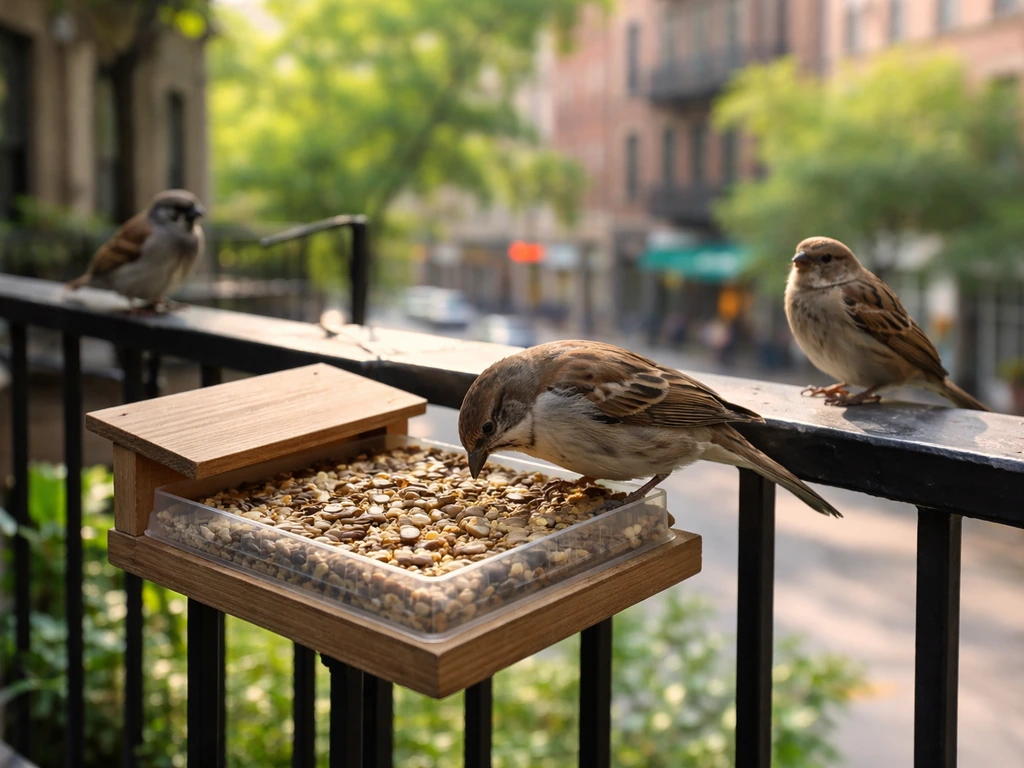
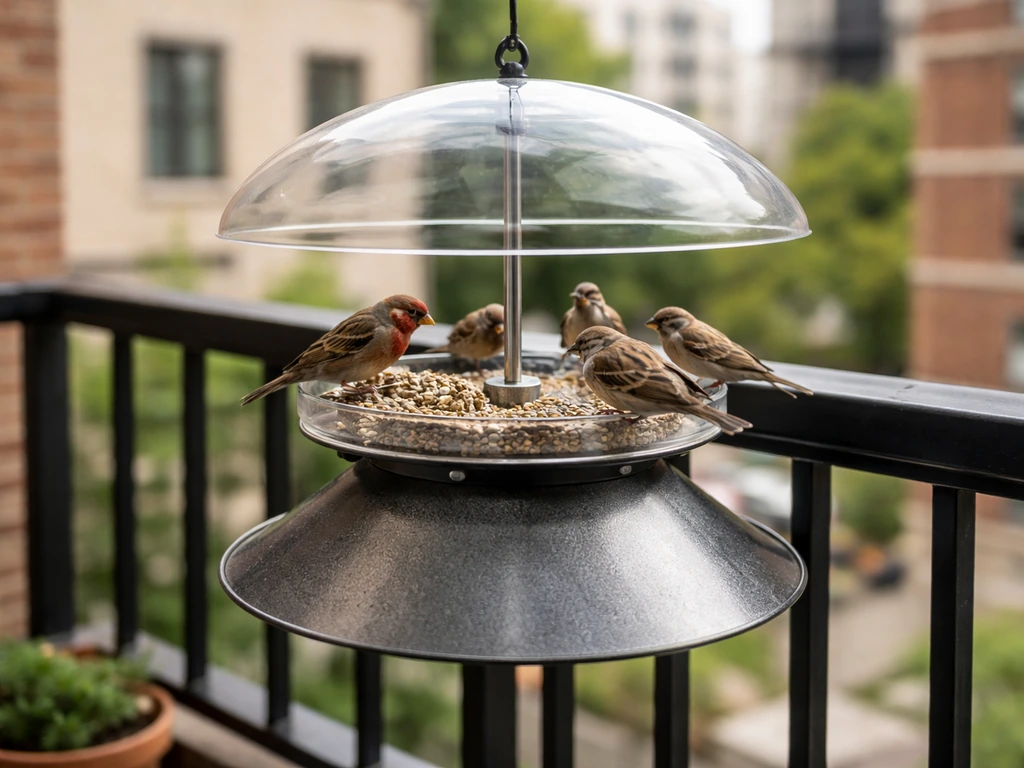
City birding is more rewarding than most people expect, but you should go in with realistic expectations. The birds that show up at urban feeders are not the same lineup as a rural backyard. House sparrows, European starlings, and pigeons are almost guaranteed visitors, and in many cities grackles are a constant presence. That said, you will also get genuinely exciting species: house finches and goldfinches, chickadees, dark-eyed juncos, white-throated sparrows, mourning doves, downy woodpeckers, and in neighborhoods with trees, cardinals and nuthatches. If you live anywhere with flowering plants nearby, ruby-throated or Anna's hummingbirds may visit too.
The nuisance species (starlings, house sparrows, pigeons, grackles) are not just annoying, they actively drive away the birds you want and burn through seed fast. Building your whole setup around excluding them is not paranoid, it's just practical. Cities in the Midwest and South tend to have the worst grackle pressure. If you're in Chicago, New York, or another major metro, the species mix shifts slightly by geography, and you may want to dig into city-specific guides for your region. If you want a quick way to compare options, check our picks for the best bird feeders for Chicago before you decide. The core principles here apply everywhere, though.
Best feeder types for small urban spaces
Not every feeder design makes sense in a city. Here's how the main types stack up when space is tight, maintenance has to be easy, and you're trying to discourage pests.
Tube feeders
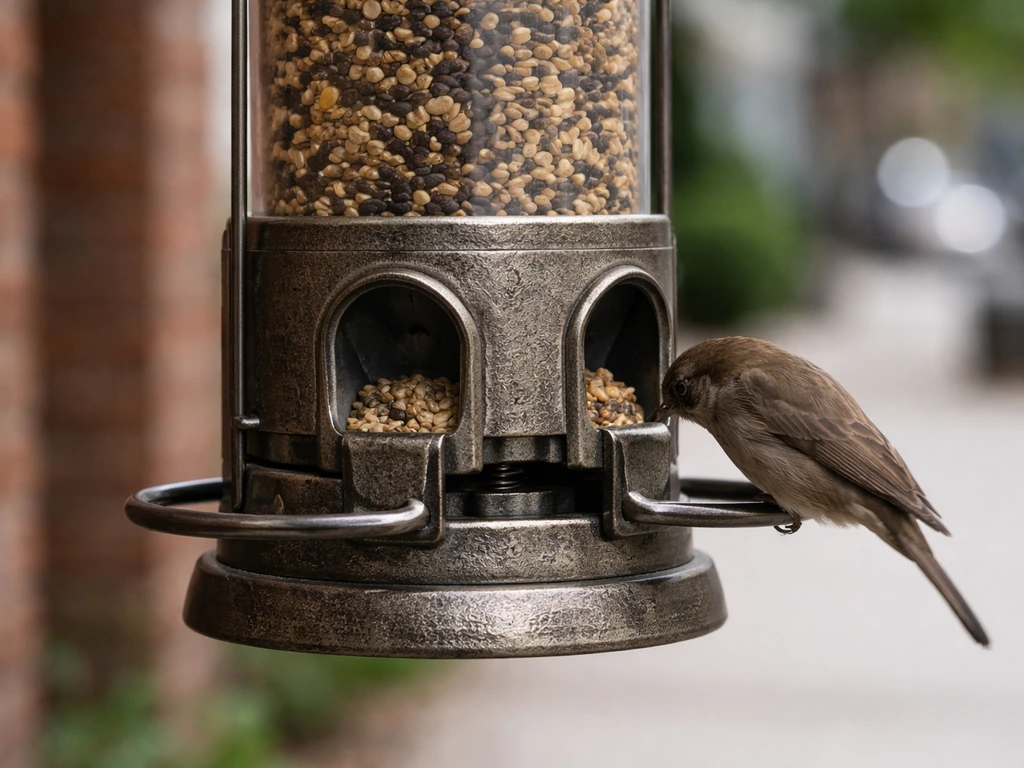
Tube feeders are the city workhorse. They hold a decent amount of seed, keep it dry, and many models have weight-activated mechanisms that shut down access when something heavier than a songbird lands on them. They work well on a pole, hanging from a hook, or clamped to a balcony rail. If I had to pick one feeder type for a city setup, this is it.
Hopper feeders
Hopper feeders hold more seed and attract a broader range of species including cardinals, blue jays, and chickadees. The Chicago Botanic Garden specifically recommends a hopper filled with sunflower seeds for attracting cardinals, chickadees, blue jays, and house finches. The downside in a city: hoppers tend to be larger, they're harder to make fully squirrel-resistant, and they collect more seed debris underneath. If you have a courtyard or small yard and can mount one on a proper pole with a baffle, they're worth it.
Platform feeders
Platform feeders are open trays that attract the widest variety of species, including ground-feeding birds like doves and juncos. The problem is they're also the least squirrel-resistant design and the hardest to keep clean in rainy weather. In a city where you have high foot traffic, nearby pigeons, and unpredictable weather, a platform feeder tends to create more mess and pest problems than it solves. Use one as a secondary feeder, not your primary.
Suet cages
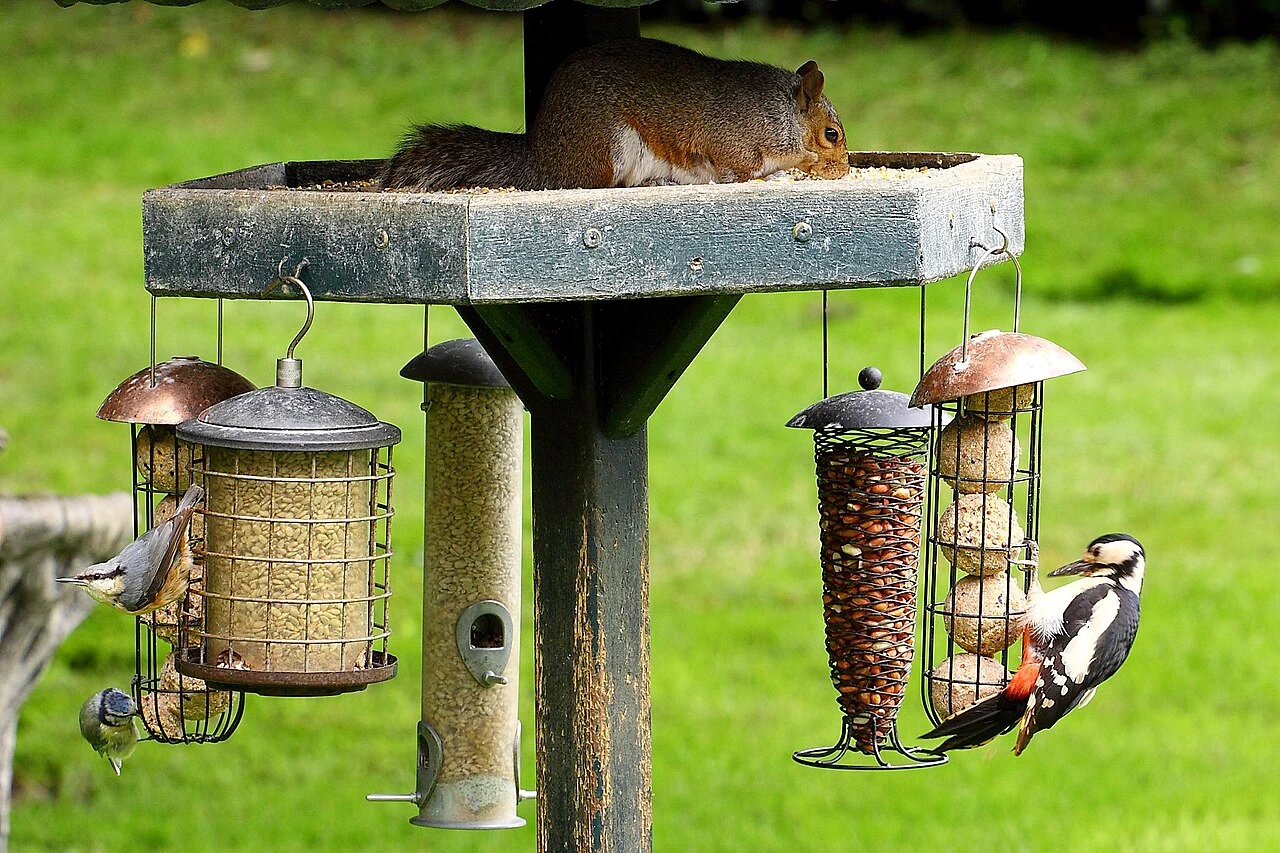
A small wire suet cage is one of the best additions to an urban setup if you want woodpeckers, chickadees, and nuthatches. They're inexpensive, easy to hang from a hook or rail, and suet cakes are mess-free compared to loose seed. In warm weather, switch to no-melt suet formulas to avoid a greasy mess. Suet cages are a natural complement to a tube feeder because they attract different species without adding much complexity.
Window feeders
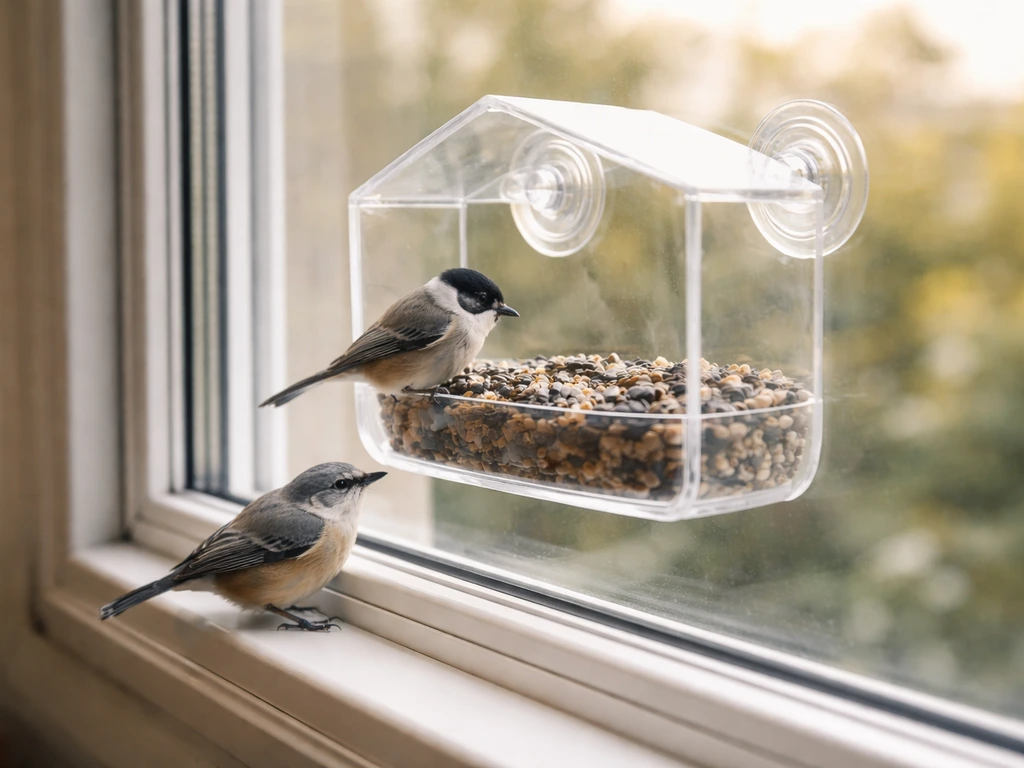
For apartment dwellers with no balcony, a suction-cup window feeder is the only realistic option, and honestly they're more effective than you'd expect. Birds adjust quickly to feeding right at the glass, and placing a feeder within about 3 feet of a window actually reduces collision risk because birds don't build up enough speed to hurt themselves. The trade-off is capacity: window feeders are small and need refilling often. Keep one clean and topped up and you'll see chickadees and finches within a week in most urban areas.
Hummingbird feeders
If hummingbirds pass through your city during migration, a small glass or high-quality plastic nectar feeder is worth hanging. Make the nectar yourself: one part white sugar dissolved in four parts boiling water, cooled before filling. Skip the red dye, it's unnecessary. The main city-specific challenge with hummingbird feeders is the cleaning schedule. Nectar ferments fast in heat, so you need to clean and refill every two to three days in summer. If that sounds like too much upkeep for your schedule, skip it and focus on seed feeders.
Squirrel- and pest-proofing: the real city challenge
Squirrels are the most obvious pest, but in cities, starlings and grackles are equally destructive. Both can completely empty a feeder in a morning and scare off everything you actually wanted to attract. Your pest-proofing strategy needs to cover all three.
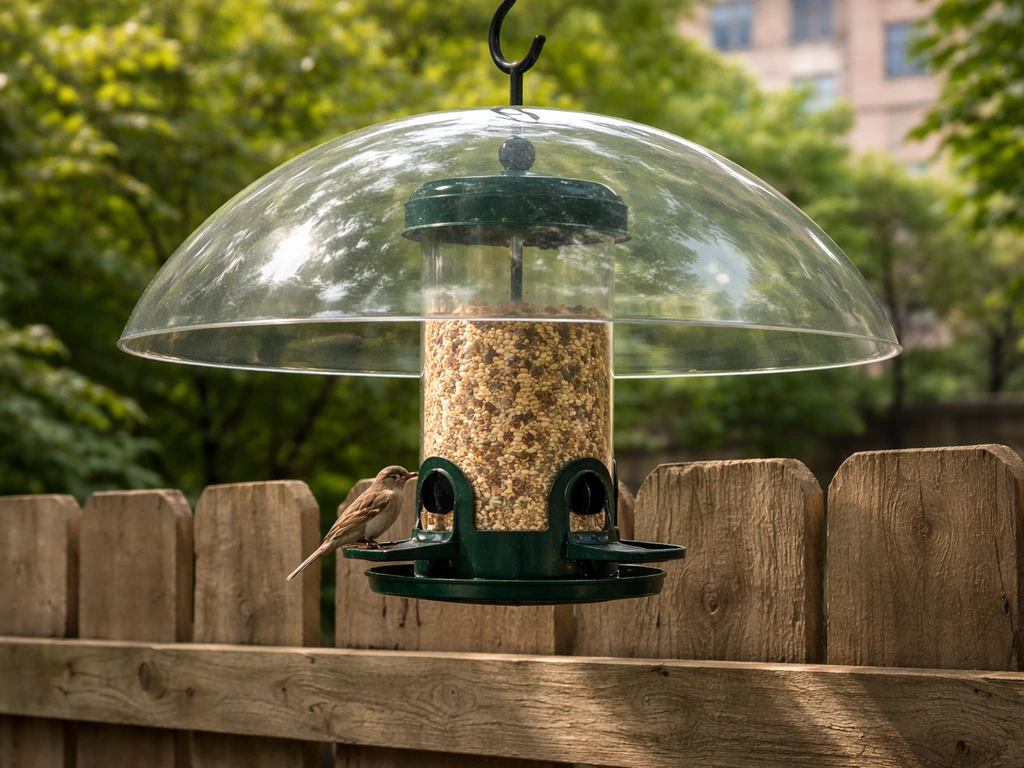
For squirrels, weight-activated feeders are the most reliable technology. The mechanism works simply: when something heavier than a songbird lands on the perch ring, the seed ports close. Brands like Brome's Squirrel Buster line and Droll Yankees' Blocker use this approach, and it genuinely works. A dome baffle above a hanging feeder adds a second layer of protection, but as a standalone solution baffles fail if a squirrel can jump horizontally directly to the feeder from a nearby ledge or rail. The combination of a weight-activated feeder plus a baffle, mounted at least 12 to 15 feet from any tree, shrub, or surface a squirrel can use as a launch point, is what actually keeps them off.
For starlings and grackles, caged tube feeders (feeders with a wire cage around the tube that only allows small birds through the openings) are highly effective. The cage lets chickadees, finches, and nuthatches reach the ports while physically blocking larger birds. You can also use a feeder with short perches, since starlings prefer long perches to balance on. Avoid platform feeders and open hoppers if grackles are a serious problem at your location.
Raccoons are another real urban pest, especially if your feeder is accessible from a fence or railing. A weight-activated feeder won't stop a raccoon since they're heavy enough to trigger the closure, but a pole-mounted setup with a wide baffle skirt will. Bring feeders in at night if raccoons are persistent.
Weatherproofing, durability, and keeping things clean
City feeders take a beating. Rain, wind, and high humidity accelerate mold growth in seed, and a busy feeder with lots of bird traffic accumulates droppings and hulls fast. Material choice matters here. Metal and UV-stabilized polycarbonate feeders outlast basic plastic significantly, especially if you're leaving them out year-round on an exposed balcony or rooftop. Avoid thin acrylic or plain plastic ports, they crack and yellow quickly.
Clean seed feeders every two weeks as a baseline, and more frequently in hot or humid weather. If seed ever clumps or smells off, dump it, don't top up over spoiled seed. The cleaning process is straightforward: disassemble the feeder, scrub it with a 9:1 water-to-bleach solution, rinse thoroughly, and let it dry completely before refilling. Drying is the step people skip, and it leads directly to mold coming back fast.
For hummingbird feeders, the timeline is tighter. Discard unused nectar and clean the feeder every two to three days in summer heat. If you see any cloudiness in the nectar, pink residue on the ports, or mold anywhere inside, clean it immediately. Glass feeders are easier to clean thoroughly than plastic and worth the slight extra cost.
One underrated weatherproofing feature is a rain guard or weather dome above a tube or hopper feeder. These keep seed dry in the ports and dramatically reduce how often you're dealing with wet, clumped seed. If the feeder you're considering doesn't include one, it's worth buying a separate dome to hang above it.
Mounting and placement for apartments, balconies, and courtyards
The biggest limiting factor for city feeders isn't budget or feeder choice, it's figuring out where to actually put the thing. Your options depend entirely on your space.
- Balcony rail clamps: A pole or arm that clamps to a rail is the standard balcony solution. Look for clamps designed for standard 1.5 to 2-inch rail widths. These let you position the feeder out over the edge, away from the railing surface squirrels might use as a platform.
- Freestanding pole with baffle: If you have a courtyard, patio, or small yard, a freestanding shepherd's hook or dedicated feeder pole is the most versatile mounting option. A smooth metal pole at least 5 feet tall with a wide baffle skirt 4 to 5 feet off the ground is the standard squirrel-deterrent setup. Keep it at least 12 to 15 feet from trees and structures.
- Wall-mount brackets: A heavy-duty bracket screwed into a masonry or wood wall works well for balconies and courtyard walls. This is a permanent solution but very stable in wind.
- Window suction-cup mounts: For feeders placed directly on glass, choose heavy-duty suction cups rated for the feeder's filled weight. Clean the glass before attaching and recheck suction every few weeks.
- Hanging from a hook or overhang: Simple and effective for suet cages and small tube feeders. Just make sure the hook is rated for outdoor use and won't corrode and drop the feeder after one winter.
Window placement deserves extra attention because of collision risk. The safest positions are either very close (under 3 feet from the glass) or far away (more than 30 feet). Mid-range distances of 5 to 15 feet are actually the most dangerous because birds build up speed before hitting the glass. If your only option is a mid-range mount, add window collision decals or tape to break up the reflection.
One practical note if you're in a condo or apartment building: check your HOA or building rules before installing anything. Some buildings prohibit feeders outright, and others have restrictions on what can be attached to exterior surfaces. A window feeder that attaches only by suction cup is usually the safest option from a rules perspective.
Matching seed and food to the birds you want
Seed choice is where a lot of people waste money buying expensive mixes full of filler seeds that urban birds don't want. Keep it simple: black-oil sunflower seed is the single most versatile, widely accepted feeder food you can buy. Cardinals, chickadees, house finches, goldfinches, nuthatches, woodpeckers, and jays all eat it. It's cheaper per pound than most mixes, and birds don't kick the uneaten bits onto your balcony floor the way they do with millet-heavy blends.
| Target Species | Best Food | Best Feeder Type |
|---|---|---|
| Cardinals, chickadees, jays | Black-oil sunflower seed | Hopper or tube feeder |
| House finches, goldfinches | Black-oil sunflower or nyjer (thistle) | Tube feeder (nyjer requires fine-hole ports) |
| Woodpeckers, nuthatches | Suet cake or black-oil sunflower | Suet cage or tube feeder |
| Mourning doves, sparrows | Black-oil sunflower, millet | Platform or hopper feeder |
| Hummingbirds | 1 part sugar to 4 parts water (no dye) | Nectar tube feeder with red accents |
| Chickadees, titmice | Black-oil sunflower, suet | Tube feeder or suet cage |
Nyjer seed (also called thistle) is the specialty seed for goldfinches and siskins and requires a tube feeder with very small ports designed specifically for it. If attracting finches is your goal, a dedicated nyjer feeder alongside a standard tube feeder with sunflower is a great two-feeder city setup. Just be aware that nyjer goes stale faster than sunflower and should be replaced every few weeks even if it hasn't been fully consumed.
One thing to avoid: bargain mixed seed bags that are mostly milo, millet, and red millet. Most songbirds ignore these, and the rejected seed ends up on the ground attracting pigeons and rats, which is the last thing you want in a city. If you're on a budget, straight black-oil sunflower in bulk is a better value than any cheap mix.
Smart feeders and AI cameras: worth it in a city?
Smart bird feeder cameras have become genuinely compelling over the last few years. Models like the Bird Buddy (around $199) and Birdfy's AI-powered feeder cameras record short video clips of each visit, run species identification automatically, and send you a push notification with the ID result. Birdfy records a 20-second video of every visit and alerts you when it identifies a bird, squirrel, or other creature. These aren't gimmicks, they're genuinely useful if you want to know what species are visiting while you're at work.
In a city context, smart feeders have some specific advantages. If you're on a high floor and can't always see the feeder clearly, camera alerts let you know when something interesting shows up without standing at the window. For apartment feeders on balconies or mounted outside a window, a smart feeder effectively extends your viewing range. They're also great for migration season when you might get a surprise visitor you'd otherwise miss.
The honest trade-offs: AI species identification is good but not perfect. Difficult lighting, partial occlusion, or unusual angles can produce wrong IDs, and the technology works better for common species than rarities. Most smart feeders also still require the same cleaning schedule as traditional feeders, and some have more crevices and electronic components that make thorough cleaning more fiddly. Battery life and WiFi connectivity on a balcony can also be inconsistent depending on your building layout.
My honest take: if you're genuinely excited about knowing which species visit and want a record of your city birds over time, a smart feeder is worth the premium. If you just want birds to watch from the kitchen window, a well-chosen traditional feeder at a third of the price does the job fine. The camera doesn't change which birds come, just how much data you get about them.
| Feature | Smart/AI Feeder Camera | Traditional Feeder |
|---|---|---|
| Price | $150–$250+ | $20–$80 |
| Species ID | Automatic AI alerts | Manual identification |
| Cleaning ease | More complex (electronics) | Straightforward |
| Best for | Tech enthusiasts, migration tracking, remote monitoring | Casual birders, beginners, budget setups |
| City-specific benefit | Alerts when rare migrants visit; remote viewing | Simpler, more durable in weather extremes |
| Subscription | Some features free; others may require plan | None |
Your city feeder buying checklist
Before you buy anything, run through these questions. Your answers will tell you exactly what to get. If you want the best bird feeders for New York City, use these answers to match the feeder type to your birds, space, and pest-proofing needs.
- What's my mounting situation? (Balcony rail, window, courtyard pole, wall bracket) This determines feeder size and mounting style before anything else.
- Do I have a serious squirrel or grackle problem? If yes, prioritize a weight-activated tube feeder with a caged outer guard over any open hopper or platform design.
- Which birds do I most want to attract? Finches and goldfinches point toward a nyjer tube feeder. Cardinals and chickadees point toward sunflower in a hopper or tube. Woodpeckers point toward a suet cage. Hummingbirds require a separate nectar feeder.
- How often can I realistically clean the feeder? Every two weeks minimum for seed feeders, every 2 to 3 days for nectar feeders in summer. If nectar maintenance sounds like too much, skip the hummingbird feeder.
- Is weather protection a priority? Look for feeders with integrated rain guards or budget for a separate dome. Choose metal or UV-stabilized polycarbonate over thin plastic.
- Do I want AI identification and camera features? If yes and budget allows, Bird Buddy or Birdfy are the leading options. If you just want birds, a classic tube feeder is the smarter spend.
- Have I checked my building rules? Confirm before drilling or clamping anything to building surfaces.
Top picks by city situation
| Your Situation | Best Feeder Setup | Seed Choice |
|---|---|---|
| Small balcony, squirrels present | Weight-activated caged tube feeder on a rail clamp with dome baffle | Black-oil sunflower |
| Apartment with no balcony | Suction-cup window feeder (large, heavy-duty) | Black-oil sunflower or sunflower chips (less mess) |
| Courtyard or small yard | Pole-mounted weight-activated tube feeder + suet cage, 12–15 ft from trees | Black-oil sunflower + suet cake |
| Want finches specifically | Nyjer tube feeder on a rail clamp alongside a sunflower tube feeder | Nyjer + black-oil sunflower |
| Want hummingbirds on balcony | Small glass nectar feeder on a rail hook or wall bracket | Homemade 1:4 sugar-water nectar |
| Tech-forward, want bird ID | Smart AI camera feeder (Bird Buddy or Birdfy) in most accessible spot | Black-oil sunflower |
| Grackle or starling problem | Caged tube feeder with small openings only | Black-oil sunflower (avoid millet mixes) |
If you're still not sure where to start, go with the courtyard or balcony setup in the table above: a weight-activated tube feeder on a good pole or rail clamp, filled with black-oil sunflower, with a suet cage hanging nearby. That covers the most birds, handles the most common city pests, and gives you something durable enough to leave out year-round. Add a nyjer feeder later if you want more finch action, or a smart camera once you're hooked and want to level up your setup. If you want the best nyjer bird feeder results, choose a tube model with the tiny ports that finches need Add a nyjer feeder later.
FAQ
How far should my feeder be from trees or railings to prevent squirrels from reaching it?
Aim for a mount that keeps the feeding ports at least 12 to 15 feet away from any launch point, like trees, shrubs, fences, or balcony rails. If you must place it closer, you will usually need to upgrade to a fully enclosed approach like a caged tube (for starlings and grackles) plus a baffle that wraps the feeder down close to the mounting pole.
If grackles and starlings keep emptying the feeder, what adjustment works best?
For grackles and starlings, the most effective change is restricting access to the tube ports, not just using seed guards. A caged tube feeder blocks larger birds physically, and adding short perches (or no perches) can further reduce visits from birds that prefer balancing on longer footholds.
What’s a good second feeder to add after I buy the best city tube feeder?
A suet cage is usually the easiest “second feeder” to add because it attracts a different set of birds (woodpeckers, nuthatches, chickadees) without increasing loose-seed mess. In wet seasons, prioritize a design with a drip-friendly top or a partial roof, because suet is cleaner than seed but it can still get gunky if it sits in rain.
Can I use a pole tube feeder and a window feeder together in the same apartment setup?
Yes, but you should keep them close enough to be practical for you. A common setup is one pole-mounted tube feeder plus one window feeder within the same line of sight, but avoid placing both feeders on a single short pole or shared surface that birds can use to coordinate with pests. If squirrels are active, treat each feeder as its own potential entry point and use separate baffles or separate mounting strategies.
What should I do if my seed feeder gets wet or starts growing mold?
If you see clumped seed, mold odor, or visible moisture in the ports, don’t top off, dump and refill. Also check the “drying step” after cleaning, many people rinse but refill before the feeder is fully dry, and that shortens the time until mold returns even if your cleaning solution was correct.
My birds keep hitting the window, how can I fix the placement quickly?
Most of the time, collisions are caused by mid-range placements where birds build up speed (roughly 5 to 15 feet). If you must feed there, add high-contrast window collision decals, or reposition laterally so reflections don’t create a clear landing lane. Keep the feeder either very close or far away when possible.
What’s the fastest way to improve results if birds aren’t showing up at my feeder yet?
Start by swapping to black-oil sunflower, since filler-heavy mixes leave waste that attracts pigeons and rodents. If you still aren’t seeing the birds you want, only then consider a specialty feeder for a specific species, like nyjer for finches, because matching feeder food to port size matters as much as the seed itself.
Can I put nyjer seed into a regular tube feeder filled for sunflower?
For nyjer, the feeder has to have tiny ports designed for that seed, otherwise birds can’t access it consistently and you end up with waste. Plan to replace it more often than sunflower, even if some appears left, because nyjer goes stale faster and stale seed reduces feeding activity.
My squirrel-proof feeder still fails, what are the most common reasons?
If a squirrel defeats your weight-activated feeder, the usual causes are missing the correct mounting distance from launch points, a weak baffle placement, or horizontal access from adjacent surfaces. Recheck the height relative to nearby rails, and ensure the baffle blocks the feeder from multiple angles, not just from one side.
How often do I need to refill and clean a window bird feeder in a city?
Window feeders are small, so set expectations for frequent refilling and quick cleaning. To reduce collisions, place it very close to the glass (under 3 feet) or far away (over 30 feet), and keep it clean since birds will return repeatedly during busy seed windows.
Do smart bird feeder cameras reduce how often I need to clean the feeder?
Smart feeders still need the same core maintenance, battery-powered models especially require you to keep the ports and any moving access parts free of hull buildup. Before buying, consider whether you can access the feeder easily for cleaning from your balcony or window, because fewer crevices and easier disassembly can matter more than the AI features.
How should I use a feeder camera if I see nuisance visitors taking over?
Use the camera for learning, not for letting pests “teach themselves.” If you get notifications showing squirrels or starlings dominating visits, respond with the same behavioral fixes from traditional setups, like switching to a caged tube for larger birds or tightening baffle placement for squirrels, because the footage doesn’t prevent access.
What’s a practical timeline for seeing results after I set up the best city feeder?
Prioritize feeding during the hours when you can observe, and keep seed fresh, mold-free, and dry, because that’s what actually sustains repeat visits. If you’re trying to attract finches, add nyjer only once your sunflower tube is stable, then evaluate after a few weeks since finch discovery and settling can be slower than common seed-eaters.
Next Article
Best Bird Feeders for Apartment Balconies: Top Picks
Quick picks for balcony rail, wall, hanging and window feeders with pest proofing, easy cleaning and space fit for apart