The best all-around bird feeder for South Carolina yards is a weight-sensitive tube feeder like the Brome Squirrel Buster Plus paired with a hopper or platform feeder loaded with safflower for cardinals and a dedicated nyjer sock for goldfinches. That combination covers the widest range of South Carolina's common backyard species, keeps grackles and squirrels from eating you out of house and home, and holds up through the state's brutal summer humidity and the occasional tropical storm. Everything below explains exactly why, with type-by-type breakdowns, species-specific placements, and honest notes on what actually works in coastal, Piedmont, and Upstate SC yards.
Best Bird Feeders for South Carolina: Top Picks & Guide
Marcus Holloway
7 Aug 2026
Why South Carolina is its own challenge for backyard feeders
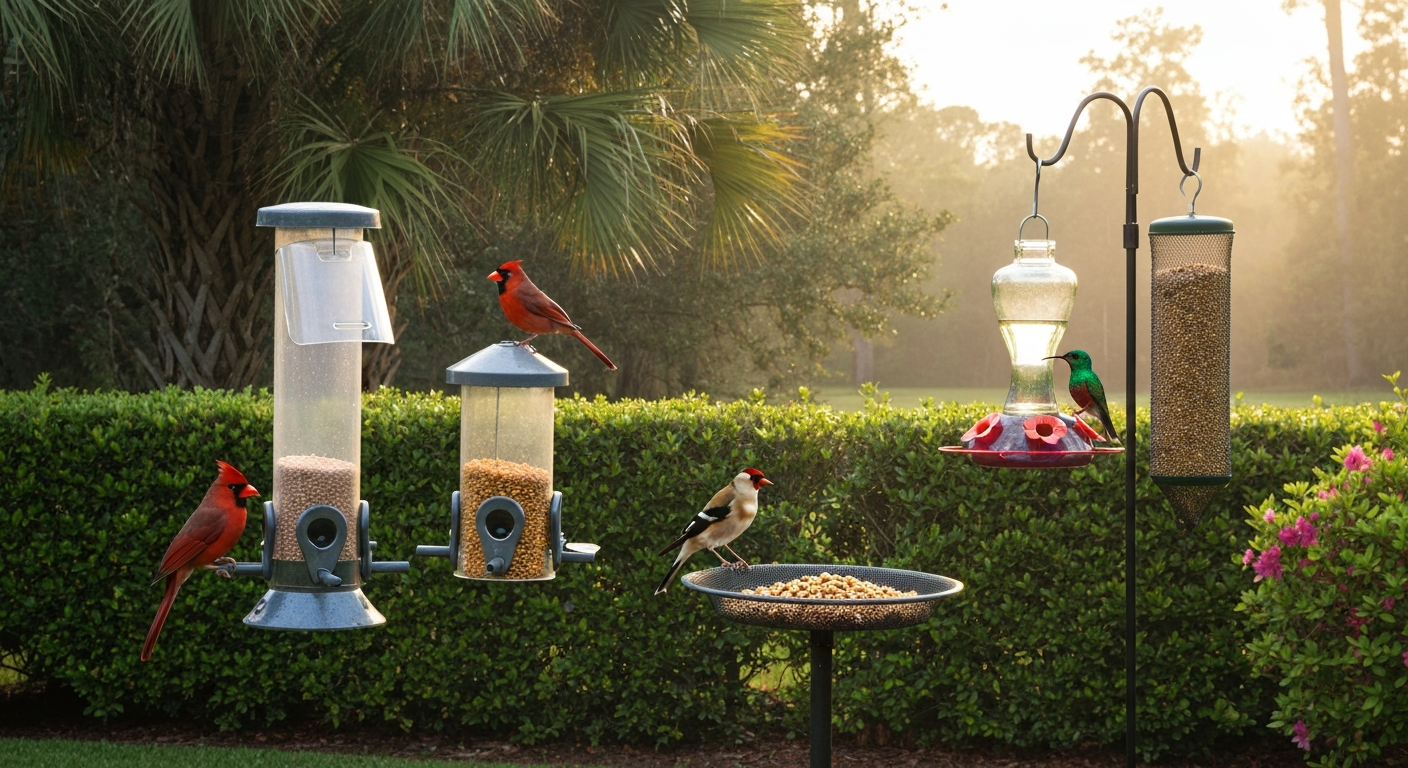
South Carolina sits in a humid subtropical climate zone, which sounds like a weather description but really means your bird feeders are fighting multiple enemies at once: relentless summer heat, high year-round humidity, mold-prone seed, UV degradation of plastics, salt spray if you are anywhere near the coast, and the occasional hurricane. The coastal zone from Hilton Head up through Myrtle Beach sees milder winters and earlier spring migration but faces direct tropical storm exposure from June through November. The Piedmont (Columbia, Aiken, Greenville's lower elevations) gets the heat without the salt but still hits 90-plus-degree days regularly from May through September. The Upstate, around Greenville and Spartanburg at higher elevations, gets slightly cooler summers and sees more winter finches push through. These regional differences matter when you're picking materials, capacity, and even which species to plan for.
Bird diversity here is genuinely impressive. Over 120 landbird species nest in the state, and species composition shifts noticeably by region and season. See the eBird printable checklist, South Carolina (region list) for detailed species and regional nesting information eBird printable checklist — South Carolina (region list). The coast gets migrants that rarely make it inland; the Upstate occasionally sees pine siskins and purple finches in winter that never show up in Charleston. That's part of the fun, but it also means a one-feeder setup rarely serves the full range of birds that could visit your yard across the year.
I've tested feeders across all three zones over several seasons, and the failures tend to follow a pattern: cheap plastic cracks within 18 months in direct sun, wire mesh rusts through (especially within a few miles of salt water), seed ports clog with moist clumps during humid spells, and anything on a basic shepherd's hook pole gets stripped by squirrels within days. The picks below are things that have actually survived those conditions.
Quick top picks at a glance
| Feeder Type | Top Pick | Best For | Seed/Fill |
|---|---|---|---|
| Tube (weight-sensitive) | Brome Squirrel Buster Plus | Mixed songbirds, squirrel resistance | Sunflower hearts, safflower |
| Hopper | Droll Yankees Yankee Barn | Cardinals, titmice, larger songbirds | Sunflower, safflower mix |
| Platform/Tray | Aspects Quick-Clean Seed Tray | Carolina wrens, bluebirds, ground feeders | Sunflower hearts, mealworms |
| Suet | Stokes Select Double Suet Feeder (metal cage) | Woodpeckers, nuthatches, chickadees | Suet cakes |
| Nectar/Hummingbird | More Birds Ruby Vintage Glass | Ruby-throated hummingbirds | 1:4 sugar-water solution |
| Thistle/Nyjer | Brome Finch Magnet or mesh nyjer sock | American goldfinch, pine siskin, purple finch | Nyjer (sterilized) |
| Smart/AI Camera | Bird Buddy Smart Feeder or Birdfy Feeder Cam | All species + photo ID | Sunflower hearts |
Detailed picks by feeder type
Tube feeders
The Brome Squirrel Buster Plus is the tube feeder I keep coming back to in South Carolina yards. Its weight-sensitive shroud closes off the seed ports when anything heavier than a small songbird lands on it, which handles both squirrels and larger pest birds like grackles. The polycarbonate tube is UV-stabilized, which matters a lot here since cheap clear plastic turns brittle and cloudy within a single South Carolina summer. The metal components are powder-coated rather than bare steel, and the seed ventilation design at the base reduces moisture buildup that causes that nasty seed clumping you get in humidity. Brome backs it with a lifetime warranty, and replacement parts are genuinely available. The main trade-off is cost: it runs $50 to $70 depending on size. For coastal yards, check that the perch ring hardware is stainless or powder-coated rather than bare zinc. I found the medium size (approximately 3.4-lb seed capacity) gives a reasonable refill interval without holding seed so long it goes stale in summer heat.
- Pros: Weight-sensitive port closes on squirrels and grackles, UV-stabilized polycarbonate, ventilated seed base, lifetime warranty, wide species range
- Cons: Higher upfront cost, perch ring should be inspected for corrosion in salt-air environments, smaller port spacing limits large seeds like whole peanuts
Hopper feeders
Hopper feeders are the go-to for northern cardinals, tufted titmice, and house finches in South Carolina because they offer a wide, stable perch and easy seed access from a covered trough. The Droll Yankees Yankee Barn is one of the few hopper feeders I've used that holds up in humid conditions: the seed compartment has a sloped floor to encourage drainage, the roof overhangs generously so driving rain doesn't flood the trough, and the metal roof with powder-coated finish doesn't warp or peel the way painted wood roofs do after two or three rainy seasons. Capacity runs around 5 lbs, which is genuinely useful if you don't want to refill every other day. The caution with hoppers: they attract everything. Grackles, starlings, house sparrows and squirrels all find them easily. I run safflower seed in mine instead of mixed seed or standard sunflower, which cuts nuisance bird pressure noticeably without driving away cardinals, titmice, or chickadees.
- Pros: High capacity, wide perch suits cardinals and larger songbirds, good roof overhang for rain, powder-coated metal construction
- Cons: Open trough design is accessible to grackles and squirrels, requires more frequent seed monitoring in humid weather to catch mold early
Platform and tray feeders
Platform feeders attract the widest variety of species of any feeder type, but that's also the problem: they attract everything, including every pest bird in the neighborhood. In South Carolina I use them selectively, usually as a secondary feeder placed lower to the ground or mounted on a railing for Carolina wrens and towhees that won't use elevated tube feeders. The Aspects Quick-Clean Seed Tray screws onto a standard pole and has a mesh screen bottom that actually lets water drain through rather than pooling under the seed. That's non-negotiable in South Carolina where a summer afternoon thunderstorm can flood a solid-bottom tray in minutes. I keep these stocked with sunflower hearts (no shell waste) or a small pile of mealworms when bluebirds are nesting nearby. Platforms need checking every one to two days in peak summer for clumped or moldy seed.
- Pros: Broadest species appeal, mesh drain bottom keeps seed drier, easy to clean, compatible with mealworms for bluebirds and wrens
- Cons: Fully exposed to pest birds and squirrels, requires most frequent seed checks in summer, no built-in pest deterrent
Suet feeders
Suet is the top draw for downy woodpeckers, red-bellied woodpeckers, Carolina chickadees, and white-breasted nuthatches in South Carolina, and a good metal cage suet feeder is one of the simplest, most durable setups you can run. Go with a double-cake coated steel cage feeder from Stokes Select or a similar brand with a welded wire construction and a plastic-free design. The practical issue with suet in South Carolina is temperature: standard suet cakes go rancid fast above 80°F. From about April through October you need to use no-melt suet specifically formulated to hold up in heat. I've had regular suet turn into a greasy, foul-smelling mess on a 90-degree June day, and nothing empties a feeder yard faster. No-melt suet extends safe usage up to around 100°F. Suet feeders with tail-prop extensions (a flat board extending below the cage) attract larger woodpeckers like red-bellied and pileated that brace their tail while feeding.
- Pros: Strong draw for woodpeckers and nuthatches, simple metal construction resists corrosion, inexpensive, easy to swap cakes
- Cons: Standard suet goes rancid quickly in South Carolina heat; must use no-melt varieties from April through October; starlings also love suet cages
Nectar and hummingbird feeders
Ruby-throated hummingbirds are the only hummingbird species that breeds in South Carolina, though rufous hummingbirds occasionally appear along the coast in fall migration. They arrive as early as late March in coastal areas and linger through October in most of the state. The standard nectar ratio is 1 part white granulated sugar to 4 parts water by volume, boiled or thoroughly stirred until dissolved. Do not use red dye, honey, or artificial sweeteners. In South Carolina summers, nectar ferments and molds in two to three days at peak heat. That means every-other-day changes from May through August if you want birds returning consistently. A glass feeder is easier to clean thoroughly than plastic and doesn't leach chemicals into warm nectar. The More Birds Ruby Vintage Glass feeder has a simple wide-mouth bottle that fits in a dishwasher, a metal-topped base with ant moat built into the hanger, and enough port count (usually 5 ports) for small yards without so much capacity that nectar sits too long. The main practical rule: smaller capacity means more frequent refilling but fresher nectar. In a South Carolina July, that's a feature, not a flaw.
- Pros: Glass resists UV degradation and odor absorption, dishwasher-safe for thorough cleaning, built-in ant moat, simple port design is easy to brush-clean
- Cons: Heavier and breakable compared to plastic, must be refilled every 2–3 days in summer heat, more ports are not always better if nectar sits unused
Thistle and nyjer feeders
American goldfinches are year-round residents in South Carolina (plumage varies dramatically by season, so winter birds look nothing like the bright yellow males you see in summer). Pine siskins push through in irruptive winters, and purple finches appear mainly in cooler months. All three strongly prefer nyjer seed, which is sterilized before sale to prevent germination. Nyjer requires a finch-specific feeder: either a tube with very small seed ports or a mesh thistle sock. The Brome Finch Magnet is a well-built option with small metal-lined ports that resist wear and don't crack open the way cheap plastic ports do. Mesh nyjer socks are inexpensive and work, but they deteriorate in UV over one season and should be replaced annually. A key thing to know about nyjer: it goes stale and oily relatively quickly, and finches will abandon a feeder that isn't fresh. In summer, buy smaller bags and rotate stock frequently.
- Pros: Highly selective (grackles and starlings won't touch nyjer), strong draw for goldfinches and siskins, mesh socks are inexpensive entry point
- Cons: Nyjer goes stale fast; mesh socks degrade within a season in UV; small ports clog with damp seed in humidity
Smart feeders and bird-feeder cameras
Smart feeders with built-in cameras and AI species identification have improved significantly. The Bird Buddy Smart Feeder and the Birdfy Feeder Cam are the two I've spent time with. Both use a camera triggered by motion or bird presence to capture photos and short video clips, and both run AI identification against a library of species to tag what showed up at your feeder. The practical experience is genuinely useful for keeping a yard list and sharing with platforms like eBird. For South Carolina specifically, look for IP65 or better weatherproofing (both Bird Buddy and Birdfy claim this rating), solar charging panels if you plan to mount away from an outlet, and a local SD card slot in addition to cloud storage so you're not locked into a subscription for your own footage. The main limitation is that AI ID performance drops on partially occluded birds or unusual angles, and it occasionally tags a house sparrow as something more exciting. Neither feeder excels in its seed-handling design the way purpose-built feeders do, so treat them as supplemental observation stations rather than primary feeding setups. For species ID specifics, the AI tends to perform best on birds with strong visual markers, which conveniently covers most of South Carolina's common visitors.
Species-focused setups: matching feeders to South Carolina birds
Northern cardinal
Cardinals are year-round and one of the most consistent feeder visitors across all three SC regions. They want a wide, stable perch and prefer seeds they can crack open themselves: sunflower (black-oil or striped), safflower, and cracked corn. A hopper feeder at medium height (4 to 6 feet off the ground) near shrub cover works well. Cardinals are cautious and won't feed at a feeder suspended in open air with no nearby cover. Place the hopper within about 10 feet of dense shrubs or a fence line. I've had the most success running safflower in my cardinal hopper, since it cuts down on grackle competition while keeping the cardinals happy.
Carolina wren
Carolina wrens are bold, curious birds that rarely use tube feeders because the perch geometry doesn't suit them. They prefer a platform feeder or a low tray, and they go wild for suet crumbles, sunflower hearts, and mealworms. Keep the platform at or just above ground level and place it close to leaf litter or brushy cover. Unlike most feeder birds, wrens actively forage in and around the feeder structure itself, so a feeder with flat landing areas rather than just perch rods works much better for them.
Tufted titmouse
Titmice are regular visitors at tube and hopper feeders stocked with sunflower hearts or whole peanuts. They have a distinctive habit of grabbing a single seed and flying off to crack it on a branch rather than feeding in place, so even a modest feeder will see heavy titmouse traffic. They tolerate tube feeders well and also visit suet cages. They're not shy about cold weather, so if you're in the Upstate and keeping feeders going through winter, expect titmice to be among your most reliable customers.
Eastern bluebird
Bluebirds are insect eaters first and are rarely drawn to seed. The way to attract them to a feeder is live or dried mealworms on a platform tray, ideally placed in open areas with low grass. They're territorial during nesting season (which starts early in South Carolina, sometimes in February in the coastal zone) and will return to a reliable mealworm source daily once they discover it. Keep the platform tray fairly close to a nest box if you have one, but set at table height or slightly higher to reduce cat access. Dried mealworms work but get ignored far more often than live ones.
American goldfinch and other finches
A dedicated nyjer tube or sock feeder away from your main feeding station works best. Finches prefer calmer, less-trafficked spots. Place the finch feeder on a separate pole 10 to 15 feet from the main feeder cluster so larger birds moving through the main station don't startle finches off the sock. In the Upstate, watch for pine siskins in irruptive winters; they'll mob a nyjer feeder in large numbers.
Ruby-throated hummingbird
Hang the nectar feeder in partial shade to slow fermentation and near red or orange tubular flowers if you have them (trumpet vine, coral honeysuckle, and salvia are native SC options that complement feeder use). Coastal SC birders can put feeders up by late March; Upstate birders can typically expect arrivals by mid-April. Take feeders down no earlier than two weeks after you see your last hummingbird of fall, as late migrants pass through into October and occasionally November in warmer years.
Woodpeckers
Downy and red-bellied woodpeckers are the most common SC feeder woodpeckers. Both readily use suet cages. Red-bellied woodpeckers also visit hopper feeders for sunflower and whole peanuts. For pileated woodpeckers (a more dramatic, less common visitor), a large suet feeder or a log feeder with peanut butter and suet pressed into drilled holes mounted directly on a tree works well. Place suet feeders on the shaded side of a tree or structure to slow summer rancidity, and switch to no-melt suet from spring through fall.
Baltimore oriole
Baltimore orioles are primarily spring and fall migrants through South Carolina rather than summer breeders in most of the state, though they do nest in some Upstate locations. The peak window to catch them is during spring migration, roughly late April through May. An oriole feeder stocked with fresh orange halves and grape jelly is the standard approach. Orioles also occasionally visit hummingbird feeders with larger ports. The feeder window is short, so have it up and ready before the birds arrive and check it daily since jelly ferments quickly in the heat.
Dealing with grackles and other aggressive visitors
Common grackles and boat-tailed grackles are facts of life in South Carolina yards, and they can clear a platform or hopper feeder in a matter of hours when they arrive in flocks. Brown-headed cowbirds and European starlings add to the pressure. There's no single perfect solution, but layering a few strategies together gets the problem down to manageable.
The most effective passive deterrent is seed selection. Switch your hopper and platform feeders to safflower seed. University of Nebraska–Lincoln Extension, Squirrel‑resistant bird feeding guidance (selective feeding) notes that safflower seed is often rejected by grackles, starlings, and some squirrels, making it a practical seed swap to reduce nuisance pressure University of Nebraska–Lincoln Extension — Squirrel‑resistant bird feeding guidance (selective feeding). Grackles strongly dislike safflower's bitter coating and typically leave it alone, while cardinals, titmice, chickadees, and house finches eat it readily. It's not a guarantee with every individual grackle population, but in my experience the difference is dramatic within a week of switching. Nyjer in dedicated finch feeders is another grackle-proof option since the small ports physically prevent large birds from feeding.
Beyond seed choice, weight-sensitive feeders like the Brome Squirrel Buster models close off access to heavier birds automatically. Cage feeders, where a wire cage surrounds the inner feeder, allow small songbirds through while physically blocking grackles and starlings. Gardman and Woodlink make inexpensive cage add-ons that fit over many standard tube feeders. Timing also helps: grackles tend to arrive in the morning and late afternoon in large foraging groups. Bringing platform feeders in during early morning hours or reducing accessible seed volume during peak grackle season (late winter through early spring is often worst for flock pressure) can reduce the damage. The same principles apply broadly in other southern states, though species mix varies. Birders dealing with similar pressure in the Florida panhandle or North Carolina Piedmont will recognize the same pattern.
Materials, build quality, and durability for southern climates
South Carolina's climate is genuinely hard on feeder materials. UV radiation is intense from spring through fall, temperatures can hit 100°F, humidity stays high, and coastal areas add salt-air corrosion into the mix. Here's what to look for and what to avoid.
| Material | Durability in SC Climate | Best For | Watch Out For |
|---|---|---|---|
| UV-stabilized polycarbonate | Good (3–5+ years with quality additives) | Tube feeders, window feeders | Cheap versions not UV-stabilized will crack and yellow in 1–2 seasons |
| Powder-coated steel | Good to excellent | Hopper roofs, suet cages, pole systems | Check welds and seams for rust after 2+ years; touch up scratches promptly |
| Marine-grade (316) stainless steel | Excellent (coastal) | Coastal hardware, screws, mounting fixtures | More expensive than 304 stainless; essential within a mile or two of salt water |
| 304 stainless steel | Good (inland) | Inland hardware, wire mesh | Pitting possible in heavy salt-air; acceptable 10+ miles from coast |
| Standard galvanized wire | Fair (inland), poor (coastal) | Budget cage feeders | Rusts through within 1–2 seasons in coastal humidity; upgrade to coated wire |
| Recycled plastic / poly lumber | Excellent UV and moisture resistance | Hopper bodies, decorative feeders | Heavier than polycarbonate; color fades but structure stays sound |
| Cedar/teak wood | Fair to good if maintained | Hopper feeders, platform trays | Requires annual sealing; standard pine or painted wood warps and rots quickly in SC humidity |
| Standard acrylic/polystyrene | Poor | Avoid for outdoor SC use | Becomes brittle and cracks in one to two southern summers |
For coastal SC specifically, marine-grade 316 stainless steel is the correct choice for any metal hardware including screws, mounting bolts, and wire mesh. The difference between 316 and standard 304 stainless is that 316 contains molybdenum, which dramatically improves resistance to chloride pitting from salt spray. It costs more but avoids the rust-spotted, structurally weakened mess that cheaper hardware becomes within a single season near the water.
Drainage and ventilation are just as important as the material itself. Look for seed trays with drainage holes or mesh floors, tube feeders with a ventilated base plug, and hopper designs with sloped floors. Seed that sits in standing water or trapped moisture turns moldy within days in summer and becomes a genuine health hazard for birds. Clean feeders with a 10 percent bleach solution (about 1 part bleach to 9 parts water) and rinse thoroughly, allowing complete drying before refilling, every one to two weeks in summer and monthly in cooler months.
Capacity, refill frequency, and sizing your setup
Bigger isn't always better when it comes to feeder capacity in South Carolina. A large-capacity hopper sounds convenient because you refill less often, but in summer heat a 10-lb seed load sitting in a hopper for a week will have the bottom layer going rancid or molding before birds get to it. The practical rule in SC is to match capacity to a two-to-four day refill interval in summer (April through September) and a five-to-seven day interval in cooler months.
For a typical suburban SC yard with moderate bird traffic, a 3 to 5 lb tube feeder and a 5 lb hopper cover most needs without overloading seed before it can be consumed. Dense suburban neighborhoods, especially those with mature tree cover, may support heavier traffic that justifies larger capacity. Rural properties or yards with active woodlot borders can see dramatically higher traffic during migration periods (April through May and September through October) and may need more frequent checks and higher-capacity feeders during those windows.
One practical consideration specific to South Carolina: hurricane and tropical storm season runs from June through November. If a named storm is approaching, bring feeders in rather than letting them become projectiles. After a storm passes, check that no debris has contaminated the seed before birds return. Having a container of fresh seed stored indoors means you can reload quickly once conditions are safe.
Predator and pest proofing: squirrels, rats, raccoons, and cats
South Carolina's warm climate means squirrels are active year-round with no winter slowdown. Eastern gray squirrels and fox squirrels will defeat most pole setups and destroy plastic feeders quickly. Raccoons and rats are equally persistent, especially in coastal and suburban areas. Free-roaming cats are a serious and underappreciated predator pressure on ground-feeding birds. Here's what actually works.
Pole systems and baffles
The most reliable squirrel solution is a dedicated feeder pole with a properly sized and positioned baffle. A smooth metal stovepipe or torpedo baffle mounted on the pole at about 4 to 5 feet height prevents squirrels from climbing up. The pole must be placed at least 10 feet from any structure, fence, or branch that a squirrel can jump from. Most failed baffle setups fail because the pole is too close to a launch point, not because the baffle itself is inadequate. Multi-arm shepherd's hook poles work for suspending multiple feeders but require a large-diameter wraparound baffle to cover the entire pole circumference below the hooks.
Weight-sensitive feeders
For feeders mounted where pole placement isn't practical (deck railings, fence posts), weight-sensitive feeders are your best option. Brome's Squirrel Buster line adjusts the closing weight so you can tune it to shut off access to squirrels (which run 12 to 20 oz) while remaining open for small songbirds (roughly 0.5 to 1.5 oz for most SC feeder birds). The Droll Yankees Yankee Flipper takes a different approach with a motorized spinning perch ring that activates under heavier weight and physically spins squirrels off. It's entertaining to watch and effective, though it requires batteries or a power source.
Cage feeders for excluding large birds
A wire cage surrounding an inner feeder (with cage mesh spacing of about 1.5 inches) lets chickadees, nuthatches, small woodpeckers, and finches through while physically blocking grackles, starlings, and squirrels. These work especially well for suet and for seed tube feeders in grackle-heavy yards. The trade-off is that they also exclude larger welcome visitors like northern cardinals, so you'd run a caged feeder alongside an open hopper with safflower for the cardinals rather than replacing one with the other.
Managing rats and raccoons
Rats and raccoons are drawn primarily to seed spilled on the ground and to feeders accessible from the ground or from low structures. The practical solutions are: use tube feeders and hoppers with catch trays that minimize ground spillage, raise feeders to at least 5 feet off the ground, use no-mess seed blends (hulled sunflower, sunflower hearts, safflower) that produce little shell debris on the ground, and bring feeders in at night if rat or raccoon pressure is high. A thick raccoon-deterrent baffle (torpedo-style, at least 18 inches in diameter) on the feeder pole handles most climbing attempts. Don't leave water dishes or fallen fruit accessible near feeding stations, as these attract the same pests.
Cat predation
Free-roaming cats kill enormous numbers of birds, particularly ground-feeding species like Carolina wrens, towhees, and sparrows. Keep platform feeders and ground-level trays at least 5 feet off the ground where possible, or place them on poles with baffles. Position feeders with clear sightlines from all directions so birds can see approaching threats. Dense shrub cover right next to a ground feeder sounds like bird-friendly habitat but actually gives cats a concealed hunting position. Keep the immediate zone around ground feeders clear of dense low cover while providing escape cover 10 to 15 feet away.
Mounting options and placement for South Carolina yards
Mounting choices depend on yard type, but a few principles hold across SC regions. Freestanding poles with baffles give the most flexibility and the best pest protection. Deck-mount pole adapters (clamp-on or railing-mount bases) work well for smaller yards or where digging isn't practical, but they're harder to baffle effectively. Window feeders bring birds within close viewing distance and work surprisingly well for small birds like chickadees and titmice, though they require frequent cleaning since birds defecate while feeding. Tree mounts are tempting but almost impossible to squirrel-proof adequately.
For hurricane preparedness, any feeder mounted on a thin shepherd's hook style pole should be moved or removed when a tropical storm warning is posted. Heavier post-and-baffle systems can often stay if protected from direct storm surge, but anything that could become windborne should come down. Using quick-disconnect pole sections makes seasonal removal fast and practical. The same logic applies to hummingbird feeders during storm events: take them in, store them filled with fresh nectar, and rehang within 24 hours of the storm passing since hummingbirds resume feeding quickly and may be stressed by the interruption.
Seasonal maintenance: keeping feeders healthy year-round in SC
Maintenance needs shift with the seasons in South Carolina more than in most of the country. Summer (May through September) is the hardest period: mold grows fast, nectar ferments in two to three days, nyjer goes stale, and suet goes rancid. Clean all feeders every one to two weeks, check seed for clumping or off smell before refilling, and run smaller seed loads that birds consume within two to three days. Change hummingbird nectar every two days when temperatures are consistently above 85°F.
Fall (September through November) brings migration waves that can dramatically increase feeder traffic temporarily. Keep feeders well-stocked and add a platform tray for migrating species that don't normally visit your yard. This is also the time to set up or recheck your oriole feeder if you want to catch late fall migrants passing through.
Winter in SC is mild compared to most of the U.S., but it still matters for feeder birds. High-fat foods like suet, peanuts, and sunflower hearts are most valuable to birds in cold snaps. The Upstate sees more cold weather and is more likely to see winter finch irruptions. Coastal SC winters are mild enough that you may have hummingbirds (mainly rufous hummingbirds from the west) appearing at nectar feeders from November through February in some years, so consider keeping one feeder up if you're in a coastal county.
Spring (March through May) is migration time and the peak season for new species. Have feeders cleaned and stocked before the first warm days in March. Hummingbird feeders should be up by late March for coastal areas and by early to mid-April for Piedmont and Upstate. Oriole feeders should be ready by mid-April. If you're interested in comparing seasonal feeder strategies for nearby states, the approaches used in North Carolina and Florida share enough overlap with South Carolina's conditions that tips from those setups translate well, with adjustments for SC's specific species calendar. For recommendations tailored to coastal Florida conditions, see our guide to the best bird feeders for South Florida. For comparisons and adjustments specific to neighboring climates, see our guide to the best bird feeders for North Carolina (d1cc4447-8953-40c5-a477-ed3edec7bf82). For guidance tailored to Florida's climate and species mix, see our guide to the best bird feeders for Central Florida. For contrast on feeder choices in a drier southern climate, see guidance on the best bird feeder for North Texas. For specifics on feeder models and setup tips tailored to Florida's climate, see our guide to the best bird feeder for Florida.
FAQ
Which types of bird feeders are best for South Carolina's climate and bird species mix?
Use a mix: tube feeders (black oil sunflower) for cardinals, titmice and finches; hopper/box feeders for cardinals, bluebirds and larger songbirds; platform feeders for ground‑feeding species and mixed viewing (expect grackles); suet cages for woodpeckers and wrens; nectar/hummingbird feeders with perches and ant/moat protection for hummingbirds; thistle/nyjer finch feeders (small ports or mesh socks) for goldfinches and pine siskins. Prioritize feeders built from UV‑stabilized plastics, powder‑coated steel or marine‑grade 316 stainless in coastal sites to resist corrosion and sun damage.
What feeder features matter most for southern heat, humidity and storms?
Key features: corrosion‑resistant materials (316 stainless or powder‑coated metal), UV‑stabilized plastics, good drainage and ventilation (drain holes, mesh trays) to reduce mold, tight seals to keep rain out, solid mounting points for wind/hurricane resistance, and easy disassembly for frequent cleaning. For coastal exposures, prefer 316 stainless or marine coatings.
How do I choose feeders to attract specific species common in SC (cardinals, Carolina wren, tufted titmouse, bluebirds)?
Cardinals: hopper or tray feeders with large perches and sunflower (whole or hearts) or safflower. Carolina wren and titmouse: tube or hopper feeders using mixed seed or suet; provide sheltered perches near shrubs. Bluebirds: nest‑box habitat and specialized bluebird tray/platform feeders with mealworms; place 4–6 ft above ground on poles away from dense cover. Adjust perch size and seed type to suit each species.
Which feeders work best for finches and nyjer seed?
Use dedicated finch/nyjer feeders with small ports or mesh thistle socks to keep tiny seed from spilling. Expect some ground spillage; use tray catchers if desired. In humid heat change nyjer less frequently than shelled seed but still monitor for mold; choose feeders with easy access for cleaning and dry storage.
How can I deter grackles, starlings and squirrels common in SC?
Use selective feeding and physical deterrents: offer safflower seed (less preferred by grackles), nyjer for finches in specialized feeders, weight‑sensitive ports (Brome/Squirrel Buster style) that close under heavy birds, metal cages sized to exclude large blackbirds, smooth pole baffles, and hanging feeders with predator‑proof placement. Results vary by local pest pressure; combine strategies.
What maintenance schedule is recommended for feeders in hot, humid South Carolina summers?
Clean and disinfect feeders every 7–10 days in hot weather (shorten to 3–5 days during heat waves or heavy use); change nectar every 2–3 days at high temperatures; always remove wet or moldy seed immediately. Rinse and scrub with a 10% bleach solution or mild vinegar, rinse thoroughly, and dry completely before refilling to reduce mold and bacterial growth.
Next Articles
Best Bird Feeders for Central Florida: Top Picks & Care
Best bird feeders for Central Florida: species picks, weatherproofing, pest-proofing, cleaning tips & where to buy
Best Bird Feeders for South Florida: Top Picks and Buying Guide
Best bird feeders for South Florida: top picks by type, plus anti-squirrel and anti-grackle mounting, cleaning, and pest
Best Bird Feeder for North Texas: Pick the Right One
Choose the best bird feeder for North Texas with tube, hopper and suet picks for hot, windy, pest-prone yards.