The best bird feeders for New York City are compact, weather-resistant, and built to handle squirrels, pigeons, and grackles without requiring a yard. For most NYC setups, a Brome Squirrel Buster Plus tube feeder (around $55–$70) handles house finches, chickadees, and nuthatches on a balcony rail or window mount, while a dedicated nyjer sock or tube feeder pulls in American Goldfinches year-round. If you have a window ledge or glass door, a suction-cup window feeder gives you close-up views with minimal footprint. For tech-forward birders, smart feeders like the Bird Buddy 2.0 or Birdfy offer AI-powered species ID with built-in cameras, though they come with subscription caveats worth knowing before you buy.
Best Bird Feeders for New York City: Urban Balcony Guide & Species Picks
Marcus Holloway
12 Aug 2026
Why NYC birding has its own set of rules
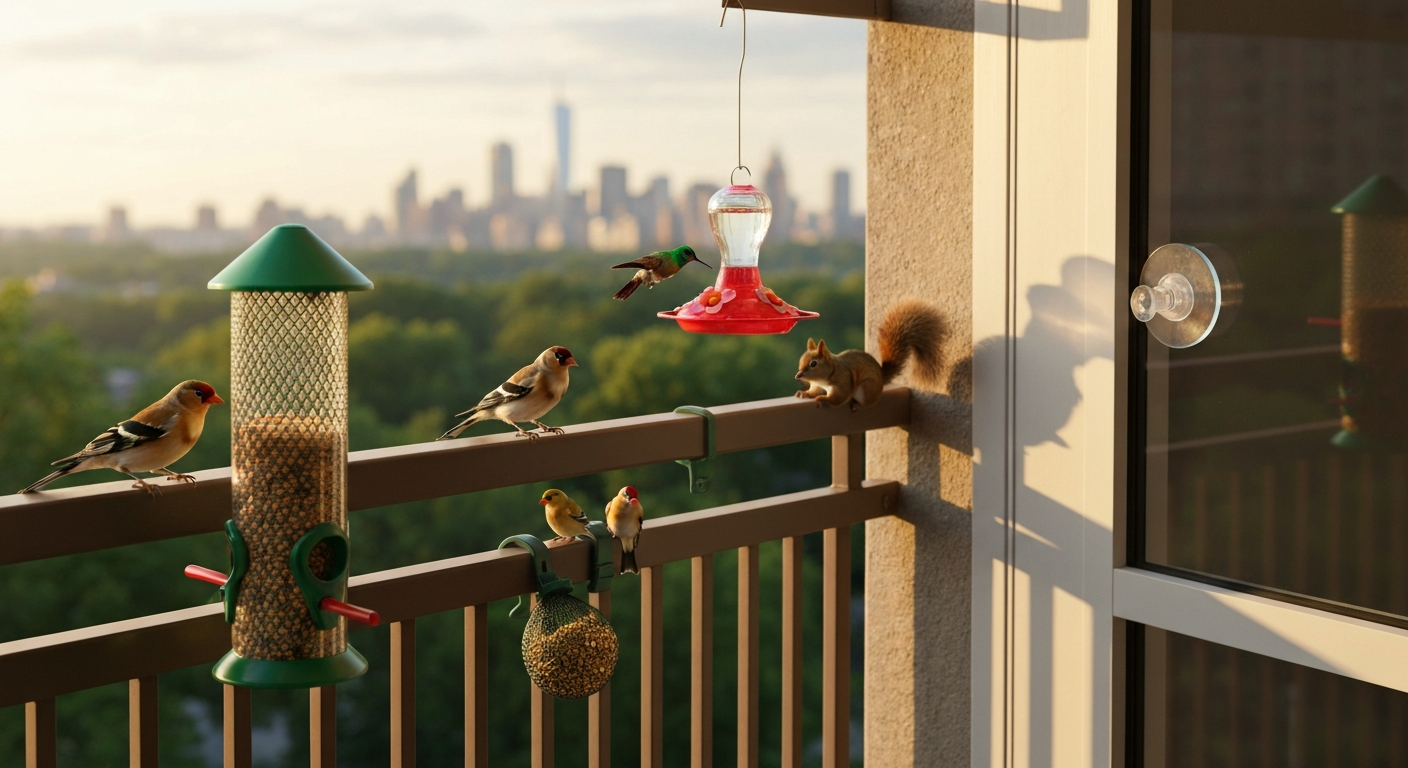
Feeding birds in New York City is genuinely different from doing it in a suburban backyard, and not just because your 'yard' might be a fifth-floor balcony. Space is the obvious constraint, but the real complications run deeper. Squirrels in NYC parks and neighborhoods are bold and experienced. Pigeons and house sparrows will mob an open platform feeder within minutes. Buildings have rules about drilling, hanging, and what goes on railings. And the city itself has regulations worth knowing: NYC Health Code section 161.09(d) and related Parks rules restrict pigeon feeding in certain contexts, and NYC Parks has proposed additional amendments to 56 RCNY section 1-04(g) that could further limit wildlife feeding in parks. The practical upshot: keep feeders on your own private property (balcony, stoop, rooftop garden, or yard), avoid spilling seed onto public sidewalks, and check your building's lease before installing anything. None of that should stop you from attracting birds, but it does shape which feeder designs and mounting solutions make the most sense.
The good news is that NYC bird diversity is genuinely impressive. Central Park alone hosts documented flyway migrants and year-round residents across dozens of species, from Northern Cardinals and Downy Woodpeckers to American Goldfinches and Ruby-throated Hummingbirds in season. Even if you're in a dense borough neighborhood, the right feeder and seed combination will bring in real variety. I've personally run feeders from a Brooklyn apartment balcony and a Queens backyard, and the difference in what shows up based on feeder type, seed, and placement is dramatic.
Top pick categories at a glance
Before diving into specifics, here's a quick orientation by price tier so you can jump to what fits your budget and situation.
| Tier | Price Range | Best For | Representative Models |
|---|---|---|---|
| Budget | Under $20 | First-time feeders, window ledges, nyjer socks | Perky-Pet window feeder, basic nyjer sock feeders |
| Midrange | $20–$60 | Balcony rail mounts, tube and hopper feeders, suet cages | Droll Yankees A-6F tube feeder, basic Brome Squirrel Buster models |
| Premium | $60–$130 | Squirrel-resistant setups, high-capacity hoppers, specialty suet/hummingbird | Brome Squirrel Buster Plus, Droll Yankees Yankee Flipper, Aspects HummZinger |
| Smart/AI-enabled | $80–$200+ | Species ID, camera views, tech-forward birders | Bird Buddy 2.0, Birdfy Mate, Kiwibit Beako |
The tiers above are starting points, not strict rankings. A $15 nyjer sock will outperform a $60 hopper feeder if your goal is American Goldfinches and you're in an apartment with a single railing. Context matters more than price.
How to figure out what you actually need
I'd push back against the instinct to just buy the highest-rated feeder on a general list. NYC-specific constraints mean the right answer for a Bronx rooftop differs from the right answer for a Staten Island backyard. Work through these four questions before buying anything.
Space and mounting options
A balcony railing clamp or suction-cup window mount rules out pole-mounted feeders entirely. Rooftop gardens can often support a freestanding shepherd's hook pole (about 7–8 feet is standard, which keeps feeders 5 feet off the ground, above most squirrel jump range from a flat surface). Small stoops and yards may accommodate a ground-level baffle system. Measure your actual available space before buying, especially for hoppers, which can be large.
Target species
The feeder you need depends almost entirely on which birds you're trying to attract. Goldfinches need nyjer; Cardinals prefer large platform or hopper feeders with a generous perch; Downy Woodpeckers need suet cages; Hummingbirds need a nectar feeder with red accents. If you try to attract everything with one generic tube feeder and mixed seed, you'll end up feeding House Sparrows and squirrels more than anything else.
Maintenance commitment
Cornell's Project FeederWatch recommends cleaning seed feeders every one to two weeks under normal conditions, and more frequently in warm or wet weather. In NYC summers, that's closer to weekly. A 10% bleach solution (roughly 1 part bleach to 9 parts water, soaked for about 10 minutes) is the most effective at reducing Salmonella contamination, per cleaning method research. If you travel frequently or can't commit to that schedule, stick to a single small feeder rather than a large-capacity hopper that sits wet.
Theft and vandalism risk
This is an NYC-specific concern that rarely shows up in general buying guides. Ground-floor windows, stoop railings, and easily-reached balconies are all targets. A stolen Bird Buddy smart feeder at $180 stings considerably more than a $20 tube feeder. Consider whether a feeder can be brought inside easily, whether it's mounted in a way that requires tools to remove, and whether the investment is proportionate to the risk level of your specific location.
Feeder types explained
There are eight primary feeder designs you'll encounter, and each serves a different combination of species and feeding style. Knowing what each one does prevents the common mistake of buying a feeder that the birds you want simply won't use.
| Feeder Type | Best Species | Typical Seed/Food | NYC Suitability |
|---|---|---|---|
| Tube | House Finch, Chickadees, Nuthatches, Goldfinch (small ports) | Black-oil sunflower, nyjer | Excellent — compact, rail-mountable |
| Hopper/House | Cardinals, Doves, Sparrows, Jays | Mixed seed, sunflower | Good for yards/rooftops; large footprint |
| Platform/Tray | Cardinals, Mourning Doves, Juncos | Mixed seed, millet, peanuts | Use cautiously — pigeons love them |
| Nyjer/Thistle | American Goldfinch, House Finch, Pine Siskin | Nyjer (thistle) seed | Excellent — very targeted, pigeon-resistant |
| Hummingbird nectar | Ruby-throated Hummingbird (May–Sept) | 1:4 sugar-water solution | Good on balconies; needs shade and frequent cleaning |
| Suet cage | Downy Woodpecker, Nuthatches, Chickadees | Suet cakes, peanut suet | Excellent — mounts anywhere, inexpensive |
| Window mount | Any small feeder bird | Varies by seed type | Ideal for apartments with no outdoor space |
| Specialty/Smart | Varies; cameras for all species | Any compatible seed/nectar | Great for engagement; needs Wi-Fi and power planning |
A note on platform feeders in NYC: I pulled mine after two days because six pigeons had moved in. If you want to attract Cardinals on a tray, place it somewhere pigeons can't easily land in numbers, or use a covered platform feeder with a cage surround that excludes larger birds. Tube feeders with small ports naturally screen out pigeons and grackles by making perching difficult for heavier birds.
Which birds actually show up in NYC, and what they want
Project FeederWatch (Cornell Lab and Birds Canada) maintains a Common Feeder Birds list for eastern North America that maps directly onto NYC's resident and migratory species. Here's a practical breakdown of the birds you're actually likely to attract and the food-feeder pairings that work.
American Goldfinch and House Finch
Both species respond strongly to nyjer (thistle) seed in dedicated nyjer tube feeders or mesh sock feeders. Goldfinches are year-round residents in NYC and are among the most reliable feeder visitors. Small tube ports designed for nyjer exclude most larger birds automatically. A nyjer sock costs under $5 and can be clipped to a railing, making it one of the easiest entry points for apartment-based birding. For a deeper look at dedicated nyjer feeder options, a focused guide on the best nyjer bird feeders covers the top tube, mesh, and sock designs in more detail.
Northern Cardinal
Cardinals are granivorous and strongly prefer black-oil sunflower seed, according to Cornell's All About Birds species account. They're also ground-feeders by nature, which means they do best at platform feeders, hopper feeders with wide trays, or low tube feeders with large perches. In an NYC context, a hopper feeder in a small yard or rooftop garden is the best bet. Cardinals are skittish and won't compete well with pigeons at an open tray, so a covered hopper or cage-surround setup helps. Red-colored feeders reportedly attract their attention faster.
Downy Woodpecker
The Downy Woodpecker is the most common woodpecker at backyard feeders in eastern North America, and they show up reliably in NYC parks and even well-treed neighborhoods. Their food of choice is suet, particularly high-fat suet cakes. A basic wire suet cage ($5–$10) mounted on a fence post, balcony post, or tree trunk is all you need. Peanut-suet blends are particularly effective. Nuthatches and Chickadees will use the same feeder. The suet cage is probably the highest-value feeder purchase per dollar for NYC urban birding.
Ruby-throated Hummingbird
Hummingbirds are seasonal in NYC, typically arriving in May and departing by early October. A nectar feeder with the standard 1-part white sugar to 4-parts water recipe (no red dye, no honey, no artificial sweeteners) is all they need. Audubon and Cornell both confirm this ratio. In NYC summer heat, change nectar every two to three days to prevent fermentation and mold. A shaded balcony or window location helps slow spoilage. Red feeder accents on the nectar ports attract hummingbirds without needing dyed nectar. The Aspects HummZinger Excel is a well-reviewed option at around $30 with easy cleaning access.
House Sparrows, Pigeons, and Starlings
These three species will come regardless of what you put out. House Sparrows are extremely adaptable and will use almost any feeder type. Pigeons and Starlings prefer open platform feeders and large hoppers. The practical strategy is not to attract them specifically but to choose feeders that make it harder for them to dominate. Tube feeders with small perches, nyjer feeders, and caged feeders that only allow small birds through the wire surround are the most effective passive deterrents.
Top picks by target species (NYC-focused)
Best for Goldfinches and Finches: Brome Squirrel Buster Finch
The Brome Squirrel Buster Finch feeder (around $55–$60) is a dedicated nyjer feeder with weight-activated port closure. It holds about 1.4 pounds of nyjer seed, which is a manageable refill amount for a weekly maintenance schedule. The weight-activation system closes off seed access when a squirrel or heavy bird lands, which is one of the more reliable mechanical exclusion designs on the market. BobVila and other independent testing roundups consistently rank Brome's Squirrel Buster line among the most effective squirrel-resistant options available. For an NYC balcony, it clamps to a rail or hangs from a bracket and is compact enough not to require a pole. The downside is that nyjer seed is more expensive per pound than sunflower seed, so factor that into ongoing costs.
Best for Cardinals: Droll Yankees hopper or Aspects platform feeder
Cardinals won't use a small-port tube feeder comfortably. They need a generous perch and a clear sightline. A hopper feeder like the Droll Yankees Classic Hopper (around $45–$55) with a wide seed tray beneath it, mounted on a 6–8 foot pole with a baffle in a small yard or rooftop, is the most reliable setup. The baffle keeps squirrels off the pole; the hopper keeps seed dry and visible. If space is very limited, a wide-tray platform feeder mounted on a railing, kept away from known pigeon congregation points, also works. Cardinals tend to be early morning feeders, so place them where you can actually see them from inside.
Best for Downy Woodpeckers: Stokes Select or Nature's Way suet cage
Any sturdy wire suet cage in the $8–$15 range gets the job done for Downy Woodpeckers. The upgrade worth paying for is a tail-prop design (a small wooden or plastic extension below the cage) that lets woodpeckers brace naturally while feeding, which increases dwell time at the feeder. Nature's Way and Stokes Select both make tail-prop suet feeders under $20. Mount them on a tree, fence post, or wooden balcony beam with a screw eye. In winter, suet doesn't freeze solid the way nectar does, which makes it a year-round option that requires minimal adjustment for NYC's Central Park-confirmed freeze-thaw climate cycle.
Best for Hummingbirds: Aspects HummZinger Excel
The HummZinger Excel (around $30–$35) is a saucer-style nectar feeder that's easier to clean than bottle-style feeders, which matters a lot when you're changing nectar every two to three days in July and August. It holds about 12 ounces of nectar, which is a reasonable amount for one or two visiting hummingbirds. The built-in ant moat (a water-filled channel around the central mount) prevents ants from reaching the nectar ports without chemical deterrents. The wide shallow design also prevents the overflow and drip problems that attract wasps to bottle-style feeders. Hang it on a balcony bracket in partial shade.
Best for general small birds: Brome Squirrel Buster Plus tube feeder
For a single all-purpose feeder that handles House Finches, Chickadees, Nuthatches, and occasional Cardinals without becoming a squirrel buffet, the Brome Squirrel Buster Plus ($65–$75) is the most consistently well-reviewed option across independent tests. For a wider roundup of best urban bird feeders that compares models across city settings, see our detailed guide. It uses an adjustable weight-activated shroud that drops to cover seed ports when a squirrel's weight is detected. You can calibrate the sensitivity to exclude heavier birds like grackles while still allowing smaller species through. Capacity is about 5.1 cups of seed. It hangs from a standard hook or can be adapted to a rail mount with a bracket. It's not cheap, but it's one of the few feeders that actually does what it claims with squirrels.
Top picks by living situation
Apartment balconies and railings
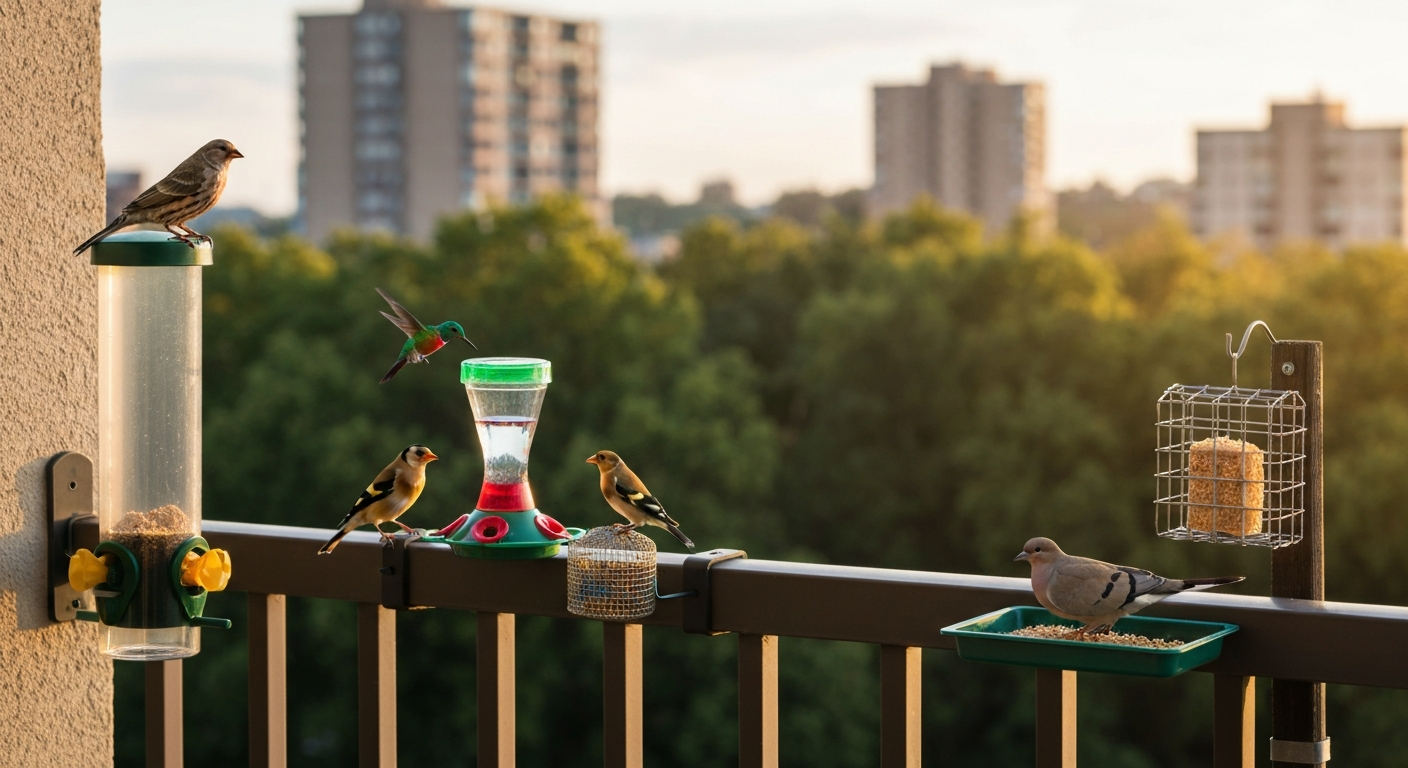
The balcony setup is probably the most common NYC birding context, and it's where feeder choice matters most because you can't just drive a pole into the ground. The best approach is a railing clamp bracket (available for $10–$20 at most hardware stores) paired with a compact tube or nyjer feeder. The Brome Squirrel Buster Finch or a standard Droll Yankees A-6F tube feeder both work well here. Keep the feeder close enough to a window that you can actually enjoy watching it without binoculars. Avoid platform feeders on balconies entirely unless you're prepared to manage pigeon congregations. For a broader look at balcony-optimized designs, the dedicated guide on the best bird feeders for apartment balconies covers mounting hardware, weight limits, and landlord-friendly setups in detail.
Window-mounted setups
If a balcony isn't an option, suction-cup window feeders are genuinely functional, not just novelty items. The Wild Birds Unlimited WBU Window Feeder and several similar designs from Nature's Hangout hold enough seed for a few days of traffic and mount directly to glass with no drilling. The key limitation is that suction cups fail in extreme cold (below about 20°F, which NYC does reach occasionally in January and February according to NOAA's Central Park climate normals), so bring them inside during hard freezes. Position window feeders on north-facing or east-facing windows to reduce glare and overheating.
Rooftop gardens
A rooftop garden is the closest NYC equivalent to a suburban backyard, and it's the only urban setup where a proper freestanding pole with a baffle makes real sense. An 8-foot shepherd's hook with a raccoon/squirrel baffle mounted at the 4-foot mark creates a genuinely predator-resistant setup. A hopper feeder on the pole attracts Cardinals, Doves, and Juncos; a suet cage mounted on a nearby post handles woodpeckers. Wind is a real issue on NYC rooftops, so choose heavy, weighted feeders and avoid mesh sock feeders that will blow around and spill. The Droll Yankees Classic Hopper has enough weight and a stable hang to hold up to moderate roof winds.
Small yards and stoops
In outer borough neighborhoods with small yards or stoops, you have more flexibility but also higher squirrel pressure. A pole-mounted setup with a baffle is more practical here than on a rooftop. A baffle-plus-pole combination (around $40–$60 total for a basic setup) is the single most effective squirrel deterrent in practice, arguably more effective than any feeder-level mechanism on its own. Pair it with a Brome Squirrel Buster Plus for belt-and-suspenders squirrel exclusion. For stoops specifically, wall-mounted bracket setups are available that extend feeders out away from building walls.
Top picks by problem to solve
The squirrel problem
NYC squirrels are not timid. They've had generations of urban adaptation and will defeat a poorly-designed feeder in under an hour. The three most effective interventions, in order of effectiveness, are: (1) a pole-mounted baffle that prevents climbing, (2) a weight-activated feeder like the Brome Squirrel Buster series that closes ports under squirrel weight, and (3) the Droll Yankees Yankee Flipper, a motorized spinning perch that physically ejects squirrels when they land. The Yankee Flipper (around $100–$120) is entertaining to watch and genuinely effective, but it runs on four C batteries that need replacement every few weeks with heavy squirrel activity. Independent tests and buyer reviews via BobVila and similar outlets note that no single feeder is 100% squirrel-proof, and placement plus baffling remains the most reliable strategy. Keep feeders at least 10 feet from any surface a squirrel can launch from.
The pigeon and grackle problem
Pigeons and grackles are both heavier birds that dominate open feeders. The most practical solutions are feeder designs that physically exclude them. Caged tube feeders (sometimes called 'cage feeders' or 'exclusion feeders') surround a standard tube feeder with a wire cage whose openings are sized to allow small birds in but block birds the size of a grackle or pigeon. The Woodlink Caged Bird Feeder and similar designs run about $25–$40 and work reliably. Weight-activated feeders like the Squirrel Buster Plus with the sensitivity calibrated toward the heavier end also close ports when a Common Grackle lands. Avoiding millet and cracked corn in your seed mix also reduces pigeon attraction significantly. Black-oil sunflower and nyjer are both naturally less attractive to pigeons than mixed seed.
Predator-proofing (cats and hawks)
Cooper's Hawks actively hunt feeders in NYC, which is actually a sign of a healthy feeder ecosystem but can be alarming. There's no feeder modification that prevents a hawk from taking a bird mid-flight. The most helpful practice is placing feeders within a few feet of shrub or brush cover that smaller birds can retreat into, or near a window where a hawk's reflection deters repeated strikes. For cats, particularly feral cat colonies which are documented across NYC neighborhoods, any feeder with a ground spillage problem attracts ground-feeding birds that then become cat targets. Tray feeders beneath main feeders should be at least 5 feet off the ground. A baffle below a pole-mounted tray further limits cat access.
Theft-resistant setups
For lower floors and high-foot-traffic areas, the simplest theft deterrent is a feeder that looks inexpensive and is quickly removed when you're not home. Smart feeders like Bird Buddy (around $180) or Birdfy (around $130) are not good candidates for unattended low-floor windows. A more practical approach for high-risk locations: use an inexpensive ($15–$20) tube or nyjer feeder that can be brought inside at night and is not a meaningful financial loss if taken. If you do want to run a smart feeder, a higher-floor location or one accessible only from your own balcony significantly reduces the risk.
Smart and AI-enabled feeders: what you actually get
Smart feeders have improved considerably in the past two years. Current options like the Bird Buddy 2.0, Birdfy Mate, and Kiwibit Beako offer 2K to 4K cameras, onboard or cloud-based AI for species identification, and app connectivity. Hands-on reviews from Digital Camera World (Kiwibit Beako) and Homes and Gardens (Bird Buddy 2.0) note several real-world tradeoffs that matter specifically for NYC use. Homes & Gardens' Bird Buddy 2.0 review, Bird Buddy 2.0 review, Homes & Gardens (smart‑feeder feature summary) summarizes practical smart‑feeder features to evaluate for NYC use: whether AI runs locally or in the cloud (privacy/offline ID), power options (solar or removable battery vs AC), Wi‑Fi stability for multi‑story apartments, and which identification features require a paid app subscription Bird Buddy 2.0 review — Homes & Gardens (smart‑feeder feature summary).
- Wi-Fi reliability: multi-story apartment buildings with thick concrete walls or metal-heavy construction can create dead zones that cause connectivity drops, missed photos, and failed notifications. Test your Wi-Fi signal at the intended feeder location before buying.
- Power source: solar-plus-battery hybrid models (Birdfy Mate, some Beako variants) are more practical for balconies without outdoor outlets than AC-only models. Solar charging is less reliable on north-facing balconies or locations with significant shade.
- Subscription costs: species ID accuracy at a useful level often requires a paid subscription tier for cloud processing. Free tiers typically offer limited daily identifications or reduced AI accuracy.
- Privacy: cloud-AI models upload photos and video clips to vendor servers. If that's a concern for your building or neighbors, look for models with local/edge AI identification (some Birdfy models offer this).
- False positives: all current smart feeders occasionally misidentify species, particularly between similar-looking species like House Sparrow and Song Sparrow. Treat IDs as a starting point, not a definitive record.
- Theft: smart feeders are the highest-value items in this category and the most visible targets. Mount them in locations accessible only to you.
For a first smart feeder purchase in an NYC apartment, the Bird Buddy 2.0 (around $180 without subscription) is the most polished experience from an app and ID perspective, but the Birdfy Mate's solar-battery hybrid makes it more practical for balconies without power access. Neither replaces the value of a good tube feeder and nyjer setup for actually attracting birds; the camera and ID features are an add-on experience layer.
Maintenance, cleaning, and winter care in NYC
NYC's climate, per NOAA Central Park normals for 1991 to 2020, means freezing temperatures from roughly December through February, with occasional hard freezes below 20°F in January and early February. Summers are hot and humid. Both extremes create feeder maintenance challenges.
- Clean seed feeders every one to two weeks, more often in summer. Use a 10% bleach solution (1 part bleach to 9 parts water), scrub thoroughly, rinse completely, and air-dry before refilling. Research on cleaning methods confirms this is more effective against Salmonella than soap and water alone.
- Change hummingbird nectar every two to three days in warm weather (May through September). In temperatures above 80°F, daily changes may be needed to prevent fermentation.
- In winter, switch to straight suet feeders where possible — suet doesn't freeze solid and doesn't require the same cleaning frequency as seed feeders. Black-oil sunflower in a squirrel-resistant tube feeder also works well year-round.
- Remove suction-cup window feeders when temperatures drop below 20°F to prevent suction failure and potential window damage from ice expansion.
- Inspect perches, ports, and seed hoppers for mold, especially after rain. NYC's wet spring weather creates mold conditions inside feeders faster than most general guides acknowledge.
- If you see sick or dead birds near a feeder, stop feeding and clean thoroughly before resuming. Project FeederWatch guidance on disease response is available on the Cornell Lab website.
NYC regulations and building rules: what to check before you set up
This section doesn't need to be alarming, but it's genuinely worth a few minutes of your time. NYC Health Code section 161.09(d) and related city administrative code provisions address wildlife and pigeon feeding. NYC Parks has proposed amendments to 56 RCNY section 1-04(g) that would further restrict wildlife feeding in city parks. The upshot for most people: feeding birds on your own private property (your balcony, backyard, rooftop) is generally fine, but feeding in parks or on public sidewalks can be restricted. Pigeons specifically have historically been the target of the city's feeding restrictions, not songbirds.
Building rules are a separate issue entirely and more practically relevant for most apartment dwellers. Check your lease and, if necessary, ask your building management before drilling any mounting hardware or hanging anything from a fire escape (fire escapes are almost always prohibited by both city code and lease terms). Rail-clamp brackets and suction-cup mounts that require no drilling are the safest starting point from a building-rule perspective.
A practical buyer checklist before you purchase
Use this checklist to narrow your decision down to the right feeder for your specific situation before spending anything.
- Identify your mounting option: railing clamp, suction cup, shepherd's hook pole, wall bracket, or tree/fence post.
- Choose your target species: Goldfinch/Finch (nyjer feeder), Cardinal (hopper or wide platform), Woodpecker (suet cage), Hummingbird (nectar feeder), or general small birds (tube with black-oil sunflower).
- Assess your squirrel pressure: low (any feeder works), moderate (weight-activated feeder recommended), high (weight-activated feeder plus pole baffle).
- Assess your pigeon/grackle pressure: use tube feeders with small ports or caged exclusion feeders; avoid open platform designs.
- Consider your maintenance commitment: if irregular, choose a small-capacity feeder with simple cleaning access rather than a large hopper.
- Set a realistic budget including ongoing seed costs (nyjer is roughly $1.50–$2.00 per pound; black-oil sunflower is about $0.50–$0.80 per pound).
- Check your building's lease or co-op rules for balcony mounting restrictions before purchasing hardware.
- If considering a smart feeder, verify your Wi-Fi signal strength at the intended mount location and check whether your preferred model requires a subscription for full AI ID features.
Comparing the best all-around NYC feeders side by side
| Feeder | Type | Price | Best For | Squirrel Resistance | NYC Setup |
|---|---|---|---|---|---|
| Brome Squirrel Buster Plus | Tube | $65–$75 | General small birds | Weight-activated, excellent | Balcony clamp, pole hang |
| Brome Squirrel Buster Finch | Nyjer tube | $55–$60 | Goldfinches, finches | Weight-activated, excellent | Balcony clamp, hang |
| Droll Yankees Yankee Flipper | Tube (motorized) | $100–$120 | Squirrel deterrence feature | Motorized spinning, very good | Pole or hang |
| Aspects HummZinger Excel | Nectar/hummingbird | $30–$35 | Ruby-throated Hummingbird | N/A | Balcony bracket, hang |
| Nature's Way/Stokes suet cage | Suet cage | $8–$15 | Downy Woodpecker, Nuthatches | Moderate (cage) | Fence, post, beam screw |
| Woodlink Caged Tube Feeder | Caged tube | $25–$40 | Small birds; grackle/pigeon exclusion | Good (cage size) | Pole or hang |
| Bird Buddy 2.0 | Smart/AI | ~$180 | Species ID, camera viewing | Depends on mount | Balcony, window (secure loc.) |
| Birdfy Mate | Smart/AI (solar) | ~$130 | Camera + solar power flexibility | Depends on mount | Balcony, rooftop |
The bigger NYC birding picture
Bird feeding in NYC is one of those things that's more rewarding than most people expect when they start. The city sits along the Atlantic Flyway, and Central Park in particular is a documented migration corridor where over 200 species have been recorded. Your balcony or rooftop is a small node in that larger system. The species variety you get, even in dense neighborhoods, tends to surprise people who assume urban birding means only House Sparrows and Pigeons.
If you're thinking about birding across multiple urban contexts, the principles here apply fairly directly to other dense American cities as well. Readers interested in how NYC-specific feeder challenges compare to those in other metro areas might find value in guides covering the best bird feeders for Chicago or broader guides on the best urban bird feeders, which address similar squirrel pressure, limited space, and pest management problems in slightly different climate and species contexts.
Start small. A $15 nyjer sock on your railing will tell you within two weeks whether you have Goldfinches in your area. A single suet cage on a fence post will confirm whether Downy Woodpeckers are nearby. Build from there based on what actually shows up, not on what you hope to attract. That's genuinely how I've ended up with the feeder configurations I have now: iteratively, driven by the birds rather than the shopping cart.
FAQ
What are the top bird‑feeder categories I should consider for NYC living (balconies, windows, rooftops, small yards)?
Prioritize compact, low‑spill, easy‑mount feeders that suit target species: tube feeders (mixed seed/black‑oil sunflower) for chickadees, finches and house finches; nyjer/thistle tube feeders for American goldfinch and other finches; hopper/baffle feeders for cardinals and larger songbirds; platform/tray feeders for doves and ground‑feeding urban birds (use narrow trays for balconies); suet cages for woodpeckers and nuthatches; hummingbird feeders (saucer/port style) for hummingbirds; window feeders for close urban viewing. Choose capacity to balance refill frequency versus theft/vandalism risk in dense areas.
Which feeders and seeds are best for specific NYC target species (finches, hummingbirds, cardinals, woodpeckers)?
Finches (goldfinch, house finch): nyjer/thistle tube feeders filled with nyjer; small perches and fine mesh ports. Hummingbirds: 4:1 water:sugar nectar in well‑sealed port feeders; change every 2–3 days in heat. Cardinals: platform/tray or large‑port hopper feeders with black‑oil sunflower or sunflower chips. Woodpeckers (Downy, Hairy): suet cages or suet brick feeders, plus peanut feeders. Generalists (sparrows, doves): hopper or tray feeders with mixed seed or sunflower. Use species‑appropriate seed to reduce waste and attract desired birds.
What mounting and placement solutions work best on NYC balconies, apartment rails, windows and rooftops?
Balconies: railing clamps, adjustable rail mounts, hanging hooks, or pole systems that clamp to railings. Windows: strong suction‑cup window feeders rated for the glass and expected wind loads (use safety tethers). Rooftops: weighted pole systems or free‑standing shepherd hooks with secure bases; consider baffles and low‑profile feeders to limit wind and theft. Small yards: powder‑coated metal poles with guy lines or wall mounts. Always secure feeders against theft/vandalism and follow building management/HOA rules before mounting.
How do I keep squirrels, grackles and pigeons from dominating feeders in the city?
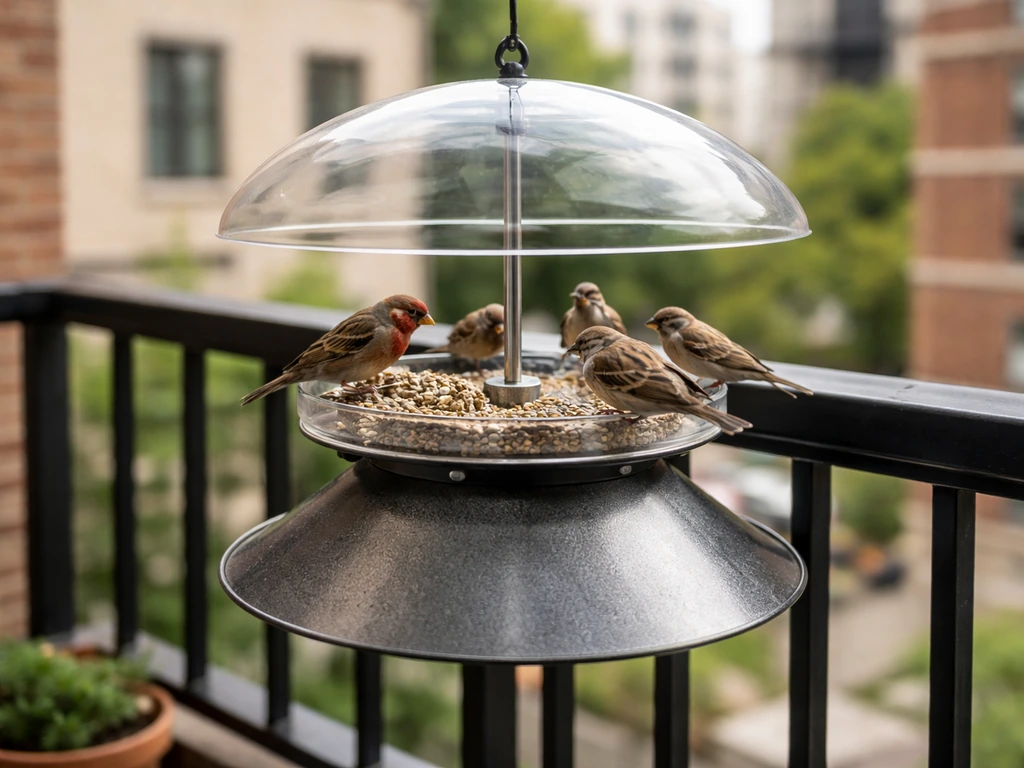
Use species‑specific designs and deterrents: weight‑activated or spring‑tension squirrel‑resistant feeders (Squirrel Buster, Brome) and motorized spinning perches (Yankee Flipper) for balconies. For grackles/pigeons: use smaller‑port nyjer feeders, caged feeders that limit access to smaller birds, or dome/baffle covers above trays. Add baffles on poles and keep feeders away from launching points (trees, ledges). No feeder is 100% proof — placement, seed choice and baffles together reduce pest access.
What anti‑vandalism and theft precautions are recommended for urban feeders?
Choose lower‑profile or less conspicuous feeders, secure mounts (bolted rail clamps, padlocks on pole hardware), and use weighted bases or tamper‑resistant fasteners. Place feeders within sightlines (for surveillance) but not easily reachable from the street. Consider motion‑activated lights or cameras (respect privacy rules). For rooftop communal areas, check building policy before installing permanent hardware.
Which materials and construction features should I look for in feeders for NYC weather and durability?
Look for UV‑stabilized plastics, powder‑coated or stainless steel hardware, rust‑resistant cages, and tight seals to keep seed dry. Ventilation/drainage ports prevent moisture and mold. For balconies with salt spray or coastal exposure, choose stainless steel or marine‑grade finishes. Removable trays and wide access points simplify cleaning and winter de‑icing.
Next Articles
Best Bird Feeders for Chicago: Top Picks for Urban Yards
Best bird feeders for Chicago: top picks, species-specific choices, weatherproof, grackle- & squirrel-proof buying guide
Best Urban Bird Feeders: Top Picks for City Balconies
Best urban bird feeders: expert, apartment-ready picks, species-focused, pest-proof, and balcony-safe.
Best Bird Feeder for City: Choose the Right Setup Fast
Pick the best city bird feeder setup for your space, birds, and mess control, including squirrel-proofing and smart came