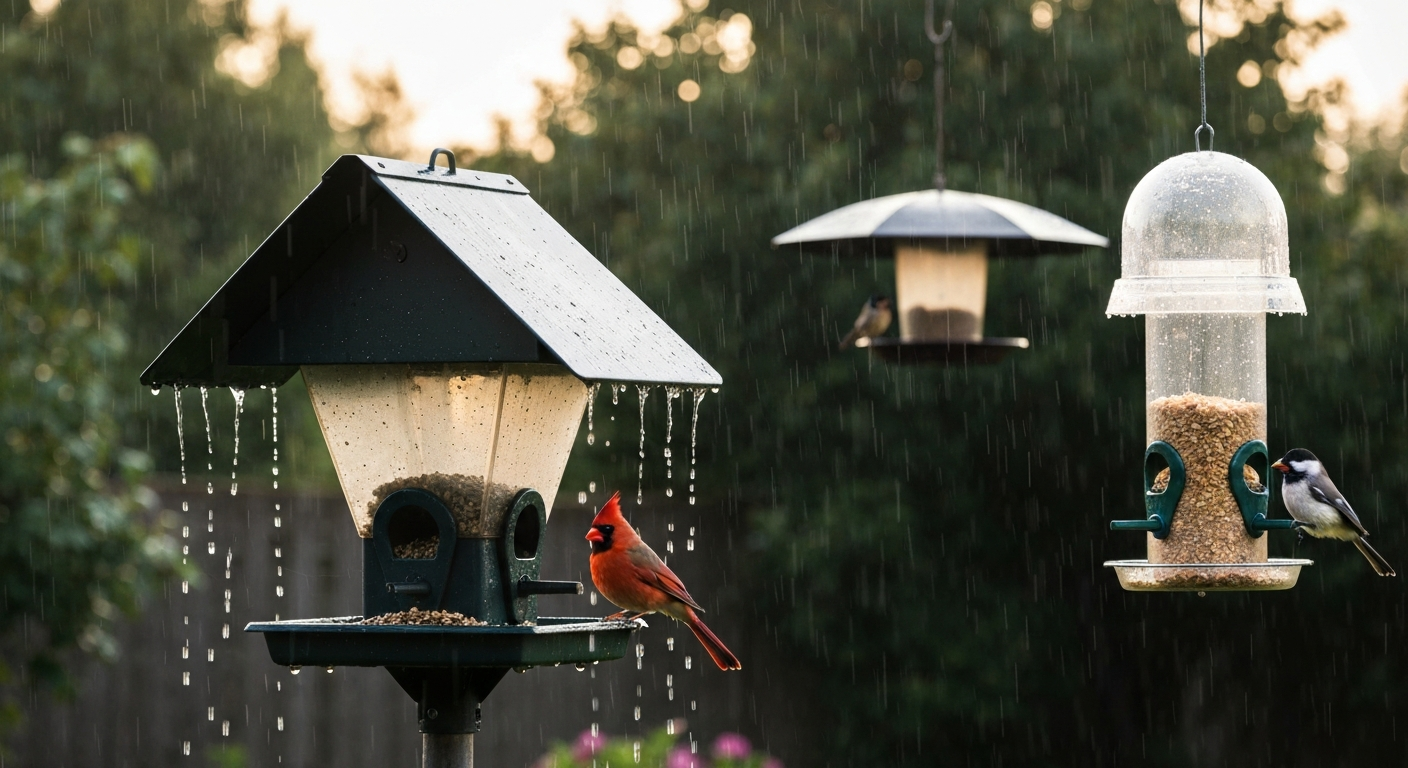
The feeders that most reliably keep seed dry share three things: a wide overhanging roof or dome that throws rain clear of the feeding ports, a perforated or raised seed floor with drain holes so any water that does get in escapes quickly, and enough ventilation to dry residual moisture before mold takes hold. Covered hopper feeders with deep roofs and drainage trays are the most practical all-weather choice for most backyards, while tube feeders paired with a polycarbonate dome baffle come in a close second. No single feeder design defeats every type of weather, so the right pick depends on whether your main enemy is driving rain, heavy snow, or wind-driven moisture, and which birds you are trying to feed.
Best Bird Feeder to Keep Seed Dry: Weatherproof Picks & Tips
Marcus Holloway
20 Jul 2026
Why wet seed is a bigger problem than most people realize
I learned this the hard way after leaving a platform feeder uncovered through a wet spring week. What started as clumped sunflower seed turned into a black, foul-smelling mass within four days. Mold and bacterial colonies establish themselves in waterlogged seed surprisingly fast, and birds either refuse it or, worse, eat it. Cornell Lab's Project FeederWatch is explicit on this: wet seed promotes fungal and bacterial disease, and removing it promptly is one of the most important things you can do to protect visiting birds. The stakes are real. Avian botulism, caused by Clostridium botulinum toxin accumulating in decaying organic matter and contaminated food, can paralyze and kill birds. A feeder that keeps seed consistently dry is not a luxury upgrade, it is a basic welfare issue.
Hummingbird nectar is even more time-sensitive. Peer-reviewed research has found that microbial communities inside hummingbird feeders diverge significantly from those in natural floral nectar, with yeast and bacteria thriving under warm feeder conditions. Yeast fermentation produces ethanol, and studies have measured hummingbirds ingesting low concentrations of it from feeders left out too long. Cornell Lab recommends changing nectar every two to three days in the shade and daily in very hot weather. A feeder design that minimizes sun and rain exposure can stretch those intervals a little, but there is no substitute for regular cleaning.
The quick answer: top feeder styles and picks for dry seed
If you want one recommendation without reading further: a covered hopper feeder with a generous roof overhang, a removable perforated seed tray, and at least four small drain holes in the base is the most consistently effective option for keeping seed dry across mixed weather. For tube feeders already in your yard, adding a UV-stabilized polycarbonate dome above the feeder (sometimes called a squirrel baffle or rain dome) is the single most cost-effective retrofit you can make. For platform feeders, a dome on a separate mounting arm above the tray is the only way to get meaningful rain protection. Here are the feeder styles that perform best in field conditions, ranked by how well they manage precipitation:
- Covered hopper feeder with deep roof and drainage tray: best all-round dry-seed performance in rain and snow
- Tube feeder with manufacturer-fitted roof cap and drain ports: reliable in moderate rain; add a dome for heavy weather
- Platform feeder under a wide dome or roof-over-tray combo: effective when properly set up but needs attentive maintenance
- Specialty seed-silo feeders with sealed reservoirs: excellent for extended dry storage between fills
- Hummingbird and nectar feeders with shaded, recessed ports: reduce sun and rain exposure but require frequent cleaning regardless
How weather actually wets seed: rain, snow, wind, and humidity
Rain is the obvious culprit, but the way it damages seed varies. Straight-down rain is easily blocked by any competent roof. The real test is driving rain: wind-blown water that comes in at an angle will defeat a shallow overhang completely. I have seen a feeder with a two-inch roof extension soaked through on a windy afternoon while a feeder with a four-inch overhang on the same pole stayed dry. Snow creates a different problem. It can accumulate on roofs and eventually slide into the seed tray, or it can pack around ports and block them. Feeders with steeply pitched roofs shed snow better than flat or low-pitch designs. Wind matters even on dry days because it accelerates evaporation of morning dew but also drives moisture into open trays and feeding ports if there is no lip or baffle. Humidity is the sneakiest issue: seed sitting in a humid environment without ventilation will absorb moisture from the air, swell, clump, and start to mold even with no direct rain contact at all. That is why ventilation slots matter as much as drain holes.
Waterproof vs. weatherproof: what the terms actually mean
These words get used loosely in feeder marketing, and the distinction matters. Waterproof, in a strict engineering sense, means the product prevents water ingress entirely and can be quantified using the IEC 60529 Ingress Protection (IP) scale. An IPX4 rating indicates splash resistance from any direction; IPX6 means resistance to powerful water jets. For smart feeders with built-in cameras or solar electronics, checking the stated IP rating of the electronic components is genuinely useful because it tells you whether the hardware will survive rain. For passive seed feeders, however, no feeder is truly waterproof in use because they have open ports by design. Weatherproof is the more relevant and honest term for feeders: it describes materials and construction that resist degradation from UV, temperature swings, and moisture over time, without claiming that no water can enter. When you see a feeder marketed as waterproof, what the manufacturer usually means is that the construction materials will not rot, rust, or crack in outdoor conditions, which is a materials claim, not a seal claim. The practical question is not whether the feeder is waterproof but whether its design actively sheds water away from the seed.
Design features that actually keep seed dry
Roof geometry and overhang
A roof that overhangs the feeding ports and tray by at least three to four inches on all sides deflects both vertical and moderate-angle rain. Patent designs for bird feeders, including US6,360,690 (self-cleaning feeder) and US5,086,730 (dome feeder), specifically describe overhanging roofs and wide conical domes as the primary mechanisms for blocking precipitation. The US5,086,730 patent specifies a dome diameter roughly double the width of the feeder trough below it, a useful rule of thumb when choosing or retrofitting a dome. See patent US5086730A, Bird feeder (Google Patents) which specifies a dome diameter roughly double the width of the feeder trough and describes conical baffles used to block precipitation and prevent deformation US5086730A — Bird feeder (Google Patents). Steeply pitched roofs (45 degrees or steeper) shed snow better than flatter profiles and also reduce the surface area on which rain pools before dripping through.
Drain holes and perforated trays
Drain holes are not optional on any tray or hopper with an enclosed base. The best designs use multiple small holes (six to eight holes around the tray perimeter rather than one central large hole) because small holes drain water while limiting pest and insect entry. Perforated or mesh seed floors are even more effective: they let water pass through while seed stays on the surface rather than sitting in a puddle. Removable perforated seed trays are the gold standard because you can pull them out, rinse off the residue, and dry them completely between fills. Product reviews of well-regarded hopper feeders consistently identify drainage tray design as the single feature that most separates clean, dry feeders from problem ones.
Baffles and wind shields
Baffles are typically conical or domed barriers mounted above or below a feeder on the pole or hanging cable. Above the feeder, a dome baffle blocks driving rain and redirects wind-blown water away from feeding ports. Below the feeder on a pole, a baffle primarily serves a squirrel-proofing function but also reduces splash from rain hitting the ground and bouncing upward. Some manufacturers integrate a baffle directly into the feeder housing as a rain guard over each feeding port, which is particularly effective on tube feeders.
Ventilation slots
Ventilation is the underrated feature. Small slots or gaps in the feeder body, particularly near the seed reservoir and tray, allow airflow that accelerates drying after rain events. Without ventilation, residual moisture trapped inside a sealed hopper creates a humid microenvironment that triggers mold even on seeds that appear superficially dry. A good feeder combines drainage (to remove liquid water) with ventilation (to remove water vapor) as a paired system.
Sealed reservoir vs. open tray design
Hoppers and seed-silo feeders with enclosed reservoirs keep bulk seed dry by design: seed only enters the tray or port area in small amounts as it is consumed. Open platform feeders expose all the seed at once, which means any rain event wets the entire supply. If you want to use a platform feeder, pairing it with a wide dome roof cover is non-negotiable in any climate with regular precipitation.
Materials and construction: which ones hold up to wet weather
Material choice determines how long a feeder maintains its weather-protective properties, not just whether it looks intact. Here is how the main options compare in real outdoor conditions.
| Material | Water Resistance | UV Resistance | Weight | Maintenance Needs | Best Use |
|---|---|---|---|---|---|
| UV-stabilized polycarbonate | Excellent (does not absorb water) | Good with UV stabilizer (Makrolon-type grades resist yellowing) | Light | Low; rinse clean | Tubes, domes, transparent reservoirs |
| Powder-coated steel | Good (coating protects underlying metal) | Good (validated to ASTM G154 UV and B117 salt-spray standards) | Heavy | Low-medium; check coating for chips | Hopper bodies, roof panels, frames |
| Stainless steel (grade 316) | Excellent (molybdenum content resists chloride corrosion) | Excellent | Medium-heavy | Very low | Hardware, screws, cable hooks, coastal/humid climates |
| Recycled or virgin HDPE plastic | Good (non-porous, does not rot) | Variable (UV stabilizers in better grades) | Light-medium | Low | Hopper and tray bodies, perches |
| Cedar or redwood (untreated) | Moderate (natural oils resist moisture but wood eventually swells and checks) | Poor without finish; moderate with exterior stain | Medium | High; annual sealing recommended | Traditional hopper and platform styles |
| Acrylic (PMMA) | Good (water-resistant surface) | Moderate (yellows faster than polycarbonate under prolonged UV) | Light | Low; scratches easily | Transparent panels in hoppers |
| Powder-coated aluminum | Excellent (aluminum does not rust) | Good with quality coating | Light | Low | Feeder frames, roof structures |
A practical note on wood feeders: cedar and redwood are genuinely attractive and birds take to them readily. The problem is that raw wood swells when wet, which can cause seed to jam in the hopper throat or tray warping that compromises drainage. If you prefer a wood feeder, treat it annually with a non-toxic exterior wood oil or stain, and inspect the drain holes each spring because swollen wood frequently closes them off. Painted wood offers no real waterproofing benefit without a proper primer and exterior topcoat.
For hardware specifically (screws, hanging cables, perch rods), grade 316 stainless steel is worth paying for if you live in a coastal area or somewhere with persistently humid winters. Grade 304 stainless corrodes slowly in salt-laden air and eventually produces rust stains that can transfer to seed. The molybdenum content in 316 makes a measurable difference to corrosion resistance in wet or marine conditions.
Comparing feeder types for dry-seed performance
Different feeder designs have very different starting points when it comes to keeping seed dry. Understanding the structural strengths and weaknesses of each type helps you set realistic expectations and know which retrofits are worth adding.
Covered hopper feeders
Hopper feeders are the workhorses of backyard birding, and for good reason. A well-designed hopper encloses the bulk seed in a reservoir and dispenses it through a slot or opening at the base only as birds feed. The enclosed body keeps stored seed dry even during prolonged rain, provided the roof seals well at the peaks and the drainage tray is functional. The weak points are the seed dispensing gap (where rain can blow in if the hopper face points into prevailing wind) and the tray below (which needs drain holes and ideally a perforated floor). Hoppers with deep, steeply pitched roofs that extend well beyond the feeder body sides are the most weather-resistant. Cardinals, chickadees, house finches, and jays all use hopper feeders readily, making them a good choice when you want to attract a mixed flock.
Tube feeders with roofs and baffles
Tube feeders present seed at individual ports along a cylindrical or hexagonal body. The seed inside a quality tube (polycarbonate or UV-stabilized plastic) stays reasonably dry because the reservoir is enclosed and ports are small. The vulnerability is the bottom cap: seed that falls to the base and is not consumed can trap moisture and mold. Look for tube feeders with removable bottom caps that you can unscrew and clean, and check whether drain holes are present in the cap itself. Adding a polycarbonate dome on the hanging wire above the tube converts a basic tube feeder into a genuinely weather-resistant setup. Manufacturers like Aspects market UV-stabilized polycarbonate dome tops (Super Tube Top style) explicitly for this purpose, and they also serve as squirrel deterrents. Tube feeders suit finches, chickadees, nuthatches, and small sparrows.
Platform feeders with domes
Open platform feeders have the worst baseline weather resistance of any feeder type because seed is fully exposed. Their advantage is that they attract the widest species range, including cardinals, doves, juncos, and towhees that prefer feeding in an open, flat space. The fix is a wide dome or roof mounted directly above the platform on a separate arm or on the same pole. The dome diameter should be at least double the platform width for serious rain protection. Even with a good dome, platform feeders require more frequent seed refreshing after weather events than hopper or tube designs, so they work best where someone is actively monitoring the feeder rather than doing a weekly fill-and-forget routine.
Tray and roof combos
Tray-with-roof feeders are essentially shallow platforms with an integrated overhead cover on posts or a hanging frame. They sit between open platforms and hoppers in weather resistance. The roof keeps direct rainfall off, but driving rain and side-angle precipitation still reach the seed unless the roof has meaningful sidewall depth. The best versions have a roof that extends down to partially enclosed sides, effectively creating a mini shelter. These are good for ground-feeding species like doves, sparrows, and juncos, and for larger birds like woodpeckers that want a broad landing area. Drainage holes in the tray floor are essential.
Specialty feeders: seed socks, silo feeders, and nectar feeders
Nyjer (thistle) sock feeders are breathable by design, which actually helps: water drains and evaporates through the mesh quickly. The trade-off is that seed can still clump in extended rain. Silo-style feeders with sealed reservoirs and small feeding ports handle wet weather well because very little seed is exposed at any time. For hummingbird nectar feeders, weather protection has a different meaning. Saucer-style feeders with the nectar reservoir below the ports keep nectar out of direct sun and reduce rain dilution, but no feeder design eliminates the need for regular cleaning. Shaded placement matters as much as feeder design for nectar freshness. Ports that face downward or are deeply recessed reduce rain entry, though the real enemy of nectar is heat and fermentation, not rain dilution on its own.
| Feeder Type | Dry-Seed Rating | Best Birds | Rain Defense | Snow Handling | Maintenance Level |
|---|---|---|---|---|---|
| Covered hopper (deep roof + drain tray) | Excellent | Cardinals, chickadees, finches, jays | Very good (enclosed reservoir) | Good (pitched roof sheds snow) | Low-medium |
| Tube feeder + polycarbonate dome | Very good | Finches, chickadees, nuthatches | Good (dome blocks driving rain) | Moderate (dome deflects snow) | Low |
| Tube feeder (no dome) | Moderate | Finches, chickadees, nuthatches | Moderate (ports are small but base cap can trap water) | Moderate | Medium |
| Platform feeder + wide dome | Good (with dome) | Cardinals, doves, juncos, towhees | Good if dome is wide enough | Poor (snow loads on tray) | High |
| Tray/roof combo feeder | Moderate-good | Doves, sparrows, woodpeckers, juncos | Moderate (roof helps, sides open) | Moderate | Medium |
| Seed silo/sealed reservoir | Very good | Finches, sparrows, mixed small birds | Excellent (minimal exposed seed) | Good | Low |
| Nyjer sock feeder | Moderate | Goldfinches, siskins | Poor in heavy rain (mesh wets through) | Poor | Medium-high |
| Hummingbird nectar (saucer, shaded) | N/A (nectar) | Hummingbirds | Good (recessed ports) | Not applicable | Very high (change every 2-3 days) |
Weather-specific recommendations: rain, snow, and wind
Rainy season and high-precipitation climates
If you live somewhere with a genuine rainy season, Pacific Northwest, Gulf Coast, or anywhere that gets multi-day rain events, the hopper feeder with drainage tray is your foundation. Pair it with a polycarbonate dome baffle above if it is a hanging feeder, or place it on a pole under a separate roof structure if you are mounting on a post. Fill the feeder more frequently but in smaller quantities during rainy periods so that seed does not sit long enough to absorb moisture through the dispensing gap. If you are using tube feeders, models with rain guards over individual ports (some manufacturers machine a small overhang into each port hole) significantly outperform bare ports in side-driven rain tests. Field testing using a garden hose spray at 45 degrees is a simple way to identify whether a feeder's existing ports are vulnerable before committing to a wet-weather setup. Related feeder types worth exploring for consistently wet climates include fully waterproof-bodied feeders, which are covered in depth in the best feeders for rainy weather and best waterproof bird feeder guides on this site.
Winter and snow
Snow creates seed problems through two mechanisms: direct accumulation in and on the feeder, and freeze-thaw cycles that turn wet seed into an icy slab. A steeply pitched roof (45 degrees or steeper) sheds snow loads before they become heavy enough to slide into the seed tray or crack plastic components. Metal roofs with a slick powder-coat finish shed snow faster than textured surfaces or wood. In very cold climates, avoid feeders with rubber or silicone seals around the reservoir lid because those materials can stiffen and crack below about minus 20°C. UV-stabilized polycarbonate holds up better in freeze-thaw cycles than standard acrylic or PVC, which become brittle. For winter bird feeding, a hopper with an elevated, off-the-ground mounting position on a baffled pole keeps snow splash from below from wetting the seed tray. Keep the feeder filled more consistently in deep winter because birds rely on predictable food sources during cold snaps and an empty feeder in a snowstorm is a welfare concern. The best bird feeder for winter guide on this site covers cold-specific design choices in much more detail.
Windy locations
Wind is the condition that defeats the most otherwise-competent feeders. A feeder that handles vertical rain perfectly can flood in wind-driven rain if the overhang is not deep enough or if the feeder body swings and tips. For exposed or windy gardens, a pole-mounted feeder on a stable, heavy-base pole system is more reliable than a hanging feeder on a thin wire because it does not swing and change angle relative to driving rain. If you use hanging feeders in windy areas, weight the feeder slightly (some designs allow you to add a water reservoir base or weighted tray) to reduce sway. A dome baffle above a hanging feeder also reduces pendulum-like swinging in wind. Feeders with enclosed, narrow feeding ports (tube style) rather than open trays handle wind-driven moisture much better than open platform designs. The best bird feeders for windy areas article covers mounting hardware and windbreak placement strategies for persistent-wind situations.
Species-specific guidance
The feeder design that keeps seed driest is only useful if the birds you are trying to attract will actually use it. Here is a practical species-by-species breakdown:
- Cardinals: prefer large, open feeding platforms or wide hopper trays with good perch space. A covered hopper with a wide tray and roof overhang suits them well. They will not use small-port tube feeders reliably.
- House finches and goldfinches: comfortable on tube feeders. A tube feeder with a dome baffle overhead is an excellent dry-seed solution for this group. Nyjer socks work for goldfinches but are poor in heavy rain.
- Chickadees and nuthatches: adaptable to tube feeders, small hoppers, and even peanut feeders. Almost any covered feeder works for these species.
- Woodpeckers: need a broader landing area than most tube feeders provide. A suet cage under a hopper overhang or a tray/roof combo suits them. Suet is less vulnerable to rain than loose seed but should still be sheltered from prolonged soaking, which can wash away fat and soften the cake.
- Mourning doves and ground-feeding sparrows: need a platform or tray. Use a wide dome overhead and accept that these feeders need more frequent attention in wet weather.
- Hummingbirds: saucer-style feeders with downward-facing ports and shaded placement reduce both nectar dilution from rain and fermentation from sun. Change nectar every two to three days (daily above 32°C) regardless of feeder type. Clean with a bottle brush and hot water, no soap, at every refill.
- Juncos and towhees: primarily ground feeders. A low tray feeder with a wide roof cover on a short post, or seed scattered on a covered ground-level platform, works best. Keep quantities small during wet weather to avoid mold accumulation.
Smart feeders and camera models: weather protection to look for
AI-enabled and camera-equipped feeders have become genuinely useful tools for identifying visiting species, but they add electronics into an inherently wet outdoor environment. When evaluating a smart feeder for weather resistance, look for the IP rating of the camera module and any solar charging component. IPX4 (splash-resistant from any direction) is the minimum acceptable for most backyard conditions; IPX5 or higher is better if the feeder will be fully exposed. Beyond the electronics, apply the same seed-dryness standards you would to any passive feeder: check whether the feeder body has a proper roof overhang, drainage ports, and a cleanable seed tray. Some smart feeders compromise on seed-protection design in favor of camera positioning (mounting the camera at an angle that also means the roof overhang is shallower than ideal), so inspect the geometry before buying. The best smart feeders combine a clear polycarbonate tube or window for camera visibility with a separate roof structure that still provides genuine weather protection for the seed.
Placement and mounting strategies that reduce wet seed
Even the best-designed feeder will struggle if you put it in the wrong spot. Placement choices that reduce seed wetting: position feeders on the lee side of a structure (house wall, fence, dense shrub) that blocks the prevailing wind direction, which dramatically reduces driving rain exposure. Avoid placing feeders directly under tree canopy because drip from leaves after rain can wet seed for hours after the rain stops. If you hang feeders from a branch, hang them at the end of the branch rather than directly beneath a drip point. For pole-mounted feeders, use a baffled pole system that also separates the feeder from ground-level splash. Mounting height of 1.5 to 1.8 meters off the ground is a practical standard: high enough to reduce splash, low enough for easy filling and cleaning. During extended wet weather, temporarily moving a feeder to a covered porch or carport overhang is a legitimate strategy to protect both the seed and the feeder itself.
Squirrels, grackles, and pigeons: the wet-seed complication
Pest birds and squirrels worsen the wet-seed problem beyond just competition for food. Squirrels sitting in a feeder tray displace seed into wetter outer zones and damage drainage holes by chewing. Grackles and pigeons feed in large, messy groups that scatter seed onto wet surfaces below the feeder and also flick seed into standing water in the tray. A feeder that is squirrel-resistant by design (caged tube feeder, weight-sensitive closing mechanism, or baffled pole) tends to also have design features (small ports, enclosed body) that improve weather resistance. A weight-activated closing mechanism that shuts ports when a heavy bird lands is not only a grackle solution, it also means the feeding opening is partially closed during non-feeding periods, reducing rain ingress. Addressing squirrel and nuisance-bird access is effectively dual-purpose maintenance for wet-seed prevention.
Retrofitting an existing feeder for better weather resistance
If you have feeders already and want to improve their dry-seed performance without replacing them, these are the most cost-effective interventions in order of impact:
- Add a polycarbonate dome baffle above the feeder on the hanging wire or mounting arm. This is the single highest-impact retrofit for any hanging feeder in rain and wind.
- Drill additional drain holes in the seed tray if the existing holes are few or small. Use a 4-6mm drill bit and add holes at the perimeter. This takes about five minutes and dramatically improves drainage.
- Insert a mesh or perforated plastic insert into the tray floor. Cut a piece of plastic mesh (like garden mesh) to fit the tray so seed sits above the tray base and water drains through.
- Reorient the feeder so the dispensing face or open tray side points away from the prevailing wind direction.
- Add ventilation by drilling small (3-4mm) slots near the top of a hopper body on sheltered sides to encourage airflow without direct rain entry.
- Treat wooden feeder components with a food-safe exterior wood oil or beeswax finish annually to reduce wood swelling that blocks drain holes.
- Move the feeder location to the lee side of a wind-blocking structure if driving rain is the primary issue.
Maintenance schedule to keep seed genuinely dry
The best feeder design in the world fails if maintenance is neglected. Here is a practical schedule based on real weather conditions rather than calendar dates:
- After every significant rain event: check seed in trays and dispensing areas for clumping or wet patches. Remove and discard any wet or clumped seed immediately. Do not cover wet seed with dry seed on top.
- Weekly in dry weather, every 2-3 days in rainy or humid weather: empty and inspect the feeder tray and seed reservoir. Look for any dark discoloration (early mold), musty smell, or insect activity.
- Monthly: full disassembly and cleaning with a 9:1 water-to-bleach solution or hot soapy water followed by thorough rinsing and complete air-drying before refilling. This is the step most people skip and the one that matters most for bird health.
- Annually (spring): inspect all drain holes and clear any blockages; check wooden components for swelling or cracking; inspect powder-coat or painted surfaces for chips or rust spots; re-treat wood feeders with exterior oil.
- Hummingbird feeders: change nectar every 2-3 days in shade, daily in temperatures above 32°C. Clean with hot water and a bottle brush at every nectar change during summer. Discard nectar at the first sign of cloudiness, mold spots, or sour smell.
Your dry-seed feeder buying checklist
Use this checklist when evaluating any feeder for purchase or comparing models side by side. A feeder that checks six or more of these boxes will perform well in most backyard weather conditions.
- Roof overhang of at least 3-4 inches on all sides, steeply pitched (45 degrees or more)
- Enclosed seed reservoir (hopper or tube design) that limits seed exposure to small ports or dispensing slots only
- Drain holes in tray base: multiple small holes (6+ holes) rather than one large central hole, or a perforated/mesh tray floor
- Ventilation slots near reservoir top or hopper body sides to allow airflow and moisture escape
- Materials rated for outdoor UV and moisture: UV-stabilized polycarbonate, powder-coated steel (validated to ASTM G154/B117), or rot-resistant wood with exterior treatment
- Removable seed tray and reservoir for cleaning access
- Compatible with or already includes a dome baffle for mounting above the feeder
- Hardware (screws, hooks, hanging cable) in stainless steel grade 304 minimum, grade 316 for coastal or very humid climates
- Port or dispensing gap geometry that minimizes wind-driven rain entry (recessed ports, downward-facing openings, or port guards)
- For smart/camera feeders: IP rating of IPX4 or higher on electronic components
Final recommendation
For the majority of backyard setups, a covered hopper feeder with a deep, steeply pitched roof, perforated drainage tray, and a dome baffle added above it on a baffled pole delivers the best combination of dry-seed performance, species range, and manageable maintenance. For specific models that meet these criteria, see our guide to the best weatherproof bird feeder. For specific model recommendations and hands-on tests, see our guide to the best waterproof bird feeder. If you primarily want to attract finches and do not mind a little more hands-on upkeep, a quality tube feeder with a polycarbonate dome added is an excellent narrower-purpose option. Platform feeders are worth using for the species that prefer them but should be treated as a daily-check feeder rather than a fill-and-leave-for-a-week one. Whatever feeder you choose, the design features and materials matter far less than consistent maintenance: check seed after rain, clean monthly, and discard wet seed without hesitation. A modest feeder maintained well will protect birds more effectively than an expensive one that gets ignored.
FAQ
Which feeder designs keep seed the driest in rain, snow and wind?
Covered hopper feeders with wide overhanging roofs and raised perforated seed trays perform best for dry seed; tube feeders with a large roof and a baffle/dome above the ports are a close second. Platform feeders can work if fitted with a dome or roof and have drainage/raised mesh floors. Avoid open trays without a cover in rainy or snowy sites.
What specific design features actually prevent seed from getting wet?
Key features: broad overhanging roofs/domes sized larger than the feed ports, recessed or louvered feeding openings, raised seed floors with multiple small drain holes, ventilation slots to speed drying, and baffles above or around ports to block driving rain/wind. Materials and finish that resist warping and corrosion (UV‑stabilized polycarbonate, powder‑coated steel, stainless hardware) also preserve seals and overhang geometry.
How do materials affect weather resistance and longevity?
UV‑stabilized polycarbonate and thick acrylic resist yellowing and shed water well for domes and tubes. Stainless steel hardware (grade 316 best near coasts) and powder‑coated or galvanized steel resist corrosion. Avoid cheap thin plastics that crack or deform, because gaps let water in. Look for weather‑rated finishes and stainless fasteners to maintain fit over time.
What's the difference between waterproof and weatherproof for feeders?
Weatherproof means the feeder is designed to resist typical outdoor exposure (rain, sun, wind) over time; waterproof implies components resist direct water intrusion (rare for whole feeders). For electronics, check IP ratings (e.g., IPX4 splash, IPX5 water jets). For mechanical feeders, prioritize 'weatherproof' features: properly sized roofs, drainage and ventilation rather than claiming fully waterproof.
Which feeder types are best for rainy seasons vs. winter/snow vs. windy sites?
Rainy season: covered hoppers or tube feeders with large domes and drainage. Winter/snow: hopper feeders with sealed roof joints, steep roof pitch to shed snow, and raised seed-trays; use larger overhangs to prevent drifting snow. Windy locations: feeders with recessed ports, heavy-duty mounts to reduce swinging and baffles on poles to block driving rain. In all cases ensure drainage and ventilation to avoid trapped moisture.
How should I place and mount a feeder to minimize wet seed?
Position feeders under partial cover (eaves, tree canopy) but not so close that predators use perches. Mount on sturdy poles with predator baffles and add a drip shield or roof extension above the feeder. Avoid mounting where wind funnels toward the feeder. Use fixed mounts rather than hanging lines if feeder swing causes rain entry. Angle tube ports slightly down if adjustable.