For windy backyards, the feeders that hold up best are heavy, low-profile hopper feeders with locking lids, weight-activated tube feeders with seed guards, and pole-mounted cage suet feeders with tight-fitting hardware. Platform feeders work too, but only when they are mounted close to the ground with a deep lip. The common thread is mass, a secure seed reservoir, and a mount that absorbs sway rather than amplifying it. Get those three things right and you will spend far less time chasing empty feeders across the yard and refilling trays that blew clean overnight.
Best Bird Feeders for Windy Areas: Windproof Picks
Marcus Holloway
7 Jul 2026
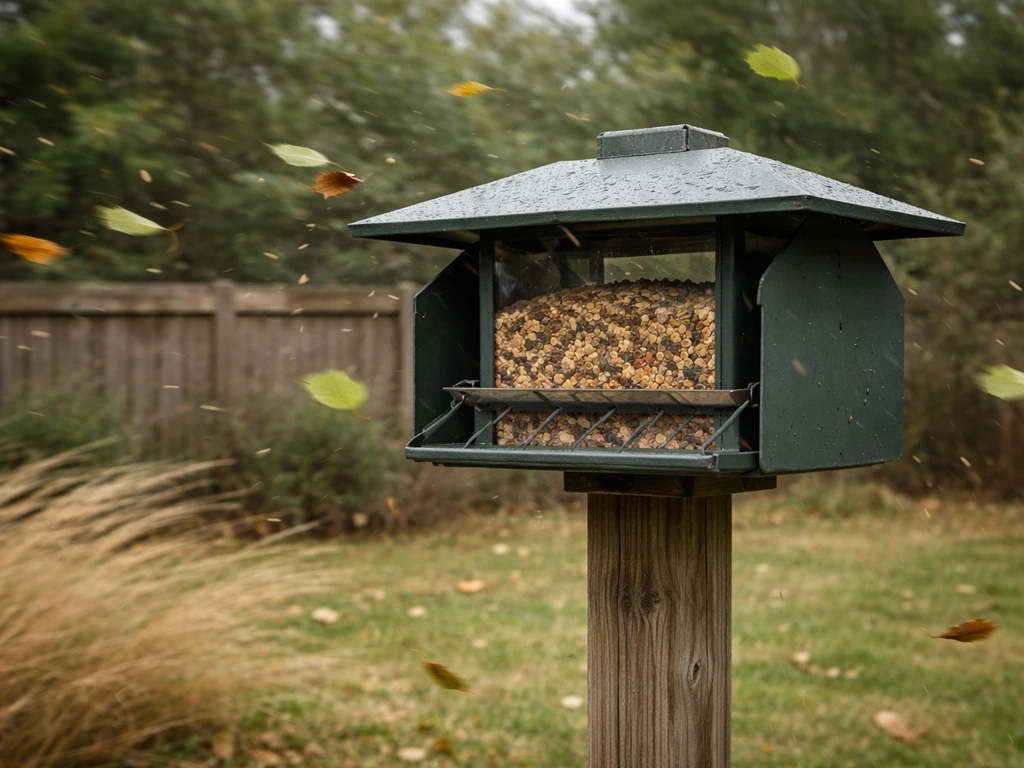
Why wind wrecks most feeders (and what to look for)
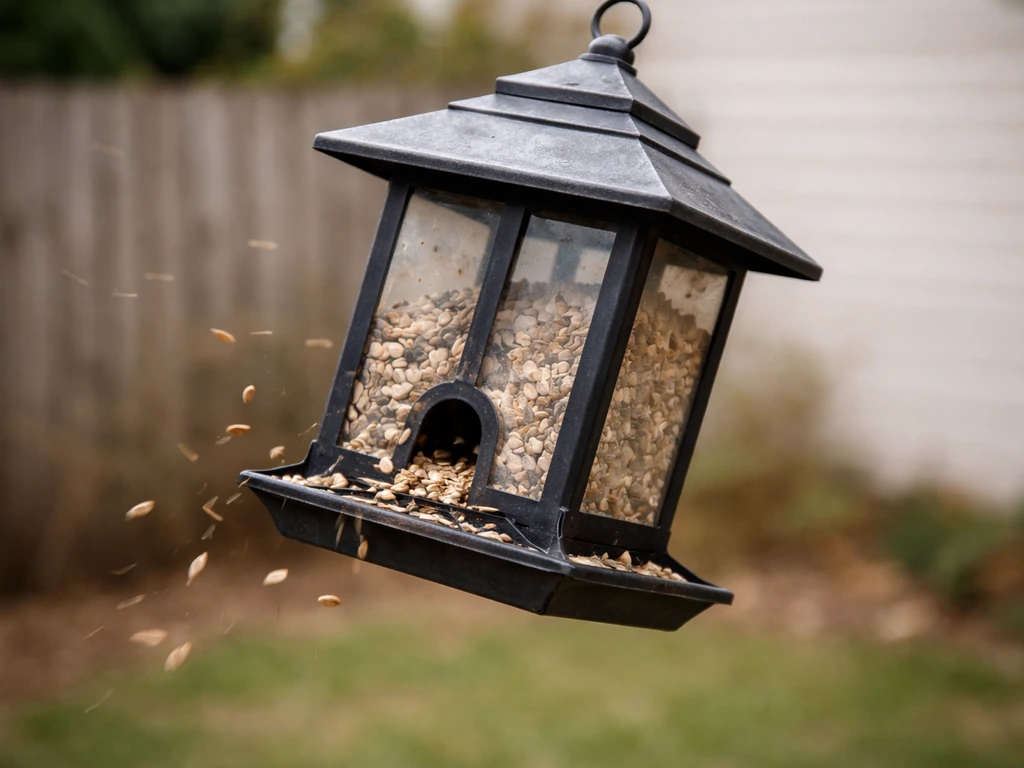
Wind causes four distinct problems for backyard feeders, and understanding each one makes shopping a lot easier. First is seed spillage: any feeder that hangs freely will sway, and once it starts rocking the seed flies out of the ports and off the tray, sometimes faster than birds can eat it. Second is structural failure: lightweight plastic hoppers and thin tube feeders crack or split at the seams when they whip against a pole or slam into a fence.
Third is weather intrusion: a poorly designed roof or an unlocked lid lets rain and driven snow pack the seed solid, causing mold practically overnight. Fourth is bird reluctance: most songbirds, especially cardinals and larger ground-feeding species, avoid a feeder that is swinging wildly because they cannot land steadily on a moving perch.
When you are shopping, the features that address all four of those problems are the same: a feeder with meaningful mass (heavier feeders sway less), a locking or snap-fit lid so gusts cannot pop it open, seed ports or trays that are sheltered under a wide overhanging roof, and a rigid mounting connection rather than a simple S-hook on a single wire. A locking lid like the Sure-Lock cap design keeps the reservoir sealed against both squirrels and weather, so the same feature that stops theft also stops spill-off in a storm. Weight-activated mechanisms like the Squirrel Buster Plus (which holds 5.1 lbs of seed and stands 28 inches tall) add useful ballast just by being full of seed, which genuinely reduces the swing arc in a steady breeze.
Which feeder types actually hold up in gusts
Not every feeder style is equally suited to wind. Here is how the main categories compare when the gusts pick up.
Hopper feeders
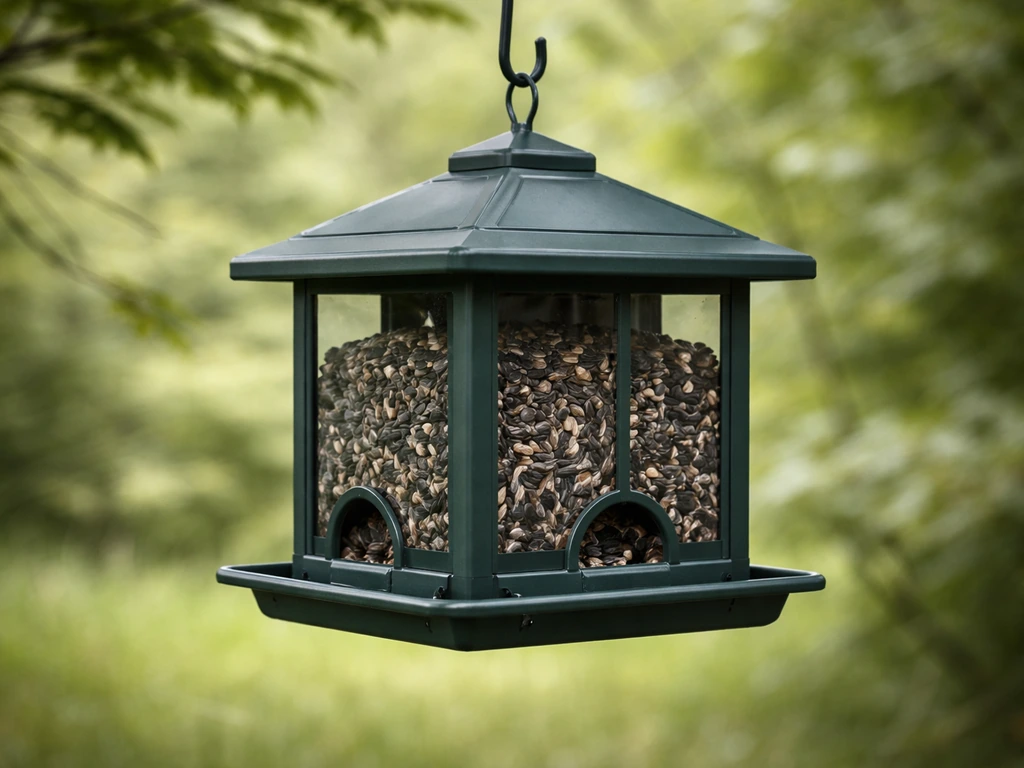
Hoppers are the most wind-tolerant hanging feeder style because of their weight and enclosed design. A full hopper loaded with blank" rel="noopener noreferrer">black-oil sunflower seed is heavy enough that it resists wild swinging on most days. The enclosed reservoir keeps seed dry during rain and reduces scatter from sideways wind. The trade-off is that cheap hoppers with thin roofs and no lid locks can still blow open. Look for a metal or thick polycarbonate hopper with a hinged roof that either latches or uses friction-lock hardware. Avoid hoppers with wide open trays on both sides in exposed locations; the tray acts like a sail and the seed blows right off.
Tube feeders
Tube feeders are lighter than hoppers, which makes them more vulnerable to sway, but the better-engineered ones handle wind reasonably well. The key features to look for are a weather cap at the top (ideally with a ventilation system that lets humidity escape rather than trapping moisture that rots seed), a seed tray with drainage holes at the bottom, and ports that face partially downward or inward so driving rain does not flood them. Tube feeders with seed tube ventilation built into the cap are worth the extra cost in humid or rainy climates. For nyjer feeders specifically, the tiny ports are actually a mild wind advantage since seed does not pour out easily, though the feeder itself is light and needs a stable mount.
Platform and tray feeders
Open platform feeders are the most problematic in wind. They have no walls, so seed simply blows off. If you want to use a platform feeder in a windy yard, choose one with a raised lip of at least 1. 5 inches around the perimeter and mount it low (close to the ground or on a short post rather than hanging) so the wind speed is lower and there is less swing.
A roofed platform with mesh screening on the bottom drains quickly after rain and keeps the seed from sitting in a puddle, which matters because wet seed molds fast. In very exposed areas, I honestly steer people away from open platforms as a primary feeder and suggest using one as a supplemental ground-level tray instead.
Suet and cage feeders
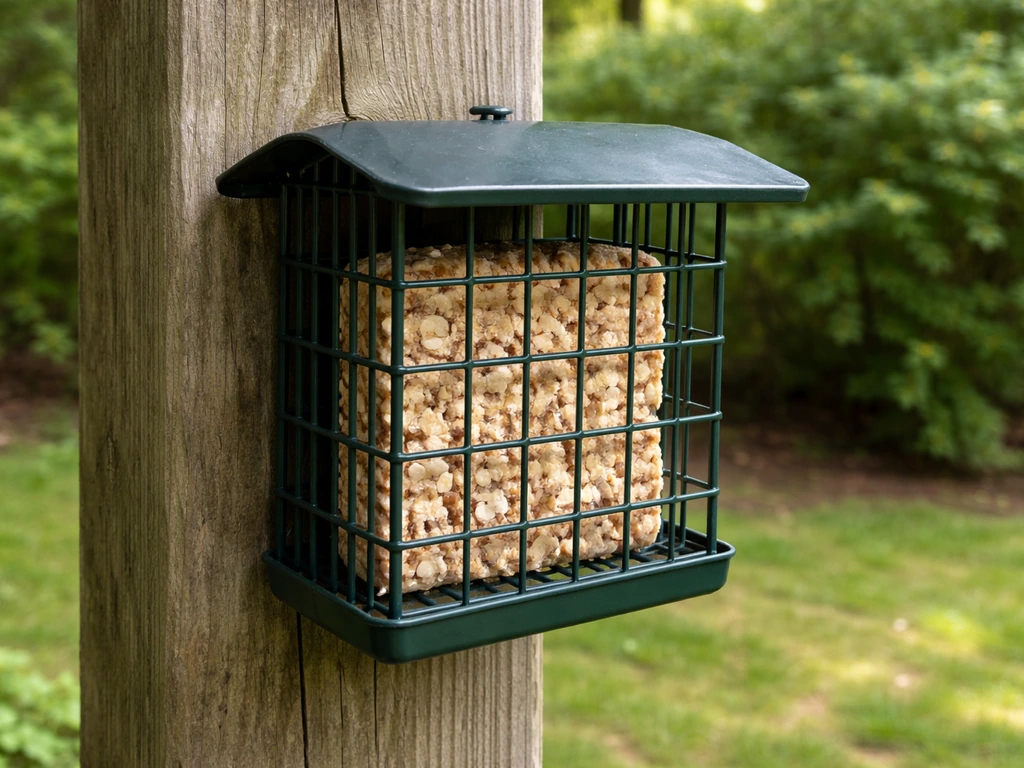
Suet cage feeders are actually one of the best wind-resistant options. They are compact, have almost no surface area for wind to catch, and the suet cake itself is dense and locked behind bars so it is not going anywhere. The main failure mode is a poorly fitted cage door that swings open in strong gusts; look for a cage with a closing mechanism that hooks or pins shut rather than just folding over. A double-cake cage is slightly heavier and wobbles less than a single-cake version. For woodpeckers and nuthatches, a tail-prop suet feeder adds a lower extension that gives birds a brace point, and it is short enough that the extra length does not create much additional swing.
Specialty and weight-activated feeders
Weight-activated squirrel-proof feeders like the Squirrel Buster Plus happen to perform well in wind for a simple reason: the spring-loaded shroud mechanism adds weight and the whole unit is engineered to be a rigid, balanced assembly. When a gust hits, the mass of the seed (up to 5.1 lbs) and the structural integrity of the tube keep the sway minimal. The shroud also partially shelters the ports from sideways rain and wind-driven debris. These feeders cost more, but in windy yards they are genuinely pulling double duty.
| Feeder Type | Wind Resistance | Best For | Main Weakness |
|---|---|---|---|
| Hopper (metal/polycarbonate) | High | Cardinals, jays, chickadees, general mix | Wide trays act as sails; lock the lid |
| Weight-activated tube | High | Most perching songbirds | Lighter when empty; keep it full |
| Suet cage (double-cake) | High | Woodpeckers, nuthatches, chickadees | Door latch quality varies |
| Standard tube (nyjer) | Moderate | Goldfinches, siskins, redpolls | Light; needs rigid pole mount |
| Platform/tray (roofed) | Low-Moderate | Cardinals, doves, sparrows (ground feeding) | Open design; seed blows off easily |
| Open platform (hanging) | Low | Supplemental/emergency use | Significant seed loss in wind |
Where and how to mount feeders in a windy yard
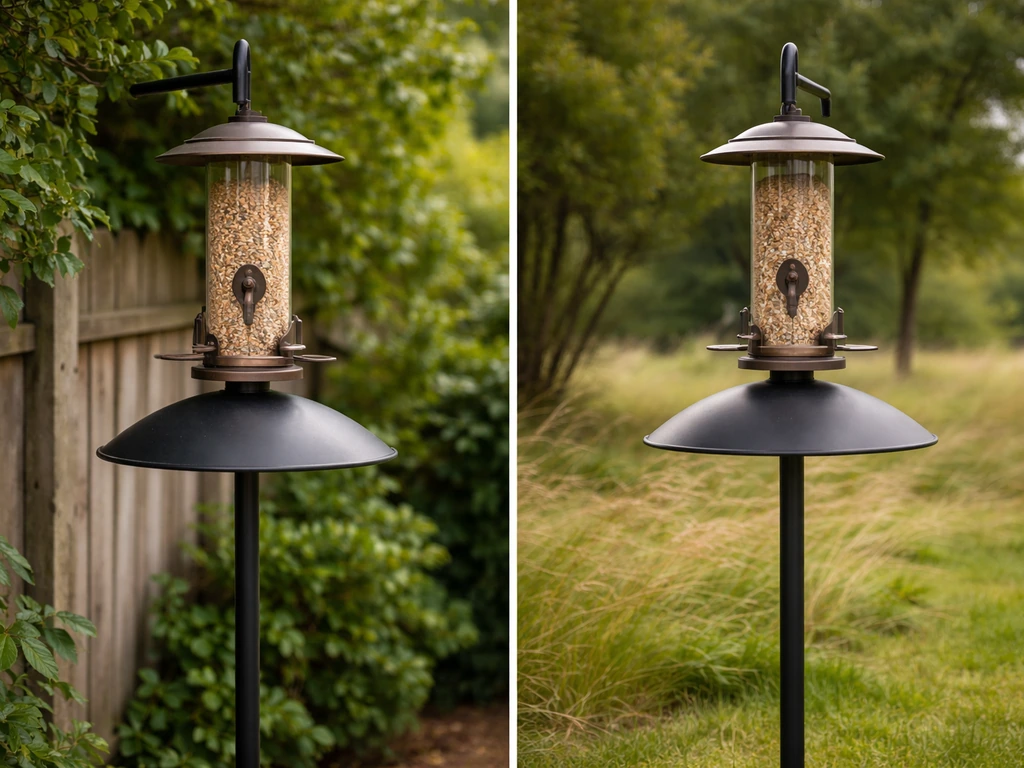
Placement changes everything. A feeder that performs poorly hanging from a tree branch in an open yard might work perfectly mounted on a sturdy post in a sheltered corner. The general guideline I follow is the 5-7-9 rule: about 5 feet off the ground, 7 feet from fences and vertical structures, and 9 feet from overhanging branches.
The 5-foot height is partly about cat deterrence but it is also about wind: wind speeds near the ground are lower than at 8 or 10 feet, so a low post mount reduces sway by default. The 7-foot horizontal clearance keeps the feeder from slamming into a fence in a big gust. The 9-foot roof/branch clearance prevents both squirrel drops and the turbulent downwash you get on the leeward side of a tree.
The single biggest upgrade you can make in a windy yard is switching from a hanging wire to a rigid pole mount. A pole-mounted feeder simply does not swing. A quality shepherd's hook or dedicated feeder pole with a wide base, or one that you can drive 18 or more inches into the ground, creates a stable platform that stays put in all but the most extreme gusts.
If you are in a genuinely exposed location like a coastal yard or an open rural property, consider a pole with a tension wire or a guy wire staked into the ground at an angle. It looks slightly utilitarian, but the birds do not care and neither will you when you watch everyone else's feeders tumbling across their lawns.
Avoid mounting feeders at the corners of your house, at the edges of tree canopies, or anywhere a building edge creates acceleration of airflow. Wind funnels around corners and roof edges, and feeders hung there will spin and bounce regardless of how good the hardware is. Instead, place feeders in the partial lee of a fence, a shed wall, or a dense shrub that breaks the wind while still leaving enough open space that birds can approach safely from multiple directions. A windbreak does not need to eliminate wind entirely; reducing gusts by even 30 to 40 percent is enough to keep most feeders stable.
Baffles, squirrel-proofing, and predator guards when it is windy
This is where a lot of people run into trouble: they install a baffle correctly for calm conditions and then a windy day undoes everything. A hanging baffle above a feeder acts like a parachute in the wind, adding swing and sometimes spinning the whole assembly. The fix is to use a pole-mounted baffle below the feeder instead of, or in addition to, an above-feeder hanging baffle. A pole-mounted squirrel baffle like the 16-inch diameter Perky-Pet Transparent Squirrel Baffler sits on the pole shaft and is fixed in place; it does not move in the wind. It physically prevents squirrels from climbing the pole, and because it is rigid, it adds nothing to the sway equation.
For hanging setups where a pole is not practical, a weight-activated feeder like the Squirrel Buster Plus is a more wind-coherent solution than a separate hanging baffle. The squirrel climbs onto the feeder, its weight drives the shroud down and closes the ports, and the mechanism is self-contained. There is no additional hardware flapping in the breeze. Perky-Pet's Sure-Lock cap design is worth calling out here too: the lid locks down not just against squirrels trying to pry it open but against wind popping it loose, which means your seed stays inside the feeder during a storm rather than turning into a mulch pile on the ground.
About 18 inches of horizontal clearance from any climbable structure is the rough threshold for keeping squirrels from launching onto a feeder. In windy conditions, that clearance matters even more because a swinging feeder can drift closer to a fence post or branch momentarily, giving a squirrel a window to jump. A stable, rigid mount with proper clearance is both your squirrel defense and your wind defense at the same time. If squirrels are persistent even after all of that, switching some of your seed mix to safflower can reduce the incentive: squirrels are less interested in safflower, cardinals love it, and it is a clean win.
Materials and design features that survive the weather
Wind rarely comes alone. In most backyards it shows up with rain, snow, or both, so the material your feeder is made from matters as much as its shape. Here is how the main materials stack up in real-world conditions, keeping in mind that weather durability is closely related to the concerns you would also have when choosing a weatherproof or waterproof feeder for other seasons. Choosing the best weatherproof bird feeder also means matching the material and design to the rain, snow, and moisture conditions in your area weatherproof or waterproof feeder.
- Powder-coated steel and cast metal: The most durable option for structural components (poles, cage bars, lid hardware). Resists denting, does not crack in cold, and adds the mass that reduces sway. The downside is that if the coating chips and the metal is not galvanized, you will eventually get rust.
- UV-stabilized polycarbonate: The best transparent material for tubes and hoppers. True polycarbonate (not thin PVC or standard acrylic) resists UV yellowing for years, does not crack in cold snaps, and is impact-resistant enough to survive a feeder knocked off its hook in a storm.
- Powder-coated or galvanized wire mesh: Excellent for suet cages and nyjer sock replacements. Mesh lets water drain immediately, dries fast, and does not hold moisture against the seed. Look for vinyl-coated mesh on perch areas because bare wire is slippery and uncomfortable for birds in cold, wet weather.
- Copper and recycled metal roofs: Wide overhanging roofs shed water and deflect wind-driven rain away from the ports. A steep-pitched roof (45 degrees or more) works better than a shallow one in real rain. Copper and galvanized steel roofs outlast painted sheet metal by years.
- Recycled plastic lumber: Some feeders use recycled HDPE for the body, which does not rot, fade, or crack over decades. These feeders tend to be heavier than standard feeders, which is a genuine wind advantage.
- Thin injection-molded plastic: The material you want to avoid for windy, wet yards. It cracks in cold, fades in UV, and the seam joints are the first thing to fail when a feeder slams into a post. Fine for sheltered setups; a liability in an exposed yard.
Roof design deserves its own mention. A wide, steeply pitched roof does three things in a windy yard: it sheds rain before it can soak the seed, it creates a partial wind shadow over the ports so birds can perch more comfortably even in a moderate gust, and it breaks up the visual profile that makes a feeder look like a spinning hazard to approaching birds. Some tube feeders include a weather cap that doubles as a ventilation system, allowing warm humid air to escape from inside the tube upward and out. That keeps the seed drier in summer heat and reduces clumping in humidity, which is relevant if you are also thinking about feeders for rainy weather or feeders designed specifically to keep seed dry.
Best feeder picks by the birds you are trying to attract
Species preferences matter here because the feeder design that works for a goldfinch is completely wrong for a pileated woodpecker, and a feeder optimized for one species might actively discourage another. Here is how I think about it for windy-yard setups specifically.
Cardinals
Cardinals are big, cautious birds that prefer a wide, stable perch. A swinging feeder makes them nervous. The best wind-suited option for cardinals is a heavy hopper feeder on a rigid post, loaded with black-oil sunflower or safflower seed. Safflower is worth using in windy yards specifically because it is heavier per seed than nyjer and does not blow as easily. Cardinals will eat from a weight-activated tube feeder with a perch ring, but they really prefer a hopper with a proper tray-style perch they can stand on rather than grip. If your yard is too windy for a hanging hopper to stay stable, a post-mounted wooden or recycled plastic hopper with a lock-down lid is the right call.
Finches (goldfinches, house finches, siskins)
Nyjer feeders for goldfinches are lightweight almost by definition, because the seed is light and the feeder tubes are narrow. That makes them flutter a lot in wind. The solution is a rigid pole mount with the feeder secured to the pole using a threaded connection or a dedicated feeder arm with a locking collar rather than a simple hook.
Mesh-style nyjer feeders (sometimes called finch socks or mesh tubes) actually handle wind better than port-style tubes because the seeds are gripped by the mesh and do not pour out when the feeder tips. The mesh also drains instantly, which matters when wind-driven rain hits. For house finches and goldfinches eating sunflower chips rather than nyjer, a small weight-activated tube feeder works well and has enough mass to reduce swing.
Woodpeckers
Woodpeckers need a feeder they can brace against, which is why suet cage feeders are their natural fit. A double-cake suet cage mounted on a post or screwed directly to a tree trunk is essentially immune to wind: there is nothing to swing, nothing to spill, and nothing to flip open. For larger woodpeckers like pileateds, a tail-prop style cage with a vertical extension below the cage gives the bird a brace point and is still compact enough that wind is a non-issue. If you want to offer peanuts or chunky suet to woodpeckers in a feeder format rather than a cage, a heavy cage-style peanut feeder with locking hardware is the closest equivalent.
Chickadees and nuthatches
Chickadees and nuthatches are agile enough to use a moving feeder, but they still prefer a stable one. They are comfortable on tube feeders with small perches and on suet cages. In a windy yard, a weight-activated tube feeder on a rigid mount covers both species well. Nuthatches in particular will use a suet cage upside-down (they naturally forage head-down), so a cage feeder anchored to a post is a perfect low-maintenance option. Both species also eat sunflower and safflower, so a hopper serves them alongside cardinals without requiring a separate setup.
Doves, sparrows, and ground-feeding species
For species that prefer feeding close to the ground, a low post-mounted platform with a raised lip and a mesh bottom is the most practical wind option. Position it about 2 to 3 feet off the ground rather than at the full 5-foot mark; the lower height means lower wind speed and less exposed surface. Seed scattered by wind from higher feeders will also land near a ground-level tray, so it serves double duty and reduces waste. Keep the tray quantities small and refresh often rather than loading it up, especially in wet or windy weather where seed can go from fresh to moldy in a day or two.
Your shopping checklist and setup steps
Before you buy anything, walk your yard on a windy day and note where the gusts are worst (usually open corners and roof edges) versus where they calm down (the lee side of a shed, a dense hedge, or a fence panel). That mental map should drive your mounting location decision before you even look at a product page. If you also need an outdoor option that stands up to rain, look for the best waterproof bird feeder so the seed stays usable even in wet weather.
- Choose a sheltered mounting spot first: partial lee of a structure, at least 7 feet from vertical obstacles, 9 feet from overhanging branches, and roughly 5 feet off the ground for a pole mount.
- Pick a feeder with real mass: a full hopper, a weight-activated tube feeder, or a double-cake suet cage. Avoid thin lightweight plastic in exposed locations.
- Confirm the lid locks: look for a Sure-Lock style cap, a hinged roof with a latch, or a cage door with a positive hook closure. A lid that can blow open means seed on the ground and possible mold in the reservoir.
- Plan a rigid mount: a shepherd's hook or dedicated feeder pole driven at least 18 inches into the ground, or a wall-mount bracket with screws rather than a wire hook over a branch.
- Add a pole-mounted baffle: a 16-inch diameter disc baffle on the pole below the feeder blocks squirrels without adding wind-catching hardware above the feeder.
- Match seed to species: black-oil sunflower for the widest range (cardinals, chickadees, nuthatches, finches, woodpeckers); safflower as a squirrel-discouraging alternative for cardinals; nyjer in a mesh-style tube for goldfinches; suet cakes for woodpeckers and nuthatches in cold weather.
- Set a cleaning schedule: every two weeks for seed feeders as a baseline, more often in summer heat and humidity. Dry the feeder completely before refilling. Rake up seed hulls and debris from the ground beneath feeders regularly to reduce mold and rodent attraction.
- Evaluate after a windy day: check how much seed is on the ground, whether the feeder has shifted position, and whether the lid stayed closed. Adjust mount height, add a windbreak shrub, or switch to a heavier feeder if you are seeing significant scatter or structural stress.
The cleaning and maintenance piece is easy to overlook when you are focused on wind-proofing, but a feeder clogged with wet, wind-driven seed is a disease risk regardless of how sturdy the hardware is. Complete drying before a refill, combined with sweeping the area under the feeder, keeps things healthy for the birds and extends the life of the feeder itself. If you are also dealing with seasonal challenges beyond wind, the same feeder designs that perform well in gusts tend to overlap with what works best for winter conditions, rainy weather, and keeping seed genuinely dry, so the investment in a quality feeder pays off across all seasons rather than just on breezy days.
FAQ
Can I use a hanging bird feeder in a windy yard if I choose a “windproof” model?
Yes, but only if you keep it truly stable. For windy yards, choose a hopper with a locking lid and a low-profile body, mount it on a rigid pole (not an S-hook on a wire), and avoid placing it in open gaps where it can sway freely. If you need to hang it, use a weighty feeder plus a wind-sheltered location (partial lee of a fence or shed) because hanging still leaves room for rocking and spill-off.
What if I really want a platform feeder, are they ever a good choice for windy areas?
A deeper lip helps, but the real limiter is how much wind hits the open surface. In practice, open platforms are best as supplemental trays near the ground (so wind speed is lower and seed does not travel far), using a tray with at least a 1.5 inch raised perimeter and frequent small refills. If the platform is meant to be a primary feeder, a roofed platform with fast drainage is usually the minimum requirement.
Why does my feeder keep emptying overnight even when the lid seems closed?
Most “leaks” in windy setups are actually driven by rocking that sloshes seed out of ports or trays. To reduce waste, use feeders with sheltered ports (downward or inward-facing), ensure the lid truly locks, and keep the feeder mounted close to the ground or on a rigid pole. Also choose tube feeders with drainage holes so any wind-driven moisture can exit instead of turning into clumps that later dislodge and spill.
How do I keep seed from getting moldy after windy rain?
In humid or rain-prone windy climates, ventilation matters. Look for tube or cap designs that let humidity escape, plus drainage holes at the bottom of seed trays. After storms, empty and let everything dry before refilling, because wind-driven rain can soak seed inside sealed-looking hoppers and lead to clumping that then jams ports.
Do baffles help in wind, or can they make things worse?
Use the right mount, not just the right feeder. If you are attaching to a pole, prioritize a wide base (or a stake you can drive 18 inches or more) and use a rigid connection that cannot twist. Hanging baffles above feeders often worsen wind behavior, so for hanging setups aim to use a weight-activated or pole-mounted baffle that stays fixed rather than a moving assembly.
Where exactly should I mount feeders so wind does not turn them into a spinning hazard?
Yes, and the main point is avoiding “wind funnels.” Corners of buildings and edges under eaves tend to accelerate airflow, so placing a feeder there often causes spinning or bouncing even with excellent hardware. Use your yard-walk on a windy day, then place feeders in partial shelter (lee of a fence, shed wall, or dense shrub) while keeping a clear approach path for birds from more than one direction.
How can I tell early that a feeder will fail in strong gusts?
Start by checking structural connections: hinge points, lid latches, and where the feeder meets the mount. Thin polycarbonate and lightweight plastics are more likely to crack at seams when they whip against hardware, so inspect for hairline splits and loosened fasteners after a few strong gust events. If the feeder rocks more than before, re-seat the mount or switch to a heavier hopper or a rigid-pole setup.
Which seed types reduce waste in windy areas?
Yes, because different seeds behave differently in wind. Safflower tends to blow less than nyjer because it is heavier per seed, which can help reduce scatter in breezy yards. Cardinals often respond well to safflower, while finches may need mesh-style nyjer feeders that grip the seeds and drain quickly if wind-driven rain hits.
Can I use seed on the ground to reduce waste from windy feeders, and how do I do it safely?
A low-mounted tray can catch seed blown from higher feeders, but avoid overfilling. Keep quantities smaller and refresh more often, especially after rainy windy days, because wet seed sitting in a tray molds quickly. If you scatter seed for ground feeders, consider a tray with drainage (mesh bottom) so the area dries faster between gusts.
What should I do if squirrels still get the feeder, even after I choose a weight-activated or lockable model?
For squirrels, wind can create brief “windows” where a swinging feeder drifts closer to branches or fence posts. That means clearance and rigidity both matter: set feeders with adequate horizontal clearance from climbable structures and prefer rigid pole mounts. If squirrel pressure continues, switch part of the menu to less attractive options like safflower and rely on feeders with mechanisms that lock ports under load or lid-lock designs that resist both tampering and gusts.
Next Articles
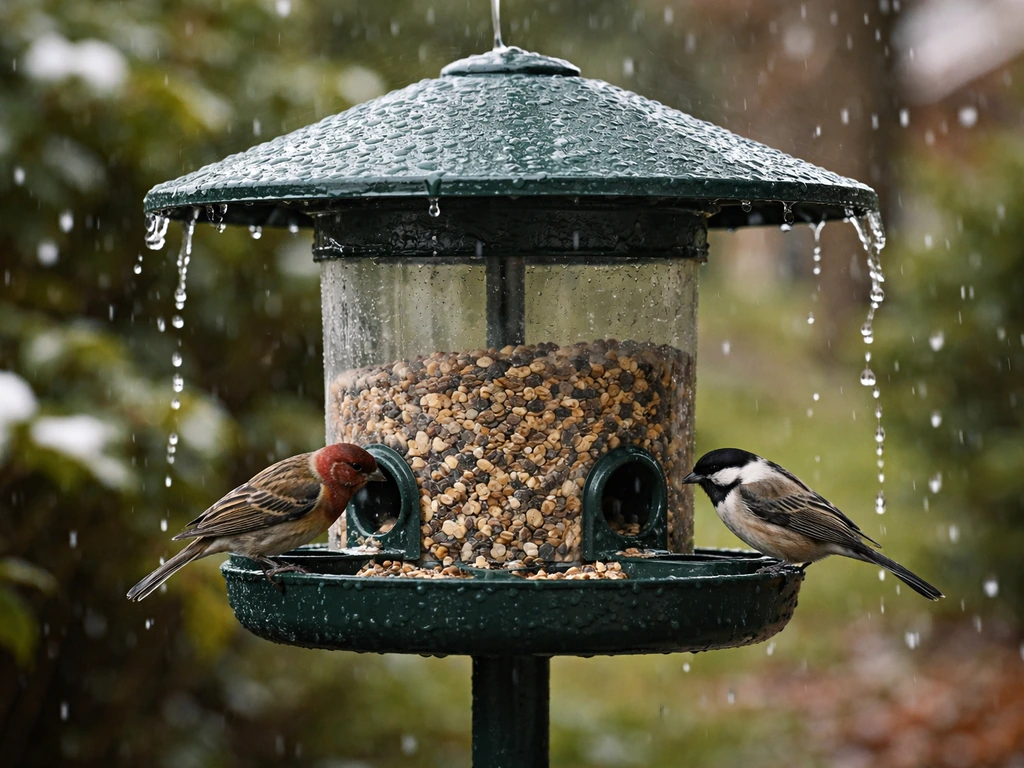
Best Waterproof Bird Feeder: How to Choose and Buy
Buying guide to the best waterproof bird feeder: key waterproofing features, yard fit, and rain-proof setup tips.
Best Weatherproof Bird Feeder Guide for Rain Proof Feeding
Pick the best weatherproof, rain proof bird feeder by design, materials, cleaning, mounting, and wildlife proofing.
Best Bird Feeders for Rainy Weather: Top Picks and Setup Tips
Top rainy-weather bird feeders with weatherproof features, species picks, setup tips, and cleaning to prevent mess and s