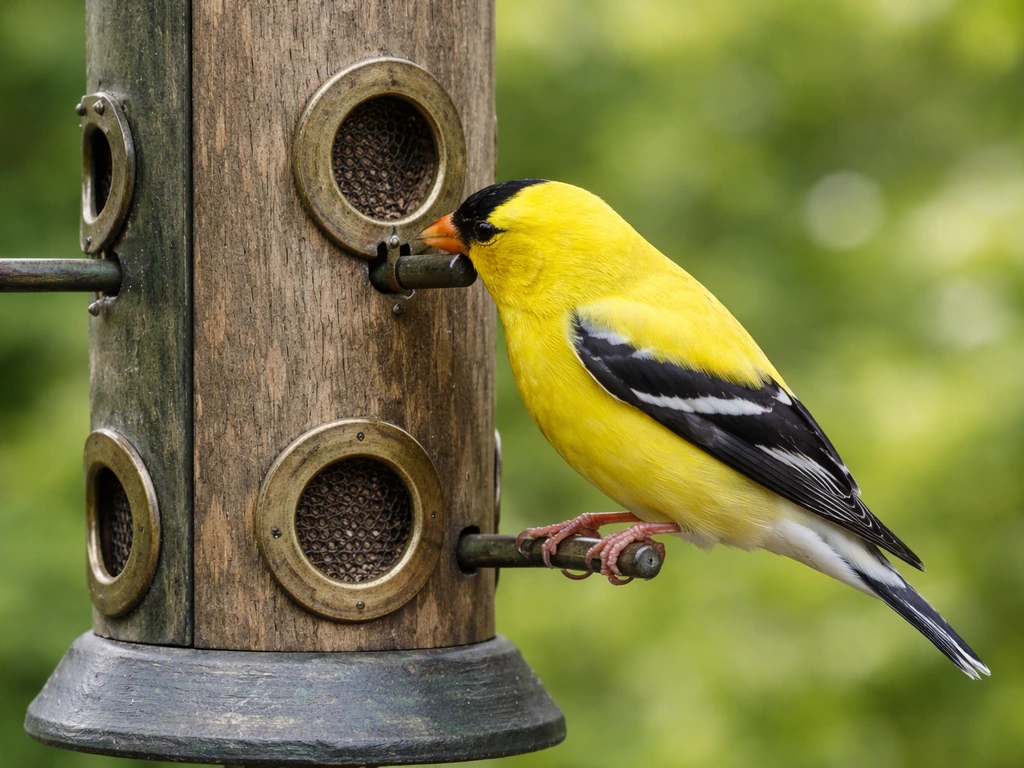
The best bird feeder for finches is a tube feeder with small ports designed specifically for Nyjer (thistle) seed, paired with a squirrel baffle on a freestanding pole. Wikipedia summarizes that the American goldfinch is granivorous and has a conical beak adapted for feeding on seeds.
Best Bird Feeder for Finches: Top Options for Goldfinches
Marcus Holloway
10 Apr 2026
That single setup will bring in more finches, more consistently, than any other combination. If you are targeting goldfinches specifically, a dedicated Nyjer tube or mesh feeder is the move. For house finches and a broader mix of small songbirds, a tube feeder loaded with black-oil sunflower or fine sunflower chips works just as well. The rest of this guide breaks down exactly what to look for so you are not wasting money on the wrong feeder.
How to choose the best feeder for finches
Finches are small birds with small beaks, and that single fact should drive every decision you make about your feeder setup. The most important things to evaluate are port size, seed compatibility, and capacity relative to the number of birds you expect. Get any of those wrong and you will either watch the feeder sit empty or watch larger bully birds clean it out before your finches get a turn.
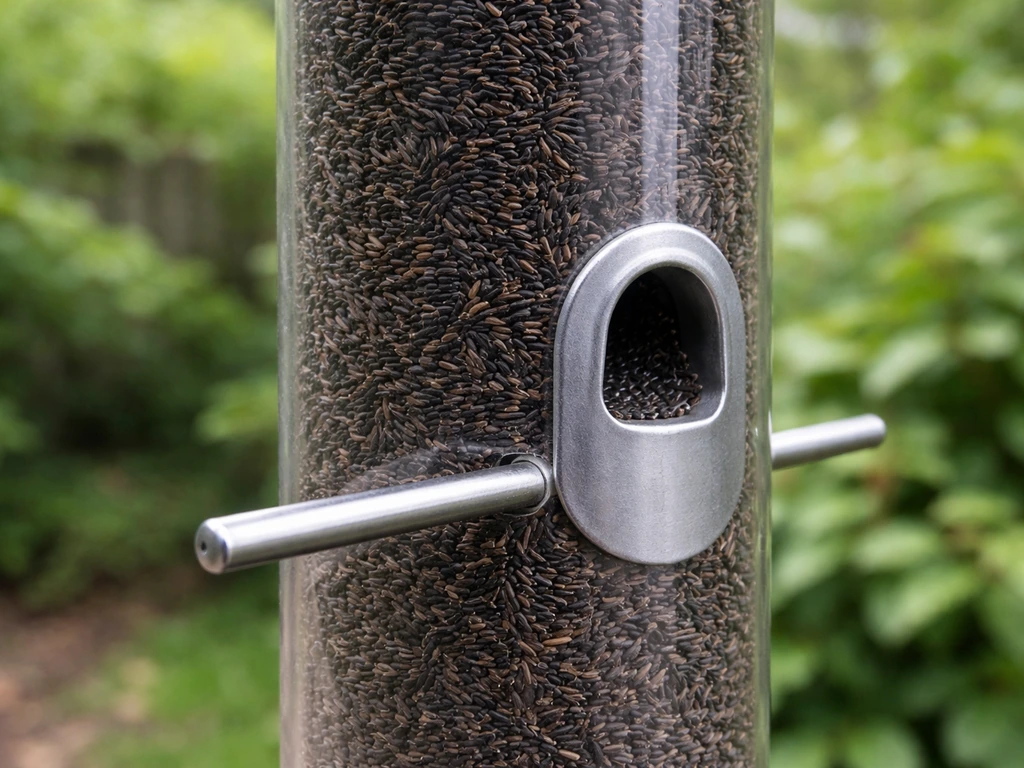
Port size matters more than most people realize. blank" rel="noopener noreferrer">Nyjer feeders are engineered with very small ports, sometimes barely a few millimeters wide, so finches must pull individual seeds out one at a time. That design is not accidental: it controls the dispensing rate, minimizes waste, and, as a bonus, makes it genuinely difficult for squirrels to reach in and pull out seed.
Project FeederWatch also notes that special small feeding ports are required for nyjer seed to prevent spillage special (small) feeding ports are required for nyjer seed to prevent spillage. Tube feeders with larger ports designed for sunflower seed are fine for house finches but will result in a lot of wasted Nyjer if you try to use them for goldfinches.
Capacity is a real-world consideration that gets ignored in most buying guides. A small 6-port tube feeder looks tidy but empties fast if you have an active goldfinch flock hitting it daily. During peak migration in spring and fall, I have had a small feeder drain in under 48 hours. An EcoClean-style large finch tube with a seed diverter to move Nyjer toward the ports as it depletes is genuinely worth the extra cost if you want to refill less often.
Ease of cleaning is the underrated third factor. Nyjer seed can go stale in as little as 4 to 6 weeks during summer heat, so you need to be able to dump, rinse, and dry your feeder frequently. Look for models with a removable base or a quick-clean design. Feeders that require you to disassemble eight parts to scrub the inside will not get cleaned as often as they should, and stale or moldy Nyjer will drive goldfinches away fast.
What goldfinches actually want to eat
American Goldfinches are reliably and powerfully attracted to Nyjer seed above everything else. Nyjer (often marketed as thistle, though it has no relation to native wild thistle plants) is the single best thing you can put in a goldfinch feeder. Sunflower hearts and chips come in as a strong second choice, and they are worth offering if you want to attract a wider range of small finches without committing to a dedicated Nyjer setup. Canary seed and white proso millet also show up on goldfinch preference lists, but Nyjer is the anchor.
House finches lean differently. Their top preference is black-oil sunflower seed, with white proso millet as a solid secondary option. A standard tube feeder with sunflower ports handles house finches well. If you want to attract both species, consider running two feeders side by side: one dedicated Nyjer tube for goldfinches, and one sunflower tube for house finches and the broader small-bird mix. That approach also avoids the common mistake of putting Nyjer in a wide-port feeder, which results in a lot of expensive seed falling to the ground.
One thing worth knowing before you buy a giant bag of Nyjer: it has a short shelf life. In hot summer conditions, Nyjer can go stale in 4 to 6 weeks, and goldfinches will simply stop visiting a feeder with old seed. Buy smaller quantities and store it in a sealed container in a cool spot. This is one of the most common reasons people tell me "goldfinches won't come to my feeder" when the real answer is the seed is just old.
Best feeder styles for finches, ranked
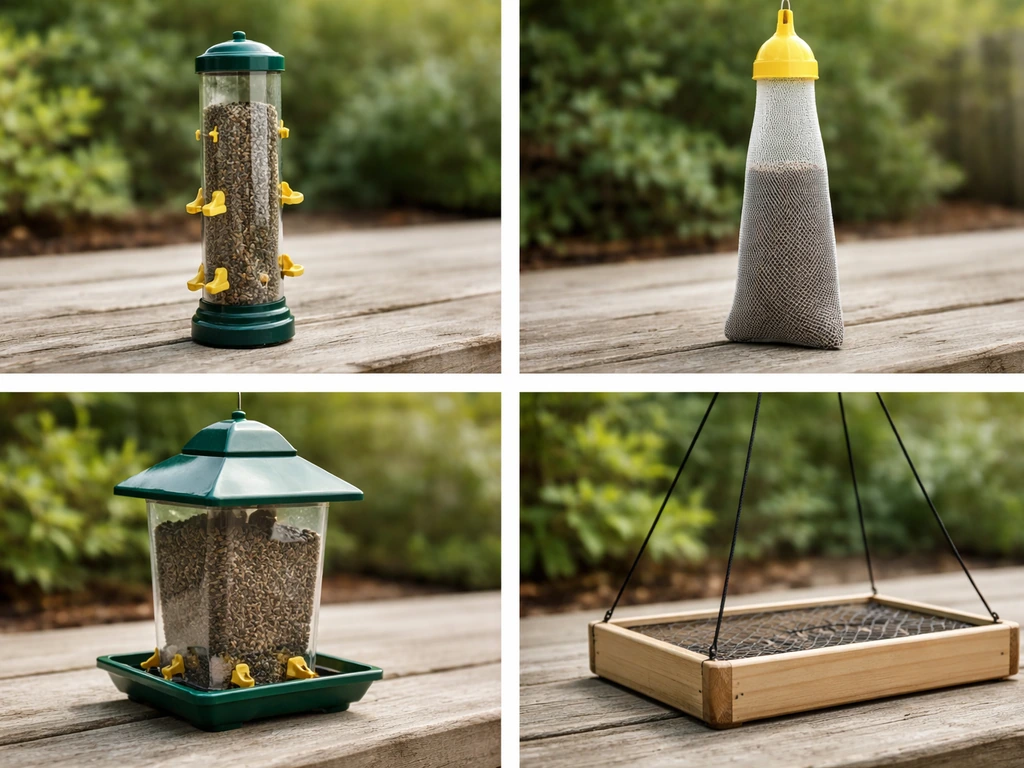
There is no single perfect finch feeder design, but some styles clearly outperform others for specific situations. Here is how the main options stack up.
Tube feeders (the gold standard)
A tube feeder with multiple small ports is the most versatile and effective option for finches. The tube design keeps seed contained and dry, the ports control waste, and the perches are sized for small birds. Models with antimicrobial protection embedded in the tube material (like the WBU EcoClean line with its black powder-coated metal components, seed diverter, and perch covers) are worth the investment if you are serious about keeping seed fresh and reducing bacteria buildup. For goldfinches, make sure the tube is specifically rated for Nyjer and has appropriately small ports. For house finches, a standard sunflower tube works fine.
Mesh and sock feeders
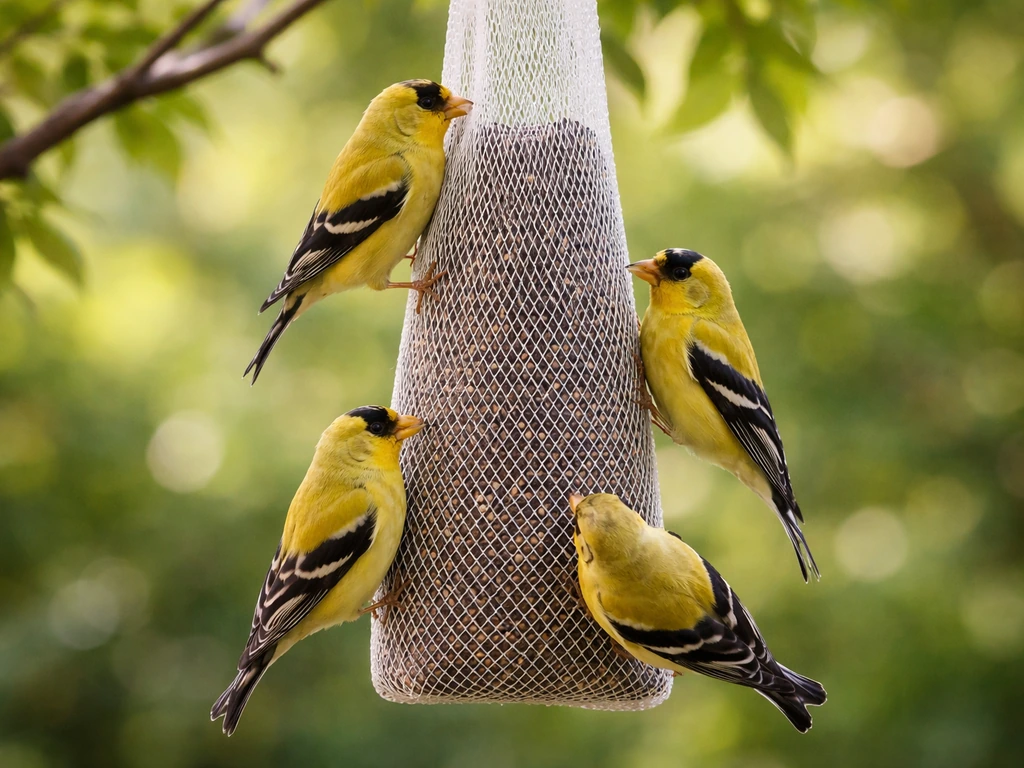
Nyjer mesh feeders, sometimes called finch socks, are a great secondary option for goldfinches. The entire surface is the feeding station: birds cling anywhere on the mesh and pull Nyjer through the openings. A two-sided mesh feeder can host multiple goldfinches at once, which is a real advantage during peak season when competition at a standard tube feeder gets intense. The downside is durability. Mesh feeders, especially fabric sock types, degrade quickly in UV and rain. Metal mesh designs hold up much better and are worth the extra few dollars.
Hopper feeders
Hopper feeders are not ideal for goldfinches. The open design and wide tray access make them difficult to fill with Nyjer economically, and larger birds like grackles and starlings will crowd out smaller finches. That said, if you fill a hopper with sunflower chips or black-oil sunflower, house finches will use it happily alongside chickadees, nuthatches, and other small birds. If a hopper is what you already own, it is not useless for finches, but I would not buy one specifically for a goldfinch setup.
Platform and tray feeders
Platform feeders work for house finches if you load them with millet or sunflower chips, and some ground-feeding finch species (like pine siskins) will visit open trays. The problem is exposure: seed sitting on an open platform gets wet fast, spoils quickly, and attracts every large bird in the neighborhood. If you go this route, choose a covered platform with drainage holes and keep the quantities small. For goldfinches specifically, a platform feeder is a last resort, not a first choice.
Specialty upside-down goldfinch feeders
One clever design worth knowing about is the inverted or upside-down Nyjer feeder. Goldfinches are acrobatic and have no problem hanging inverted to feed, but most larger birds find it awkward and give up. This style is a natural bully-bird deterrent without any moving parts or weight-sensitive mechanisms. If house sparrows or other small pests are a problem at your standard tube feeder, an inverted design is worth trying. Similar principles apply to feeders designed for wrens, which also benefit from designs that reward agile, small birds over larger, dominant species.
Durability and weather protection
A finch feeder that looks great on day one but warps, cracks, or fills with mold by week three is not a good feeder. Durability comes down to materials and design details. UV-stabilized polycarbonate or hard acrylic tubes hold up better than cheap clear plastic, which yellows and becomes brittle within a single season. Metal components, particularly black powder-coated steel for ports, perches, and end caps, last significantly longer than their plastic equivalents and resist chewing from squirrels.
Weather protection for seed is just as important as feeder construction. A Weather Guard dome or rain hood placed over a tube feeder keeps Nyjer from getting wet during rain, which dramatically slows the rate of spoilage and mold. Wet Nyjer clumps together, blocks the ports, and turns rancid fast. If you live somewhere with frequent rain or high humidity, a weather guard is not optional, it is a necessary part of the setup. Some feeder lines include it as an add-on; budget for it if it does not come in the box.
The internal design matters for moisture too. Feeders with an angled seed baffle inside the tube keep Nyjer moving toward the ports as birds feed and prevent it from packing together in the lower half of the tube where moisture accumulates. A removable base also means you can shake out any wet clumps and dry the feeder properly between fills rather than just topping it off and hoping for the best.
Keeping squirrels and bully birds out
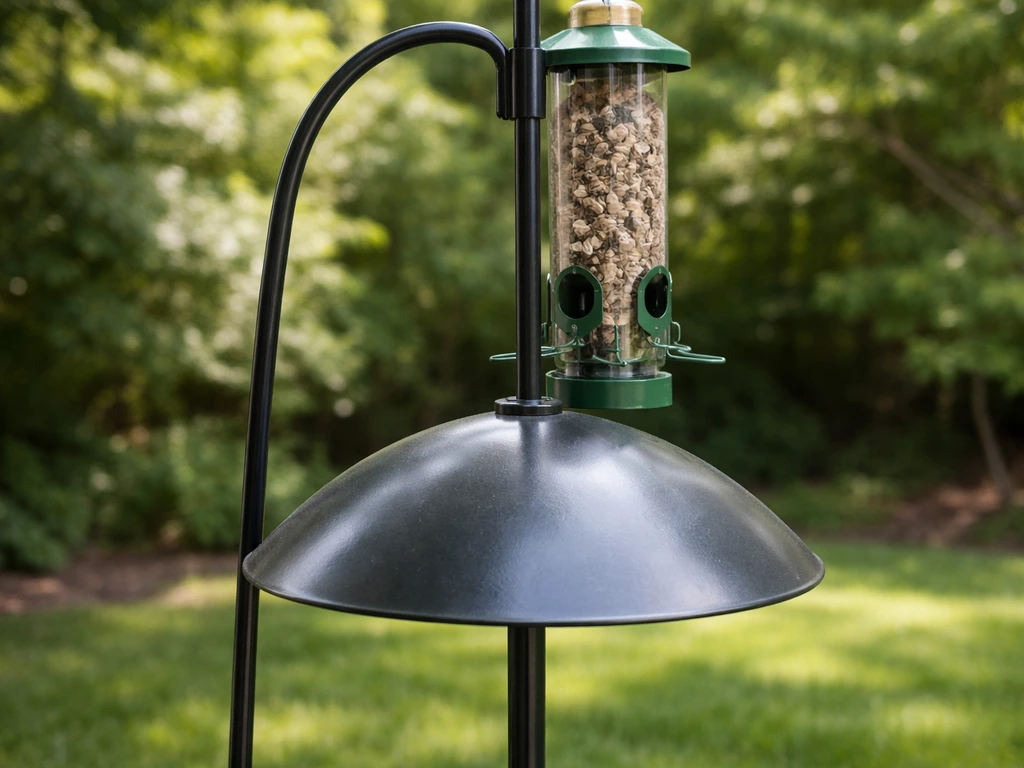
Squirrels will absolutely destroy a finch feeder if you give them the chance. I have watched squirrels chew straight through the plastic tube of a cheap feeder in under a week. The good news is that squirrel-proofing a finch feeder is well understood, and you do not need a battery-powered spinning feeder to do it.
The most effective approach is a combination of correct placement and a physical baffle. Mount your feeder on a freestanding metal pole and attach a dome-shaped squirrel baffle below the feeder, positioned between 4 and 5 feet off the ground. Placement matters just as much as the baffle: position the feeder at least 8 to 10 feet from any solid launch point including trees, fences, buildings, and overhanging branches.
Squirrels are excellent jumpers, and anything within that radius is a viable launchpad. A practical rule I use is the 5-7-9 rule: feeder about 5 feet high, at least 7 feet from structures like decks or fences, and at least 9 feet from overhanging branches. Understanding what a baffle does and how to use one correctly is honestly one of the best investments you can make in your whole feeder setup, not just for finches.
The small port design of a good Nyjer tube feeder also provides passive squirrel resistance. A squirrel cannot reach its paw into a port sized for a finch beak, so even if one does manage to reach the feeder, it cannot extract the seed efficiently. This does not replace a baffle, but it is a meaningful secondary line of defense that purpose-built finch feeders provide by default.
Bully birds, particularly house sparrows, European starlings, and grackles, are a separate problem. Larger tube feeders with weight-sensitive perches can shut out heavy birds while allowing finches to feed freely. Inverted feeders, as mentioned earlier, are another low-tech solution. If grackles are genuinely overwhelming your setup, the same cage-style exclusion principles that protect blue jay feeders from larger intruders can be adapted around a finch tube by adding a wire cage enclosure that only small birds can pass through.
Placement and mounting tips to attract finches faster
Finches are not particularly shy, but they do have preferences about where they feel safe feeding. They favor open sight lines where they can watch for predators while perched. A feeder positioned in an open area of the yard, visible from multiple angles, will typically attract finches faster than one tucked against a wall or in dense shrubs.
That said, having some vegetation nearby (not directly adjacent) gives finches a staging area where they can wait their turn and retreat quickly if startled. A feeder mounted about 10 to 15 feet from a shrub or small tree gives them that security buffer without compromising your squirrel-proofing distance requirements.
Height matters less for finches than for some other species. Goldfinches and house finches readily visit feeders at typical pole height (around 5 feet off the ground), and they will feed at eye level or even lower without complaint. What they will not tolerate is a feeder that swings violently in the wind. Use a stable pole mount rather than a hanging hook off a tree branch if you want consistent visits. Hanging feeders are fine, but anchor them somewhere that limits excessive swinging.
One placement tip that is often overlooked: put your finch feeder where you can actually see it from inside the house. I know that sounds obvious, but the enjoyment of watching goldfinches is a big part of why people set these up, and a feeder you cannot easily observe tends to get neglected. It also lets you notice quickly when the feeder is getting low, when seed has gotten wet and clumped, or when a new species has shown up.
Chickadees, for example, are frequent co-visitors at finch tube setups, and if you notice them struggling with a feeder design, that is a clue your port sizing might need a rethink. If you are considering a dedicated setup built around chickadees, the placement principles overlap significantly with finch feeding.
If you are also seeing painted buntings in your region (primarily the southeastern US and parts of Texas), note that they share finch-friendly seed preferences including millet and fine seeds, and a well-placed finch feeder can double as an attractant. The best feeder setups for painted buntings have a lot in common with what works for finches, so one thoughtful placement can serve both.
Top picks: finch and goldfinch feeders compared
Here is a side-by-side look at the main feeder types worth considering, with honest notes on who each one is best for.
| Feeder Type | Best For | Seed Compatibility | Squirrel Resistance | Weather Performance | Ease of Cleaning | Best Situation |
|---|---|---|---|---|---|---|
| Nyjer Tube Feeder (small ports) | Goldfinches, Pine Siskins, Redpolls | Nyjer / thistle exclusively | High (ports too small for squirrel paws) | Good with rain guard add-on | Easy with removable base design | Dedicated goldfinch setup, any yard size |
| EcoClean-Style Large Finch Tube | Goldfinches, high-traffic yards | Nyjer, fine sunflower chips | High (small ports + durable metal components) | Excellent (antimicrobial tube, metal parts) | Very easy (removable base, fewer crevices) | Active feeders who want less frequent refills |
| Metal Mesh / Wire Nyjer Feeder | Goldfinches, multiple birds at once | Nyjer only | Moderate (clinging design deters some squirrels) | Moderate (seed exposed on mesh surface) | Moderate (rinse and air dry) | Yards with large goldfinch populations |
| Standard Sunflower Tube Feeder | House Finches, Chickadees, Nuthatches | Black-oil sunflower, sunflower chips, millet | Moderate (depends on port size and placement) | Good (tube contains seed) | Easy | Mixed small-bird feeding, house finch focus |
| Inverted / Upside-Down Nyjer Feeder | Goldfinches (bully bird deterrent) | Nyjer | Moderate | Good | Easy | Yards with house sparrow or starling pressure |
| Hopper Feeder | House Finches as secondary visitors | Sunflower, millet, mixed seed | Low (open tray accessible to all) | Poor (open seed exposure) | Moderate | Existing hopper owners adding mixed seed |
My personal top recommendation for most backyard birders is a dedicated Nyjer tube feeder with a quick-clean removable base, mounted on a metal pole with a dome baffle, positioned following the 5-7-9 rule. Add a Weather Guard rain dome if you live somewhere with regular rainfall. That combination costs roughly $40 to $80 all in depending on the feeder brand and baffle quality, and it will reliably attract goldfinches within days of setup in most regions during spring and fall migration.
If you want to expand from a goldfinch-focused setup to attract a broader range of small songbirds, add a second tube feeder with black-oil sunflower or sunflower chips alongside your Nyjer tube. That two-feeder approach covers goldfinches, house finches, pine siskins, and quite a few other small species without overcomplicating things. Think of the Nyjer feeder as the goldfinch magnet, and the sunflower tube as the general finch and small-bird station.
The most common mistake I see is buying a beautiful decorative hopper feeder, filling it with Nyjer, and wondering why the goldfinches are not showing up. The seed is right but the delivery system is wrong. Match the feeder to the seed, keep it clean, keep the seed fresh, and get a baffle on that pole. Do those four things and you will have finches.
FAQ
Can I use the same feeder for goldfinches and house finches?
Use a dedicated Nyjer (thistle) feeder with very small ports, and avoid mixing in larger sunflower seed. If you want one feeder to serve both species, run two tubes side by side (one Nyjer, one black-oil sunflower), because many “dual seed” feeders have ports that waste Nyjer and invite wasteful clumping.
What happens if I put sunflower seed in a Nyjer tube feeder (or Nyjer in a sunflower feeder)?
Yes, but do it with the feeder style in mind. If you have a Nyjer tube, you can offer fine sunflower chips or black-oil sunflower in moderation, but only if the ports are sized for small seeds. With a sunflower tube, Nyjer usually won’t feed properly and will fall wastefully to the ground.
Goldfinches stopped visiting my feeder, what should I check first?
Start by using only fresh seed and correct moisture management. Nyjer can go stale in as little as 4 to 6 weeks in summer, and wet seed can also clog ports. If visits drop suddenly, dump and clean the feeder, dry it completely, and switch to a freshly purchased batch.
Where should I place a finch feeder if I want finches to feel safe but squirrels out of reach?
Staging and safety matter, but don’t put it too close to launch points. Mount on a freestanding pole and keep it at least 8 to 10 feet from structures, then place it about 10 to 15 feet from a shrub or small tree so the birds have cover without letting squirrels jump from nearby surfaces.
Does feeder height or swinging in wind matter for finches?
Aim for stability first. A feeder that swings wildly in wind is harder for small birds to land on, and it also spreads seed unevenly, leading to more clumping in the bottom. Use a solid pole mount, and position it so the feeder isn’t directly sheltered by a branch that can shake it.
How do I stop house sparrows or starlings from taking over my finch feeder?
If you see larger birds dominating, add a control layer rather than changing the seed. Use a tube feeder with appropriate perch design for small birds, consider an inverted Nyjer style, or add a small-bird exclusion cage around the tube if grackles or very large competitors are persistent.
How often should I clean a Nyjer finch feeder?
Clean it on a schedule tied to climate. In hot weather, plan on a full dump, rinse, and dry at least every few weeks, and sooner if you notice dampness or residue. Nyjer can also mold when it gets wet, so you should never just top off an already clumped feeder.
Is a larger-capacity finch feeder always better than a smaller one?
Screw the “bigger is better” mindset for finches. Even if you use a large feeder, choose a model with ports sized for finch beaks, otherwise you will lose seed to waste and to non-target birds. Port size plus a fresh-seed plan usually beats buying a larger but wrong-style feeder.
I have an existing feeder, can I convert it to attract goldfinches?
Avoid mixed-seed “all birds” setups if your goal is goldfinches. If you want both, use separate feeders rather than trying to include Nyjer in a wide-port hopper or platform design. Separating feeders reduces seed waste and limits what bully birds can access.
How do I keep the feeder stocked during spring and fall when finches show up in bursts?
If the feeder keeps draining or emptying too fast, refill timing is part of the solution. During peak migration, use a larger tube or one with a diverter design to keep seed moving and reduce port packing, and refill on a tighter cadence instead of waiting until it looks completely empty.
How can I tell if my feeder is compatible with the specific type of seed I’m buying?
For pellet or specialty seed issues, prioritize “small seed, small port” compatibility. Confirm the manufacturer states it is rated for Nyjer, and check that the ports are not oversized. If you are feeding fine sunflower chips, make sure they are consistent in size, because very irregular chunks can jam ports.
Next Articles
Best Red Cardinal Bird Feeder: Top Picks & Buying Guide
Best red cardinal bird feeder guide: top picks, painting tips, seed & placement advice to attract Northern Cardinals.
Best Bird Feeder for Red Birds: Top Picks and Setup Guide
Top feeders and setup tips to attract cardinals and other red birds using the right seed, mounts, and squirrel-proofing.
What Color Bird Feeder Attracts Birds Most: Quick Guide
Discover which bird feeder color draws the most birds, plus setup tips for durability, placement, and reducing squirrels