The best-looking bird feeders are ones that stay attractive after a full season outdoors, not just on the day you unbox them. That means choosing materials that resist UV fading, rain, and squirrel damage, picking a style that suits your yard's scale and plantings, and placing everything where you can actually see the birds from a window or porch. If you can nail all three, you get a setup that looks intentional rather than accidental, and one that keeps working year after year.
Best Looking Bird Feeders: Style, Placement, and Species Picks
Marcus Holloway
10 Jun 2026
What 'best looking' actually means for a bird feeder
Most people searching for a great-looking feeder are really asking two things at once: does it look good in the yard, and does it keep looking good after months of weather, seed, and bird activity? Those are different problems. A feeder can have beautiful copper trim and still look like a mess after one rainy spring if the finish oxidizes badly or the seed tray stays caked with hulls. So when I think about curb appeal for feeders, I break it down into four criteria: style and color that match the yard, proportions that fit the space without looking overwhelming or toy-like, a finish or material that ages well rather than fading or yellowing, and ease of cleaning so it actually stays presentable.
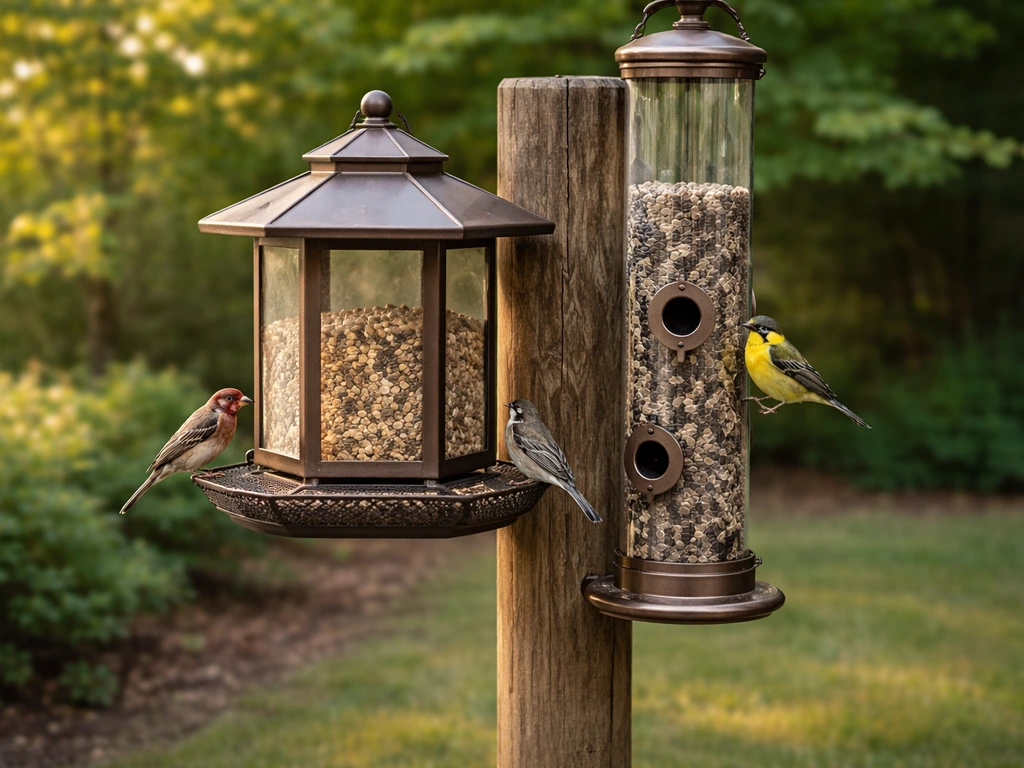
Style is personal, but there are a few broadly flattering categories. Traditional lantern-style hopper feeders with wood and copper or black powder-coat hardware look classic in cottage gardens. Sleek clear tube feeders with brushed metal fittings read more modern and minimal. Blown-glass or ceramic hummingbird feeders work as yard art. If you care about how the whole setup looks from your kitchen window, also think about the pole, hook, or shepherd's crook holding the feeder, since those are as visible as the feeder itself.
Feeder types that look great and actually work
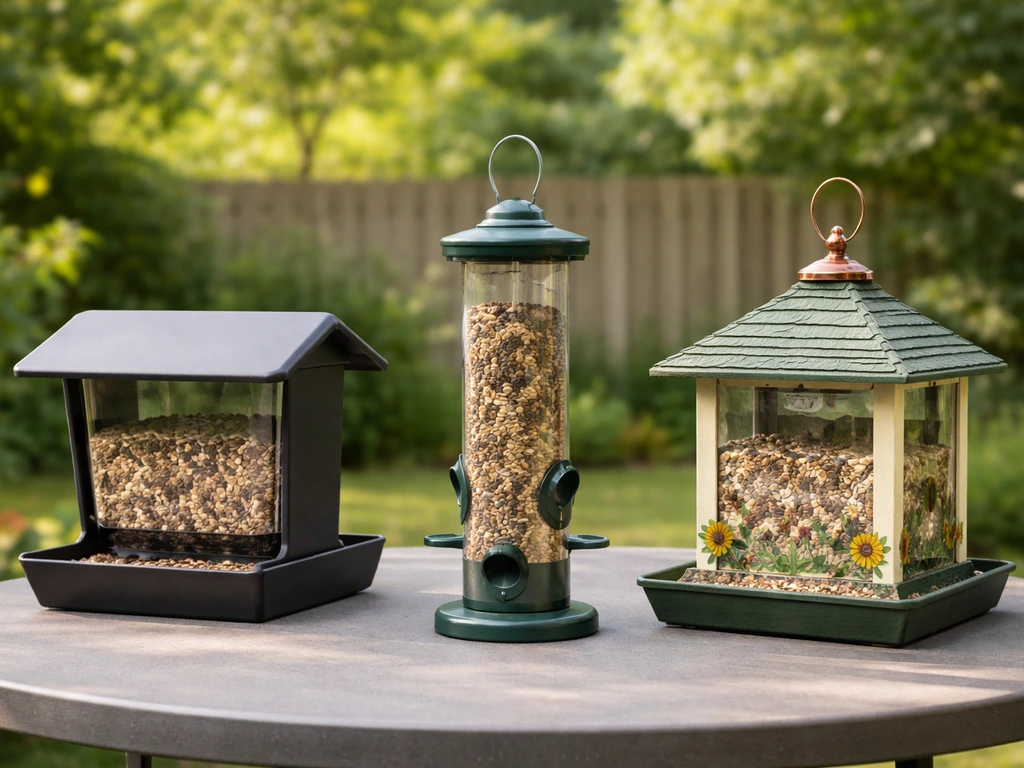
Different feeder styles suit different yards, birds, and aesthetics. Different bird feeder types work better depending on what birds you want to attract and how you want the setup to look. Here's how the main types stack up on both looks and function. A simple way to start is by comparing two types of bird feeders, like hopper-style and tube-style options. If you compare bird feeders side by side, you can match the feeder type to the birds you want and avoid surprises with cleaning and weather durability.
Hopper and lantern-style feeders
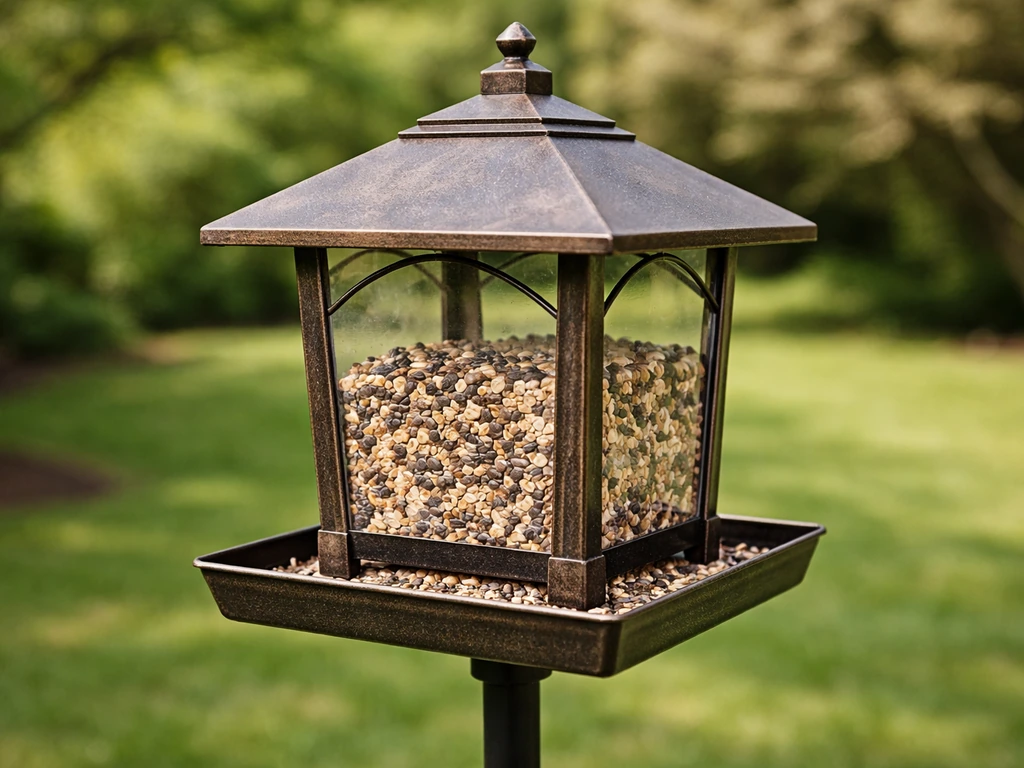
Hopper feeders, sometimes called house or barn feeders, are probably the most visually familiar style. They look like a small house or lantern, with a covered seed reservoir that drops onto a platform tray. Done well in cedar, recycled poly lumber, or powder-coated steel, they're genuinely handsome in a garden. They hold a large volume of mixed seed, which cardinals and other larger songbirds love. The downside is that the platform tray can get messy quickly and becomes an open invitation for grackles if it's wide enough. Choose a model with a narrower tray lip to limit that problem without losing the look.
Tube feeders
Clear or frosted acrylic tube feeders are clean-lined and modern-looking, especially when mounted on a simple steel pole. They work brilliantly for sunflower chips, safflower, and nyjer, and their transparent body means you can see the seed level at a glance, which is its own kind of satisfying. Mesh tube variants, like the finch-focused magnet mesh designs from Birds Choice, swap the solid tube wall for a stainless steel screen that lets small birds cling anywhere along the surface instead of waiting for a perch. If you want the best song bird feeders, focus on tube and mesh designs that small birds can grip easily without being blocked by larger species. These look particularly good in clusters on a multi-arm pole. The visual appeal stays high as long as you keep the plastic clean: yellowing or cracking is the enemy, which is why UV-stabilized polycarbonate or metal mesh models hold their look far better than cheap clear plastic.
Platform and tray feeders
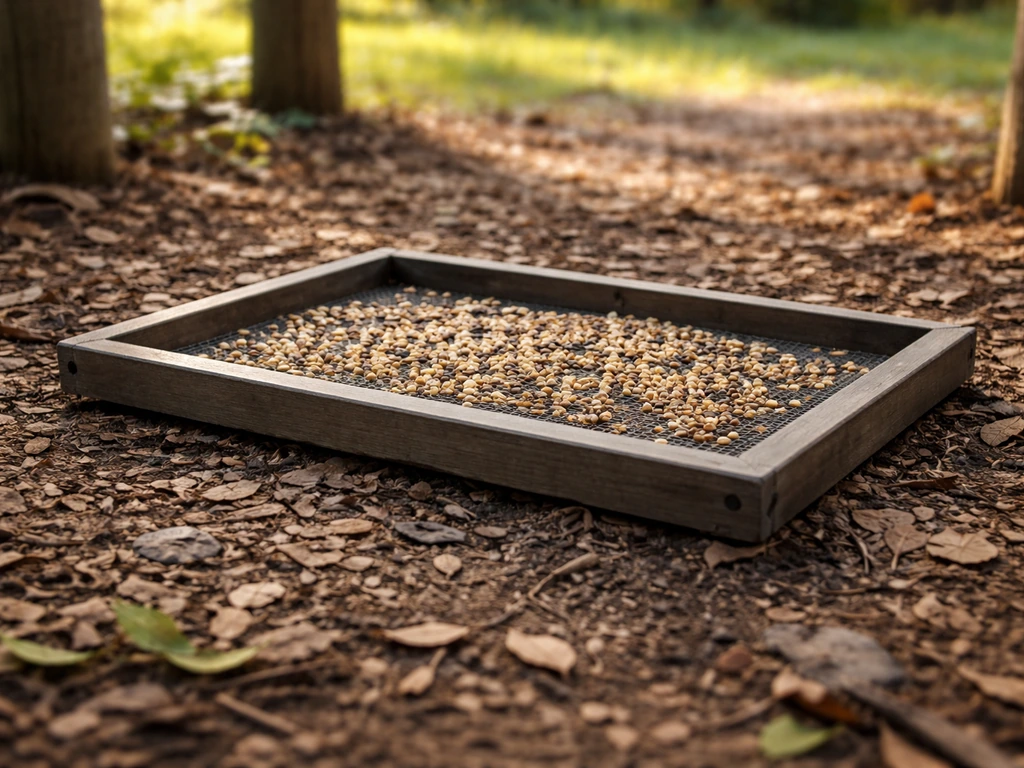
Open platform feeders are simple, low-profile, and blend easily into naturalistic yards. They attract the widest range of species, including ground-feeding birds that are otherwise hard to bring in. Aesthetically, a cedar or teak tray with drainage holes looks sharp, especially when mounted at railing height on a deck. The catch is that open platforms show every bit of seed debris, so they need regular brushing. They also offer zero squirrel resistance on their own, which is something to factor in before committing.
Hummingbird feeders
Hummingbird feeders have the most variety in terms of pure visual design, from hand-blown glass globes in jewel colors to simple saucer styles with flower-petal ports. Glass feeders genuinely look beautiful and hold up far better than plastic: BobVila testing noted that plastic hummingbird feeders can fade, warp, or crack after just a few seasons of UV exposure. A blown-glass or copper-accented glass feeder keeps its color and finish for years with basic cleaning. The saucer style is especially easy to clean, which matters because nectar feeders need washing every two to three days in warm weather.
Suet feeders for woodpeckers
Suet feeders are usually the least decorated type, and that's mostly fine because they're often hung on or near tree trunks where the bark provides its own visual context. A tail-prop suet cage with a brushed steel or black powder-coat finish looks clean and purposeful rather than cheap. Tail-prop models add a lower extension below the cage so downies and pileateds can brace their tails while feeding, which is both species-appropriate and visually interesting to watch.
Nyjer feeders for finches
Nyjer or thistle feeders attract goldfinches, siskins, and redpolls, and the best-looking versions are mesh tube or sock designs. A stainless mesh tube with a removable base (like the Birds Choice Quick-Clean nyjer design) looks neat, is simple to take apart and rinse, and the mesh itself has a refined industrial quality that reads well in a modern garden setting. Avoid cheap nylon socks if you care about appearance; they go limp, stain yellow, and look sad within a season.
Materials and finishes that stay attractive through the seasons
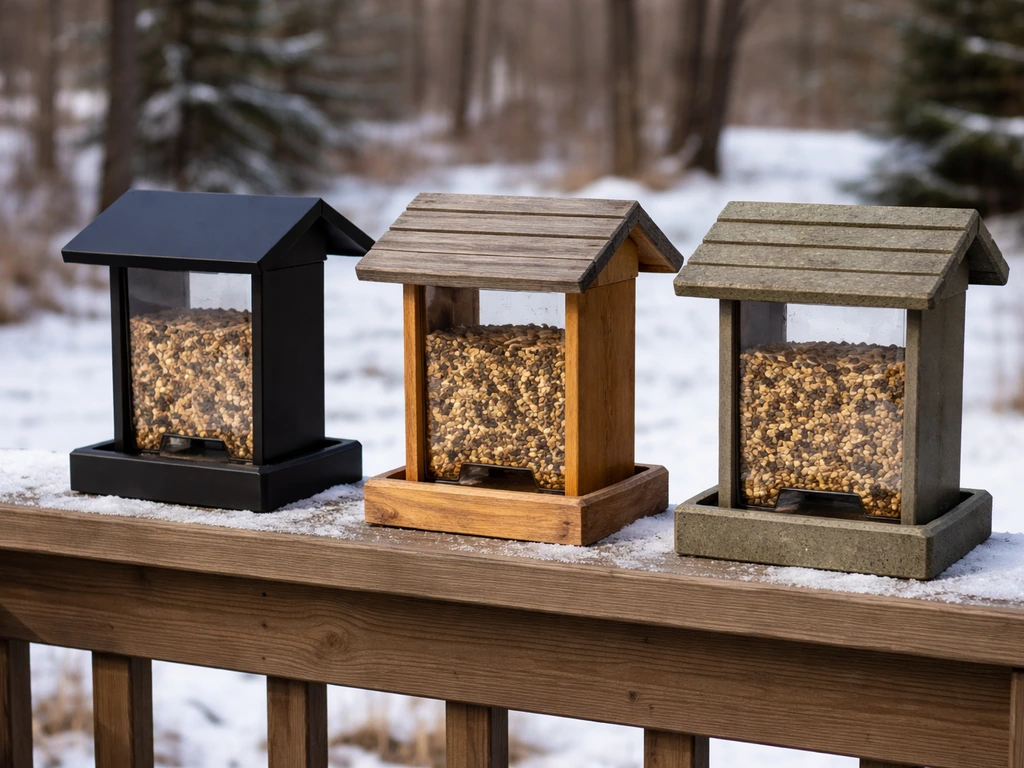
This is where a lot of otherwise beautiful feeders fall apart, sometimes literally. The material choice determines whether your feeder still looks sharp after a Minnesota winter or a Georgia summer. Here's how the main options compare.
| Material | Looks New For | Weather Resistance | Best For |
|---|---|---|---|
| Recycled poly lumber | Many years | Excellent, won't rot, fade, or warp | Hopper/platform feeders |
| Cedar / untreated wood | 2–4 seasons with care | Good, grays attractively, can rot if water traps | Traditional hopper feeders |
| Powder-coated steel | 5+ years | Excellent if coating is intact; chips can rust | Poles, cage feeders, suet feeders |
| UV-stabilized polycarbonate | 3–5 years | Good, resists yellowing longer than standard acrylic | Tube feeders, hopper windows |
| Blown glass / borosilicate | Indefinitely | Excellent, UV-immune, no fading | Hummingbird feeders |
| Stainless steel mesh | Indefinitely | Excellent, rust-resistant, easy to clean | Nyjer/finch tube feeders |
| Standard clear plastic | 1–2 seasons | Poor, yellows and cracks with UV | Budget tube feeders only |
All About Birds emphasizes that a good feeder must be sturdy enough to survive winter weather and squirrel pressure, keep seeds dry, and be easy to clean. I'd add that the cleaning requirement is directly tied to looks: a feeder that's a pain to disassemble will stay dirty, and a dirty feeder looks terrible and can harm birds. If you're choosing between two otherwise equal models, always pick the one with a removable base or a roof that lifts off with a simple mechanism.
Mounting and placement that makes feeders look and work better
Placement is doing more visual work than most people realize. A beautiful feeder hung from a rusty nail on a fence post looks like an afterthought. The same feeder mounted on a powder-coated shepherd's crook centered in a garden bed looks curated. Think of the whole setup: feeder, pole or hook, and the backdrop behind it when viewed from your window or patio.
A University of Wisconsin Extension bird-feeding guide makes two points I keep coming back to: place feeders near natural cover like shrubs or small trees (so birds have somewhere to retreat to), and make sure feeders are visible from inside the house. Both of these are design principles as much as functional ones. A feeder tucked too deep in a shrub isn't visible or photogenic; one set 8 to 10 feet in front of a naturalistic planting backdrop is both bird-safe and visually anchored.
For window placement, All About Birds recommends positioning feeders either closer than 3 feet to a window or at least 30 feet away, because birds can't build up enough speed to seriously injure themselves in less than 3 feet. Mounting a feeder on a window frame or using a window-mounted suction-cup feeder is actually safer for birds and gives you an incredible close-up view. The U.S. Fish and Wildlife Service also notes that external window screens help reduce collisions by breaking up reflections.
Pole setups, hooks, and stands
A multi-arm steel pole system is the cleanest way to set up multiple feeders in one spot. You get a cohesive look, and a single quality pole with a ground anchor holds feeders stable in wind so they don't swing and spill constantly. Shepherd's crooks work for single feeders and look charming in cottage or perennial garden settings, but avoid cheap thin-gauge steel that bends at the first squirrel or windstorm. Deck-mount hooks and window clamps are useful in small spaces or apartment balconies, where a freestanding pole isn't practical.
Matching feeders to the birds you want to attract
The right feeder for your yard depends a lot on which birds you're targeting. Getting the match right means more bird activity, which is part of what makes a setup look alive and worth watching.
| Bird | Best Feeder Style | Best Seed/Food | Visual Notes |
|---|---|---|---|
| Northern Cardinals | Hopper or wide-tray platform | Safflower, sunflower hearts | Cardinals are bold red; a dark green or black feeder sets them off beautifully |
| American Goldfinches | Nyjer mesh tube or sock feeder | Nyjer (thistle) seed | Bright yellow birds against stainless mesh looks striking in any yard |
| House/Purple Finches | Tube feeder with short perches | Sunflower chips, nyjer | Use a tube with multiple ports to support small groups |
| Downy/Hairy Woodpeckers | Suet cage (tail-prop style) | Suet, peanuts | Looks best hung on or near a tree trunk |
| Pileated Woodpeckers | Large suet cage or log feeder | Suet, large chunks of peanut | Log-style feeders look naturalistic near trees |
| Hummingbirds | Glass saucer or bottle feeder | Nectar (4:1 water to sugar) | Glass with red accents is most attractive and durable |
| Chickadees & Nuthatches | Tube or small hopper feeder | Sunflower chips, peanut pieces | Small, active birds; any clean tube feeder works well |
| Indigo Buntings | Small tube or platform feeder | Millet, nyjer | Low platform near dense cover tends to attract them |
Cardinals are a good example of why matching matters visually as well as functionally. They need a substantial perch and a feeder wide enough for their size. Put a cardinal on a dainty nyjer sock feeder and it's both uncomfortable and awkward-looking. Put it at a deep-red or forest-green hopper feeder with a wide shelf, and the combination of the bold red bird against a rich background color is genuinely stunning. Thinking about bird-feeder color contrast is a small detail that makes a real visual difference.
Keeping squirrels and grackles out without ruining the look
Pest-proofing is where a lot of otherwise nice setups go wrong. People add ugly plastic baffles as afterthoughts, or they switch to a wire cage feeder that looks industrial. The good news is that well-designed squirrel and pest deterrents can actually improve the visual coherence of a setup, not detract from it.
Squirrel baffles done right
Baffles work, but only if they're placed correctly. Both the University of Nebraska Extension and Homes & Gardens guidance agree: a pole-mounted baffle needs to be at least 4 feet off the ground, and the entire pole setup must be at least 8 to 10 feet away from any tree, fence, or structure a squirrel can launch from. Get those two measurements right and a baffle does its job. For looks, a torpedo or dome baffle in brushed steel or a color-matched finish blends into a pole system much better than a beat-up white plastic dome. Thick polycarbonate or powder-coated metal baffles also resist squirrel chewing better than thin plastic, which means they don't end up looking chewed and defeated after one winter.
Grackles and large nuisance birds
Grackles are smart and persistent, but they're also big. That's the weakness you exploit. Project FeederWatch recommends using feeders designed for smaller birds, specifically tube feeders with short perches and no catch basin on the bottom, because grackles struggle to get comfortable on them. BirdWatching Daily also points to tube feeders surrounded by wire cages, which keep large-bodied birds at a distance while still letting chickadees, finches, and small sparrows pass through easily. Cage feeders can actually look intentional and architectural on a pole system, especially in black powder coat. A weight-sensitive feeder that closes its ports when a heavy bird lands is another clean-looking solution, since the mechanism is hidden inside the feeder body.
Smart bird feeder cameras that look good too
Camera feeders have improved dramatically, and the best current ones (like blank" rel="noopener noreferrer">Birdfy's AI-powered models) are designed to look like a regular feeder rather than a surveillance device. Birdfy's system records a 20-second video clip of every bird visit and uses cloud AI to identify species in real time, including blank" rel="noopener noreferrer">distinguishing sex in sexually dimorphic species like cardinals. Alerts can be filtered so your phone only buzzes when birds or squirrels are actually at the feeder, not for every gust of wind.
From a placement standpoint, camera feeders need slightly more thought than regular feeders. You want the camera lens facing away from direct sun (usually facing north or east) to avoid blown-out footage and lens flare. You also want the feeder at a height where the camera angle shows birds clearly against a clean background rather than looking straight down at the top of their heads. Most camera feeders work best at about 5 to 6 feet high, which is also a comfortable viewing height from a seated position inside. The Chirpful app and Birdfy app both offer live HD video, saved clips, and species filtering, so you can scroll through footage by bird species rather than hunting through hours of empty footage.
One honest trade-off: AI species recognition on Birdfy is subscription-based through their cloud service. If you're comfortable with that, it's genuinely impressive. If you'd rather not pay a monthly fee, there are simpler camera feeders that record footage without AI tagging, though you lose the instant-notification-by-species feature. Either way, a camera feeder placed on a dedicated pole arm, with a coordinated color or material choice, fits naturally into a multi-feeder pole setup without sticking out as a tech object in the garden.
How to build a setup you'll actually be happy with
Start with two or three feeder types rather than one, because variety in feeder style and food brings variety in birds, and that's what makes the whole thing worth watching. If you want the best bird feeder designs, focus on the feeder type that matches your yard, the birds you’re targeting, and materials that keep their finish through changing weather. A solid anchor combination for most backyards is a hopper or tube feeder with sunflower seed for cardinals and chickadees, a mesh nyjer tube for finches, and a glass hummingbird feeder in season. Those three cover most of the species people want to see, look cohesive on a multi-arm pole, and don't require complicated maintenance.
For materials, lean toward recycled poly or cedar for hopper bodies, UV-stabilized polycarbonate or stainless mesh for tubes, and borosilicate or thick glass for hummingbird feeders. Avoid cheap clear plastic wherever possible: it's the fastest route to a feeder that looks old and sad after one season. A powder-coated steel pole in black or forest green ties everything together visually and holds up indefinitely.
Finally, don't skip the baffle if squirrels are present in your area. A well-fitted metal baffle on a properly placed pole (4 feet high, 8 to 10 feet from launch points) is invisible from the house most of the time and protects both the feeder and the seed investment. Combine that with cage-protected tube feeders or weight-sensitive ports and you'll spend far less time refilling, repairing, and cleaning up the mess that squirrels and grackles leave behind, which is ultimately the biggest factor in whether a feeder setup keeps looking good month after month.
FAQ
How can I tell if a feeder will still look “new” after a full season of rain and sun?
Choose a finish that stays visually consistent after wet weather, not just one that looks good when dry. For example, powder-coated metal and UV-stabilized polycarbonate tend to look consistent over time, while cheap clear plastics often yellow or develop a hazy look that makes even a pretty feeder seem worn.
What feeder features make it easier to keep a feeder looking clean and attractive?
Plan for cleaning as part of the design, not an afterthought. If you hate taking parts off, a platform hopper with frequent brushing will look messy quickly. Prefer models with removable trays, lift-off roofs, or bases you can rinse without tools, because a cleaner feeder looks better and also stays safer for birds.
Can I mount multiple best looking bird feeders on a deck or balcony without making the setup look cluttered?
Yes, but it must be done with weatherproof mounting in mind. Use a dedicated, powder-coated pole or a stable deck/window mount designed to handle wind and rain, and keep the pole finish matching the feeder hardware. Also make sure the placement still clears any squirrel “launch” points so the baffle and feeder area stay tidy.
Is it safe to hang a bird feeder right next to a window if I want the closest possible view?
Feeders closer than about 3 feet to glass can create a safety risk from fast bird impacts, and they also produce a more reflective, chaotic look with glare. The most practical “pretty and safe” approaches are either positioning the feeder far enough away or using a window-mounted suction-cup or frame mount that gives you close-up viewing.
What’s the best way to style a multi-feeder setup so it looks intentional instead of messy?
More is not always better for looks. If you cluster several feeders, match the visual “language” (same metal color, similar height, and consistent style of perches or ports) and use one coordinated pole system. This keeps the group from looking random, and it prevents feeding zones from overlapping in ways that cause messy spillover.
If grackles ruin the look of my feeder area, what style choice helps the most?
For grackle-prone yards, the biggest visual and functional difference is choosing designs that smaller birds can use comfortably while limiting how big birds feed. Tube feeders with short perches and setups that use cages around smaller ports can look architectural and help keep the feeder area tidier than an open platform that gets dominated.
How do I keep hummingbird feeders from looking grimy, especially in hot weather?
Avoid relying on charm alone. Even a beautiful feeder can become visually dull if seed hulls accumulate or nectar gets sticky. For nectar feeders, saucer-style designs that are easy to wash and refill on schedule typically stay more attractive than intricate shapes that are hard to scrub.
What small styling trick helps my feeder look better in photos and from the house?
Color contrast is more noticeable than people expect. Pair a bold bird color (like deep reds for cardinals) with a feeder color that reads rich rather than washed out, such as darker hopper tones, so the bird looks like the focal point instead of blending into a bright, noisy feeder.
Do squirrel baffles need to match the feeder style, or is placement the only thing that matters?
The most common mistake is choosing a feeder “cage” or baffle system that is either poorly placed or visually clashing. Correct placement matters, and choosing a metal baffle in a brushed or color-matched finish usually blends into the pole system. When the baffle is too low or too close to trees or structures, both the bird access and the visual cleanliness suffer.
Can camera feeders look as good as regular feeders, and what should I do to avoid a “tech” look?
Yes, but the trade-off is that you may still need extra attention to lens placement and background cleanliness. If you use a camera feeder, coordinate its pole color and mount height with your other feeders, and aim the lens to avoid direct sun flare so your setup still looks like yard decor, not a tech gadget.
What feeder materials hold their appearance best when squirrels are chewing everything?
If squirrels are active, the “prettiest” feeder is often the one that resists chewing and keeps its parts straight and intact. Metal mesh tubes, properly fitted baffles, and chew-resistant materials can stay visually crisp, while flimsy plastic socks or cheap clear components tend to sag or look damaged quickly.
Next Articles
Best Song Bird Feeders: Buy and Set Up for Your Yard
Choose the best songbird feeders for your yard, including setup, food matches, predator-proofing, and smart camera optio
Best Bird Feeder Designs: Plans, Placement, and Fixes
Actionable bird feeder designs and plans: placement, predator-proofing, species fit, and fixes plus smart camera options
Best Type of Bird Feeders: Choose by Species and Setup
Best type of bird feeders by species and yard setup, with clear picks for finches, hummingbirds, cardinals and more.